

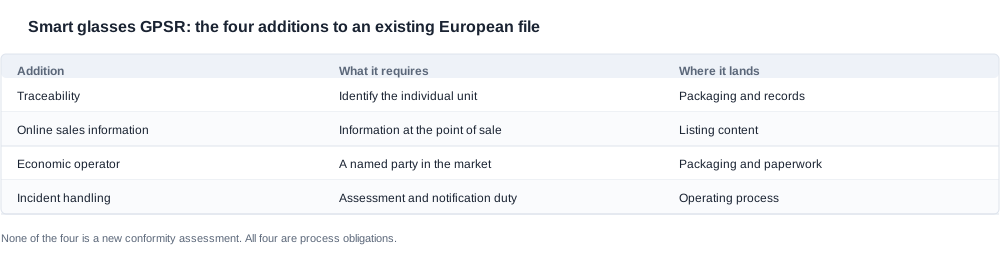
The General Product Safety Regulation, Regulation (EU) 2023/988, applicable from 13 December 2024, does not add a new conformity assessment to your smart glasses. It adds four things that your current European file probably does not contain: traceability that reaches the individual unit, information that must travel with online sales, a defined economic operator in the market, and incident handling with timelines attached. If your existing file covers the radio, the safety and the materials requirements and stops there, these four are the gap.
That is the whole answer, and the rest of this article is the detail behind each of the four, plus why the usual framing of this regulation as "another EU regulation" leads buyers to under-scope it. The framing that costs money is the one that treats it as a paperwork addition to a file already assembled for the radio. It is not a paperwork addition. It is a record-keeping and operating obligation that begins the moment the product carries your name, and it attaches to units rather than to model ranges.
Smart glasses GPSR: who carries the obligation, and why it lands on the buyer
Three conclusions for an importer taking on the operator role
Three conclusions will change how a buyer scopes this regulation. First, it is not a test and not a certificate. Nothing is commissioned for it, nothing is filed with an authority, and there is no document to request from a laboratory. What it requires is a set of records and a procedure, and the cost of compliance is measured in administrative effort rather than in fees. Second, the obligation follows the party that places the product on the market, which means that a brand buying under its own name and importing into the European Union takes on the role of economic operator itself, with the traceability, information and incident duties attached to that role. Third, the part of the regime that creates the largest commercial exposure is the incident clock, because it starts at the moment the duty is triggered and it does not wait for the cause of the incident to be understood.
The practical instruction is short and it is often missed: before the first order, decide who the economic operator will be for each market, and decide how a unit will be identified in the field. Everything else in this regulation can be assembled later. Those two decisions, taken late, are the ones that cannot be recovered. Before you order anything, the red flags worth naming are a supplier who cannot say who the operator will be, packaging artwork with no unit identifier on it, and a listing with no responsible party named.
The reader of a traceability obligation, and what it exposes
The reader is a brand-side compliance lead, a procurement manager or an importer who already has a European file and has been asked what more is required. Some of them are placing a product under their own brand for the first time and have just discovered that the role of importer comes with obligations they did not price. Others have a product in the channel and have had a customer ask, reasonably, how a unit would be identified if the product had to be withdrawn next month.
What such a reader is managing is not a filing. It is the exposure that comes with being the party in the chain who can be asked questions. In a product safety matter, the authority asks the economic operator, and the operator's answer is a record. If the record cannot be produced, the operator has a problem that has nothing to do with whether the product was defective.
There is a second thing being managed, which is less visible and more expensive. The four additions are process obligations, and process obligations are cheap when the process is designed and expensive when it is improvised after an incident. The difference between the two is almost entirely in whether the identifier was decided before the packaging artwork was locked.
Why this regulation adds nothing to the conformity assessment
The reason buyers under-scope it is that the regulation sits alongside harmonised legislation and therefore does not create a new conformity route for a product that is already covered by it. A radio product placed on the European market under the Radio Equipment Directive does not acquire a second conformity assessment under the general product safety regime. The radio file, the chemical declarations and the general safety assessment are untouched by this.
What the regulation does is add obligations that apply to the product as an article on the market, independently of which regime already covers it. Those obligations bite in three places. The first is traceability: the product has to be identifiable, the identification has to reach the individual unit rather than the carton, and the economic operators have to be identifiable. The second is information: for a product sold online, the manufacturer, the responsible economic operator and the warnings have to be available at the point of sale rather than only inside a box. The third is incidents: a duty to assess, to notify and, where the product is dangerous, to run a corrective action with public notice.
None of those three is a laboratory cost. All three are record costs, and record costs are paid in staff time and in system changes rather than in invoices. That is why a buyer can underestimate this regulation by an order of magnitude. The due diligence question is therefore not which documents to request but which of the four additions the configuration already depends on, and what the total cost of creating that record will be.

The four additions, and the evidence each one needs
The audit list, and what a record-only answer looks like
These obligations are discharged by records rather than by test reports, and the table below is therefore written as an audit list that can be run against a file in an afternoon. Each line carries how it is measured, the line it has to meet and the shape a weak answer takes, and the last column is the one that matters: a record can be produced without anything being true, so the question is always whether it would survive an inspection.
| Line to test | How it is measured | The line it has to meet | How a weak answer shows up |
|---|---|---|---|
| Unit level identification | Read the identifier on a production unit and on its packaging. | The unit carries an identifier that reaches the individual unit. | A batch number only, which identifies a shipment rather than a unit. |
| Manufacturer identification | Read the name and address on the packaging or the documentation. | A manufacturer is identifiable, with a postal and electronic address. | A trading name with no address behind it. |
| Economic operator in the market | Ask who is the importer or the authorised representative for each market. | One named party, in the market, with reachable contact details. | An agent's name with no indication of who assumes the duty. |
| Duties written down | Ask for a document describing what the operator must do. | The duties are recorded, and assigned to a named person. | A paragraph in the terms of purchase with no owner. |
| Online sales information | Open the listing as a buyer would and read it. | The manufacturer, the operator, the warnings and the instructions are present. | A listing with a product page and no responsible party named. |
| Country of origin | Ask for the origin recorded against the production batch. | The origin is recorded and it matches what the documentation says. | An origin asserted in a template rather than from the records. |
| Instructions and warnings | Read the instructions as a buyer would, in the market's language. | Warnings are present, legible and specific to the product. | A multilingual PDF that nobody in the market reads. |
| Accident intake | Ask what happens when a report arrives. | A named intake, a written procedure and a clock. | A general mailbox and an intention to look at it. |
| Incident assessment | Ask how a report is assessed for danger. | A documented assessment step with a named owner. | A judgement made informally and then forgotten. |
| Notification route | Ask who notifies the authority and in which language. | The route is known and the contact is current. | An assumption that the supplier will handle it. |
| Corrective action plan | Ask for the recall runbook. | The stages are written down and have been rehearsed. | A one-paragraph description of emailing customers. |
| Record retention | Ask how long the identification records are kept and by whom. | The period is stated and covers the life of the product in the market. | Records that live in one person's mailbox. |
| Scope across variants | Ask which models and colours the procedures cover. | Every shipped variant is inside the procedure, with no gap. | A procedure written for the launch colourway only. |
Two of these rows are routinely compared as though they were equivalent, and the comparison produces a false conclusion. A batch identifier and a unit identifier are not equivalent, because a batch identifies a population and a unit identifies an object, and a corrective action aimed at a population is a different and much more expensive exercise than one aimed at an object. And an online listing that names a manufacturer is not equivalent to a listing that names the operator responsible for it, because the buyer of a listing is entitled to reach the party that carries the duty.
Two records that cannot be compared between suppliers
There is a structural point here that is worth making explicitly, because it is where buyers lose time. Two suppliers with otherwise comparable products will have completely different positions on this regulation, and the difference is a question of who does the work rather than a question of quality. One supplier may already have a unit identifier scheme running through production, a named importer in each market, and a rehearsed incident procedure, because the supplier has been placing product into those markets for years. Another may have none of that and may be treating the regulation as the buyer's problem.
A buyer should establish this before comparing anything else, because it determines whether the compliance work is a line item in the quotation or a project the buying organisation has to run. The questions to ask are short: does the production process stamp an identifier onto each unit, does the supplier already act as economic operator in the target market, and who has run an incident drill in the last two years.

The trace and the clock: what an incident actually requires
Tracing one unit back in an hour
The test that separates a working traceability system from a filing exercise is simple and unforgiving: pick a unit from a shelf, read its identifier, and produce the full chain within an hour. When to run that test is worth deciding as well: a buyer who runs it once a year, on a real unit rather than on a file, will find the gaps while they are still cheap to close. The signs that a system is a filing exercise rather than a record are simple — nobody can say who holds it, and a request takes more than a day to answer. If that can be done, the system exists. If it cannot, the system is a set of spreadsheets describing an intention.

The chain has six links and each one has to be answered by a record rather than by memory:
-
Read the identifier from the unit and from the packaging, and confirm that they agree.
-
Match the identifier against the production record, which should give the batch, the date and the line.
-
Confirm which economic operator placed that batch on the market in that country.
-
Confirm the country of origin recorded for the batch.
-
Establish the instructions and warnings that shipped with the unit, and confirm they were the ones in force at the time.
-
Record the whole chain in a form that can be produced in an hour, by somebody other than the person who built it.
The sixth link is the one that decides whether the other five were worth anything. A record kept by the only person who understands it is not a record, and this is the single most common failure in this category. A good test is whether a colleague who did not build the system can produce the chain from it.
The clock that runs from awareness, not from cause
Incident handling is the part of the regulation with the hardest timing in it, and the timing is what makes it expensive to get wrong. A dangerous product triggers a duty to notify the market surveillance authority without delay and no later than fifteen days after the duty's holder became aware of the circumstances. Awareness, not diagnosis. A team that starts its fifteen-day clock when it has finished investigating has already lost most of it.
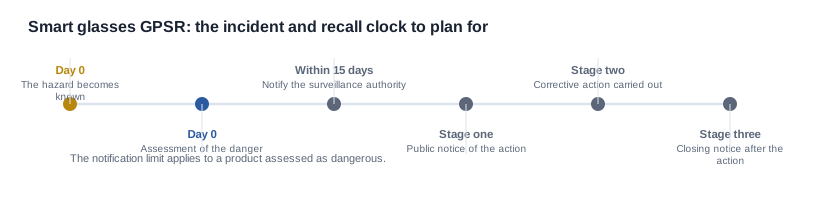
The corrective action itself runs in stages, and the stages have to be published rather than merely performed. A first public notice goes out, then the corrective action is carried out, then a further notice closes the episode and reports what was done. For a product with an established customer base, that means a communication plan, a customer list and a decision about the channel, prepared in advance rather than assembled under a deadline.
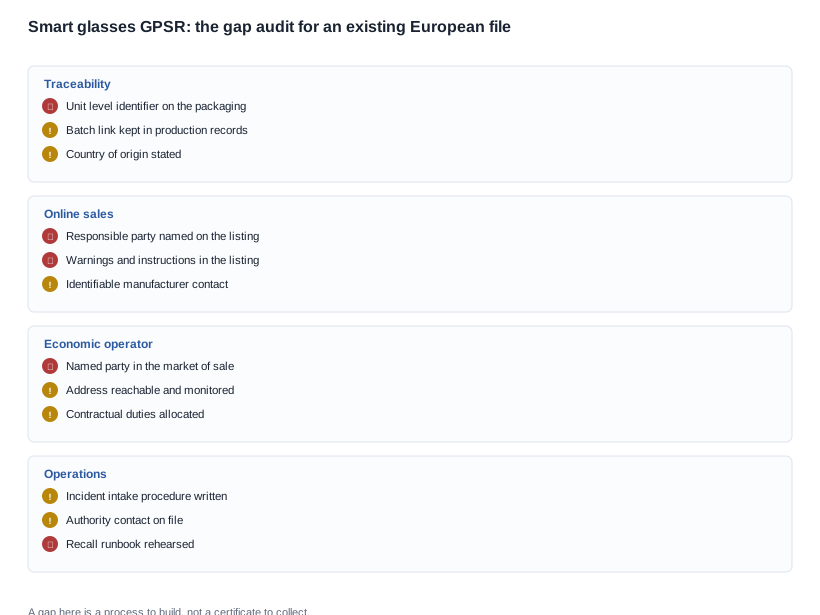
The audit above is organised by the four additions rather than by supplier, because that is how the gaps arrive. Traceability gaps appear when the identifier stops at the carton. Online sales gaps appear when the listing was written by a marketing team and never updated by a compliance one. Economic operator gaps appear when the contract did not allocate the duty. Operational gaps appear when nobody owns the clock.

Where the record breaks after launch, and what can still be negotiated
Where the record breaks after launch
The identifier that stops at the carton. The packaging carries a batch number and the units carry nothing. The symptom is that a corrective action aimed at the affected batch has to be executed against a population rather than an object. The cause is a decision taken at packaging stage without anyone asking how a unit would be identified in the field. The prevention is to settle the unit-level identifier before the artwork is locked, and to check it on production units rather than on samples.
The listing that nobody updates. The product page names the manufacturer and the warnings as they were at launch, and the operator changes hands two seasons later. The symptom is that a buyer of the listing cannot reach the party responsible for it. The cause is a listing owned by a commercial team and not by a compliance one. The prevention is to put the listing content on the change register, so that any change to the operator or the warning triggers a review of the listing.
The duties that were never allocated. The purchase agreement says the supplier will handle European compliance, and neither party has written down what that means in practice. The symptom is an incident where both parties assume the other is notifying. The cause is a clause written at category level. The prevention is to write the duties into the agreement as named actions with owners and a clock.
The drill that was never run. The incident procedure exists on paper and has never been tested. The symptom is that the first notification takes two days because nobody knew who to call. The cause is a procedure written and then filed. The prevention is a rehearsal once a year on a fictional case, which costs an afternoon and has been known to expose more gaps than any document review.
Procedures that have never been rehearsed are files, not plans. They are reasons to test the record rather than to assume it.
Where a traceability obligation can move, and where it cannot
The commercial conversation here has a short movable list and a long fixed one. The movable items are all process decisions rather than product decisions: whether the unit identifier is stamped at the factory or applied by the buyer at packing, whether the operator role is taken by the importer or by an authorised representative, whether the online sales information is managed centrally or per market, and who hosts the traceability database. Each of these is a cost and an effort question, and each can be moved to whichever party is better placed to carry it.
The fixed items are the notification duty, the assessment step, the public notice stages and the record retention period. None of these can be delegated to a supplier and none of them can be shortened. What can be changed is how well they are prepared, and preparation is exactly the thing that gets deferred until it is too late.
The negotiating position that follows is straightforward: the buyer decides which model and which variant carry the obligation in each market, and asks the supplier to price the record creation for each one rather than assuming it sits in the unit price. The total cost of compliance with this regulation is therefore driven by how many markets and how many variants are live at once. A buyer who enters one market with one variant has one operator, one listing and one record set. A buyer who enters six markets with three colourways each has eighteen combinations, and every one of them needs a named operator, a current listing and an identifier scheme. That multiplication is the real commercial consequence of the regulation, and it is a planning decision rather than a legal one.
A traceability launch worked through, and the limit of our catalogue
A traceability programme, step by step
The scenario below is hypothetical by design, because the point of this category is the order of the reasoning rather than any particular outcome. No client is described and no figures are claimed; the model, the quantity and the markets are assumed so the steps can be followed.
The scenario. A buyer is placing a private-label product on the European market through a channel customer who wants the traceability and responsible-operator position confirmed before listing. The first order is in the low thousands of units, and two further markets are planned for the following year.
Step one, the operator. The buyer establishes, before anything else, who will be the economic operator in each market. Under its own brand, the buyer is the importer, and the buyer therefore takes on the duties. That has a commercial consequence — a role, a cost and a procedure — and it is far cheaper to accept it than to discover it after the first shipment.
Step two, the identifier. The buyer asks how each unit will be identified and gets an answer that distinguishes the batch from the unit. Where the factory can stamp a unit identifier, the question is closed; where it can only print a batch number on the carton, the buyer decides whether to accept a population-wide corrective action or to add a step at packing.
Step three, the listing. The buyer writes the online sales information into the listing template and puts the listing on the change register, so that a change of operator or warning triggers a review rather than being missed.
Step four, the procedure. The buyer writes the incident procedure with a named intake, an assessment step and a notification route, and confirms with the supplier who will do each part. The clause in the purchase agreement is then written to match the procedure rather than the other way around.
Step five, the drill. Six months in, the buyer runs a fictional incident on the camera model and asks for the chain to be produced in an hour. The two common pitfalls in this step are running the drill with the people who built the record, which proves nothing, and running it without a written scenario, which produces a conversation instead of a timed one. The first attempt surfaces two gaps and one assumption about who holds the record. Both are fixed at a cost of an afternoon, and both would have cost a launch window if they had been found during a real matter.
The specification we publish, and the record we do not
The distinction we hold is between a specification and a record. A specification is something a buyer can rely on: cell capacity, charging time, rated runtime, charging method, the Bluetooth version where a row exists, the pixel class, the IP54 marking on the V06 and the S7, and the 158 g weight of the MT6 glasses body with its 1200 mAh folding charging case. A record is something that has to be created, owned and kept — a batch identifier, an operator in each market, a listing that names the responsible party, an incident procedure with a clock running on it. The catalogue carries the first kind and no part of the second, and there is no per-model certification row anywhere in it. We will tell you plainly which is which rather than let the second be assumed from the first.
We publish no per-model certification row, no batch or serial number scheme, no traceability record and no incident procedure, because the catalogue text contains no reference to this regulation, to CE, to FCC, to RoHS or to REACH, and the export certification page it does carry is a company-level page whose content is images rather than text — ten patent certificates, eight appearance-design patents and two utility-model patents. A company-level page cannot be read across to a per-model conclusion about traceability or about who the economic operator is.
What we can do for a specific model is confirm the published specification rows that exist for it, identify the published rows that do not, and tell a buyer plainly where the record has to be created rather than retrieved. On the eleven camera models, where the catalogue publishes no Bluetooth version row at all, even the protocol position is a request rather than a reference. We would rather say that than fill a gap with a plausible sentence.
The trace to attempt this week
If you are working on this now, the next step is short and specific. Send the model, the quantity, the target markets and the channel arrangement, and ask for the traceability and operator position for that configuration. We will tell you which published rows exist for the model, which of the four additions the configuration depends on, and where the record has to be built.
The GPSR pillar page holds the requirement set, and the compliance hub places this regulation alongside the radio, chemical and transport regimes it sits next to.
Tell us the model and the markets, and we will tell you which half of this obligation is a production question and which half is a records question.


