

A second order is not a larger version of the first one. It inherits every row the first order left open, and the rows that stayed open are exactly the ones that decide whether the third order lands on the date your channel plan assumes. In this catalogue, three of the durable facts a repeat order depends on are published for every model, and four specific camera models carry a charging row that is not published at all. A multi-cycle plan is built by closing those rows once, at the first cycle, rather than by negotiating harder at the third.
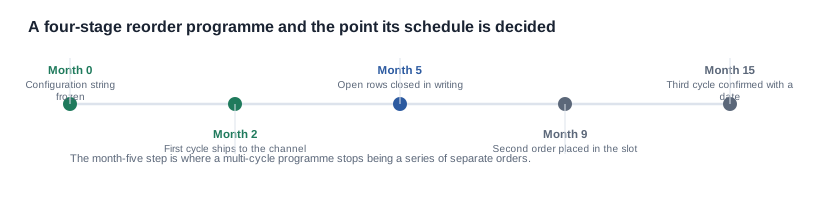
The reader here is a brand-side procurement manager or a channel buyer who has already taken one delivery and is now looking at the second and third. The question underneath is not "can you build it" — that was answered by the first shipment. It is "can you build it again, on a predictable date, without re-opening the decisions you already made." That question is decided by programme design, not by the factory working faster.
Smart glasses lead time: the aggregate schedule three correct dates cannot serve
Single-order lead time is a scheduling problem with one date. Multi-cycle lead time is a capacity-allocation problem with a demand curve, and the failure mode is specific: every order in the series is individually deliverable, every quotation is individually reasonable, and the series as a whole is impossible.
Here is how that happens in practice. A retail programme commits to a spring launch, a summer replenishment and a pre-season top-up. Each order is quoted against its own date. The spring order needs a build slot in month two. The summer order needs a slot in month five. The pre-season top-up, added late because the channel pulled forward, needs a slot in month six. The first two fit. The third does not, because month six is already full with work that was quoted in month four, and the factory is not going to build two programmes' worth of units in one month just because two buyers asked separately.
The buyer in this situation has usually done everything the first-order checklist asks for. The configuration is frozen. The artwork is approved. The sample is signed off. The only thing that is wrong is that nobody ever asked what the third order would collide with, because at the time the third order did not exist.
Three aggregate properties decide whether the series is servable, and they are worth naming because each is checkable in advance.
The first is slot demand against available capacity, and neither figure is published. We do not publish line count, monthly output or slot availability for any model, so an aggregate claim can only be made by the supplier, and only against a specific set of assumptions. The useful question is not "how much can you build" but "for a stated quantity, a stated configuration and a stated start date, which stage binds". A supplier who answers with a total rather than a binding stage has described an average, and averages are what make three correct dates into one impossible programme.
The second is the demand pattern's own shape. A programme with one large order and two small ones is easier to serve than a programme with three medium orders of the same total, because the batching already happened. Splitting one order into three, which is what a nervous buyer often does because it feels like it de-risks the programme, creates three separate slot claims and three separate chances to be sequenced behind someone else. Staggering beats batching only when the stagger is deliberate and the configuration is shared; a stagger across three different configurations is three programmes, not one.
The third is how much of the schedule is inherited rather than re-decided. Every stage that was decided in cycle one and written down is a stage that cycle two does not have to reopen. Every stage that was decided verbally, or decided on the buyer's side and left implicit, is a stage that cycle two reopens with the factory and with the channel simultaneously. The rows that stay open are the ones that accumulate.
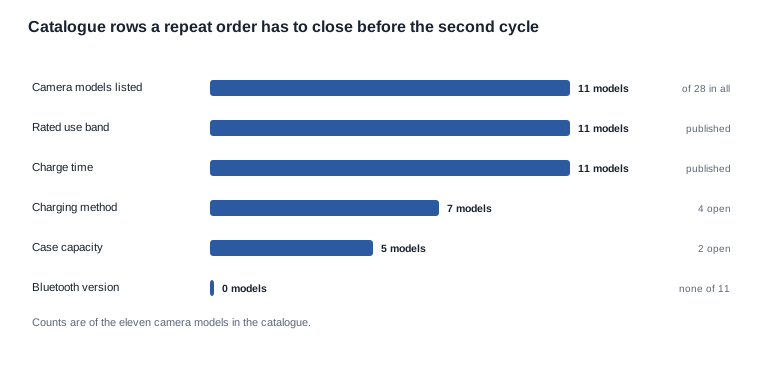
The bar chart above counts, across the eleven camera models in the catalogue, how many of them carry each of the four rows a repeat order depends on. Every one of the eleven publishes a rated use band and a charge time, so those two rows are closed. Four of the eleven do not publish a charging method at all, and that is a row a repeat order cannot assume. This is why the aggregate question is not a capacity question at the start — it is a documentation-closure question.
What a reorder inherits from the catalogue rows that were never closed
A reorder does not inherit a product. It inherits a set of rows, and the rows that were open at the first cycle are the ones that come back with interest. This is the part of multi-cycle planning that most teams treat as risk and should treat as a list.
The charging method row is open for four camera models. For the CY05 and the L1 Pro, and the MT6 and the CY03, the catalogue publishes pixels, battery capacity, charge time, rated use and a charging case capacity for all four, but it does not publish a charging method or a charging interface line. For the MT6 the case is a 1200 mAh folding one; for the L1 Pro and the CY05, and the CY03 the case is 1400 mAh. What none of the four says is how the device itself charges. That is not a cosmetic gap in a catalogue. It is the row that determines what your warehouse holds, what your after-sales bench needs, what your retail counter needs in the form of a dock, and whether a returned unit can be turned around on site. A first order can absorb an unanswered charging row, because a small number of units can be turned around in a lab. A repeat order cannot, because the return rate of a live programme turns that row into a service-cost line.
The radio row is open for every camera model. All eleven camera models publish pixels, battery and a rated use band, and not one of them publishes a Bluetooth version. The audio models by contrast publish it explicitly, mostly as V5.4, with the K01 and the K02 on V5.3. For a repeat order this is the row that decides whether your validation script can be written at all, and whether a firmware update you validated in cycle one is even the firmware that arrives in cycle two. You cannot write a repeatable acceptance test for a radio whose specification you have not been given.
The case-capacity row is open for two camera models. The KY06 and the MT5 both publish a charging case and a rated use band of 6~8 h, and neither publishes the case capacity. A programme that ships with a case in the box and rotates through three replenishment cycles is holding three times the unknown quantity. The row is cheap to close — one written answer to one question — and expensive to leave open, because the answer determines the size and the cost of the retail packaging that goes around it.
The variant row is published but narrow. The V03 Pro is offered in three colours, the V06 in four, and the MT6 in one. Colour is a reorder lever that looks free and is not: a new colourway on the same model is an artwork approval, a packaging artwork approval, and a fresh sample approval, and on a sport model such as the V06 or the S7 the two IP54-marked models in the catalogue, the variant also interacts with the detachable inner frame that the catalogue lists as a feature. A reorder that adds a colour is a reorder with three extra stages in it.
None of these rows is dramatic. Together, across a programme with several cycles, they are the difference between a schedule you can write down and one you can only describe.

How to stage a programme instead of placing three separate orders
The practical answer to the aggregate problem is not a bigger order. It is a programme document that states the sequence once, so that the second and third orders inherit a decision rather than reopening it. Four elements do most of the work.
Element one is a single configuration string that carries across every cycle. Write the model, the pixel tier, the colourway, the case configuration, the packaging configuration and the destination market into one string, and require that every order in the programme is quoted against that string. The catalogue makes this easy for camera models in a way that is easy to underestimate: the L2 Utral is published with a 290 mAh cell and a case available at 900 mAh or 1400 mAh, so a "Utral" order is not a configuration until the case capacity is fixed. A programme that quotes "Utral" in cycle one and a 1400 mAh case in cycle two has changed the configuration, and the two are not the same order.
Element two is a written open-row list, owned by one person. Every question the supplier did not answer in cycle one goes on a list with a name against it and a date by which it must be answered before the next order is placed. The list above is a reasonable starting population: charging method for the four camera models that do not publish it, radio version for whichever camera model you have selected, case capacity for the KY06 and the MT5. The important part is not the list's length. It is that the second order cannot be placed while any item on it is unanswered, which is a rule you can write into the programme and a rule a factory can price.
Element three is a slot reservation that is a date, not a conversation. A slot held verbally between quotation and order is a slot that is not held. A slot confirmed in writing, with a start date, a configuration reference and a date by which the order must be placed to keep it, is a slot. This is the mechanism by which a flexible date becomes currency: offering a later date in exchange for a confirmed position is a trade a factory can accept, because what it costs them is a slot they would otherwise have released.
Element four is a split rule decided before you need it. If a programme is going to ship in two parts, the rule for which part carries the first-build risk should be written before the first shipment rather than after the first delay. There is an obvious version of this rule and an expensive version, and the difference between them is which configuration arrives in which parcel. Shipping the first parcel in the lower-risk configuration — the colour already approved, the case configuration already validated, the volume already in the supplier's history — buys you a working channel while the rest of the programme is still in production.
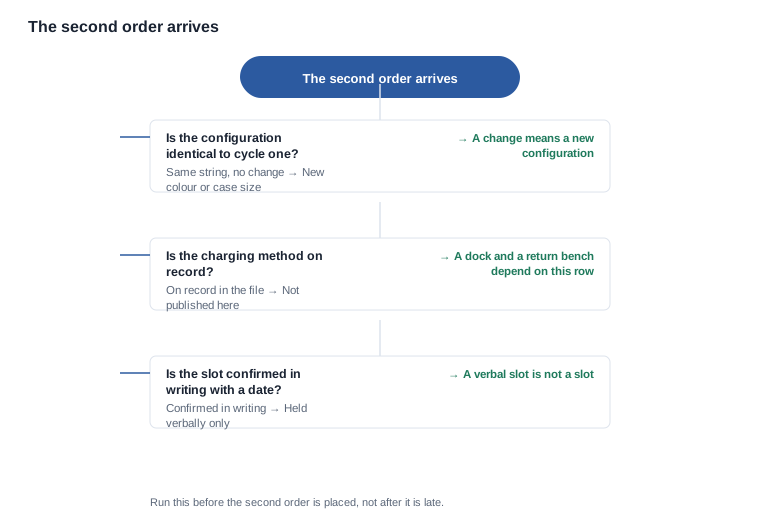
The decision tree above is the working version. Its first branch is the one most programmes never reach, because they treat the second order as routine and only meet the open rows when the second order is already late.
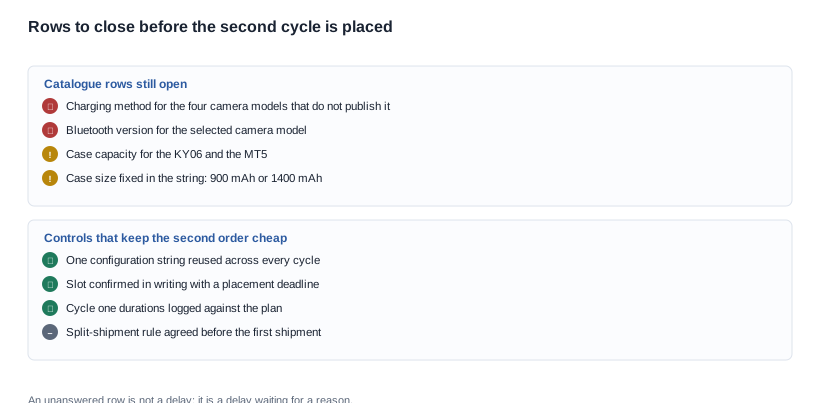
The checklist above is the short form. The longer form is the set of questions to ask, and the order in which they are asked decides how much of the answer you get.
- Which rows does the published data already close for the models we have selected, and which ones will you answer in writing? Ask for the answer as a line in the file rather than a paragraph in an email, because the second order's incoming inspection script has to be written from it.
- What is the total cost of the open rows for this programme — not the unit price, but the cost of the service loop, the dock and the rework? This is the figure that decides whether a row is worth closing now, or whether the programme should be resized around it.
- Which model on the shortlist carries the fewest open rows, and what does closing them cost you in specification terms? A camera model with a published charging method and a published case capacity removes a service-bench line, and a buyer should know what that removal is worth before the shortlist is set rather than after it is signed.
- What would make you re-quote the second order, and what would not? A trade-off that is named in advance is a trade-off; one that turns up at the second order is a dispute.
There are also signs that a programme is not actually ready for a second cycle, and they are worth listing because they are easy to misread. A supplier who answers the open-row questions with a second quotation rather than with a document is telling you the row will still be open at the second order. A programme whose cycle-one durations were never logged cannot be assessed against its own plan, so any "no slippage so far" claim is unmeasured rather than confirmed. And a shortlist that changed between cycles without a written reason has usually changed because someone reacted to a stock-out rather than because anyone assessed the configuration.
The failure modes worth designing out at this level are the ordinary ones, repeated. A configuration that drifts between cycles — a case capacity that changes because the packaging designer found a cheaper box, without anyone revisiting the string. A service loop that is cheaper per unit than it was in cycle one only because the first cycle's returns were absorbed by a person rather than a process. And a peak-season date that was committed on the strength of a slot held verbally in cycle one and never confirmed in writing.

What a second cycle costs when the first cycle left rows open
The cost of an open row is not the delay itself. It is that the delay appears at a point where the programme has no slack, because the rows reopen in the same window as the commercial pressure. Here is how a specific set of them compounds in a three-cycle programme, described as a sequence rather than as a claim about a real customer.
Cycle one. A brand launches a camera model into one market. The unit sells through a channel that returns units for service rather than for resale. The buyer's first-order file does not record the charging method, because the question was not asked, and the catalogue row for that model is one of the four that is not published. The first two hundred units go out and the service loop is handled manually, at a cost the buyer has not modelled, because the cost of handling a unit by hand does not appear until someone counts the hours.
Cycle two. The programme grows and the return volume grows with it. The buyer asks the supplier to answer the charging row in order to build a return bench and to write a retail instruction. The supplier answers, and the answer is fine, and it is also a document that did not exist when the first order was placed. The dock the buyer designed has to be replaced, or the bench has to stay manual, and both of those are costs that arrive with the second order rather than with the first. The radio row, meanwhile, is still open, so the acceptance test for the second cycle is still written by hand, which means the second cycle's incoming quality check is slower and less consistent than the first's.
Cycle three. The channel asks for a date for a seasonal peak, and the buyer needs an answer four months out. The answer is now available in a way it was not in cycle one, because the rows have been closed. But the programme has lost the thing that would have made the answer reliable, which is a baseline: a second and third cycle cannot be measured against a first cycle that was never measured, because the first cycle's actual durations were never logged against the plan. The buyer now has a quotation, a service cost they cannot un-encumber, and a peak date — and no history to lean on.
The generalisable lesson is narrow and worth stating plainly: in a multi-cycle programme, the analytical value of cycle one is not the first shipment. It is the baseline. A first cycle that is not logged is not a data collection opportunity, it is an irreversible loss of the only clean measurement the programme will ever get, and every later cycle is negotiated against a plan rather than against a record.
Two published durations survive this analysis and are worth logging in cycle one because they are the same in every cycle. The charge time is published for every model in the catalogue: two hours or less across the range, with the D17 and the ZH12 at roughly one hour on Type-C. The rated use band is published for every model as well, and it is the figure that determines how long a unit has to sit on a charge during the return loop. Neither is a lead time, and both are frequently mistaken for one; what they give you is the lower bound on the service turnaround you can promise a channel, which is a number a buyer can actually plan around even when the production slot is uncertain.
What we will and will not put in a multi-cycle plan
We publish the configuration, the electrical rows, the charging method where the catalogue states it, the charging case capacity where the catalogue states it, the pixel tier and the colour options. We do not publish monthly output, line count, slot availability, minimum order quantity or a nominal production lead time, and we are not going to start, because a programme-level number that does not hold for a specific configuration is exactly the number that gets a buyer to build a launch plan on a date nobody committed to. The lead time section covers what the published rows do and do not support.
What we will do is close the open rows in writing for the models a programme actually selects. Send us the models, the quantities per cycle, the configuration for each cycle and the destination markets, and we will tell you which of the four rows above are already closed by the published data, which need a written answer from us, and which are yours to close with your own suppliers. We will also say plainly where a two-cycle programme is a better fit for a model than a three-cycle one, because the models that carry the most open rows are not the models you want in a five-cycle programme.
What this changes in practice. Nothing about how fast we build. It changes where the conversation happens: one programme document, one open-row list, one slot rule, before the first order rather than during the third. A multi-cycle plan that closes its rows in cycle one is a plan the second order can cite.
Related reading
- How lead time works, stage by stage — the chain of waits
- MOQ and the multi-cycle question — where order size binds
- Verifying a supplier's schedule claim — the evidence a date needs
- Lead time and production capacity — the constraint behind a slot


