

Smart glasses production capacity affects lead time in a way that surprises buyers who expect a single relationship between the two. Capacity is usually quoted as a rate, and a rate is not a schedule. What actually determines the date is the binding stage — the one step in the sequence that every unit of your order has to pass through and cannot skip — and that step is frequently not the assembly line. A factory with enormous line capacity and a constrained camera module supply will deliver late, and it will deliver late on a schedule that looked comfortable at the quotation stage. This page works through how the two figures relate, what a lead time has to be measured against, and how to convert a quoted duration into a held slot before the deposit is paid.
Smart glasses production capacity sets the lead time, not the factory
The conclusion, stated up front
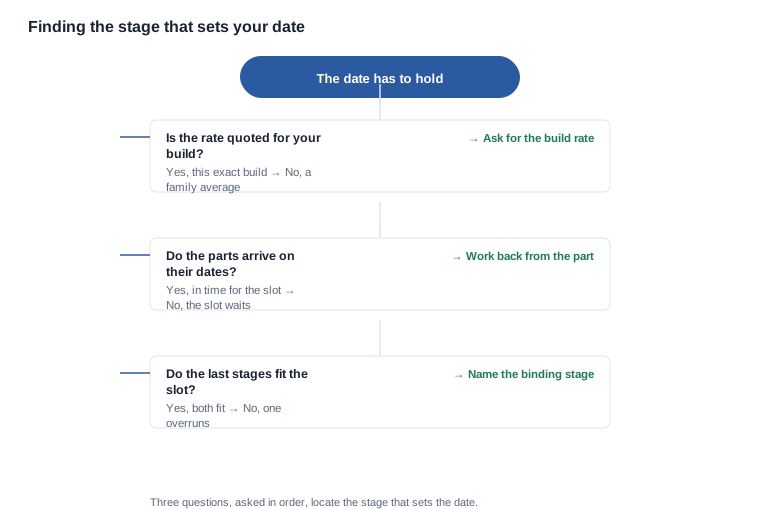
A lead time is a sum, and only one term in the sum is usually binding. Find that term and the date becomes negotiable; leave it unidentified and every conversation about capacity is really a conversation about the wrong stage. The three questions that locate it are cheap — what rate is quoted for my build, which parts arrive on their own dates, and do the last two stages fit inside the slot — and they are asked in the first round of an enquiry by every factory that has thought about its own schedule.
The relationship that is not a relationship
There is no arithmetic that turns a capacity figure into a lead time, and any supplier who appears to offer one is doing one of two things. Either they are quoting the duration of the stage they control, which is a partial answer, or they are quoting a standard lead time that assumes a configuration, a quantity and a starting state that may not match yours. In this category the second is common, because the range contains configurations that differ in ways that change the sequence rather than merely the pace: eleven models carry a camera module, eight are audio models and three are sport models, and each group has its own incoming inspection, its own firmware step and its own packaging path.
The practical consequence for a buyer is that a lead time quoted as a single number is a statement about the easiest build on the list. It is worth asking the question that exposes this without being abrasive: what is the lead time for this configuration, starting from the arrival of the constrained parts rather than from the receipt of my purchase order? A supplier who answers with a stage-by-stage breakdown is giving you a plan. A supplier who answers with the same number as before is giving you a template.
Who reads a schedule
The reader is a brand-side buyer, a channel buyer or an importer with a date attached to a programme and a quotation attached to that date. They are not choosing between products. They are choosing between schedules, and they need to know which schedule is real before they put money behind it. What they are managing is not a delivery delay — a delay is a consequence — but the fact that a date is usually a promise about a queue rather than a promise about a factory.

The stages a lead time is made of
Six stages, and who owns each one
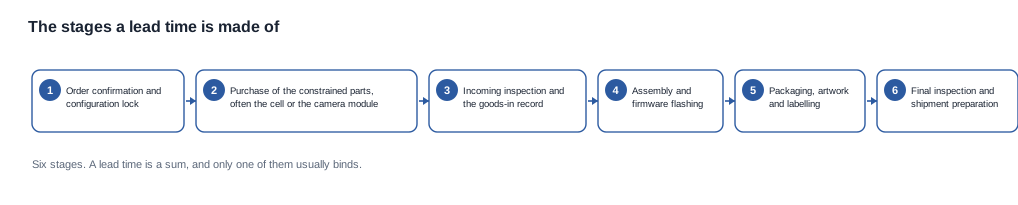
The flow above is the sequence a smart glasses production run follows. Each stage consumes something different, and — this is the part that matters for a buyer — each stage has a different owner. Two of the six are owned by the buyer, and those two are the ones that move most often.
- Order confirmation and configuration lock. The build is frozen here: model, colour, charging interface, case configuration where one applies, firmware revision. Everything after this stage is a consequence of this decision.
- Purchase of the constrained parts. Cells, camera modules, casings, hinges. This is usually outside the factory's direct control and is very often the binding stage.
- Incoming inspection and the goods-in record. Lots are recorded and held, and the hold time here is rarely in the quoted schedule.
- Assembly and firmware flashing. Line time, plus programming slots, which are a separate resource from line time.
- Packaging, artwork and labelling. Owned by the buyer in the sense that artwork approval sits on the buyer's side of the line, with more approvers than anyone expects.
- Final inspection and shipment preparation. Test capacity, sampling position, and the transition into the transport file.
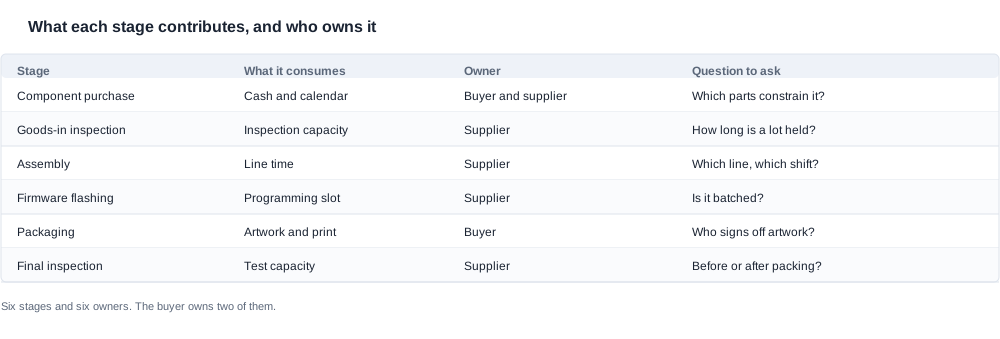
Three of those six stages are partly the buyer's, and a buyer who treats all six as the factory's is missing levers that can be pulled this week. Component purchase begins with a forecast the buyer controls: how firmly a forecast is committed determines how much of the cell and the module supply the factory will hold on your behalf. Packaging begins with artwork, and artwork approval sits on the buyer's side of the line with more approvers than anyone expects — a stage that is trivially compressible by agreeing a review deadline in advance. The third is case pairing, and it is the one buyers rarely consider at all. Whether the case ships in the same build as the glasses or is supplied separately changes the bill of materials, the packing sequence and the number of units the line has to handle. Our catalogue makes the scale of this visible: the CY05 and the L1 Pro, and the CY03 are published with a 1400 mAh case, the L2 Utral with either a 900 or a 1400 mAh case, the MT6 with a foldable 1200 mAh case, the KY06 and the MT5 with a case whose capacity is not published, and the V03 Pro with no case at all. A programme that mixes a case build with a no-case build has two bill-of-material routes rather than one, and two set-ups.
Why the binding stage is usually not the one you are discussing
Buyers spend most of the conversation on assembly capacity, because assembly capacity is the easiest thing to describe and the most quotable. But the stage that actually sets a date is frequently a purchased part, and it is frequent for a structural reason: the parts that differentiate the product are the parts with the fewest alternative sources. This is visible in the catalogue even without any internal factory data. A camera module requires a different incoming inspection route, a different firmware integration step and a different defect profile from a Bluetooth audio product, so a camera model inherits the schedule risk of its module supply. The cell is the other one, and the range spans 40 mAh on the A05 and A06 up to 290 mAh on the CY03, the CY05 and the L2 Utral, and the L1 Pro, with 55 mAh twice over, 70 mAh, 90 mAh twice over, 100 mAh, 115 mAh, 200 mAh, 220 mAh, 260 mAh and 265 mAh in between — a spread of cell configurations that a factory with one cell source has to plan around.
The way to test which stage binds is not to ask the supplier which one it is, but to ask for the lead time of your configuration with and without the component purchase included. If the two numbers are identical, the purchase stage is not in the quoted schedule and the quoted duration covers only what happens inside the factory. If the second number is materially longer, you have found the constraint, and you can now ask the useful question: what would have to be true for that part to arrive inside the slot? That question has a practical answer — a forecast commitment, a buffer stock, an alternative source, or a different date — and it is the one that turns a vague delay into a decision you own.
What a lead time has to be measured against
Three references, and choosing the right one
A lead time is meaningless without a reference point, and there are three candidates: the purchase order, the arrival of the constrained parts, and the start of the build. Quoting from the purchase order includes the purchase stage and is the most common; quoting from the arrival of the constrained parts is the most honest about risk; quoting from the start of the build is the one that hides the risk entirely. Ask which one is being used, and then ask whether the date that was promised to you is measured on the same reference. In practice, the date a buyer is given is often a build-start date while the date in the contract is a receipt date, and the gap between the two is the whole problem.
The second reference is the order quantity. A lead time for a sample is not a lead time for a production lot, because a sample passes through the sequence once and a lot passes through it in batches, with the setup amortised. Ask for the lead time at your quantity rather than the lead time quoted in the general terms. A factory that will re-derive the date for a stated quantity has a schedule; one that repeats a standard figure has a catalogue.
The published figures and what they cannot tell you
Our catalogue publishes charge time for every model: twenty-six of them at two hours or less, with the D17 and the ZH12 at around one hour. That is a real number and it is worth having in the file, but it has no starting state of charge attached and no criterion for when the charge is judged complete. A charge cycle without a starting state is not a cycle you can schedule, which is why it cannot be converted into a shift interruption or compared against a competitor's published figure. Buyers who have modelled a shift around a charge time are modelling something that the underlying data does not support.
The same caution applies to the charge method, which is published for twenty-four of the twenty-eight models: seventeen with a magnetic interface and seven with a Type C interface. The four camera models where the method is not published — the CY03 and the CY05, and the MT6 and the L1 Pro — are a good illustration of why "the catalogue does not say" is a scheduling item and not merely a documentation one. A magnetic interface and a Type C interface are different fixturing decisions on the line.

Confirming a slot before it becomes a promise
The difference between a date and a slot
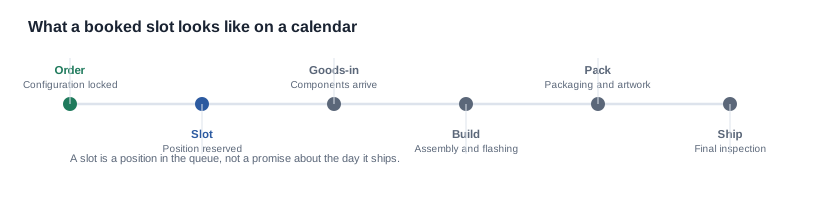
A date is a statement about the calendar. A slot is a statement about the queue. The one you need before a deposit is the second, and it has three parts: the position, the period it covers, and the notice period for its release. Ask for all three, in writing, and ask for them against the configuration you have frozen. A slot held against a different configuration is not your slot, and a slot held without a notice period is a slot you discover has moved after you have committed your inventory plan to the old date.
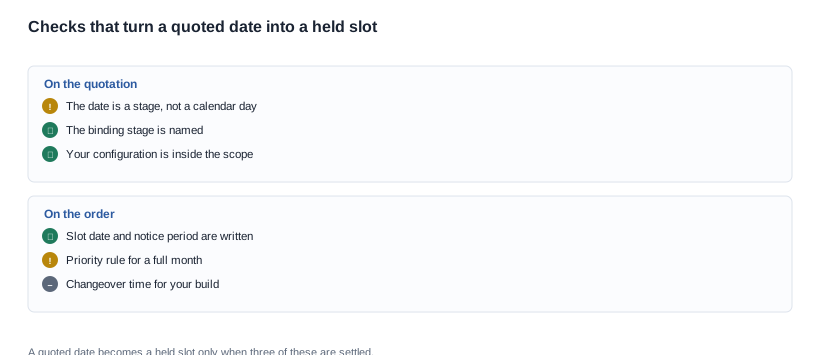
The three checks on the checklist above are the ones that matter most in practice. The binding stage has to be named, because a date without a named stage cannot be improved — you cannot renegotiate with an abstract queue. Your configuration has to be inside the scope of the quotation, because a slot quoted against a family average is not reserved for your build. And the notice period has to exist, because it is the only mechanism that gives you time to respond when something moves.
Building the schedule backwards from your own date
The other direction is worth working out before the enquiry rather than after the quotation. Take the date you need, work backwards through the stages in the flow above, and ask yourself where the slack is. If the constrained parts have a long arrival time, then either the order has to be placed earlier than the factory would prefer, or the date has to move, and both of those are decisions you own rather than ones the supplier owns. A buyer who arrives with a backward schedule and a specific configuration gets a much more useful answer than one who asks for a date and accepts it.
The same factory, two markets, two schedules
A complication that appears as soon as a brand sells into more than one country is that the two markets have different entry requirements, and those requirements sit on the schedule as well as on the paperwork. The technical requirements are a separate matter and are settled per model by the manufacturer, but the commercial consequence is not: a market that needs its own documentation set is a market where the order cannot be booked until that set is complete, and the documentation set is often the slowest part of the schedule rather than the fastest.
The useful discipline is to separate the two clocks and to ask which one is running. There is a manufacturing clock, which is the sequence in the flow above, and there is a documentary clock, which runs from the moment the configuration is frozen to the moment the file for that configuration is complete. They start together and they rarely finish together, because the documentary work is usually concurrent rather than sequential. A buyer who asks when each of them ends, and who asks what starts the documentary clock, has removed the most common cause of a surprise delay in a multi-market programme — which is not that the factory was slow, but that nobody noticed the file had not been started.

How a compressed schedule changes the acceptance criteria
Where compression shows up in the product
A compressed schedule does not only change when the goods arrive; it changes what the goods are, and it does so quietly. The setup window is the first thing trimmed, and a shortened setup shows up as units from the first part of a run behaving differently from units from the middle. Next, inspection is often moved from the line to the end of the batch, which means the sampling that used to catch a drift early now catches it after the batch has been packed. Third, a purchased part may be substituted to protect the slot, and the substitute is functionally equivalent and is not the part the sample was approved against.
None of these is misconduct and all of them are ordinary responses to pressure. That is exactly why they have to be controlled by the agreement rather than by trust: the buyer cannot tell from the outside whether a given unit came from a rushed setup or a normal one. The control is written before the pressure appears, which means the acceptance criteria have to be written before the run rather than after the first defect.
The three things to fix in advance
Fix the sample as the binding reference, so "same as the sample" has a precise meaning. Fix which tests run on every unit, and which run on a sample, so the inspection position is settled rather than left to the line. Fix what a substitution requires — a written approval, a new sample, or a recorded concession — so that the decision is made by a person rather than by a schedule. The OEM ready platforms guide covers what a factory should be able to demonstrate on request, and the bulk ordering guide covers the transition from an approved sample to a production lot.
The schedule facts we can and cannot give you
Where our own position stops
Stated plainly: a date given to a buyer has to be a date we can document, and where our documentation does not reach, the answer sits in the supplier's own file. We publish the values our documentation states, we mark the rows that are open, and we will not fill an open row with a figure lifted from a general product page. A date calculated on an assumed stage duration fails in the week the goods were meant to arrive rather than in the quotation, and the correction costs more than the question would have.
The rows we do not publish are these:
-
We do not publish production capacity, line counts, daily output or stage durations. A standing figure would be wrong for most of the orders a reader compared it against, and a rate with no stage attached cannot be turned into a date.
-
Factory-level lead times are not published. A single lead time across twenty-eight models is arithmetic rather than planning, and it would be wrong for eleven camera builds, eight audio builds and three sport builds alike.
-
Minimum order quantities are not published, and the reason is that the threshold changes with the model mix. A published figure for a moving threshold is a commitment nobody intended to make, so the minimum that applies is set against the configuration being built.
What we will tell you instead
What we will tell you is what your configuration requires, which stage is binding, what has to be true to hold a slot, and which parts of the schedule are ours and which are yours. The production capacity section sets out the assessment framework, and the camera and audio range shows the configurations the assessment applies to.
How to read the rows we do publish
The rows above are published in a fixed order, and the order carries meaning: a value, then the condition that value was measured under, then the limit of what it can be used for. The MT6 weight is the clearest example. The catalogue states 158 grams for the glasses body, including the cell and the camera and excluding the foldable charging case; the case itself is 1200 mAh and its weight is not published. That is a useful number and a narrow one. It lets you compare one model against itself on the same basis, and it does not let you compare the MT6 against a model whose weight has never been published. No bare frame weight is published for any model in the range, and the temptation to read 158 grams as a frame weight is the single most common misreading of our catalogue — it would put a number on a frame that we have never measured.
The same pattern applies to the charge time row, and the two together are a fair summary of how we treat our own data. We publish what is measured, we say what it includes and what it excludes, and we leave the rest open. Send the models, the quantities and the date you need, and we will tell you which configurations exist, which stages each of them depends on, and what to put in the order so that the date you were given is the date you get.
Related reading


