

A lead time is not a property of a product. It is the output of four decisions — what you specify, where the clock starts, what evidence supports the number, and what you write into the agreement — and a first-time buyer who asks for the number before making the first three will be given an average dressed as a commitment. Work the four decisions in order and the schedule becomes something you can plan against; skip one and the date will move in week six for a reason that nobody can reconstruct.
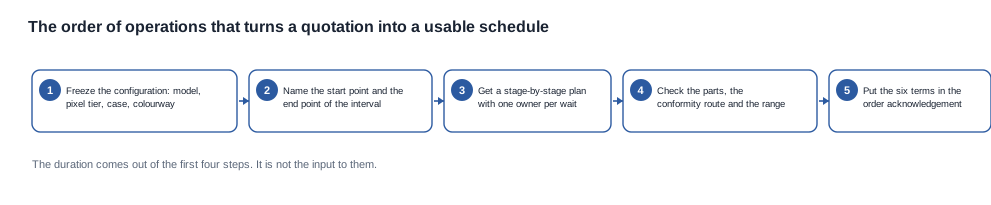
The reader is someone buying on the brand side, a channel buyer or an importer opening a category for the first time. There is no track record with the supplier, no reference build to compare against, and usually two or three quotations that all quote a duration in weeks. The fear is not a bad price. It is committing to a launch window against a number that turns out to mean something different from what the buyer assumed, then discovering that the assumption was never written down anywhere.
Smart glasses lead time: the four decisions that produce a usable number
Most first-order problems in this category are not scheduling problems. They are specification problems that arrive in a scheduling costume. A buyer asks a supplier for "how long", receives six weeks, writes it into a plan, and only learns in week four that six weeks was measured from the arrival of artwork, which nobody had commissioned.
The four decisions, in the order they have to be made, are these.
Decision one: what is being ordered, written down precisely enough to be quoted. A quotation only means something against a fixed configuration. In this catalogue the configuration surface is wider than it first appears, because a model name does not carry the variables that change the build. A camera model comes with a pixel tier — eight models in the catalogue are published at 8 MP, three at 13 MP, and that tier is the difference between two different bills of materials. A case configuration is a separate decision: the L2 Utral is published with a 290 mAh cell and a case available at 900 mAh or 1400 mAh, the CY03 and the L1 Pro, and the CY05 come with a 1400 mAh case, the MT6 with a 1200 mAh folding case, the KY06 and the MT5 with a case whose capacity is not published, and the V03 Pro with no case at all. Colour is a third decision, and a narrower one: the V03 Pro is published in three colours, the V06 in four, the MT6 in one. Ask a supplier for a duration against a model name and you will get a duration against whatever they assume, which is usually their most common build.
Decision two: where the clock starts and where it ends. A lead time is a difference between two points, and a supplier will describe the interval that flatters their build unless the endpoints are fixed by the buyer. A useful working interval runs from the point at which the last buyer-side input arrives to the point at which the goods are handed to the carrier. A supplier's interval usually runs from "order received" to "ready to ship", which quietly assumes your artwork, your approvals and your purchase order all arrived together and on time.
Decision three: what evidence supports each stage of the interval. A stage that has no document behind it is an estimate, and an estimate written in a quotation becomes a commitment the moment you pay. The evidence is usually simple — a part-level status with a date for constrained items, a written confirmation of a slot, a named owner for the compliance route — and it is usually available, because the supplier is running the same information internally.
Decision four: what goes into the agreement. Only the fourth decision converts the other three into something enforceable, and it is the one first-time buyers most often skip, because the first order is small enough to feel like a trial and a trial does not seem to need terms. It does, especially if the first order is the one your channel's launch window is built on.
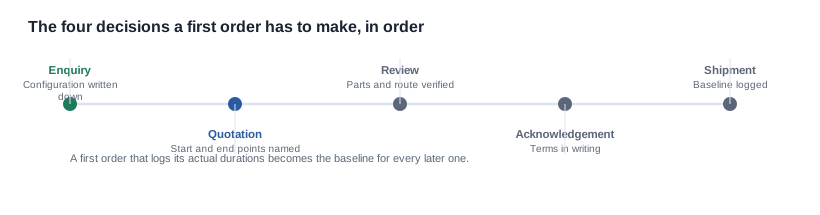
The sequence above is the whole argument of this article in one line: the number comes last. The first-time buyer who inverts the order — who asks for a duration in the first email and builds the programme around the answer — has decided to negotiate about the one thing in the chain that cannot be negotiated, because the duration is a consequence of the other three decisions rather than a thing anyone chooses.

What to specify before a supplier can quote you a date
Before any supplier can give you a meaningful number, the enquiry has to carry enough specificity to be answered. This is the part of a first order where a buyer's hesitation — not wanting to commit to a specification too early — costs the most, because a vague enquiry gets a vague answer and the vagueness is discovered late.
The specification that makes a schedule quotable has five components.
The model, with its electrical row. The catalogue publishes a battery capacity, a charge time and a rated use band for every one of the twenty-eight models, and for the eleven camera models it also publishes the pixel tier. Those published rows are the ones you can put in the enquiry without inventing anything, and they are the ones that let a supplier quote from a known build rather than a guess.
The case configuration, stated rather than implied. This is the row that most often turns a six-week quote into a nine-week one, because the case is a separate purchased item with its own position in the bill of materials and the catalogue does not settle it for you. The L2 Utral gives you a choice of 900 mAh or 1400 mAh, and the choice is not cosmetic: it changes what ships in the carton, which changes the packaging artwork, which changes an approval step, which changes a date.
The charging method, asked for explicitly. For twenty-four of the twenty-eight models the catalogue states whether charging is magnetic or Type-C, and for four camera models — the MT6, the CY05 and the CY03, and the L1 Pro — it states no charging method or interface at all. If your shortlist includes one of those four, this is a row to ask for in writing, because it determines what your warehouse holds, what your service bench uses, and whether a returned unit can be turned around on site.
The radio specification, if the model has one. The catalogue publishes a Bluetooth version for the audio and sport models, and it does not publish one for any of the eleven camera models. That gap matters less for a first order than it will for a second one, but it matters now in a specific way: if you intend to write an acceptance test or a firmware validation step against the first shipment, you need the radio specification before the shipment, not after.
The destination market and the conformity route. A radio-equipped product entering a market needs a conformity route before it can be sold, and the Radio Equipment Directive (EU) 2014/53/EU is the European instrument that governs it. The route has a duration and a set of documents, and the duration is a component of the schedule whether or not the supplier mentions it.
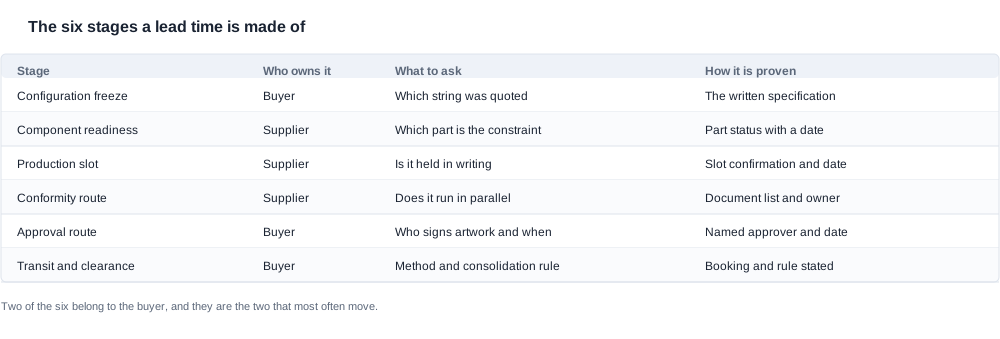
The table above sets out the six stages, who owns each one, and what a buyer should ask at each. Two of the six belong to the buyer, and they are the two that most often move: the approval route and the purchase order itself. A buyer who has named an approver, a deputy and a date for each of them has removed most of the avoidable delay from the schedule before a supplier has quoted anything.
How to measure the schedule you have been given
Once a schedule arrives, the buyer's job is measurement, and the measurement is not arithmetic. It is finding the binding link. A schedule of six stages is not a total of six stage-durations if the stages overlap; and a buyer who adds six stage-durations together to check a supplier's total will get a number that is longer than the plan, which tells them nothing.
The method is short. Write down every stage as an interval with two endpoints and an owner. Mark which stages can run in parallel. Find the longest chain of stages that cannot be shortened, because that chain — not the total — is what sets the date. Then ask a single question: which link in that chain has the least float?
Three things in this catalogue are worth using as anchors when you do this, because they are published for every model and they bound the schedule from below without being a lead time.
The charge time. It is published for all twenty-eight models: two hours or less across the range, with the D17 and the ZH12 at roughly one hour on Type-C. What it does not tell you is the starting state of charge or the end criterion for "charged", which is exactly why a charge time cannot be used to compare interruption windows and should never be treated as a lead time.
The rated use band. Also published for every model, and it is the figure that determines how long a unit sits on a charge during a service loop. The eleven camera models sit in three bands: 5~8 h for the V06 and the V03, and the V03 Pro and the S7; 6~8 h for the KY06 and the MT5; and approximately 7 h for the L2 Utral and the MT6, and the L1 Pro and the CY05, and the CY03. The eight audio models sit at roughly 8 h for the K01 and the LC-105-1, and the K02 and the LC-105-2, at roughly 7 h for the D11 and the D12, and at roughly 6 h for the G07 and the YK12 — and the two carrying the shortest band are exactly the two with the slim and detachable temple, which is why the band is published per model rather than averaged. The sport models and the photochromic unit take the remainder: the YKC02 at roughly 8 h, the D17 at roughly 7 h, the ZH12 at roughly 8 h and the photochromic model at roughly 7 h.
The case configuration. A model that ships with a case has two charge cycles to manage, and the case is the one you will find in the returned goods. The catalogue publishes case capacity for the CY05, the CY03 and the MT6, and the L1 Pro, and the L2 Utral, and leaves it unpublished for the KY06 and the MT5.
What none of these three is, and what buyers most often try to make them, is a production duration. They are electrical facts about a unit. They are useful because they are stable across orders and across suppliers, which makes them a good baseline against which a schedule claim can be tested for plausibility — and useless as a substitute for one.

Verifying a supplier's schedule claim before the deposit
Verification in this category is a documentary exercise with a physical check at the end, and it belongs before the deposit rather than after the first shipment. The steps below are ordered so that each one disqualifies a claim that is not worth spending time on.
- Ask for the schedule as a chain, not a total. Name every stage, give every wait an owner, and find the longest wait. A wait with two owners has no owner, and the wait with two owners is almost always the one that slips.
- Check the endpoints against the buyer's own calendar. A schedule that starts at "order received" is hiding the buyer's approval route inside the supplier's number. A schedule that ends at "ready to ship" is hiding the consolidation and clearance route outside it.
- Check the constrained parts. Ask which purchased items are the constraint, what each one's position is, and what the date is. A supplier who answers with a single aggregate figure has either not checked or does not want you checking.
- Check the conformity route. Ask how long the compliance route takes for the destination market, whether it runs in parallel with production, and which documents have to be in place before the goods are booked. The Radio Equipment Directive (EU) 2014/53/EU route and the transport documentation route are separate journeys, and a schedule that mentions one of them is not describing a complete plan.
- Check the range. A plan that assumes transit runs long, or that assumes the compliance route has already started, is a plan. A single date with no assumptions is a promise nobody has the information to make.
- Verify one physical thing. Compare the sample against the specification string you wrote, including the case configuration and the colourway. This is the check that finds a supplier who quoted well and built something else.
Run the whole sequence against the documents you intend to sign, and run it before the order rather than after the first shipment. The value of the sequence is that it converts a schedule from something you hope exists into something you have seen.
There is a practical test for whether a supplier's answer is a plan or an estimate, and it costs one extra question. Ask what the schedule assumes, and ask for the assumptions in writing. A supplier working from a real plan will name the float built into each stage, the part that constrains the build, and the condition under which the date changes. A supplier working from an estimate will describe a typical duration, attribute it to "the production line", and leave the parts question open. Both answers are polite, and only one of them can be put in a launch plan.
The questions to ask, in the order that disqualifies fastest, are these: which purchased part is the constraint; is the slot held in writing; does the conformity route run in parallel with production or after it; what does the plan assume about consolidation; and what changes the date. If you get clear answers to the first two, you are in conversation with an operation. If you get clear answers to none of them, you are in conversation with a price. The criteria are not hard to apply — they are just easy to skip when the commercial relationship is new and everyone is being agreeable.
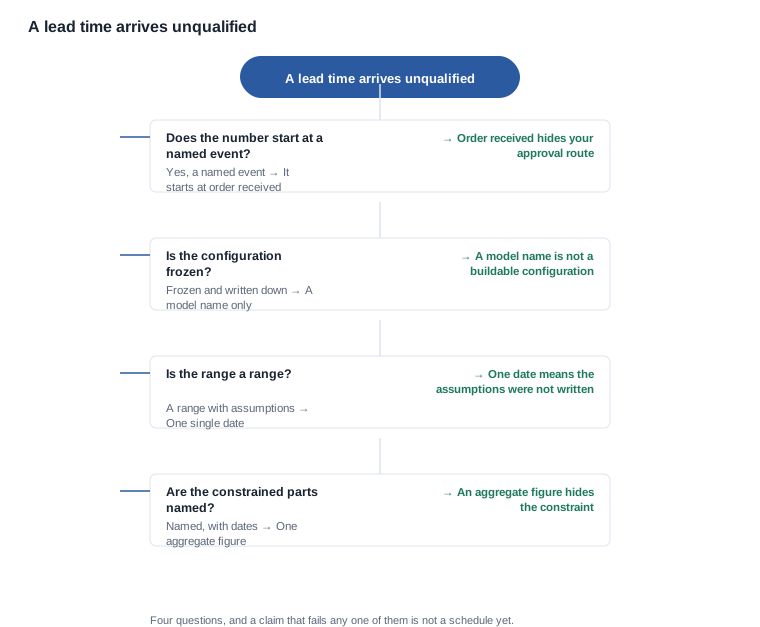
The four branches above are the ones that resolve most first-order schedules. The first branch is the most common: a number arrives with no start point, and a start point is a cheap thing to ask for and an expensive thing to guess at.

The commercial conversation a first order should contain
The commercial terms for a first order are not the same as the terms for a repeat order, and the mistake is to use the first order as a place to rehearse the second. A first order is where you establish the mechanics that make later orders cheap: the order acknowledgement, the drawing and artwork approval route, the payment node that triggers production, the slot confirmation, the inspection right, and the remedy when a documented stage slips.
What is genuinely negotiable in a first order is the shape of the plan rather than the passage of time. A frozen configuration, a single approved colourway, a documentation route started before the purchase order, and a split delivery against a frozen configuration all shorten a schedule without asking anyone to work faster, and all of them cost the supplier very little. A later ship date offered in exchange for a confirmed slot position is the most under-used currency in this category, because a date the factory can hold is worth more to them than a date you can merely request.
What is not negotiable is anything a third party controls: the component position, the conformity route and the testing behind it. A buyer who argues hardest about those usually loses the larger prize, which is the scope of the documentation and the quality of the schedule behind it.
The order acknowledgement matters more than buyers expect, because it is the document that converts a verbal slot into a dated one. Ask what the acknowledgement contains, ask that it be issued against a named configuration string, and check that it states the date by which the order must be placed to keep the position. A total cost conversation is also worth having before the order, not after, and the total cost of a first order is not the unit price: it is the unit price, the cost of the documents, the cost of the rework the inspection catches, and the cost of the one defective batch you did not catch.
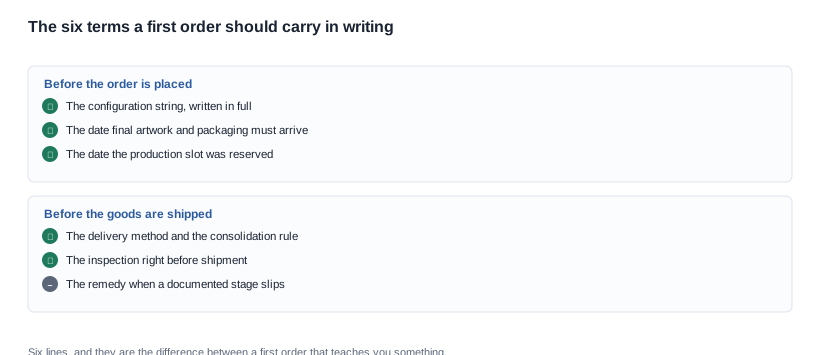
The lines worth having written into a first order are short: the configuration string, the date final artwork and packaging must arrive, the date the slot was reserved, the delivery method and the consolidation rule, the inspection right before shipment, and the remedy if a stage with a documented owner slips. Six lines, and they are the difference between a first order that teaches you something and one that teaches you the same thing again next quarter.
What we publish, and what we ask you to send
We publish the configuration surface: the model names, the pixel tiers, the battery capacities, the charge times, the rated use bands, the charging methods where the catalogue states them, the case configurations where the catalogue states them, the colour options, and the two models that carry an IP54 marking. We do not publish monthly output, line count, minimum order quantity, or a nominal production lead time for any model, and we will not fill those cells with a typical figure, because a typical figure in a first-order file is how a launch window gets built on a date nobody committed to. The lead time section sets out what the published rows support.
What we will do is tell you, for the specific models you are considering, which rows are already closed by the published data and which ones we need to answer for you in writing. Send us the models, the quantities, the configuration for each and the destination markets, and we will come back with which configurations exist, which of the open rows we can close for the models we publish, and which of the trade-offs belong to your own programme.
What a first order buys you. One honest measurement, if you log it. The durations you actually experienced, against the plan you agreed, are the only baseline a second order can be assessed against — and they are the asset that a first-time buyer usually throws away.
Related reading
- The buyer's checklist — the twelve conditions to settle
- A checklist for your first order — where the clock starts
- Verifying a supplier's schedule claim — the evidence a date needs
- Lead time myths — the beliefs to unlearn


