

A lead time quoted as a number is not a lead time, it is an assertion. A lead time is a range with conditions attached, and the conditions are the only part a buyer can actually plan against. We publish no nominal lead time and no capacity figure, so what follows is the twelve conditions to settle before a date is allowed into a launch plan — each one written with how you test it, what a bad answer sounds like, and what it changes when you get it.
The reader is a brand-side buyer, a channel buyer or an online retailer who has a quotation and a date and needs to know whether the date is usable. The situation is usually one of three: a new programme where the date was offered early to win the order, a repeat order where the last one slipped, or a launch window that has already been committed to a trade show, a retail rollout or a marketplace event. The fear is not that the supplier is lying. It is that the number in the quotation and the number in the buyer's plan do not mean the same thing, and that the difference only becomes visible in week five.
Smart glasses lead time: twelve conditions in sequence, not a list
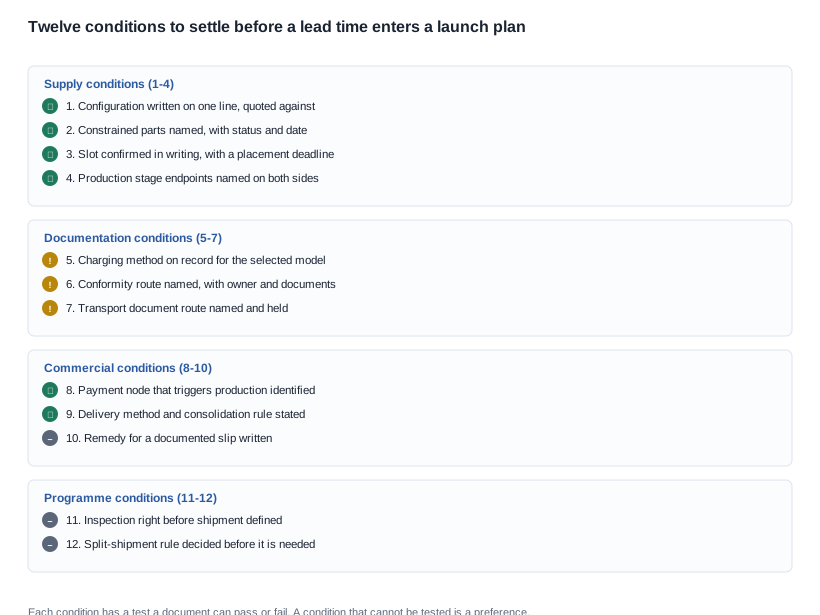
A twelve-item checklist is usually read as a set of parallel questions, and that is how it becomes decorative. The twelve conditions in this list are ordered, and the order is the argument: four supply conditions, three documentation conditions, three commercial conditions and two programme conditions. The first four determine what can be built. The next three determine whether the built goods can move. The next three determine whether the date has any force behind it. The last two determine whether the second order is cheaper than the first.
Two properties of the list are worth stating before the items themselves, because they explain how it should be used.
Every condition has a test that a document can pass or fail. A condition that cannot be tested by a document is a preference, and preferences are not what a checklist is for. "Is the supplier reliable?" is a preference. "Is the slot confirmed in writing, with a start date and a deadline for placing the order?" is a test. The second version can be answered yes or no by reading one line.
The conditions are cheap in the order they are listed and expensive out of it. The four supply conditions cost nothing to settle — they are the content of a normal technical and commercial conversation. The two programme conditions cost real effort, because they require a buyer to think about the second order before the first one has shipped. Both are still cheaper than the alternative, which is discovering in the second order that the same four supply questions are open again.
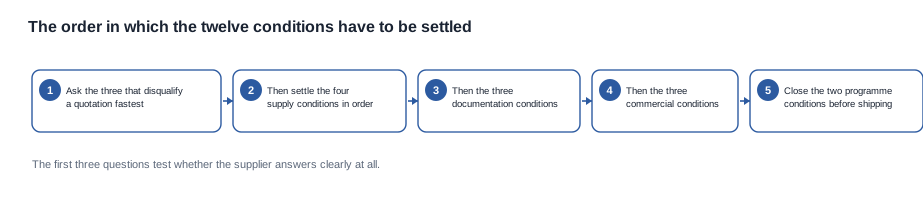
The flow above is the list read as a dependency chain. The first three questions are the ones that disqualify a quotation fastest, because a supplier that cannot answer them clearly will not answer the rest clearly either. The last two are the ones that are always skipped, and they are the two that determine whether a programme is worth running.
There is a fourth property of the list that matters as much as the twelve items themselves: each condition can fail, and the failures are not equivalent. A failed supply condition means the date in the quotation does not describe your order, which is a reason to go back to the supplier. A failed documentation condition means the goods may be built on time and still cannot be sold, which is a reason to change the configuration or the market rather than the date. A failed commercial condition means the date has no force, which is a reason to change the agreement. A failed programme condition means the first order will work and the second one will cost the same as the first, which is a reason to spend a week on it now rather than a quarter later.
That distinction is what turns a checklist into a decision aid. A buyer who has a list of twelve binary questions has to decide, for each, whether to go back, to change, to renegotiate or to accept. A buyer who has a list of twelve binary questions and knows which failure they are looking at can make that call in minutes, and can tell a supplier exactly what is missing rather than asking for "more information".

The four supply conditions that a quotation has to satisfy
Condition 1: the configuration is written down, and the quotation refers to it by name. Not the model, the configuration. In this catalogue the difference is material, because the model name does not carry the variables that change the build. Eleven of the twenty-eight models carry a camera, and they split into eight published at 8 MP and three at 13 MP. A case configuration is a second variable: the L2 Utral is published with a 290 mAh cell and a case available at 900 mAh or 1400 mAh; the CY03 and the CY05, and the L1 Pro carry a 1400 mAh case; the MT6 carries a 1200 mAh folding case; the KY06 and the MT5 have a case whose capacity is not published; and the V03 Pro has no case at all. Colour is a third: three options on the V03 Pro, four on the V06, one on the MT6.
Test: you can write the configuration on one line and hand it to a second supplier, and they would build the same thing.
Bad answer: "our AI camera glasses" or "the Utral". Neither is a configuration, and a quotation against either can be quoted against either of several builds.
What it changes: everything downstream. A date quoted against a model name is a date for their most common build, which is probably not yours.
Condition 2: the constrained purchased parts are named, with their status and a date. Ask which purchased items the build depends on most, where each one stands, and what date each is expected to be available.
Test: a part-level answer. Three to six items is a normal answer for a build of this type.
Bad answer: a single aggregate figure, or an assurance that "everything is on hand". An aggregate figure cannot be checked, and "on hand" is usually true of the parts that do not matter.
What it changes: whether the date is a plan or an aspiration, and where you should look first when it moves.
Condition 3: the production slot is confirmed in writing, with a start date and a placement deadline. A slot held verbally between the quotation and the order is a slot that has already been released to someone else.
Test: a written confirmation naming the configuration, the start date, and the date by which the order must be placed to keep the position.
Bad answer: "we can usually fit you in". Usually is a distribution, and your order is one draw from it.
What it changes: whether the date is a commitment or a forecast. It is also the cheapest trade available to you, because a later ship date in exchange for a held position costs the factory less than it costs you.
Condition 4: the production stage's endpoints are named. Where does the factory's own clock start, and where does it stop?
Test: two named events — usually the point at which the last buyer-side input arrives, and the point at which the goods are handed to the carrier.
Bad answer: "from order to shipment", which bundles the supplier's work with the buyer's approvals and the carrier's movement into one number, then reports the average.
What it changes: whether you can build a plan around the number, and whether the delay that eventually happens has an owner.
The three documentation conditions that decide whether goods can move
These three are separated from the supply conditions because they fail later and cost more. A supply failure delays a build. A documentation failure stops goods that are already finished.
Condition 5: the charging method is on record for the model you selected. The catalogue states a charging method for twenty-four of the twenty-eight models — magnetic or Type-C — and states none at all for four camera models: the CY05 and the MT6, and the L1 Pro and the CY03. Where it is published, the answer is one line. Where it is not, you have to ask, and you have to ask in writing, because the answer determines what your warehouse holds, what your service bench uses, and whether a returned unit can be turned around on site rather than sent away.
Test: the model appears in the catalogue with a charging method, or the supplier has given you the method in writing against that model.
Bad answer: "it is magnetic, like the others". On four models, that is an assumption with a dock attached to it.
What it changes: the service cost per unit, the packaging design, and the turnaround you can promise a channel.
Condition 6: the conformity route for the destination market is named, with its owner and its documents. A radio-equipped product needs a route into each market it is sold into, and in Europe that route runs through the Radio Equipment Directive (EU) 2014/53/EU. The route is a stage with a duration and a document list, and it is a stage whether or not it appears in the quotation.
Test: a named owner, a document list, and an answer to whether the route runs in parallel with production or after it.
Bad answer: "certification is handled". That phrase describes a bucket, not a schedule.
What it changes: whether the goods can be sold on the day they arrive, and how much of the schedule is the compliance route rather than the build.
Condition 7: the transport documentation route is named. This is a separate journey from the market-access route, and it is the one that produces a consignment that is held rather than one that is refused. The catalogue publishes a charge time for every model — two hours or less across the range, with the D17 and the ZH12 at roughly one hour on Type-C — and publishes the rated use band for every model, and neither of those is a transport document. What a transport file needs is a model designation that matches the unit, a cell configuration that matches the carton, and a retention arrangement that survives the shipment.
Test: you know which document covers the units you are about to buy, and who holds it after the goods have left.
Bad answer: an assurance that "all the paperwork is handled" with no document named.
What it changes: whether a shipment is routine or a re-tender. This is the condition with the least obvious connection to a lead time and the largest effect on one.
One physical check sits behind conditions 5, 6 and 7, and it is worth doing on the sample rather than on the production run. Take the sample you approved and read what it can tell you: what the charging interface is, what the model designation printed on it is, what ships in the box with it. Compare each of those against the file you have been given. A sample and a document that disagree are the most common form of this failure, and the reason they disagree is usually that the document was written for an earlier build of the same product. It takes twenty minutes with a unit in your hand, and it is the only condition on the list that a buyer can complete without asking the supplier a single question.

The three commercial conditions that turn a date into a commitment
Condition 8: the payment node that triggers production is identified. A schedule is a plan until money moves, and the moment in the schedule at which money moves is the moment the factory's clock actually starts.
Test: the order acknowledgement names the payment node and the date the production slot is reserved.
Bad answer: a deposit described as "30% on order", with no date attached to the slot.
What it changes: the whole calculation. If the clock starts on the deposit and your artwork is not ready, you are buying your own delay.
Condition 9: the delivery method and the consolidation rule are stated. Whether a consignment ships alone or consolidated changes the transit duration and, in some cases, whether it clears on arrival. A schedule that assumes consolidation when the quantity does not support it is a schedule built on a method that will not be used.
Test: method named, consolidation rule stated, and an acknowledgement of what happens if the consignment has to travel alone.
Bad answer: a single transit figure, which usually embeds consolidation and hides the penalty.
What it changes: the last third of the schedule, which is the part your channel feels.
Condition 10: the remedy for a documented slip is written. Not a penalty clause — a mechanism. Which stage, which owner, what happens, and who bears it.
Test: the agreement states what happens when a stage with a named owner runs past its date.
Bad answer: silence, which is functionally the same as the supplier deciding unilaterally.
What it changes: whether the schedule is worth planning around. A date with no remedy is a forecast; a date with a remedy is a commitment, and the two are priced differently by every supplier in the category.
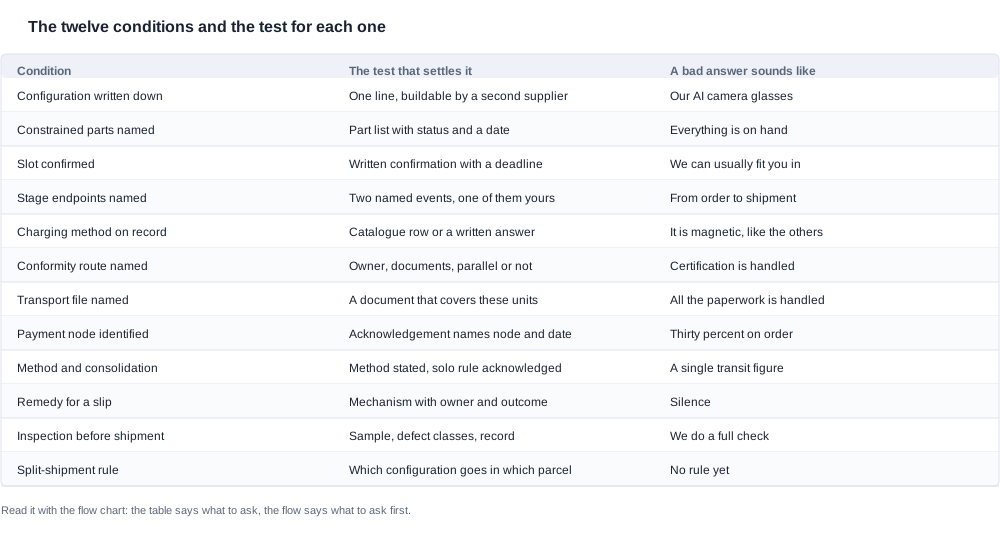
The table above is the checklist in its most compact form. Read it with the flow chart rather than instead of it: the table tells you what to ask, and the flow tells you what to ask first.
All twelve can be asked in a single message, and doing it in one message rather than in three rounds is worth more than it sounds. The reason is that the answers interact. A supplier who is asked about the slot in isolation will confirm the slot. A supplier asked about the slot, the payment node and the placement deadline together will have to reconcile them, because a slot that requires an order by a date, and a payment node that falls after that date, cannot both be true. The reconciliation is the value. The cheapest possible way to find out that a quotation is internally inconsistent is to ask for all three of the things that have to agree with each other in the same message.

The two programme conditions that make the next order cheaper
These two are the ones a single-order checklist always omits, and they are the reason this list is twelve items rather than ten.
Condition 11: the inspection right before shipment is defined. Not a spot check, but a defined one: what is inspected, against which approved sample, by whom, and on what evidence. A camera model with a pixel tier, a case configuration and a colourway has enough specification surface for a mismatch to hide in, and the mismatch is cheapest to catch while the goods are still in the factory.
Test: the inspection scope names the sample, the defect classes and the record that is produced.
Bad answer: "we do a full check before shipping", which describes an intention rather than a standard.
What it changes: who owns a defect found at the channel rather than at the factory, and what the returns reserve has to be.
Condition 12: the split-shipment rule is decided before it is needed. If the programme is going to ship in two parts, the rule for which part carries the first-build risk should exist before the first delay rather than during it. The obvious version of this rule ships the lower-risk configuration first — the colourway already approved, the case configuration already validated, the volume already in the supplier's history.
Test: the rule is written, and it names which configuration goes in which parcel.
Bad answer: no rule, which means the rule will be improvised at the moment of delay, by the person least able to decide it.
What it changes: whether a delay in the second part damages the first part, and whether your channel gets working stock while the rest of the programme is still being built.
What a twelve-item checklist still cannot tell you
Here is the honest limit of this list, and it is worth stating because a checklist that implies completeness is worse than no checklist.
It cannot tell you how long your order will take. That number is the supplier's to give, against a configuration, a quantity, a market and a date range, and it changes with all four. We publish the configuration surface, the electrical rows, the charging methods where the catalogue states them, the case configurations where the catalogue states them, the pixel tiers, the colour options and the two models carrying an IP54 marking. We do not publish a nominal lead time, monthly output, line count or a minimum order quantity, because a number that does not hold for a specific build is a number that gets a launch window built on it and then breaks. The lead time section sets out what the published rows do support.
It cannot tell you whether this supplier will perform. Nothing in a twelve-item list substitutes for due diligence on the operation, and the list is a supplement to that work rather than a substitute. The supplier verification guide covers the part that has to be checked on site.
It cannot tell you the cost of the schedule. A checklist tells you whether a date is usable; it does not tell you what the date is worth. The total cost of a lead time is the cost of holding stock, the cost of a later launch, and the cost of the reorder that follows — and those three numbers are yours, not the supplier's. Bring them to the conversation as a total cost rather than as a request for a shorter date, because a supplier can shorten a date and cannot shorten your working capital.
What the list does give you is a defensible position. Twelve conditions, each with a test, each answerable by a document, and each worth settling before a date is committed to a plan rather than after it has been missed.
Related reading
- A guide for first-time buyers — the order of operations
- A checklist for your first order — where the clock starts
- A worked case and its lesson — two schedules, two outcomes
- Red flags in a supplier's schedule — what to watch for


