

The advice that actually protects a delivery date in smart glasses is boring, unglamorous and almost entirely on the buyer's side of the line. Four of the eight actions below cost nothing but a decision, and all four sit before the purchase order. That is the uncomfortable part: most of the leverage a buyer has over a schedule is exercised before the supplier has done anything at all.
The reason is structural. The published specification already fixes most of what a factory controls — the twenty-eight models in the catalogue, their battery capacities and rated use, a charge time for every model, a charging method for twenty-four, a Bluetooth version for fourteen, a case capacity for five, an ingress rating for two. What the specification does not fix is the programme: the decisions, the artwork, the documentation route, the booking. Those are the buyer's, and they are where weeks are made and lost.
So the practical advice is not "press your supplier". It is arrive at the enquiry with the programme already decided, and leave the supplier nothing to wait for. The routine below is the version that works when the buyer cannot attend a factory, cannot travel, and cannot audit the line in person.
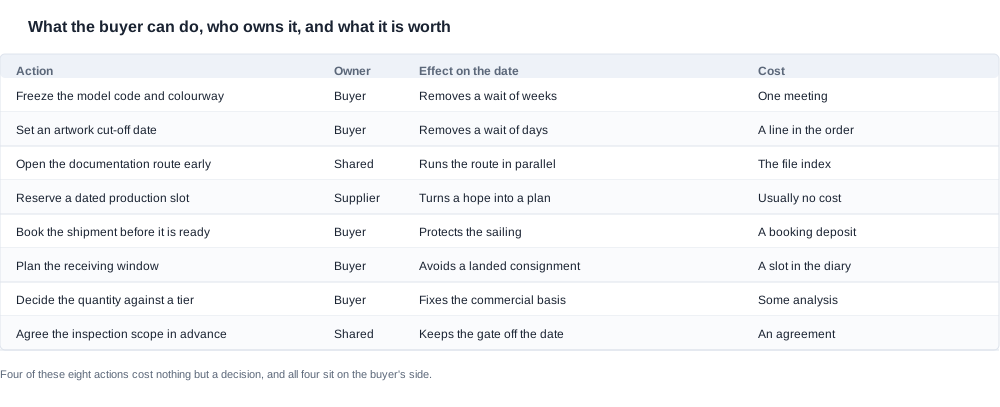
Smart glasses lead time: what a buyer controls before the order
Four things are decided by the buyer and are usually decided late. Each of them is a wait.
The configuration. The model code, the colourway, the feature set and the packaging variant. Until all four are written down, the factory cannot buy a part, cannot set up a line and cannot open a file. A configuration that is still being discussed is the largest single source of avoidable delay in this category, and it is invisible from the outside because it looks like the supplier's problem.
The artwork and the label content. The final artwork, the packaging proof and the importer identity and address that go on the label. The label depends on a decision the buyer has not made, and the print run depends on the label, so a single undecided field moves the packing stage and therefore the despatch date.
The destination market. Which market the goods are for, which determines the conformity file, the labelling rules and the transport treatment. A buyer who has not stated the destination has not stated the scope of the documentation work.
The quantity. The quantity band, not just the number. The band determines the price tier, and the tier determines whether the order is a published configuration or a made-to-order one — which is a schedule difference, not only a price difference.
The three approvals that usually sit between the buyer and the factory
Most avoidable delay in this category is not caused by a slow supplier. It is caused by the buyer's own approval chain, which is invisible to the factory and which nobody has put dates on.
The design approval. The artwork, the packaging and the colourway, usually signed off by someone outside procurement and usually on a schedule organised around internal review cycles rather than around a production plan.
The compliance approval. The destination market, the importer identity, the conformity route and the labelling content. This is the approval that most often arrives after the factory has asked for the artwork, because the compliance decision is being made while the programme is already moving.
The financial approval. The deposit, the price, the credit terms and the freight mode. Usually the fastest of the three and occasionally the slowest, because it depends on a budget cycle that has nothing to do with the order.
The fix is procedural and it is nearly free: publish all three as dates before the enquiry goes out. A factory that receives "artwork by the 12th, market decision by the 9th, payment by the 15th" can schedule around them. A factory that receives an order and then waits for three separate approvals gets a programme that starts on the day the last one lands, and no amount of chasing will move that.
The alternative, for a buyer who cannot commit to dates, is to state the assumption: "artwork will be released within ten working days of the order, and the delivery date is quoted from that date rather than from the order date." That sentence costs nothing and it moves the start condition out of the disputed zone.
The difference between a published configuration and a made-to-order one
This is worth stating separately because it is frequently misunderstood. A published configuration in the catalogue is a configuration that exists, with rows already written against it. A made-to-order configuration is a variation the factory has to set up.
The catalogue publishes twenty-eight models: eleven with a camera, split into eight at 8 MP and three at 13 MP; eight audio models; and the balance in the sports, children's, AR, electrochromic and bone-conduction lines. The camera models are listed on our AI camera glasses page. When a buyer asks for something outside those published rows — a different colourway, a logo, a different case — the order leaves the published set, and the schedule consequence is that setup, documentation and possibly the certification route have to be revisited.
The practical advice is therefore reduce the number of customisation items rather than compressing the factory. A range with fewer variants, decided earlier, ships faster and more consistently than a fully customised one delivered late.

The four moves that protect the date without asking anyone to hurry
Freeze the configuration and publish the deadline for the rest. The single highest-return action available to a buyer. It costs a meeting and it removes a wait that no commercial negotiation can recover.
Open the documentation route before the order, not after. The conformity file for the destination market, the declaration, the technical file behind it and the battery transport summary can run in parallel with the build, provided the configuration is frozen. The alternative — opening the file once the goods are finished — puts the whole route at the end of the chain with no float.
Reserve a production slot in writing, with a date. A slot held verbally is a hope, and a slot confirmed against a purchase order is a plan. The cost is usually nothing, because what the factory sells in that moment is priority rather than capacity.
Book the shipment before it is ready. The booking cut-off can pass while the goods are still being built, and the consequence of missing it is a sailing interval rather than a delay. Booking early also tells the buyer, before the production is finished, whether the consignment will consolidate — and consolidation is a decision about readiness, not about booking.

What the buyer cannot buy, and should stop asking for
Three things are routinely requested in a schedule negotiation and cannot be bought, because they belong to third parties or to physics.
A laboratory's queue. The duration of a conformity test is the laboratory's, and the only influence a buyer has is when the sample arrives and how quickly the result is chased. Asking for a shorter laboratory duration produces a discount on the fee at best.
A sub-supplier's material. The part's own date is the part supplier's commitment. A buyer can substitute a part, and a buyer can ask for part-level status, but the date itself is not negotiable at the buyer's table.
A clearance that has not started. Destination clearance belongs to the destination's authority and begins when the documentation is complete and the consignment arrives. Moving it means moving the arrival date, not the paperwork.
The practical consequence is that a negotiation which spends its leverage on these three is a negotiation that produces concessions without producing a date. The four moves above are the ones that work, and they are the ones a buyer can execute without a supplier's permission.
Why these four and not the others
The three actions a buyer usually takes — pressing for a shorter quote, asking for a discount, and chasing progress reports — all act on the supplier's side, and all three are weak. Progress reports are the weakest of them, because they measure communication rather than production, and a supplier who reports daily can still be waiting for a part.
The four moves above act on structure rather than on pressure. They change the shape of the plan rather than its ambition, which is why they work when negotiation does not.
The buyer's calendar, stage by stage
The advice is easier to apply as a calendar than as a list of principles, because the problem is a timing problem.
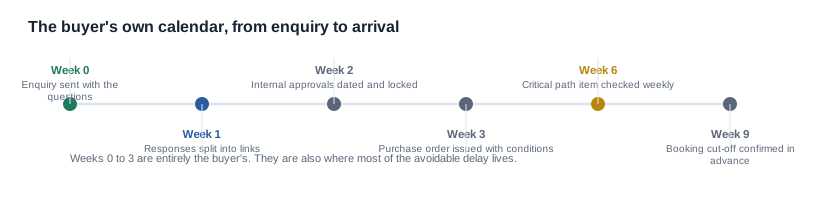
Before the enquiry goes out. Freeze the configuration to a model code. State the destination market and the importer identity. Choose the quantity band. Prepare the artwork, or state a placeholder date and accept that the slot will be held against it.
When the responses arrive. Ask each supplier for the same durations separately — production, documentation, transit, clearance — and compare the responses link by link rather than by total. A total comparison between two quotations of different scope is not a comparison.
Before the purchase order is issued. Put the internal approval deadlines into the calendar as dates, not as intentions. Attach the start conditions to the order: what has to be received before the first unit starts, by when, and what happens to the delivery date if it arrives later.
During the build. Check one item a week, and check the same item: the constrained part. Not the overall progress. A weekly question about the part on the order date catches a slip weeks earlier than a weekly question about "how things are going".
In the last week. Confirm the booking cut-off, the receiving window and the inspection slot while the goods are still being packed. Every one of these three is a date in the buyer's own calendar, and all three are the ones that are forgotten.

The habits that quietly cost weeks
These are the practices that look reasonable from the inside and cost the most from the outside.
Ordering to a forecast that nobody has reviewed. A quantity chosen for a hoped-for sell-through rate produces an order that cannot be batched, that travels alone and that may miss a price tier. The habit is not wrong in itself; the risk is that the forecast is treated as more certain than it is.
Treating a sample as the product. A sample is built outside the production flow. It proves that the specification can be built, which is not the same as proving that a run can be delivered on a date.
Letting the packaging decision arrive late. Packaging is upstream of the label, the label is upstream of the packing, and the packing is upstream of the despatch. A packaging decision made after production has started costs the schedule a week at the very end of it.
Reading a total as a schedule. A quoted duration that covers production and transit as one number cannot be planned against, because the two cannot be moved independently and only one of them is negotiable.
Accepting a status report in place of a record. A weekly statement that production is on track tells the buyer that a communication is happening. A part-level status list, a first-article record and a test report tell the buyer what is happening.
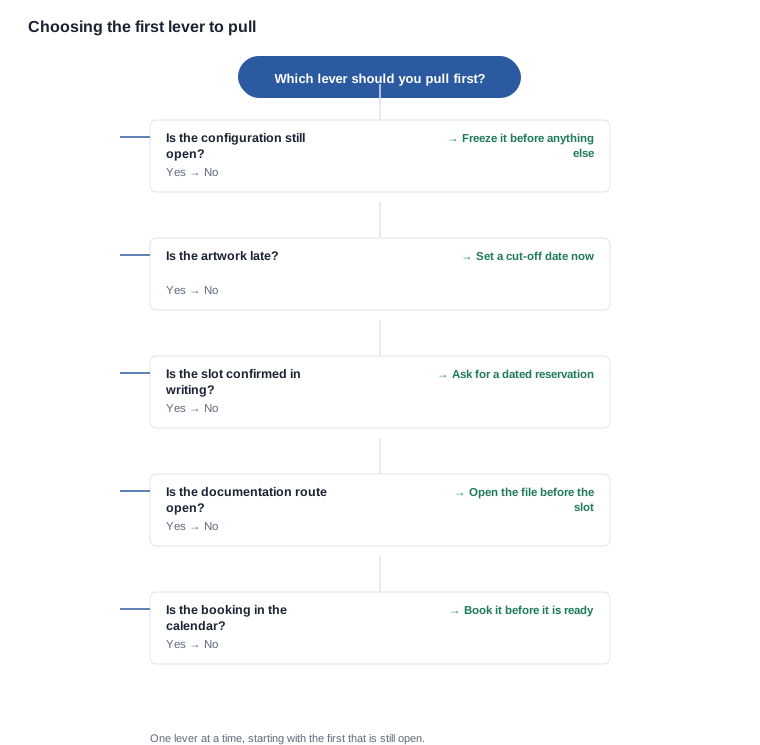
The weekly check that takes five minutes
One question a week, asked of the right item, is worth more than a daily status call.
Name the constrained item and ask for its date. Not "how is production going" but "what is the current commitment date on the camera module". The answer is short, it is specific, and it is the only number that can move the programme. A supplier who cannot name it does not know, which is itself the answer worth having.
Then check the two buyer-side dates. The artwork cut-off and the booking cut-off. These are the only two items on the critical path that the buyer can still move, and they are the two most frequently forgotten.
Five minutes a week, two questions, one item. Buyers who do this report that the surprise has stopped arriving, and the reason is not that the schedule got shorter — it is that the information arrives early enough to act on.
The questions to ask, and the order to ask them in
The questions worth asking a supplier, in the order that changes the answer:
- What has to be received before the first unit starts, and on what date?
- What is the critical path for this order, and what constrains it?
- Which durations are quoted separately, and what does each cover?
- Can the documentation route begin before the goods are finished?
- Will this quantity be batched with other work, and will it ship consolidated?
- When is the booking cut-off, and what mode will it move on?
Six questions, one exchange, and the answer to each one is a date or a name.

A working routine you can use on Monday
For a buyer who wants something executable rather than a set of principles, this is the whole routine.
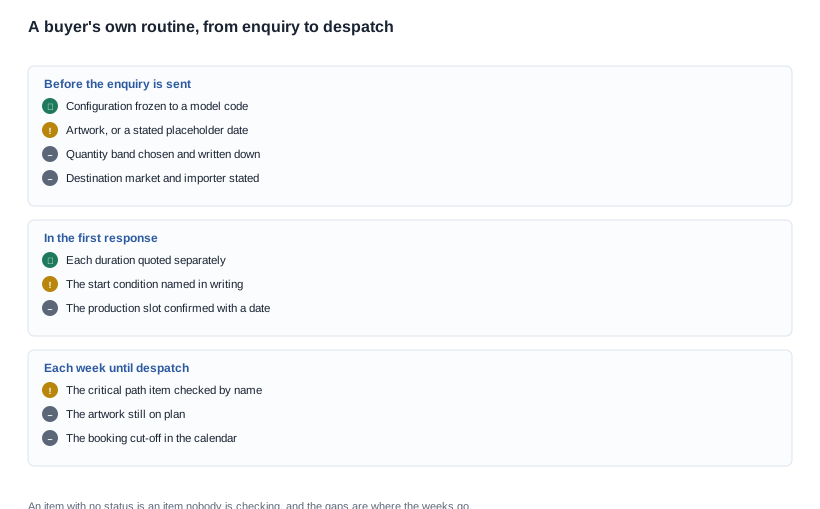
Step one, before the enquiry. Write the configuration on one line: model code, colourway, packaging variant, destination market, importer identity, quantity band. If any field is open, close it before the enquiry goes out.
Step two, with the enquiry. Attach the six questions. Ask for the durations separately. Ask for the slot to be confirmed in writing.
Step three, when the responses arrive. Split each response into its links. Compare like with like. Write the assumption that each figure depends on next to it. Identify the one link that binds.
Step four, before the order. Put the buyer's own deadlines into the calendar as dates. Attach the start conditions to the purchase order.
Step five, weekly. Ask about the constrained part, by name. Update the float on the binding link.
Step six, in the last week. Confirm the booking, the receiving window and the inspection slot.
How to know the routine is working
A routine that is not measured decays, and this one decays quietly. Four numbers tell a buyer whether it is still working, and all four are free to collect.
Days from enquiry to order. If this number is growing, the internal approvals have slipped, and the dates published to the supplier no longer describe the programme.
The rate at which artwork arrives late against the cut-off. Not late against the factory's requirement — late against the date the buyer itself published. A rising rate here is a calendar problem, and it is invisible to the supplier.
The number of surprises per programme. A surprise is any event that was not in the plan and not in the weekly check. The target is not zero, because that is unrealistic; the target is a falling number, and a buyer who cannot list the last three surprises has stopped checking.
The gap between the quoted delivery date and the delivered date. This is the only number that measures the whole system, and it is the one that should shrink once the configuration freeze and the published deadlines are in place. If it does not shrink, the cause is upstream of the buyer's routine, and the right next step is a part-level status request rather than a repeat of the same six questions.
The one habit that matters most
If only one of these survives a busy week, keep the configuration freeze. It is the only action on the list that is entirely within the buyer's control, it costs nothing, and it is the one that the rest of the schedule is built on. The first-article question, the booking cut-off and the receiving slot are all downstream of it.
The benchmark question is at industry benchmarks, and the factor analysis behind the configuration freeze is at how capacity affects lead time.
What we will tell you to do, and what we will not
The working rule we apply: advice about a schedule should be tied to something the supplier actually controls or can actually see, and an opinion without a date attached is not advice.
What we publish is the specification the advice is built on: the twenty-eight models and their rows, including the battery capacity and the rated use for each, the charging time for every model, the charging method for the twenty-four where the catalogue states it, the Bluetooth version for the fourteen where it appears, the case capacity for the five models where it is published, and the ingress rating on the two models that carry one.
What we do not publish, and will not fill with a typical figure: production lead times, minimum order quantities, unit prices, production capacity, daily output and the stage durations behind them. A schedule advice that depends on a figure we cannot stand behind is not advice, it is a guess with a confident tone.
What we will do is take a model, a quantity, a destination and a required date, and tell you which configurations exist for it, which published rows the programme has to be built around, which of the buyer's own steps is currently the binding one, and which questions to put to each supplier so that two quotations become comparable. We will also tell you plainly when a date cannot be met, and we will say so before you commit rather than after you have planned around it.
The wider framework is at the lead time section.
The action to take now. Before your next enquiry, write the configuration on one line and send the six questions with it. If any field of that line is still open, close it first — that single hour is worth more than any negotiation technique in this page.
Related reading
- Industry benchmarks — comparing quotations link by link
- How capacity affects lead time — the factor behind the ordering decision
- AI camera glasses — the eleven camera models and their published rows
- Lead time section — the commercial structure of the schedule


