

There is no published benchmark for smart-glasses lead times that a buyer can rely on, and the reason is not a shortage of data. It is that a benchmark needs a scope, a distribution and a date, and the numbers circulating in this category usually have none of the three. "Six to eight weeks" appears constantly, and it appears without saying what configuration, what quantity, what market, or which part of the chain the six to eight weeks covers.
That leaves the buyer with a peculiar position. They can hold a benchmark against a supplier, but the benchmark is a claim rather than a measurement, and the measurement has to be built from their own enquiries. This page is about how to build one, how to test whether two figures can be compared at all, and what the published catalogue does and does not give you to benchmark against.
The practical position is uncomfortable but simple: your own enquiry history is the only benchmark you own. A supplier's typical figure tells you what the supplier believes about its typical case. Your own records, collected against the same written specification, tell you what your programme actually experiences, and they are the only numbers a buyer can put in front of a supplier and expect to be argued with.
Smart glasses lead time: a quoted benchmark is not a reference point
Three properties separate a benchmark from a figure, and the figures in this category are missing all three most of the time.
Scope. A benchmark has to say what it covers. Is it the production window, the time from order to despatch, or the time from order to arrival at the buyer's warehouse? These are three different numbers, and the difference between the second and the third is measured in weeks of transit and clearance that nobody argues about because they are not in the figure.
Distribution. A benchmark is a distribution, not a point. A range of eight to eleven weeks carries information that a single nine-week figure throws away: the spread is the risk, and the risk is what a buyer is paying to manage. A supplier quoting a single number has removed the only part of the information that would have let the buyer plan a float.
Date. A benchmark describes a period. A figure collected a year ago describes a period that has passed, in a market whose capacity and component supply have moved since. This matters more than it sounds, because the most-quoted figures in this category circulate in supplier marketing that nobody dates.
What a benchmark looks like when it is written properly
It is worth seeing the difference in the abstract, because the format is simple and the discipline is what makes it worth having. A properly written benchmark entry carries seven fields: the model and configuration, the quantity band, the destination market, the scope of the clock, the range with its assumptions, the date of collection, and the source. It reads as a narrow, dated, conditional statement — "for this configuration, at this quantity, to this market, measured from order to arrival, eight to eleven weeks, assuming the documentation route opens in parallel and the consignment consolidates, collected in this quarter from three suppliers".
Everything else about that entry is a sign that it was written by somebody who expects to be held to it. The range rather than a point. The assumptions named rather than implied. The date, because a figure without one is a rumour. The scope, because without it the number describes a different question.
The test of a benchmark entry is simple: could another buyer use it to predict their own programme, and could they be wrong for a reason they were told about? A benchmark that fails the second half of that test is advertising. A benchmark that passes it is a reference point, and the difference between the two is entirely in the seven fields above.
The four ways a benchmark misleads
Averaging away the tail. An average of eight weeks can be produced by a population in which nothing takes eight weeks and a few take sixteen. The buyer who plans on the average plans on a date that the programme will miss roughly a quarter of the time, and who has no idea when that quarter is.
Survivorship. A benchmark built from quotations is built from the quotations that were answered, which are the ones from suppliers who wanted the business. It is a biased sample and the bias runs in one direction.
Staleness. Capacity claims and typical-duration claims are usually written once. They are then repeated for years without being re-tested, and the first programme that treats them as a reference discovers the gap.
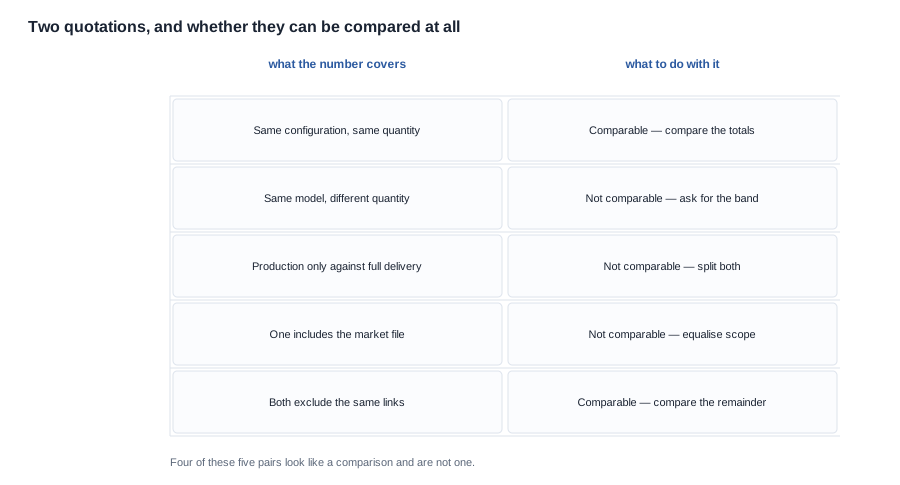
Scope mismatch. Two figures can look directly comparable and describe different questions. This is the most common failure and the easiest to check, because the question is not about the numbers at all — it is about what was counted.

The five claims that arrive labelled as benchmarks
These are the claims a buyer meets repeatedly, and the questions that settle each one.
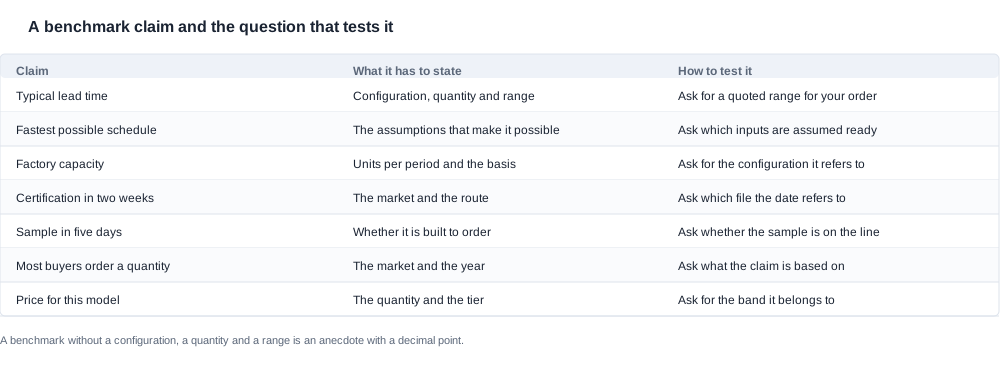
"The typical lead time is six to eight weeks." Ask for the configuration, the quantity, the market, the scope and the date. If the supplier cannot supply all five, the figure is an average of cases you are not ordering.
"We can do it in four weeks if you need it." Ask which inputs are assumed ready and which links are excluded. An accelerated figure is always a figure about a smaller scope, and the scope is the answer.
"Our monthly capacity is a hundred thousand units." Ask what the figure refers to — which model, which configuration, which line, how many shifts, and how much of it is already committed. Capacity without a basis is the most common unquotable claim in this category.
"Certification takes two weeks." Ask which market, which route and what the clock starts from. The duration belongs to a laboratory and to a route, and the start condition is the buyer's artwork.
"Most buyers order five hundred units." Ask what it is based on, for which market and in which period. A volume claim without a population is an assertion, and it is often one designed to move a buyer up a price tier.
The test that settles a claim in one exchange
"Which configuration, which quantity, and what does the clock start and stop on?" A supplier who answers that question fully has given you a usable figure. A supplier who answers with a general statement has given you a slogan, and the correct response is to ask again rather than to accept it. The questions to ask, and the order to ask them in, matter more than the volume of the enquiry.
When the supplier offers you a benchmark
The most awkward version of this conversation is the one where the supplier does the benchmarking for you: "the market norm is eight to ten weeks, we are at nine". It is a reasonable-sounding move and it deserves a specific answer rather than a refusal.
Ask what population the range describes, for which model and quantity, measured over what period, and from which link. A supplier who has a real answer to those four questions is describing a market and the buyer can work with it. A supplier who does not is describing an impression, and the impression is doing the work that a measurement should do.
The useful response is to accept the figure provisionally and to replace it with a split quotation. "Give me your production time, your documentation time and your transit time separately, and I will compare them." That request is cheap for the supplier, it is the only way to make the range comparable with another supplier's, and it turns the benchmark from an assertion into a conversation about links.

Building a benchmark from your own enquiries
A benchmark you own is built the same way every time, and the method is not expensive. It takes a written specification, a consistent set of questions, and the discipline to record what came back.

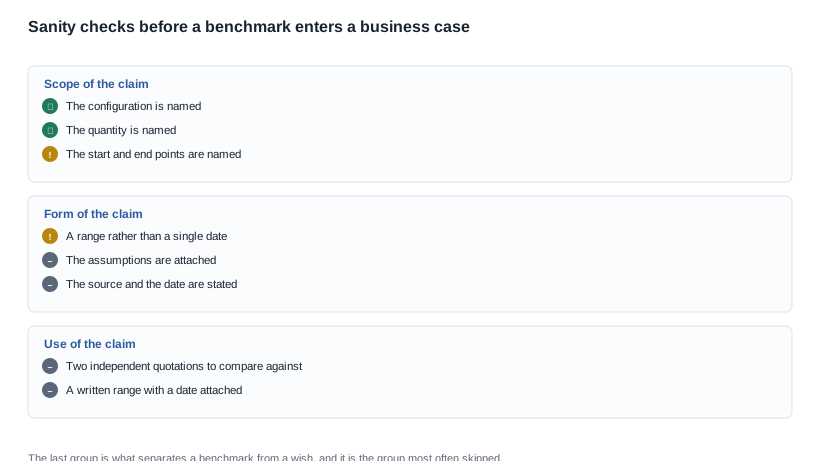
Collect against one written specification. Every enquiry in the set must be for the same model, the same quantity band and the same destination. Mixing configurations produces a figure that describes nobody's programme.
Ask for the same durations, separately. Production, documentation, transit and clearance, quoted as four items. A supplier who will not split the number has refused to give you a comparable figure, and that refusal is itself information about the supplier's schedule discipline.
Reject any quotation you cannot split. The comparison is between the parts, not between the totals, and an unsplittable quotation can only be compared on the total, which is the comparison you were trying to avoid.
Record the range, the assumptions and the date. Not just the number. The assumptions are the part that tells you when the number stops applying, and they are the part that allows you to recognise a stale figure.
Re-test on the next order. A benchmark that is never re-tested becomes a belief, and the beliefs in this category are the subject of a separate page.
Use it as a reference, never as a commitment. The benchmark tells a buyer whether a quotation is plausible. It does not entitle the buyer to expect a date from a supplier who has not committed to one.
What to do with the benchmark once you have it
A benchmark earns its keep when it is used to make three specific decisions, and it is worth being explicit about which ones, because a benchmark used for anything else is decoration.
To set a plausibility band. If three quotations came back at six, seven and eleven weeks, the band is somewhere around that, and a fourth quotation at fourteen weeks is not automatically wrong — it is a question about which link is longer. The band turns an argument about a number into an argument about a factor, which is the only kind of argument that can be settled.
To set a float. The spread in the benchmark is the float the programme needs. A benchmark with a two-week spread tells the buyer to plan two weeks of slack on the binding link, and a benchmark with a six-week spread tells them to do something about the uncertainty instead — hold more stock, split the order, or accept a longer date.
To set the shortlist criterion. The criterion for a shortlist should be written before the quotations are read, and it should be expressed against the benchmark rather than against a supplier's reputation. "Within the band" is a criterion. "The supplier we know" is a preference, and it is the one that produces the schedule problems this page is about.
The two benchmarks worth keeping
A buyer who keeps two sets of records rather than one has a materially better position in a negotiation.
The first is a historical benchmark: the durations this buyer's own programmes actually ran, broken into the same four links. It is the only figure that describes the buyer's risk profile, because it includes the programmes that went badly.
The second is a live benchmark: the quotations received in the current round, split and normalised. It describes the current market, and comparing it with the historical benchmark shows whether the market has moved — which is usually the answer to the question "why is this quotation longer than the last one".
Where the records come from, and where they do not
The buyer does not have to build this from nothing. The order acknowledgement, the part-level status list, the first-article record, the test report and the packing list already exist in most programmes, and each of them carries a date. A buyer who asks for those records with their own programmes has the raw material for a benchmark without commissioning a survey.

Using a benchmark in negotiation
A benchmark is a tool with three legitimate uses and one dangerous one.
As a plausibility test. The first use is the simplest: a quotation that is far outside the range the market has produced is either a very good offer or a quotation with an unstated assumption. Either way it deserves a question rather than a reaction.
As a question generator. The second use is more valuable. Asking a supplier why their figure is longer than a benchmark tends to produce a specific answer — a longer documentation route, a part on order, a consolidation rule — and a specific answer is a factor, and a factor can be addressed. This is the difference between a benchmark used as a lever and a benchmark used as an accusation.
As a planning input. The third use is the one most buyers skip. A benchmark built from their own programmes tells them how much float to place on each link, which is a number that belongs in the launch plan rather than in the negotiation.
The dangerous use is as an anchor for a demand. Demanding a supplier's best-ever date because a benchmark says it is achievable is a demand with no commercial logic behind it, and it invites a commitment that is either impossible or quietly unfunded. The benchmark is evidence about the market; it is not evidence about this order.
Three mistakes a benchmark invites
Using it as a lever against a supplier who is already inside the band. A supplier whose quotation is consistent with the benchmark has given a reasonable answer, and pressing them on it produces a worse answer rather than a better one.
Never re-testing it. The benchmark that is not re-tested becomes a belief, and beliefs in this category are how a buyer ends up defending a date that stopped being true two years ago. The re-test is cheap: the next order is the test.
Comparing a benchmark across configurations. The most common error in practice, because the numbers are similar enough to invite it. A benchmark built for an audio model at one quantity says very little about a camera model with a charging case at another, and the configurations differ in exactly the places where the schedule differs.
What the catalogue lets you benchmark against
Since no schedule benchmark is published, the honest question is what published material a buyer can actually compare against. The answer is the specification itself, and it is worth knowing exactly how much of it there is before deciding that a figure is reasonable.
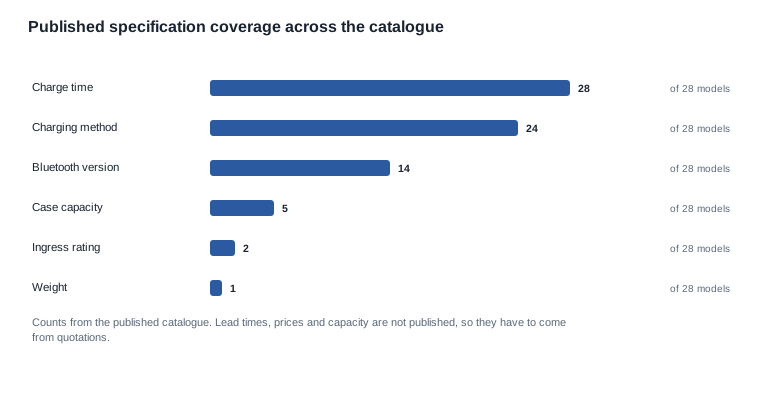
The catalogue covers twenty-eight models, and the published rows are consistent: a charge time is published for every one of them, a charging method for twenty-four, a Bluetooth version for fourteen, a case capacity for five, an ingress rating for two, and a weight for one. The camera range is eleven models, split into eight at 8 MP and three at 13 MP, and the audio range is eight models with published Bluetooth versions. The models in the camera range are on our AI camera glasses page.
What that gives a buyer is a specification benchmark: a common, checkable description of what is being bought. Two quotations for the same model and the same quantity are at least comparable in what they refer to, and that is the precondition for every other comparison.
What it does not give is a schedule benchmark, and the reason is structural rather than accidental. A schedule depends on a particular factory's supply chain on a particular day, and a catalogue that published a factory's durations would be publishing a promise it cannot keep. The rows that are open — the charging method for four models, the Bluetooth version for the camera models, the weight for all but one — are open for the same reason.
The camera range also carries a caution for anyone building a benchmark from it: the Bluetooth version for the camera models is not published in the catalogue, so any figure a supplier quotes for those models is a claim rather than a catalogue row, and it belongs in the question set rather than in the reference table. The same applies to the ingress rating, which is published on two models only.
The rule for the whole page
Benchmark the specification; question the schedule. Everything in the published catalogue can be used as a fixed point for comparison between suppliers. Everything about the schedule has to be obtained from the supplier, split into links, recorded with its assumptions, and tested against your own history. A buyer who applies that split — the catalogue for what is being bought, the enquiry for when it will arrive — has a defensible position in a negotiation. A buyer who applies it the other way around does not.
The working rule we apply: this split is the honest one, and a supplier who cannot meet it is telling the buyer something useful. We will publish the specification and we will not publish a schedule benchmark, because the catalogue describes a product while a benchmark describes one factory on one day. What we will do is take a model, a quantity, a destination and a required date, tell you which configurations exist for it, and tell you which published rows the programme has to be built around — so that the buyer comparing quotations is comparing like with like before anyone starts arguing about dates.
The related material is at the lead time section, the warning signs in a schedule are at lead time red flags, the capacity claim is examined at how capacity affects lead time, and the quality side of the same comparison is at how quality consistency affects lead time.
The action to take now. Take your last three enquiries for the same configuration and split each one into its four links. Then take your last three delivered orders and do the same from the records. The two sets, side by side, are your benchmark — and they will tell you which of your quotations to believe.
Related reading
- Lead time section — the schedule a benchmark is built on
- Lead time red flags — warning signs in a schedule
- How capacity affects lead time — the capacity claim in detail
- How quality consistency affects lead time — the quality side of the comparison
- AI camera glasses — the eleven camera models


