

A short lead time in this category is not free, and the price is paid somewhere a specification sheet will never mention. Production lead time, sample preparation time and unit prices are not published on this site and are confirmed per enquiry, so the useful question is not "how quickly can you do it" but "what is being compressed when the answer is quick".
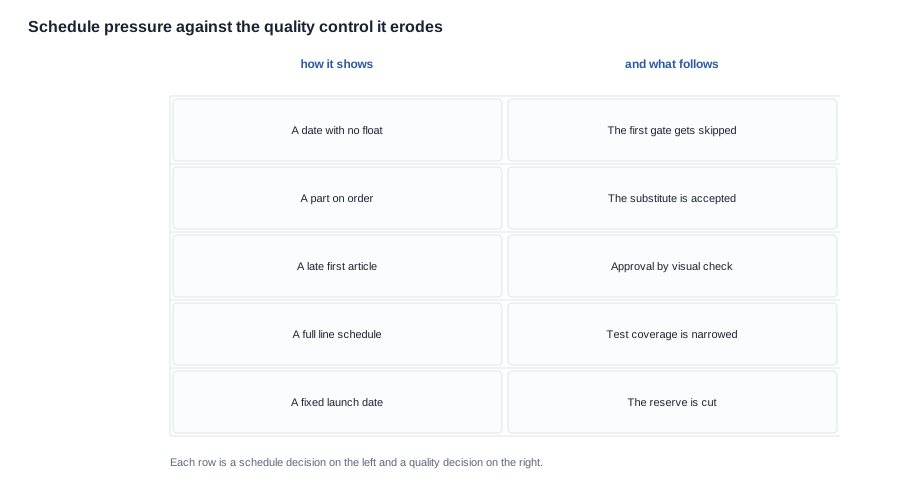
Three variables absorb almost all of that pressure. The first is incoming component consistency, because a constrained part is the usual reason a date is compressed and the usual answer is a substitute. The second is the number of suppliers genuinely available for a custom configuration, because a configuration that only one source can supply has no alternative when that source is late. The third is how much time the first-article approval actually gets, because it is the one control that is squeezed silently: an article approved quickly looks identical to an article approved properly at receipt.
A fourth variable is worth adding to the list, because it is the one that becomes visible to the buyer rather than to the factory: the test coverage carried by the shipment. If a date is compressed by narrowing what is tested, the report still arrives, the report still passes, and the difference between a programme that was rushed and one that was not is only visible in the channel, months later.
The commercial conclusion is straightforward. A compressed schedule should be a decision, not a response. It should be taken at the level where the trade-off is visible, written into the agreement, and paid for in the price rather than discovered in the defect rate.
Smart glasses lead time: where a compressed schedule puts quality at risk
Component substitution. This is the most common and the most easily hidden. The published rows of this catalogue are the visible surface of the specification — eight models at 8 MP and three at 13 MP; battery capacities from 40 mAh on the two children's models to 290 mAh on the CY05 and the L1 Pro, and the CY03 and the L2 Utral; Bluetooth 5.3 on the two audio models that carry it, the K01 and the K02, and 5.4 on the other six audio models; magnetic charging on seventeen models and Type C on seven. A substitution that changes any of those rows changes a published figure, and the change is invisible in the specification and visible only in the product.
Reduced first-article scrutiny. The hardest to detect, because the artefact is identical. A first article approved against a written script is evidence. A first article approved by a visual check is an opinion with a signature attached, and the defence is purely procedural: define the test in advance, and make the approval a signature against that script rather than a look at the unit.
Parallel production before approval. Producing a batch while the first article is still under review converts a quality question into a capital question. It is occasionally the right call, and it should be an explicit decision with a named owner rather than something that happens because the schedule left no room.
Narrowed test coverage. The test list does not change — the quantity tested does. A report that states the script but not the number of units tested is a report that cannot be compared with the previous one, which is the comparison a buyer would need after a problem appears.
Freight as the pressure valve. Air freight compresses transit, not production, and it is the standard late-stage recovery for a schedule. It also raises the cost and can trigger additional lithium transport documentation, because air and sea consignments are treated differently.
The three variables that absorb the pressure
The three variables named at the top are worth separating, because each behaves differently and each has a different defence.
Incoming component consistency is the variable that a compressed schedule attacks most often, because the part is the usual constraint and a substitute is the usual answer. The defence is not to forbid substitution — that is a commercial impossibility in this category, where a constrained part can stop a line for weeks. The defence is the written declaration and the acceptance criterion: a substitution that leaves the published rows intact and is declared before the units are approved is a production decision, and one that changes a published row is a specification decision the buyer has to be part of.
The number of suppliers genuinely available for a custom configuration decides how much room the buyer has. A configuration that only one source can supply has no alternative when that source is late, and the buyer is left asking the one party that cannot help for a faster date. A configuration built from parts with several sources has a different character entirely, and the question worth asking before the order is not "can you make it faster" but "what is the second source for this part, and how long does switching take".
The time the first-article approval actually gets is the variable that is squeezed silently. It is squeezed because it sits between two parties who each believe the other owns it, and because a shorter window looks like a smaller cost than a smaller test. The defence is procedural and total: the script, the criteria and the signature. If those three exist, the duration of the window matters far less than a buyer expects, because the work in a well-written first-article check is in reading the script rather than in waiting for it.

The controls that get shortened first
Nothing on this list is removed deliberately. It is removed by being squeezed, once, quietly, by a supplier who is trying to help.

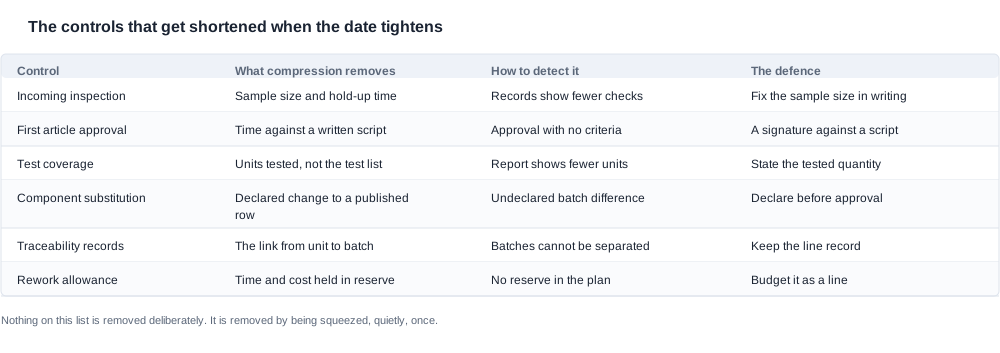
Incoming inspection. The sample size and the hold-up time are the first things to go, because incoming inspection is invisible from outside the factory and never appears in a delivery date. The defence is to fix the sample size and the criteria in the agreement rather than to rely on the supplier's habit.
First-article approval time. Squeezed by removing the wait between the unit arriving and the criteria being applied. The defence is the script, and the evidence is the signed record.
Test coverage. Squeezed by testing a smaller proportion of the batch. The defence is to state the tested quantity in writing, so that two reports can be compared.
Traceability records. The link from a finished unit back to its component batch is administrative, and it is the first thing dropped when a week is short. It is also the thing that makes a defect investigation possible at all, and it is worth paying to keep.
The rework allowance. Time and money held in reserve for a batch that fails. It is a line in the plan that nobody wants, and its absence means the rework comes out of the float.
The two questions that decide whether a compression is acceptable
Does the compression change anything the buyer will publish? If the compressed item alters a row in the catalogue — the resolution tier, the capacity, the charging method, the ingress rating — then it changes the product, and it cannot be a schedule decision. It is a specification decision with a schedule attached.
Does the compression remove an inspection or reduce a quantity? Removing an inspection is a scope decision and should be made consciously and recorded. Reducing a quantity below the level at which the result means something is not a decision; it is a risk transfer, and it is transferred to the buyer without consent.
Detecting the compression after the goods have shipped
Most quality compression is invisible at the point of shipment. It becomes visible in the channel, and by then the cost has been paid in returns, in lost listings and in a defect rate that nobody can reconstruct.
Receiving inspection against the published rows. This is the primary defence and it depends on the buyer knowing which rows are actually published. The catalogue covers twenty-eight models, and the published rows are consistent: a charge time is published for every one of them, a charging method for twenty-four, a Bluetooth version for fourteen, a case capacity for five, an ingress rating for two, and a weight for one. Everything not in that list is a row the buyer has to verify by other means.
The rows that are open, and what they mean for a buyer. The charging method is not published for the CY03 and the MT6, and the L1 Pro and the CY05, so it has to be confirmed in writing and checked at receiving. The Bluetooth version is not published for the camera models, so a supplier's figure for those models is a claim rather than a reference. The ingress rating appears on only the V06 and the S7, and only one model in the whole catalogue publishes a weight — the MT6 eyewear body at 158 g, which includes the battery and the camera and excludes the folding case; the case is 1200 mAh and its weight is not published. No model in the range publishes a bare frame weight, so a frame-weight figure quoted in a quotation is not a catalogue figure and should be asked for in writing.
Batch traceability. The line record and the incoming inspection record are what connect a defective unit to a component batch. Without them a defect investigation becomes a guess, and a guess is expensive.
The comparison against the previous shipment. Defect rate by model, by batch and by month, compared against the previous programme. This is the only method that catches a narrowing of test coverage, because the test report will not show it.
What the catalogue lets you verify, and what it does not
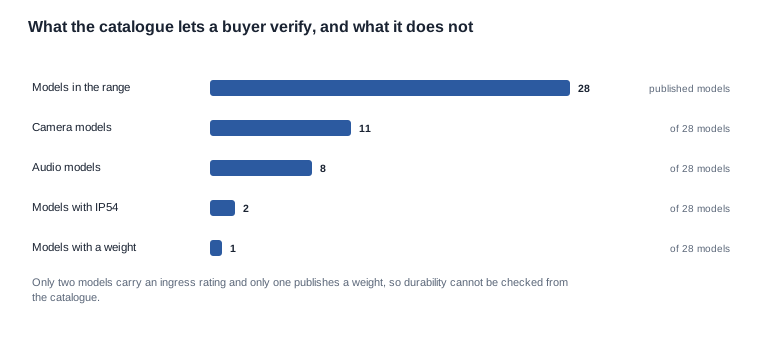
The verification a buyer can perform at receiving is only as good as the published rows, and the published rows are uneven. The composition of the range matters for this reason: of the twenty-eight models, eleven carry a camera and eight are audio models, but only two carry an ingress rating and only one publishes a weight. Durability and construction are therefore the two properties a buyer cannot check from the catalogue at all, and they are the two properties most often compressed when a date tightens. They have to come from the supplier's own file or from inspection, and the agreement should say which.

What cannot be compressed at all
Some steps are not schedule variables, and a programme that treats them as variables has already left the category of acceptable engineering.
The steps that carry a safety consequence. A battery test summary has to match the cell that is actually in the goods; a summary for a different cell is worse than no summary, because it appears to satisfy the requirement. Electrical and radio testing for the destination market has to cover the configuration that is shipped.
The labelling accuracy. The label carries the importer's identity and the designations the market requires, and it is the one document in the chain that is the buyer's decision and the factory's print run simultaneously.
The first article for a new configuration. For a first run of a new configuration there is no prior evidence, so the first article is not a formality. It is the only point at which a specification error can be caught at a cost of one unit rather than a batch.
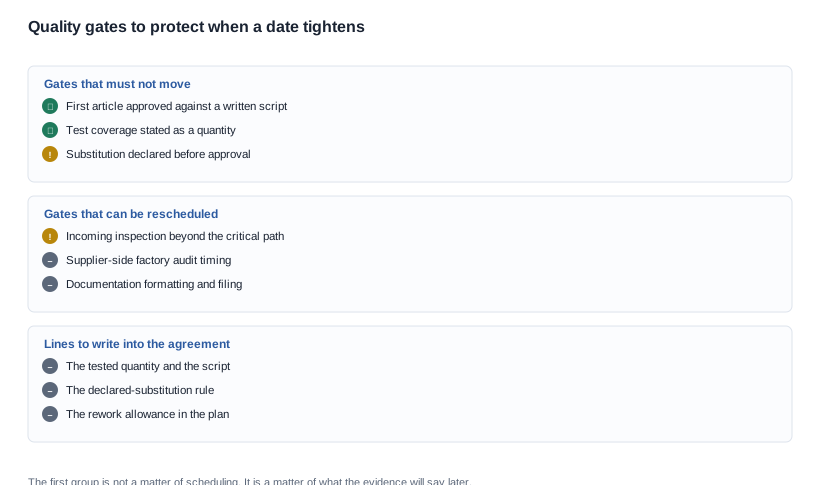
The declared-substitution rule. Any component change that alters a published row should be declared in writing before approval, not discovered afterwards. This is a process commitment rather than a test, and it is the cheapest of the four to put in place.
What to write into the agreement before the order
Four lines cover most of the exposure, and each of them is a line rather than a policy.
The substitution clause. Any change to a component that alters a published row, declared in writing before the affected units are approved, with the buyer able to reject the change without cost.
The inspection clause. What is inspected, on how many units, against which written criteria, at which point in the process — stated as quantities rather than as intentions.
The test coverage clause. The number of units tested and the script they are tested against, so that two reports can be compared with each other and a narrowing cannot be hidden inside a passing result.
The records clause. The line record, the incoming inspection record and the test report are retained and provided on request, because they are what makes a batch-level investigation possible after the fact.
The clause that carries the whole thing
One sentence does more work than the rest: any change to a published specification, including a substituted component, will be declared in writing before the affected units are approved, and the buyer may reject the change without cost. It is a clause a supplier can accept, because it is not a restriction on the production process — it is a commitment to talk. And it converts a quality risk that would otherwise be discovered in the channel into a decision made before the units exist.

A case where the date and the standard conflict
The example below is an invented scenario used to reason through the trade-off. No customer, order or shipment is described; the model, the quantity, the dates and the market are assumed.
The scenario. A brand has a retail set date it cannot move, and it places a first order for a camera model. The supplier can meet the date on two conditions: the camera module will be substituted for an equivalent part, and the first-article approval window is shortened to four hours. The substitution does not change the published 8 MP tier. The approval window does compress the scrutiny the first article gets.
The first question: does the substitution change a published row? The tier, the capacity and the charging method are unaffected, so the product is the same product. The substitution is therefore a production decision rather than a specification change, and it is declared in writing as the agreement requires. That part of the date is defensible.
The second question: what is the approval actually for? The first article exists to catch a specification error before a batch is built. Four hours against a written script is not the same as four hours against a visual check — the script is the control, not the duration. The script is agreed in advance, so the shortened window does not remove the control; it removes the deliberation, which for a written script is largely redundant.
The third question: what does the programme do about the unexamined part? The supplier proposes narrowing the test coverage on the remaining units to recover the time. That is refused, and the time is taken from the freight mode instead — the consignment goes by air on a later sailing, which costs money and does not touch the product.
The outcome. A programme that meets a harder date than the original one, with the test coverage intact, with the substitution declared, and with a freight premium that is cheaper than a defect investigation would have been. The key move was not accepting the compression but locating it: choosing the part of the schedule where compression is tolerable and refusing it everywhere else.
What this case is really about
The temptation in a fixed-date programme is to take the fastest acceptable answer on every dimension at once, because each individual compression looks small and the total is only visible later. The disciplined approach is to compress one dimension deliberately and defend the rest, and to write the trade into the agreement so that it is a decision rather than an accident.
What we will and will not stand behind
Stated plainly: we would rather be told you are under schedule pressure at the start than be discovered to have met a date by accepting a component substitution you did not know about.
So, for our own operation: defect rate, yield, rework policy, sample preparation time, production lead time and unit prices are not published for this range, so quality outcomes have to be established contractually — through a receiving inspection against the published specifications and a batch-level tracking process — rather than assumed from a schedule. We publish the specification: the twenty-eight models and their rows, including the charge time for every model, the charging method for the twenty-four where it is stated, the Bluetooth version for the fourteen where it appears, the case capacity for the five models where it is published, the ingress rating on the two models that carry one, and the camera tiers of eight models at 8 MP and three at 13 MP.
Component changes that alter a published specification get declared, in writing, before approval. And if we cannot meet a date without one, we will say so before you commit rather than after you have planned around it.
For a programme where the schedule genuinely matters, the best investment is usually reducing the number of customisation items rather than compressing the factory. A range with fewer variants, decided earlier, ships faster and more consistently than a fully customised one delivered late.
The volume side of a shortened schedule is covered at how MOQ affects your margin, the batch-level control structure is at the quality consistency advanced guide, and the commercial structure of the schedule is at the lead time section.
The action to take now. Before you accept an accelerated date, ask two questions: does this change anything published, and what inspection or tested quantity is being reduced. If the answer to the first is yes, it is a specification decision. If the answer to the second is anything, put it in the agreement before the order rather than after the shipment.
Related reading
- How MOQ affects your margin — the volume side of a shortened schedule
- Quality consistency advanced guide — batch-level control
- Lead time section — the commercial structure


