

A minimum order quantity does not eat margin in the way a bad unit price does, which is why it survives into the final decision unexamined. It eats margin through three mechanisms that all point the same way: the fixed costs get spread across fewer units than the plan assumed, the commitment locks the assortment so the fast-moving lines get subsidised by the slow ones, and the extra volume sitting in the channel is counted as revenue until the day it is not. None of them appears in a margin calculation that uses the quoted unit price, which is why they have to be modelled deliberately.
The conclusion to act on: build the margin model at three quantities, not one, and include the accessory line, the setup spread and the inventory horizon as named lines. A buyer who models only the quantity they intend to order has modelled the case where nothing goes wrong, and in this category something always goes wrong.
Smart glasses MOQ: the arithmetic that decides whether a tier pays
The conclusion, in three sentences
The margin on a smart glasses order is set by the distance between the quantity you order and the quantity at which the fixed costs stop mattering, not by the unit price on the quotation. The correct comparison is a total cost per unit at three quantities, each including the setup spread and the accessory line, and the ranking those totals produce frequently differs from the ranking the minimum implies. A margin model built on the quoted unit price alone will show that the larger order is better; a model built on total cost per unit frequently shows the opposite for a first order, and that is the finding worth acting on.
Who is building this model, and what decision it feeds
The reader is a procurement manager or a category buyer who is either preparing a range for a buying review or defending a range that has already been costed. In both cases the output is not a purchase order — it is a recommendation that other people have to accept, which means the model has to survive being read by somebody who was not in the conversation with the factory.
That constraint shapes the model in a specific way. A margin model is a negotiating instrument only while it is still being built with the supplier, and it becomes a liability the moment it is shown to a stakeholder who will treat the unit price as the fact. The tests that matter are therefore not "is this margin good" but "is this total cost per unit defensible", and the second question has a different answer from the first. A margin built on published rows can be checked by anybody; a margin built on an assumed unit price can only be checked by the person who made the assumption.
The second thing this reader is managing is the assortment. Margin in this category is decided as much by which lines you carry as by what you pay for them, and the minimum is what determines the breadth of the range you can carry. A minimum that forces two slow lines into every order is not a volume constraint; it is an assortment constraint masquerading as a volume constraint, and it will not appear anywhere in a unit price comparison.
Why the minimum and the margin are the same number
The reason the minimum matters to margin is arithmetic rather than commercial. A mould, a first-article approval, a packaging print run and a file entry are fixed, and they are charged against a production run. The unit price a supplier quotes is therefore a function of the quantity, and it is a function in the direction that seems reassuring: more units, lower unit price. The catch is that the function is not continuous. Between two tiers the unit price is flat and the setup charges have been recovered, and the position that appears worst on the spreadsheet is often the position where the buyer should be.
There is a second reason, and it is the one that catches more programmes: the commitment the minimum creates has a cost that is not per unit. Cash leaves earlier and returns later than a margin model assumes, inventory sits above plan for longer than a margin model assumes, and the assortment is narrower than the model assumes. Those three are not rounding errors on a good order; on a thin one they are the difference between a programme that works and one that needs a second discount to move.

The cost lines you can read, and the ones you have to request
What the catalogue actually publishes
The published rows are the ones that can be used without asking anyone, and they are more than most buyers realise. Across the twenty-eight catalogue entries there is a cell capacity for every model, a charging interface on twenty-four of them, a charge time on all of them, a rated use time on all of them, and a case capacity on several. The camera models alone divide cleanly on two published rows: eight of the eleven are published at 8 MP and three at 13 MP, and the charging interface is magnetic on seventeen entries across the catalogue, Type C on seven, and unpublished on four.
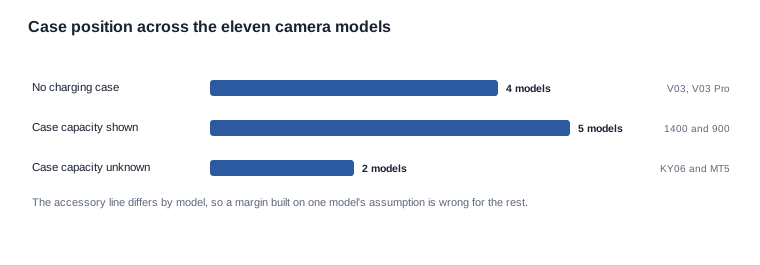
Those two splits are the reason a margin model built on one configuration cannot be transferred to another. The eleven camera models do not share a sensor line, and they do not share an accessory position: four of them publish no charging-case row at all, five are published with a case whose capacity is stated, and two are published with a case whose capacity is not stated. That is not a rounding difference in the bill of materials — it is a different bill of materials.
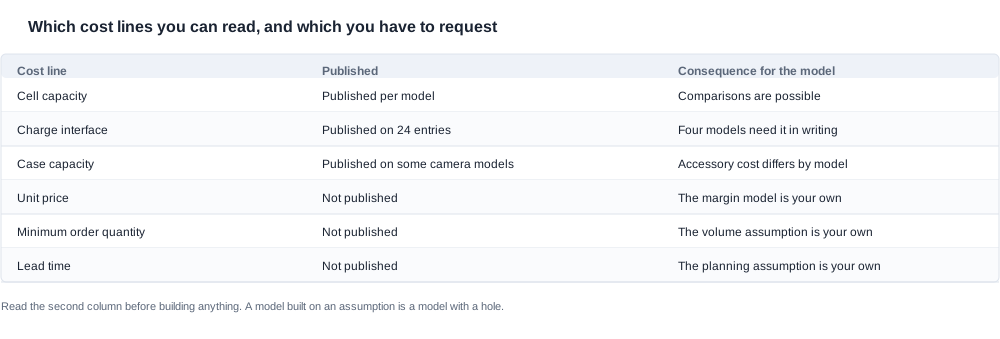
The right-hand column of that table is the useful part. Two published rows — the ingress marking and the weight — are published for only a small number of models, and a buyer who carries an assumption from one model to another will eventually be wrong in a place that matters, because the ingress marking appears on only two models in the catalogue and the weight on one.
The rows published for one model, and the rule that follows
The weight row is the sharpest example of the rule. Across the whole catalogue there is exactly one model for which a weight is published, and it is published for the glasses body including the battery and the camera, with the folding charging case given separately as a 1200 mAh item whose own weight is not published. That single row is routinely misread as a frame weight, and the misreading then travels into a specification annex and into a freight calculation.
The rule that follows is simple and it applies to every unpublished cell in every table: an unpublished row is not a row to be interpolated from a sibling model. Ask for the figure for the configuration you are ordering, and if the supplier cannot give it, record that it is unpublished rather than carrying a number from a related build. The smart glasses MOQ guide sets out the published rows we can evidence directly, and the distinction between a published figure and an inferred one is worth keeping in every model you take to a review.
The three rows that are never published
Unit price, minimum order quantity and lead time are not published on this site, and all three are confirmed per enquiry. That is not an evasion — a minimum depends on the configuration, and a price depends on the configuration, the volume, the market and the current material position, so a published figure would be a number that changes the moment it is specified.
What this means for a margin model is specific: three of its inputs have to be requested, in writing, for a specific configuration, and they have to be dated. A model that carries a price from a previous enquiry is a model with an unknown in it, and the unknown is usually the largest one.
The accessory line, treated as a cost line and not as a detail
The charging case deserves its own line in the model because it behaves like a second order. Four of the eleven camera models publish no charging-case row at all and have to be closed in writing; five carry a case with a stated capacity, including the L2 Utral published with either a 900 mAh or a 1400 mAh option and the MT6 with a 1200 mAh folding case; two carry a case whose capacity is not stated. A case is a separate SKU with its own quantity logic, its own packaging and its own unit cost, and a buyer who folds it into the unit price of the glasses will find that the case is the line that breaks the margin when the case is sold as an accessory rather than included.
The customisation options are where those decisions get made, and the pricing section is where the tier structure sits.
Building the margin model in three tiers
The four inputs, and only four
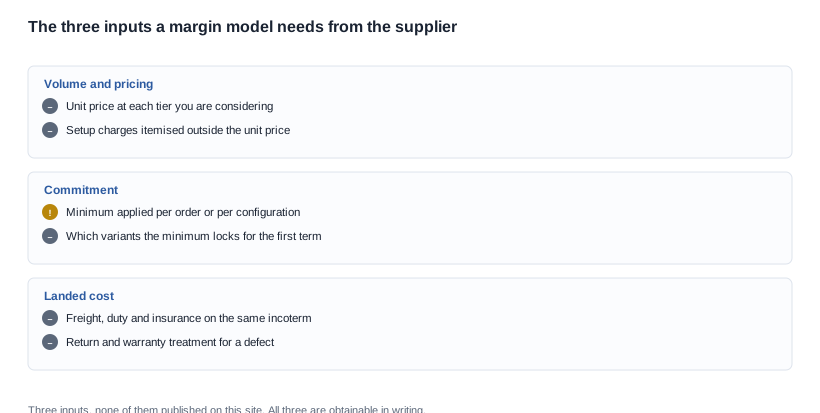
A workable model needs a unit price at each tier, the setup charges itemised separately, the accessory position stated for each line, and the landed cost on a named incoterm. Anything else that is added is usually added to make the answer read better, and a model built that way will not survive the buying review.
The unit price at each tier is the only input that requires negotiation; the other three are facts about a configuration that somebody has to state. Asking for them together, in one message, is what makes the comparison possible, and asking for them separately produces three partial answers that have to be reconciled later at a cost in time and in goodwill.
Four tests at each tier
- Amortisation. Setup charges per unit at this tier, against the volume you actually intend to order. Below a tier break this line can be larger than the unit price.
- Inventory horizon. Units held above plan divided by the sell-through rate, expressed as weeks. A tier that adds four weeks of cover is a working-capital decision, not a purchasing decision.
- Assortment breadth. How many lines the minimum forces into the order, and how much of the order is slow-moving relative to the plan. A broad minimum applied to a narrow range is a much bigger commitment than the same number applied to a wide one.
- Cash recovery. Days from the deposit to the point where the channel has turned the units. The same order with a staged payment schedule recovers earlier and behaves, for cash purposes, like a smaller order.
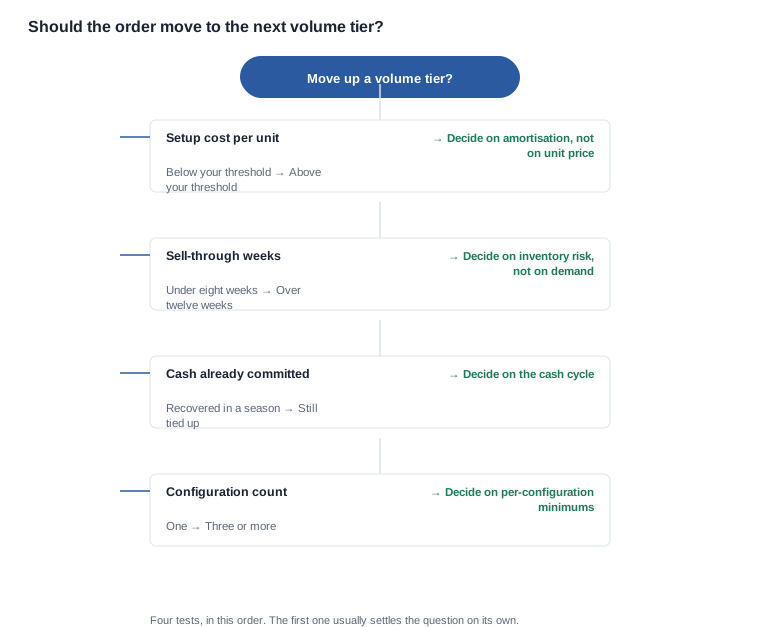
The four tests are applied in that order deliberately. Amortisation usually settles the question on its own, and a buyer who works through the other three first will find that the discussion has drifted into the part of the decision where a supplier has the most room to manoeuvre.

Where a margin model goes wrong
The model that uses the unit price from the largest tier. This is the most common error and it is easy to miss because the number reads as conservative. The unit price at the tier you will not order at is a hypothetical, and the setup spread that goes with it is usually omitted in the same breath. Compare total cost per unit at the tier you are ordering at and at one tier above, and the difference is frequently the entire margin.
The model that treats the accessory as included. Where a case is published with an option rather than a fixed capacity, and where a case capacity is not published at all, an assumed accessory cost is an invented number inside a calculation that is supposed to be evidence-based. Ask instead, and put the answer in as a line even if it is a range.
The model that counts inventory as revenue. Units in a warehouse are not revenue and are not margin. A model that projects the order as sold at the channel's list price produces a margin figure that depends on a sell-through rate nobody has verified for this category and this price point. Model the plan weeks and the realised margin separately.
There is also a trade-off that is often described as one and is not. Lowering the minimum to buy assortment flexibility while keeping the unit price low is not a trade-off, because the two come from the same place. If the minimum falls because the setup spread is amortised over fewer units, the unit price rises, and the model that assumed both would fall has produced a number that was never available.
When the model will not close, and what to do with that
Some configurations simply do not work at the scale a buyer wants, and the honest result of the three-tier comparison is that the margin does not close at any of the three points. That is a useful outcome rather than a failed enquiry, because it is the one result that stops a programme before the deposit rather than after the shipment.
The three responses that work are worth naming. The first is to narrow the configuration — one model, one colourway, the accessory sold separately — and rebuild the model on that narrower shape. The second is to move the market, because the market determines the documentation scope and the scope is often a larger part of the cost than the hardware. The third is to change the channel rather than the product, because a first order that is smaller but sells faster is a different business from a larger order that sits. In all three cases the criteria for the decision are the same as the criteria above, and the checklist is what forces the choice to be made on the numbers.
What does not work is carrying the gap into the first order on the expectation that volume will fix it. A buyer who has modelled the gap knows how large it is, and a buyer who has not modelled it will discover it in the channel.

A worked margin comparison, set out as a scenario
The scenario
Assume a brand planning a first order of smart glasses for one European market. The range is two camera models and one audio model, the cases are to be sold as accessories rather than included in the box, and the launch target is a single selling season. The figures below are not quoted from any supplier and no supplier is described; they are stated as assumptions so that the method can be followed, and the outcome depends entirely on the numbers a buyer obtains.
The buyer asks for the unit price at three quantities, the setup charges itemised, the case position per line, and the landed cost on a stated incoterm. The supplier answers with a per-order minimum for the glass line and a separate minimum for the accessory line, and a tier structure that steps down once the glass line passes a quantity the buyer has not reached.
What the comparison shows
At the planned quantity the glass line carries the full setup charge across the order, the accessory line sits below its own threshold and carries a second spread, and the combined position is worse per unit than a smaller configuration would have been. At twice the quantity the glass line crosses the tier break and the setup spread drops sharply, but the accessory line is now above two seasons of cover and the cash recovery stretches past the selling season. At a narrower quantity — one camera model only, one colourway, case as an accessory — the amortisation is poor but the cash exposure is small enough to carry a slower start.
The conclusion the comparison produces is not "order more". It is that the three quantities are three different businesses, and the buyer has to choose which one they are running rather than discover it later. The questions to ask at that point are which line carries the margin, what the total cost per unit is on each configuration at each tier, and whether the tier structure is worth an option on the range. The trade-offs are real but they are between businesses, not between a bigger order and a smaller one.
What we publish, and what we will not put into a model
Our position
We publish the model data that a margin model can be built on: the cell capacities, the case options, the charge times, the interfaces and the rated use times, the resolution class, the ingress marking on the two models that carry it, and the weight on the one model where it is published. We do not publish prices, minimum order quantities or lead times, and the reason is that all three are confirmed per enquiry because they depend on the configuration. We would rather a buyer built the model on three written answers for a specific configuration than on a published number that changes when the colour is specified.
What we will not do is supply a figure for a model the buyer has not specified, or confirm a minimum for a configuration we have not costed. A margin model built on our numbers will be checkable by anybody who reads the catalogue, and that checkability is the point.
Scope, accessory position and volume
Send the models and the options in scope, the destination market, the accessory position for each line, the quantity and the forecast behind it, and the price point you are working to. We will come back with the unit price at each tier, the setup charges itemised, the minimum per configuration, and the payment schedule we would propose against the cash exposure you have described. If the configuration you want is not one we can build, we will say so at that stage rather than after the deposit.
Related reading
- Hidden costs behind the minimum — the four costs that sit outside the unit price
- Practical advice before you order — what to send in the first message
- ODM development — where the setup charges actually come from


