

Smart glasses quality consistency is a control problem rather than an inspection problem, and the difference is where most of the money in a repeat programme is either saved or lost. At the first order, consistency is something a buyer asks for and a factory attempts. By the third order, consistency is something a control system either has or does not, and the question is no longer whether the goods are acceptable but whether the process that produced them would produce the same goods again if the order doubled. This article is for the brand-side quality lead, the procurement manager and the channel buyer who is running an established programme and needs to move from checking units to controlling a process. It covers the layers a consistency system has to cover, the six lines of a control plan that make it real, the specific difficulty of holding consistency across colours, cases and hardware variants, how a deviation is worked out, and where the trade-offs sit. The quality consistency overview covers the same subject at a more introductory level, and the FAQ collects the short answers.
Advanced smart glasses quality consistency controls
What an advanced consistency programme actually controls
An advanced programme controls three things, and it is worth being precise about which is which, because the three fail in different ways and are usually discussed as if they were one.
The first is specification consistency, which means that the goods are the same as the thing that was ordered. This is a documentation problem before it is a production problem, and it fails when the configuration was never written down in a form that survives a change of shift, a change of supplier or a change of month.
The second is run consistency, which means that units made in the same lot are the same as each other. This is a process control problem, and it fails when there is no reference against which drift can be seen, so a gradual movement is not noticed until a customer notices it.
The third is programme consistency, which means that the goods in the fourth order are the same as the goods in the first. This is a supplier-management problem, and it fails when the supplier's own production is changing underneath the programme — a new line, a new sub-supplier, a new shift pattern — and the buyer has no visibility of the change.
Most programmes that are described as having a quality problem are actually suffering from the third one, while treating it as the first. The distinction matters for what to do about it, because a documentation fix does nothing about a sub-supplier change and a supplier audit does nothing about an unwritten configuration.
The layers a control system has to cover
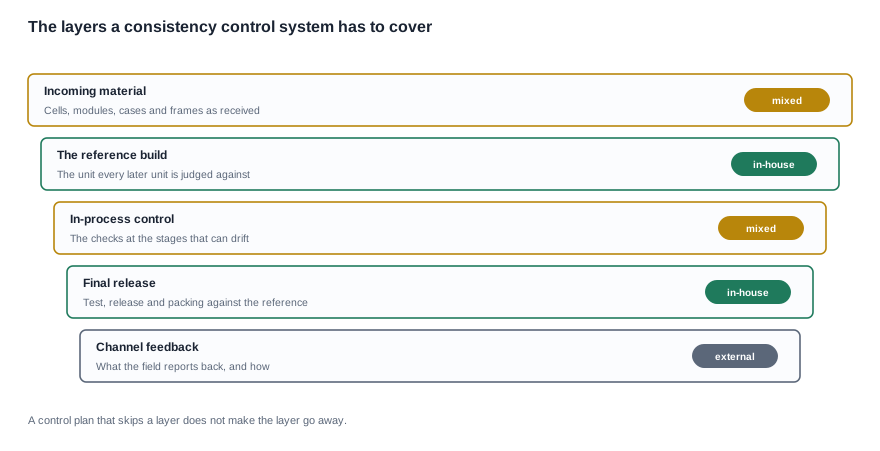
A control system has five layers, and the useful question about any of them is whether it exists at all rather than whether it is good. A layer that does not exist is invisible, which is why gaps in consistency controls show up as field complaints rather than as process failures.
Incoming material. The cells, camera modules, charging cases, frames and lens sets that arrive. The control here is a decision about which incoming attributes the programme actually depends on, and that decision is specific to the configuration. Four of the eleven camera entries in the published range do not record a charging method at all, which means that for those builds the charging route is an attribute the programme has to define itself before it can control it.
The reference build. The unit every later unit is judged against. This is the layer most often skipped and the one that makes every other layer possible. Without a reference, "consistent" is an opinion expressed by the person looking at the goods.
In-process control. The checks performed at the stages where drift is possible. The point of in-process control is that it finds drift while it is still cheap to correct, and the stages chosen should be the ones where the attribute is set rather than the ones where it is easiest to measure.
Final release. Test, release and packing against the reference. This is the last point at which a lot can be isolated before it ships, and it is the point at which a lot can be traced afterwards if the records exist.
Channel feedback. What the field reports, and whether it reaches the factory. A programme that receives complaints and passes them to a sales contact never learns anything; a programme that routes a defined report to a named owner does.

The control plan, and the six lines that make it work
Each line, and what it must not become
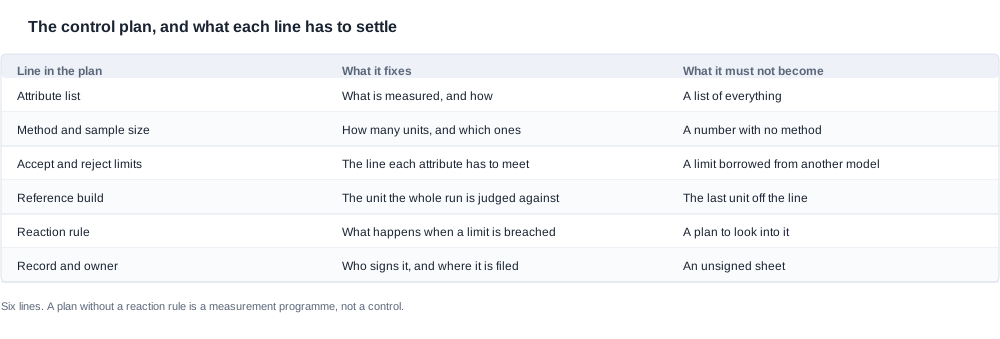
A control plan in this category is a short document with six lines, and each of them fails in a characteristic way when it is written badly.
The attribute list states what is measured and how it is measured. It must not become a list of everything that could be measured, because a list that is too long is a list that is not used. The selection rule is simple: an attribute goes on the list if a customer would complain about it and if it can drift.
The method and sample size states how many units are checked and which ones. It must not become a number without a method, because a sample size means nothing without a rule for drawing it. A plan that samples the first units off the line is not sampling, it is inspecting the easiest ones.
The accept and reject limits state the line each attribute has to meet. They must not be borrowed from another model. This is the point where product families cause trouble, because a limit that was set for a different build is either unachievable or meaningless, and in the case of a charged device it also has to be paired with a stated test condition. A runtime figure without a test condition is not comparable, and a consistency limit without a method is not enforceable.
The reference build fixes the unit the run is judged against. It must not become the last unit off the line, because a reference that changes with every batch is not a reference.
The reaction rule states what happens when a limit is breached. It must not be a plan to look into it. A reaction rule that names the disposition, the isolation scope and the owner is worth several pages of prose about intentions, and a control plan without one is a measurement programme rather than a control.
The record and owner state who signs the record and where it is filed. It must not be an unsigned sheet, because a record that cannot be attributed cannot settle a disagreement with a customer, and a disagreement that cannot be settled becomes a credit.
Where the control points belong
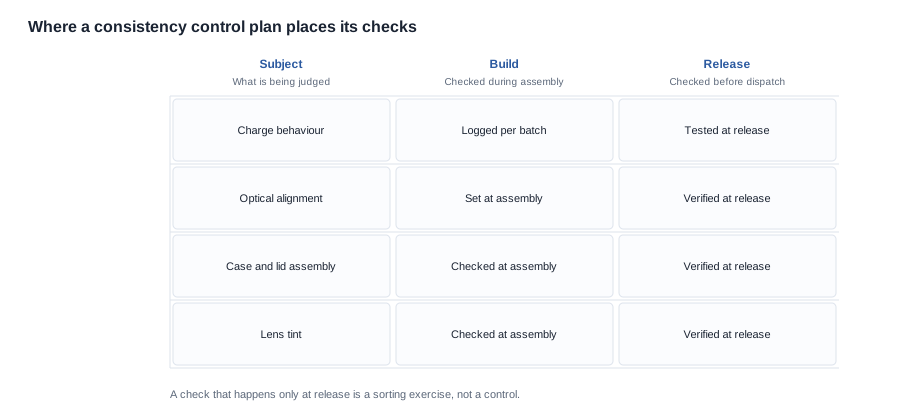
The placement of the control points is a judgement, and the rule that governs it is economic. A check performed before the attribute is set tells the buyer nothing, because the attribute has not happened yet. A check performed only at release tells the buyer what happened, but not why, and it converts the process into a sorting exercise whose cost rises with every unit. The productive placement is at the stage where the attribute is set, with a verification at release.
In practice this means the in-process checks should sit on the characteristics that are set by assembly rather than by incoming material, because the ones that come in from a sub-supplier cannot be fixed on the line and can only be screened. Charge behaviour, optical alignment and the way a case closes are assembly-determined. Cell tolerance, module variation and case moulding finish are not, and a plan that puts them in the in-process column is a plan that will produce a large number of rejections it cannot act on.
The limits that come from the product class, not from the factory
Some of the hardest consistency questions in this category are settled by the published specification rather than by anything the factory does, and a buyer who asks the factory for a decision that is not the factory's to make will get a slow answer.
The published range runs to twenty-eight entries, eleven of them camera entries, and the configuration space inside those camera entries is wide. The charging case option alone moves between a nine-hundred milliamp-hour case, a fourteen-hundred milliamp-hour case, a twelve-hundred milliamp-hour folding case, a case whose capacity is not published, and no case at all. Two camera entries do not publish a Bluetooth version. The IP54 marking appears against two entries only. Charge time is published for all twenty-eight entries: twenty-six of them at two hours or less, and the D17 and the ZH12 at about one hour.
Each of those is a specification decision that a control plan has to respect rather than reinterpret. A programme that assumes a charging method for a build that does not publish one is not applying a quality control; it is inventing a specification. The correct move is to ask the supplier to state the method for that build, and to put the answer into the control plan, so that the attribute becomes controlled rather than assumed.
Consistency across colours, cases and hardware variants
A variant is not a defect
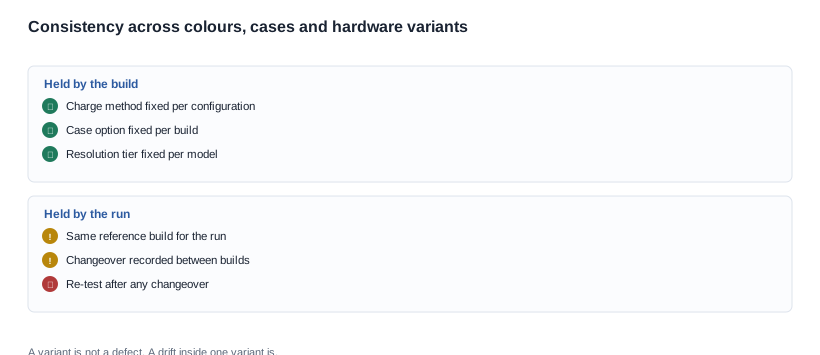
The distinction that most often causes trouble is between a variant and a defect. A variant is a build that was specified, and it is supposed to differ from the other builds in the programme. A defect is a unit that does not match the build it belongs to. A colour difference between two colourways is not a defect; the same colour difference between two units of one colourway is.
That distinction has to be written into the control plan, because the measurement limits for a colourway are set relative to that colourway's reference and not to a master. The same is true of case options: a case capacity of nine hundred milliamp-hour hours and one of fourteen hundred are two different builds, and a case-fit limit taken from one does not apply to the other. A programme with three camera builds and two case options is running several control plans, and treating it as one is the most common reason a consistency programme starts producing false alarms.
The changeover problem
The other variant problem is the changeover. A run that moves from one build to another carries a risk that is specific to the transition, and the risk is that the first units of the new build inherit something from the previous build: a fixture, a setting, a bin of parts, a half-finished tray. The units that come out immediately after a changeover are the units most likely to deviate, and they are also the units most likely to be accepted, because they are early in a lot that has not been judged yet.
The control is procedural and it is cheap: record every changeover, re-test after each one rather than relying on the routine sampling interval, and keep the changeover units identifiable so that a later complaint can be traced to a transition rather than to a supplier-wide problem. A programme that has done this has a very useful diagnostic capability, because the pattern of which lots drift tells the buyer which attribute is actually sensitive to the transition.

Working a deviation out, and the reaction rules
The sequence
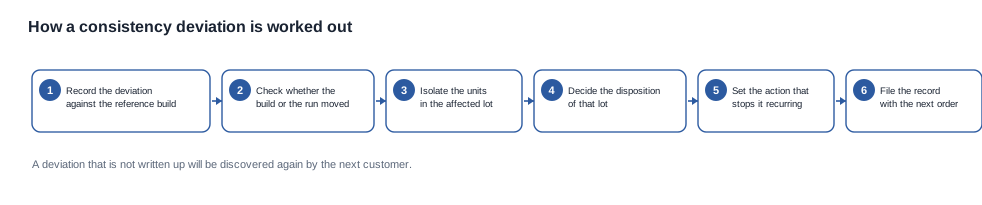
A deviation is worked out in a fixed order, and the order is what stops a deviation from turning into a dispute.
- Record the deviation against the reference build, with the lot reference, the attribute and the measurement.
- Establish whether the build moved or the run moved, because the two have different owners and different remedies.
- Isolate the units in the affected lot, and decide whether neighbouring lots need isolating too.
- Decide the disposition of that lot: release, rework, downgrade or reject.
- Set the action that stops it recurring, and name the owner of that action.
- File the record with the next order, so that the next buyer's file contains the history rather than a clean copy.
The second step is the one that is usually skipped and it is the one that decides everything after it. A build that moved means the specification was wrong or changed, and the fix is upstream of the factory. A run that moved means the process drifted, and the fix is in the control plan. A buyer who does not make that distinction will spend the whole investigation looking for a factory problem that is not there.
What a reaction rule has to protect
Every reaction rule protects one of three things, and the choice between them is a commercial decision that belongs in the plan rather than in the incident.
The first is the customer. A rule that isolates and holds the lot protects the channel from a unit that does not match, at the cost of a delay. The second is the evidence. A rule that preserves the units, the measurements and the reference protects the ability to settle a disagreement later, at the cost of a little inventory. The third is the cost of the remedy. A rule that reworks before rejecting protects margin, at the cost of a more complicated record.
The trade-offs are the reason a good reaction rule names all three. A rule that only protects the customer produces a slow, expensive programme in which every deviation becomes a total loss. A rule that only protects the cost produces a programme that discovers its own quality problems from its customers, which is the most expensive version of the same mistake. And the decision about which to prioritise is not a quality decision, it is a commercial one, which is why the criteria to ask about should be settled before you order rather than during the first incident.

What a control plan is worth commercially
The terms the control plan supports
A control plan is not a quality document that sits beside the commercial negotiation. It is the evidence that makes several commercial terms enforceable, and a buyer who has one negotiates a materially better agreement than a buyer who has only a sample and a price.
The first is the reference in the acceptance clause. A quality claim is only arguable if there is something fixed to argue against, and the reference build is that something. Written into the agreement as the standard for acceptance, it converts every future conversation about quality into a comparison rather than an opinion, and it removes the buyer's dependence on the factory's own characterisation of the goods.
The second is the change control point. A programme that has a control plan has already decided which attributes are fixed by the build, and the agreement can follow that decision: a change to a build after the freeze is a change to the specification, and it carries a defined schedule and cost consequence. Without the plan, the freeze is a negotiation the buyer has to win every time.
The third is the record ownership and the retention period. A programme that cannot trace a lot back to a build cannot settle a claim from the field, and a claim it cannot settle becomes a credit at the buyer's price, which is the most expensive way to buy consistency. Asking what to ask is straightforward: which records the factory keeps, for how long, in what form, and whether the buyer gets a copy at the end of the run.
The trade-offs the plan makes visible
Three trade-offs become visible once the plan exists, and each of them is a decision rather than a cost to be absorbed. A tighter attribute list reduces the inspection burden but also reduces the number of attributes the buyer can hold the factory to later. A wider sample improves the confidence in each lot at a direct cost per unit. A stricter reaction rule protects the customer and the evidence at the cost of speed and working capital.
The total cost of a consistency programme is the inspection and test time inside the build window, the working capital held in isolated lots, the cost of rework, and the cost of the returns that a programme with a good control plan does not have. Those four numbers are usually larger than the buyer expects, and the plan is what makes them visible, which is also why a plan that has been written properly tends to pay for itself in the first year of a repeat programme.
What to ask before you order is the commercial version of the control plan question: what does the factory need from the buyer for the plan to work, what does the buyer get in return, and which of the two is carrying the risk. The quality consistency checklist collects the items in a form that can be sent with an enquiry.
What we publish about quality, and what we will not
What we can state
We publish the configuration-level specification of every model in our catalogue, and for camera and audio models that means the resolution tier, the battery and the case option where one exists, the charging method where the catalogue records it, the charge time, and the runtime with the conditions it was measured under. We will state which attributes are fixed by the build and which are controlled by the run, and we will say where a specification does not exist, rather than filling the gap with a typical value.
We will also work against a reference build, produce a control plan for a named configuration, and state the method and sample size behind each attribute, because a control plan without those is a wish list.
What we will not state
We do not publish a defect rate, a rework rate, a yield figure or a pass rate for the range, and we will not quote one to a buyer who has not named a configuration. All of them are functions of the mix, the incoming material and the run, and a published figure would be true of a build that does not exist. We also do not publish a certificate number, a test report value or a certification scope for any model, because the catalogue does not carry a per-model certification row and the company-level certification page is not a model-level statement. A buyer who needs that scope should ask for it in writing as part of the market access file, and the answer belongs in the file before the order rather than after the consignment has been packed.
The same discipline applies to weight and to anything else we have not published. Where a model has no published weight, we will say that it has no published weight and tell the buyer to request it, rather than quote a figure that cannot be traced.
A consistency programme
Send the model, the configuration, the quantities per build, the destination market and the current reference build, and we will return a control plan with the attribute list, the method and sample size, the accept and reject limits, the reaction rule and the record ownership, together with the parts of the specification we can state and the parts that have to be supplied by you. The lead time and quality implications article covers where a control plan meets a schedule, and the microphone quality test covers one attribute in detail.
Related reading
- Quality consistency FAQ
- Quality consistency overview
- Lead time and quality implications
- how to test before ordering
Send the model, the configuration and the quantities, and we will return a control plan for that build.


