

A quoted lead time is a statement about the future made before the order exists, and the published position in this category is that production lead time is not published on any public page — every figure is established per enquiry against a named configuration. That leaves the quotation itself as the only risk control a buyer has, which makes the useful skill less about reading a number and more about reading the shape of the answer around it. The five signals set out below all point at one underlying condition: the figure was produced before the configuration was settled, which is the moment a lead time stops describing your order and starts describing a supplier's general experience of production.
None of the five means anybody is being dishonest. In this category a lead time is normally assembled from general production experience and then adjusted, and the adjustment is where the gap opens. What you are detecting with these signals is the size of that gap, and whether the supplier on the other side of the table is aware of it in the same way you are.
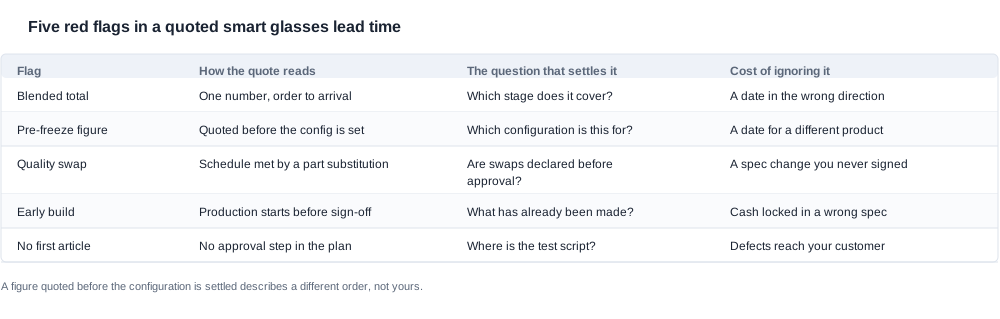
What a red flag in a smart glasses lead time actually is
The buyer reading the quote, and the exposure being managed
The reader here is a procurement manager on the brand side, a channel buyer or an importer who already has a number in front of them, probably alongside one or two competing quotations, and who now has to decide how much of that number to plan a launch around. The situation is rarely a blank enquiry. It is a comparison, a decision on which supplier to carry forward, or a date that a retailer or a trade show has already been promised.
What is being managed underneath is not the schedule as an abstract thing. It is the exposure of a cash commitment that has already been made somewhere else in the business — a deposit paid, a marketing campaign booked, a channel partner told. The fear underneath a request for a lead time is very rarely "the factory is slow". It is "I have committed a launch date to somebody else, and the date was built on a number that was never tied to what I am actually ordering".
That distinction matters for how the five signals are read. A slow factory and an imprecise quotation produce the same commercial outcome — a shipment that arrives later than the business assumed — but they are corrected in completely different ways. One of them is a supplier-selection problem. The other is a due-diligence problem, and it is solved by getting a better-defined answer rather than by changing supplier.
Why a single number is easier to produce than a schedule
Producing a schedule takes work. Somebody has to name a start point, decide which stages sit inside the number, work out which stage is longest, and then attach an owner to each one. Producing a number takes none of that. It takes a general sense of how long this kind of product takes to make, which every factory in the category has, and it takes nothing else at all.
This is why the most common weak answer to a lead time question is not a refusal but a confident figure, and why the five signals below are not a list of things to be suspicious of. They are a list of things that are easier to produce than the alternative, and a buyer who asks for the structured version is asking a supplier to do more work rather than asking them to be more honest.
The published specifications in this category make the point sharply, because they are specific enough to expose a loose answer. The catalogue carries eleven camera models across two resolution tiers — eight at 8 MP, covering the CY05 and the V06, the V03 Pro and the V03, and the CY03 and the MT5, and the MT6 and the KY06, and three at 13 MP, the L2 Utral and the L1 Pro, and the S7. Battery capacities run from 40 mAh on the children's A05 and A06 up through 70 mAh on the A07, 220 mAh on the V03 and the V03 Pro, 260 mAh on the V06 and the KY06, and the S7, 265 mAh on the MT6 and 290 mAh on the CY03 and the L1 Pro, and the L2 Utral and the CY05. Charging is magnetic on seventeen models, Type C on seven, and simply not stated for four. Bluetooth is quoted at 5.3 or 5.4 depending on the model.
A supplier quoting "about the same time" across an audio unit at 55 mAh × 2 and a 13 MP camera platform with a 1400 mAh charging case has not made a mistake. They have answered a different question than the one you asked.
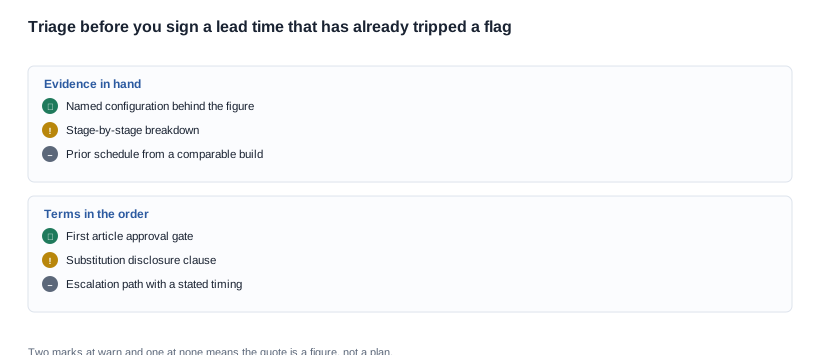

The five flags, and the question that confirms each one
Flag one — a single blended figure covering everything
"How long until I get it" answered with one number usually blends preparation, production, inspection, transit and customs clearance. That is five separate clocks with five separate owners, and merging them produces a figure that will be wrong in a direction you did not choose — most often late, because the two clocks outside the factory are the two most variable ones.
The confirming question is simple and most suppliers can answer it: ask for preparation time separately from everything downstream of it. A supplier who answers without hesitation is working from a schedule and has simply compressed it for the conversation. A supplier who has to think about it is reconstructing a number from memory, and the number you are looking at is an average of a process they have not written down.
Note the asymmetry this creates. A blended figure is almost always optimistic at the front, because preparation is the stage a factory controls and understands best, and it is optimistic at the back as well, because a supplier has little visibility into a buyer's customs broker. The middle is the only part with any real confidence behind it.
Flag two — a figure given before the configuration is fixed
A lead time quoted before the model code, the colourway and the customisation scope are settled is a guess wearing the clothes of a commitment. Customisation in this range covers logo, artwork, packaging, temple shape, system and UI, Bluetooth name and firmware — seven items with materially different schedule implications, and a firmware change in particular adds an ongoing maintenance commitment rather than a one-off delay.
The confirming question is to ask the question back: "Which configuration is this figure for?" A specific answer, naming the model, the colour and the case, means the figure has a subject and can be compared with other figures. A vague answer that returns the same number for every configuration is a factory-average figure, and it will be applied to an order that is not average.
There is a catalogue-specific version of this flag that is worth naming. Configuration options multiply the number of production items in an order: the V03 Pro publishes three colourways, the V06 publishes four, and the L2 Utral publishes two charging case options at 900 mAh and 1400 mAh. A lead time quoted for "the L2 Utral" is not a lead time for a build. It is a lead time for an average of two builds, and the average is the cheaper of the two to schedule.
Flag three — time quoted where a quality question was asked
The most common pressure move in this category is a schedule met by accepting a component substitution. The published specification surface is visible and narrow — 8 MP or 13 MP, capacities from 40 mAh upward, Bluetooth 5.3 or 5.4, magnetic or Type C, and an IP54 ingress marking on the V06 and the S7 only — so a substitution can change one of those lines without anyone noticing until somebody downstream puts the product in a rainstorm or pairs it with a device.
The confirming question is about the mechanism, not the outcome: ask whether components can change during production, and whether you would be told before the change rather than after it. The answer you want is that any substitution that alters a published specification is declared and approved before it is built, not that substitutions do not happen. Substitutions happen in every factory. Undeclared ones are the problem.
Flag four — production started before the first article is approved
A supplier who offers to begin production before the first article is signed off is offering to convert a quality risk into a capital risk. Sometimes that is the right call — a genuinely compressed launch can justify it — but in that case it should be your decision, made with the trade-off stated on the record, rather than a default that happens because the schedule is tight and somebody is being helpful.
The confirming question asks about the recovery rather than the policy: ask what has already been produced, and what the recovery path looks like if the first article is rejected. A supplier with a real answer will describe scrapping cost, rework sequencing or a re-run. A supplier without one is describing a default, and the default is that your money is gone.
Flag five — no first-article step in the plan at all
If a schedule contains no approval stage anywhere in it, something has been removed. A first-article review is the only point at which a specification difference gets caught before a batch of goods is committed, and in a category where defect rate, yield and rework policy are all unpublished, the first article is the only quality gate that is actually in your control.
The confirming question is documentary: ask to see the first-article test script. If there is no script, there is no step, and the finding is not that the supplier is careless. It is that no one has defined what "correct" means for this order, which means the acceptance conversation will happen when the goods are already in a container.
What each flag costs when it reaches the shipment
Each signal has a different downstream consequence, and treating them as one generic "be careful" is how a flagged quotation gets accepted anyway. The table below pairs each flag with the commercial damage it does when it is not corrected before the order is placed.
| Flag | The symptom that reaches you | Where the cost actually lands | The correction point |
|---|---|---|---|
| Blended total | Arrival later than planned, with no identifiable cause | Marketing commitments and channel penalties | Before the deposit |
| Pre-freeze figure | A delivery date that belonged to a different build | Working capital, because stock arrives late and cannot be reordered quickly | Before the configuration is signed |
| Quality swap | A specification that differs from the approved sample on arrival | Returns, warranty and channel credibility | Before production starts |
| Early build | Capital committed to a specification that is then rejected | Scrap or rework, paid in full by the buyer | Before the first article |
| No first article | Defects discovered at receiving rather than at the bench | Freight, duty, disposal and shelf time | Before the order is released |
Two of these five land before any money moves and three land after. That ordering is the practical use of the list: the flags are cheapest to correct at the quotation stage, and the whole point of asking the confirming question at that stage is that the supplier has not yet incurred any cost to change their answer.
The one that catches buyers most often is the pre-freeze figure, because it is the only one that looks perfectly reasonable on the page. A number attached to a real model code, a real colour and a real quantity is the most convincing answer available — and it is still not a schedule if the start point has not been named.
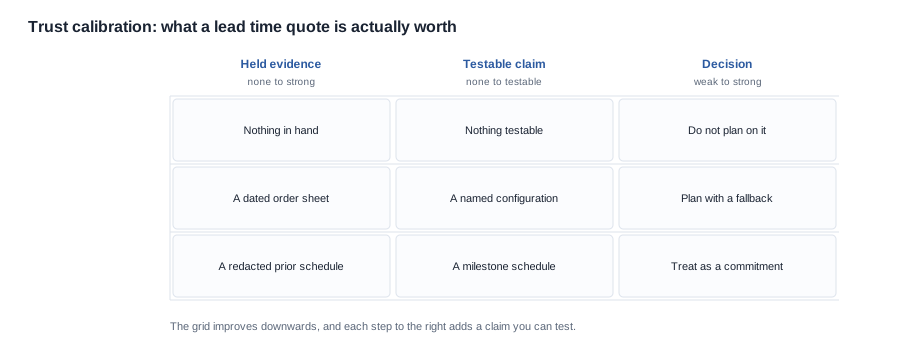

Reading a quotation after one of the five flags has been found
Separating the price conversation from the schedule conversation
A flagged answer usually arrives inside a pricing discussion, and the two conversations get mixed because the buyer is trying to be efficient. They need to be separated, because the negotiating postures are opposite. On price, a buyer benefits from ambiguity about volume and a clear position on the unit. On schedule, a buyer benefits from precision about configuration and volume and ambiguity about everything else.
Practically, this means putting the schedule questions in writing and referring to them separately, with their own deadline. A supplier asked to improve a price and a schedule in the same message will usually improve neither. It is also worth asking for the schedule in a form that can be checked later, which in practice means dated milestones rather than a duration.
The second half of this is to stop negotiating a number that cannot be verified. If the supplier will not give a structured answer, the useful move is not to press harder on the number but to reframe the risk: ask what would have to happen for the order to be a week earlier, and let the answer name the constraint. In this category that answer is usually a document or an artwork approval rather than anything inside the factory, which means the buyer can often act on it directly.
The published specification as the control on substitutions
The reason a specification swap is dangerous here is that the surface area is small enough for a buyer to actually check, but large enough that nobody checks it every time. Eleven camera models, two resolution tiers, six distinct battery capacity figures across the range, two Bluetooth versions, three charging methods. That is a checklist a receiving inspector can hold in their head, and a checklist a supplier can change without anyone noticing at the factory end.
The control is to make the specification part of the acceptance document rather than part of the conversation. The order should name the configuration string in full — model, colourway, charging case option, and the resolution tier where a camera is fitted — and the receiving inspection should test against that string. A substitution that changes any element of the string is then a documentable deviation rather than an argument about what was agreed.
The same principle applies to the IP54 marking, which the catalogue publishes on the V06 and the S7 and on no other model. A buyer who has accepted the idea that "these are IP54 glasses" across a range has accepted a specification error, and that error will be discovered by somebody else, in a worse way, at some point after launch.

What Cynrin publishes about lead time, and what it does not
Where a Cynrin answer differs from a flagged answer
The short answer: we would rather tell a buyer early that a date is not achievable than meet one by accepting a component substitution that nobody told them about. Production lead time, sample preparation time and unit prices are not published on this site, and each is confirmed per enquiry, because every one of them depends on the configuration and on where a model sits in its lifecycle.
That is the whole of our position, and it is deliberately narrow. It does not include a standard duration for any stage, a capacity figure, a daily output number, a defect rate or a yield. The reason is not that these are commercially sensitive. It is that a duration without a configuration, a quantity and a date range has no denominator, and a buyer who plans against a number with no denominator is planning against our uncertainty rather than against our capacity.
What we will do, for a configuration you name, is give a preparation time in writing, separate it from the stages that sit downstream of it, and tell you plainly which parts of the total schedule are ours and which belong to the courier and to the destination's customs authority. If a stage is open, we will say it is open rather than filling it with a typical figure from a general schedule.
The boundaries we will not cross
There are three things we will not do, and they are worth stating because they are the same three things a flagged quotation is usually hiding.
We will not quote a blended total. If you ask for one number from order to arrival, we will ask you to tell us which stage you need it for, because the answer is materially different depending on whether you are planning a factory slot, a shipment or a customs release.
We will not begin a build before the first article is approved without that being a documented decision you made, with the trade-off stated. If the schedule requires it, say so and we will write down what happens if the article is rejected.
We will not substitute a published specification line without declaring it first. The catalogue also does not publish certificate numbers, issuing bodies or validity dates, so where a document route is part of the schedule we will describe the route and its position in the chain rather than quote a reference we cannot stand behind.
The action to take when a quotation trips one of the five
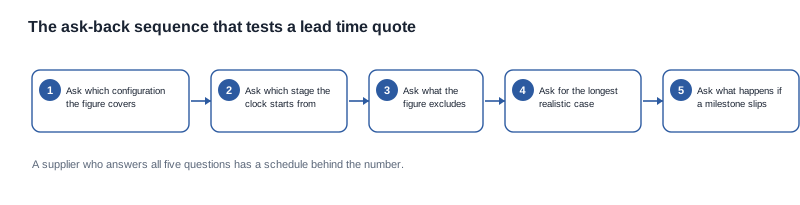
The sequence below is what we would run internally, and it is short enough to complete in a single email.
- Write down the exact figure, the exact configuration it was given for, and the date it was given. A flag that is not written down is a feeling, and feelings do not survive a negotiation.
- Ask the confirming question for that specific flag. One question per flag, not a list of everything you could ask, because a list gets answered selectively.
- Ask the supplier to re-date the answer under two assumptions — the most favourable one and a realistic one. If the two dates are identical, the schedule is not sensitive to the thing you were worried about, and you can drop that flag.
- Move the whole discussion onto a dated milestone schedule, and treat the milestone dates as the commitment rather than the duration.
- Put the configuration string, the first-article gate, the substitution disclosure clause and the escalation rule into the order, in those words, before the deposit is released.
For the longer treatment, lead time and quality implications covers where schedule pressure actually lands. For the acceptance structure, quality consistency advanced guide covers batch-level control. The wider commercial framework sits under the lead time pillar.
Related reading
- Lead time and quality implications — where schedule pressure lands
- Quality consistency advanced guide — batch-level control
- Lead time overview — the commercial structure
Send the figure you were given and the configuration it was quoted for, and we will tell you which of the five it trips and what to ask next.


