
Smart glasses lead time is one of the few numbers in this category that everybody asks for and almost nobody can read off a catalogue. The published position is deliberately silent: no production lead time, no sample preparation time, no capacity figure and no unit price appear for any of the 28 models. That silence is not an omission, it is a design choice, and it means the schedule has to be built rather than quoted. This article sets out how to build one: the six links the chain actually contains, the three published durations that put a floor under the plan, the way to verify a supplier's schedule before the order, the places these programmes fail, and the part of a schedule that a buyer can actually move.
Smart glasses lead time: who owns the wait that binds
Finding the binding link in the schedule
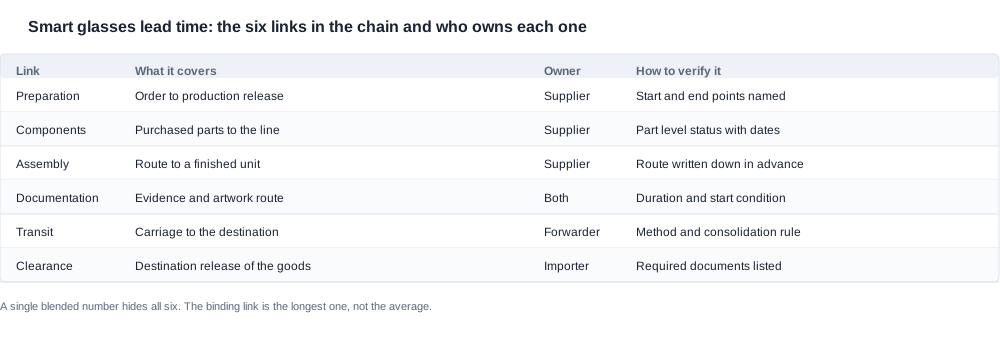
A production schedule is not a duration, it is a chain of waits, and the useful output of the calculation is the name of the link that binds. Preparation, component readiness, assembly, documentation, transit and clearance are six different clocks with six different owners, and a supplier who blends them into one number is describing an average rather than a plan. The second point is that three published figures put a floor under the plan and are frequently mistaken for lead times: the charge time, the rated run time and the component lead time. None of them is a lead time, and each of them belongs in a different place in the chain.
The third point is what a buyer can actually move. The shape of a schedule responds to an earlier configuration freeze, a reduced configuration count, a documentation route started before the order and a split delivery against a frozen configuration. The passage of time does not. So the negotiation about smart glasses lead time is not about persuading anyone to work faster; it is about removing waits from the chain and about floating the links that a third party controls.
Who is reading this, and what the schedule has to survive
The reader is a procurement manager on the brand side, a channel buyer or an importer who has a date that cannot move. It is usually a launch date, a retail listing date, a tender deadline or a trade show, and it is usually already fixed while the schedule that has to deliver it is still being assembled. The question being managed is not whether the supplier is slow. It is which link in the chain is the binding one, whether it is inside the buyer's control, and what happens to the date if it is not.
There is a second layer underneath that. A schedule is also a promise to a channel. A retailer that has committed to a listing date and then does not receive the goods does not usually cancel the listing; it takes the product out of the plan, and the cost of that is larger than the cost of the delay that caused it.
What the catalogue does and does not settle about a schedule
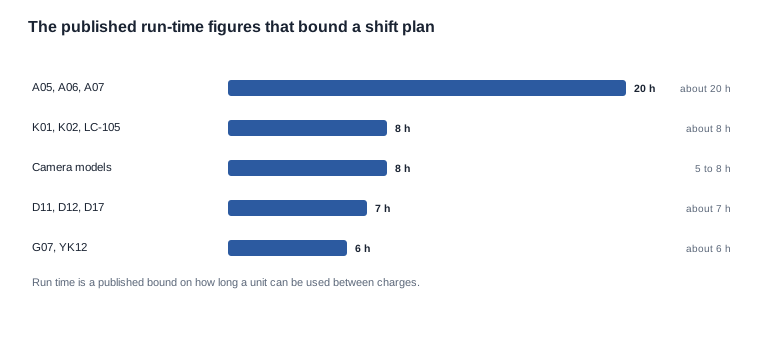
The published data settles more of a schedule than a buyer might expect, and leaves the rest entirely open. It publishes the charge time for all 28 models, with 26 written as a ceiling of two hours or less and the D17 and the ZH12 written as about one hour. It publishes the rated run time for every model, from about 20 hours on the two children's protection models and the children's audio model, through about 8 hours on much of the audio range, down to about 6 hours on the two slim-temple audio models. It publishes the charging interface for 24 models, split between magnetic charging and Type C.
It does not publish a single production lead time, a sample preparation time, a capacity figure, a yield or a price. So the first three of those published durations belong in a shift plan and in a service interval plan, and the schedule itself has to be assembled with the supplier. The lead time red flags article is the short version of what to watch for, and the lead time quality implications article is where schedule pressure lands on the product itself.

The six links in the chain, and who owns each one
The chain, and the owner of each wait
The table below is the working set. The third column is the part that decides whether a schedule can be managed, because a wait with two owners has no owner and is almost always the one that slips.
Where the binding link usually is
In this category the binding link is rarely assembly. It is usually one of three, and the pattern is consistent enough that a buyer can test for it early.
The first is component readiness, because a camera model with a case and a camera model without one are different products to source, and because the case itself is a separate line of purchased parts. In this range the charging case situation across the 11 camera models is genuinely varied: five models publish a case capacity, two publish a case with no capacity stated, and four publish no case row at all — the S7 and the V03, and the V06 and the V03 Pro. A buyer who assumes a case is bundled has to find out which kind of case it is, and when.
The second is the documentation route, because the evidence for a model is not always in hand when the goods are ready, and because the artwork and packaging route usually belongs to the buyer and therefore starts late unless the start condition is written down.
The third is clearance, because it is the one link with a hard external dependency and the one most often left out of the plan entirely. It has a named owner, which is not the supplier, and it has a start condition, which is usually the arrival of the documents rather than the arrival of the goods.

The three published durations that bound the plan from below
The charge time is a ceiling, and a ceiling has to be read as one
All 28 models publish a charge time. Twenty-six are written as a ceiling of two hours or less, and the D17 and the ZH12 are written as about one hour. That is a meaningful distinction and it is easy to get wrong in the buyer's favour by accident. A figure written as "two hours or less" is an upper bound, so it is not the same claim as "under two hours", and a buyer who builds a shift plan on the second reading is building it on a number the catalogue does not give. The safe construction is to plan on the published ceiling as the worst case and to ask the supplier for the measured figure in the condition the programme will actually use.
There is a second reason the charge time belongs in the plan even though it is not a lead time. A device that runs for about 6 hours and takes up to 2 hours to recharge has a worst-case turnaround of 8 hours, and that is the number that determines how many units a single charging point supports across a shift. The G07 and the YK12 are published at about 6 hours, the D11, the D12 and the D17 at about 7 hours, the K01, the K02, the LC-105 pair, the YKC02, the AR glasses and the ZH12 at about 8 hours, the camera models between about 5 to 8 hours, and the children's protection and audio models at about 20 hours.
The run time decides the shift, not the schedule
The published run time bounds how long a unit can be in service between charges, and that is a different question from how long the order takes to arrive. It matters for a programme that sells to a workforce, a fleet or a retail floor, because the number of units and the number of charging points have to be planned against the run time and the charge time together, not against either alone.
The third floor: component lead time, and the one nobody owns
The third duration is the lead time of the constrained purchased part, and it is the one that belongs at the very front of the chain, because it decides when the rest can start. The question to ask is not how long components take in general but which specific part constrains this configuration, what its lead time is, and whether the supplier holds it, buys it against the buyer's order, or buys it speculatively. A supplier who buys speculatively carries the risk and can promise more; a supplier who buys to order passes the risk through, and that is a commercial difference as much as a schedule one.

How to build and verify a schedule before the order
What a buyer can move, and what a buyer cannot
The useful negotiation about a schedule is about the chain, not about the total. These are the moves that shorten a programme without asking anyone to work faster, and they are listed in the order in which they are cheapest to make.
- Freeze the configuration earlier. Every wait downstream of an undecided configuration is a wait with no owner. Deciding the model, the case option and the destination before the artwork starts removes an entire link rather than compressing it.
- Reduce the configuration count. Two case options on one model means two material sets, two packing lists and two sets of documentation. One option removes a branch from the chain.
- Start the documentation route in parallel. The evidence request and the artwork approval can run alongside the purchase order rather than after it, provided the start condition is written down.
- Take a split delivery against a frozen configuration. Where the volume allows it, shipping the first part of the order earlier converts one long wait into a short one plus a second wait, and the second is the easier one to manage.
- Fix the clearance documents before the goods are made. This removes the only link with a hard external dependency from the part of the plan that is not in the buyer's control.
What a buyer cannot move is the passage of time itself, the lead time of a constrained purchased component, and the assessment of a model against a destination market, because all three are set by something other than the buyer's decision. The right way to handle those is not to negotiate them away but to attach float to them and to name the consequence if they move. A schedule commitment with float named in it is one a supplier can stand behind, which is why a plan with honest assumptions is usually easier to guarantee than a plan with a single optimistic date.
The four questions that turn a number into a plan
A buyer who wants a usable answer has to push a single blended duration back into a chain. The sequence below is the order that works, because it starts from the date that cannot move and works towards the terms.
- Start from the fixed date, not from the factory. A launch, a tender or a listing date is the only genuinely immovable point, and everything else is negotiated relative to it.
- Work backwards and mark the slack on each link. The link with no slack is the binding one, and it is the only one worth arguing about.
- Ask for the schedule as a chain, with a single owner per wait and a date per wait. A schedule presented as one figure with no owners has no chain in it, whatever the figure is called.
- Ask what the plan assumes in the two cases that most often break it: the consignment travelling alone rather than consolidated, and the documentation route not starting in parallel with production.
The spreadsheet rule that catches a mis-scoped catalogue
There is a practical trap in working with this catalogue's rows that catches buyers who build their specification from a spreadsheet, and it is worth stating because it produces wrong comparisons rather than obvious errors. The charging interface row is labelled four different ways across the 28 pages — as charging method, charging mode, charging port and charging interface. A sheet that looks for one of those labels will silently pick up 24 of the 28 models and will not see the four that publish no interface row at all, because those four do not have a differently worded row; they do not have the row. The MT6 and the CY05, and the L1 Pro and the CY03 are in that group, and all four do publish a charging case capacity, so a sheet that drops them entirely will also lose the case line and produce a materially wrong packing list.
The same discipline applies to the charge-time label, which appears under more than one wording across the pages, and to the run-time label. The rule is simple: recognise every spelling the catalogue uses before drawing a conclusion from a count.
The checklist before the order
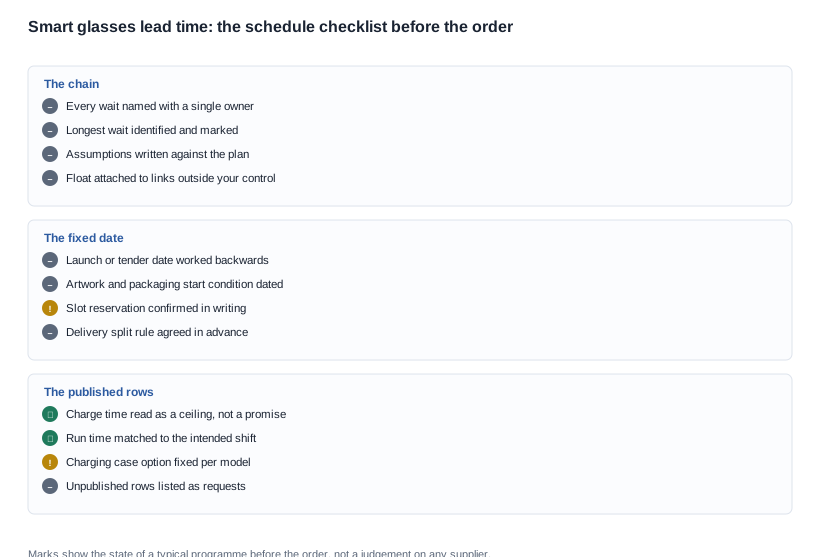
The checklist below is the same sequence in the form it can be sent to a supplier, with a state against each line so both sides can see what is outstanding.
The milestones, with an owner behind each one
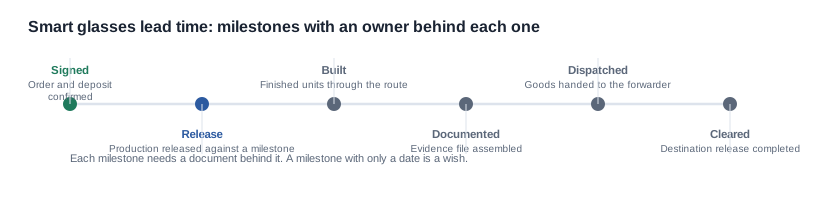
A schedule expressed as a chain of waits becomes a contract only when each wait has a milestone, and each milestone has a document behind it. A milestone with only a date is a wish, and a wish that is not written down cannot be escalated.

Where these programmes actually go wrong
Four failures account for most of the disappointment in this category, and each of them is a planning failure rather than a manufacturing one.
The schedule that was correct until the artwork arrived. Artwork and packaging sit on the buyer's side of the chain and therefore start late unless the start condition is written down. The control is to date the arrival of final artwork as a milestone in the order, not as a courtesy request in an email.
The slot that was reserved but never confirmed. A production slot held verbally and the order placed later, after the slot had gone to someone else. The control is a written confirmation of the reservation, with a date, referenced in the order acknowledgement.
The clearance with no owner. A radio-equipped product needs destination clearance, and it was in nobody's plan. The control is to add it to the chain with a named owner and to confirm which documents the destination requires before the goods are made rather than after they have left.
The single-date plan. A schedule presented as one date slipped by two weeks for reasons nobody recorded, and because there was no chain, nobody could say which link moved. The control is a range with the assumptions attached, plus a log of what actually happened against each wait, which is also what makes the next programme's plan better than the last one.
Nothing here is exotic, and none of it is grounds for changing the supplier. They are reasons to put a line in the order.
What we publish about lead time, and what to send us
The short answer: the published material is the part of a schedule we can stand behind, and the rest is a question for the supplier's own file. We publish what our documentation states, we mark the rows that are open, and we will not fill an open row with a typical figure taken from general data. A buyer who builds a plan on an estimated number finds the error in the field rather than in the quotation, and the correction costs more than the question would have.
So, to be explicit about what is not published for any model in this range: production lead time, sample preparation time, unit price, minimum order quantity, production capacity, yield, defect rate, and the frame weight for every model other than the MT6, where the catalogue publishes 158 g for the glasses body including the 265 mAh cell and the camera, with the foldable charging case excluded and the case weight not published. The certification position is a company-level export-certification page with no per-model certification row, so certificate references, issuing bodies and validity dates are issued per configuration rather than published generally, and the honest answer to a request for one is often that it has not yet been issued for that configuration.
What is published, and what a buyer can build on, is the electrical and mechanical specification: the charge time for all 28 models, the run time for all 28, the charging interface for 24, the charging case capacity for the models that state one, the camera class for the 11 camera models, the Bluetooth version for the models that publish one, and the ingress marking on the two models that carry it. Those figures bound a plan, and the plan itself is the part we build with you.
What we will not do is quote a lead time from a photograph, or fill a schedule gap with a number that cannot be traced to a document. What we will do is take a configuration, a quantity and a market, and tell you which parts are settled, which are open, and which have to come from a sub-supplier. The lead time overview holds the wider commercial framework.
Send us the models, the quantities and the target market, and we will tell you which configurations exist, which of them are open on the published data, and which link in the chain is most likely to bind for your programme. That is the whole of what most buyers most often ask about smart glasses lead time: not a number, but the name of the wait that decides it.