
Microphone quality is the specification buyers most want to compare and least often can: across our catalogue of twenty-eight models there is no pickup distance, no signal-to-noise figure, no capsule type, no microphone count and no described noise-suppression implementation for any model, at any price point. A smart glasses microphone quality smart glasses case study template is therefore not a way to publish a better claim. It is a way to produce the evidence that no catalogue publishes, in a form that another engineer can repeat, a supplier can be held to, and a channel can be shown. If you need microphone evidence before a purchase order this year, run the six fields below on two units drawn from the same batch, capture what the far end of the call actually received, and file the conditions next to the readings. If the far-end capture is missing, stop there — you are holding an impression, and no clause in the agreement will turn it into a measurement later.
Smart glasses microphone quality: what a case study has to carry
The buying task behind an evidence template
The reader here is a brand-side product manager, a channel buyer or a sourcing manager who has been asked to approve a call-led line and has discovered that there is no specification to approve. The concrete situation is ordinary: two quotations in front of them, both describing intelligent noise reduction and directional audio, both with a price gap of around twenty per cent, and no published figure that would tell them which one to take. The decision is not which microphone is better, because nobody can answer that from a sheet. The decision is what has to be produced before signing, so that the choice is defensible six months later when the first delivery arrives and a customer says the calls are worse than the demonstration they were shown.
Three situations produce that question. The first is a brand adding a call-led variant to an existing camera platform, where the microphone is inherited from whatever the platform already carried and nobody chose it. The second is a brand opening a dedicated voice line, where the acoustic arrangement is the product and the evidence is the only protection against a supplier quietly substituting a cheaper chamber. The third is a distributor who has been shown a demonstration unit and now has to place a bulk order without an engineering function able to run the protocol internally.
What the buyer is afraid of is not a quiet microphone. It is a programme in which the microphone was never specified, so nothing was ever agreed, so the first complaint cannot be diagnosed and the first claim against the supplier cannot be settled. That is what an evidence template is for, and it is worth naming the distinction early: a template does not tell you which product to buy. It tells you what you will have in your hand when the decision is questioned.
Why the same platform produces different microphone results in different rooms
Two features of this category shape everything that follows, and neither of them is a number.
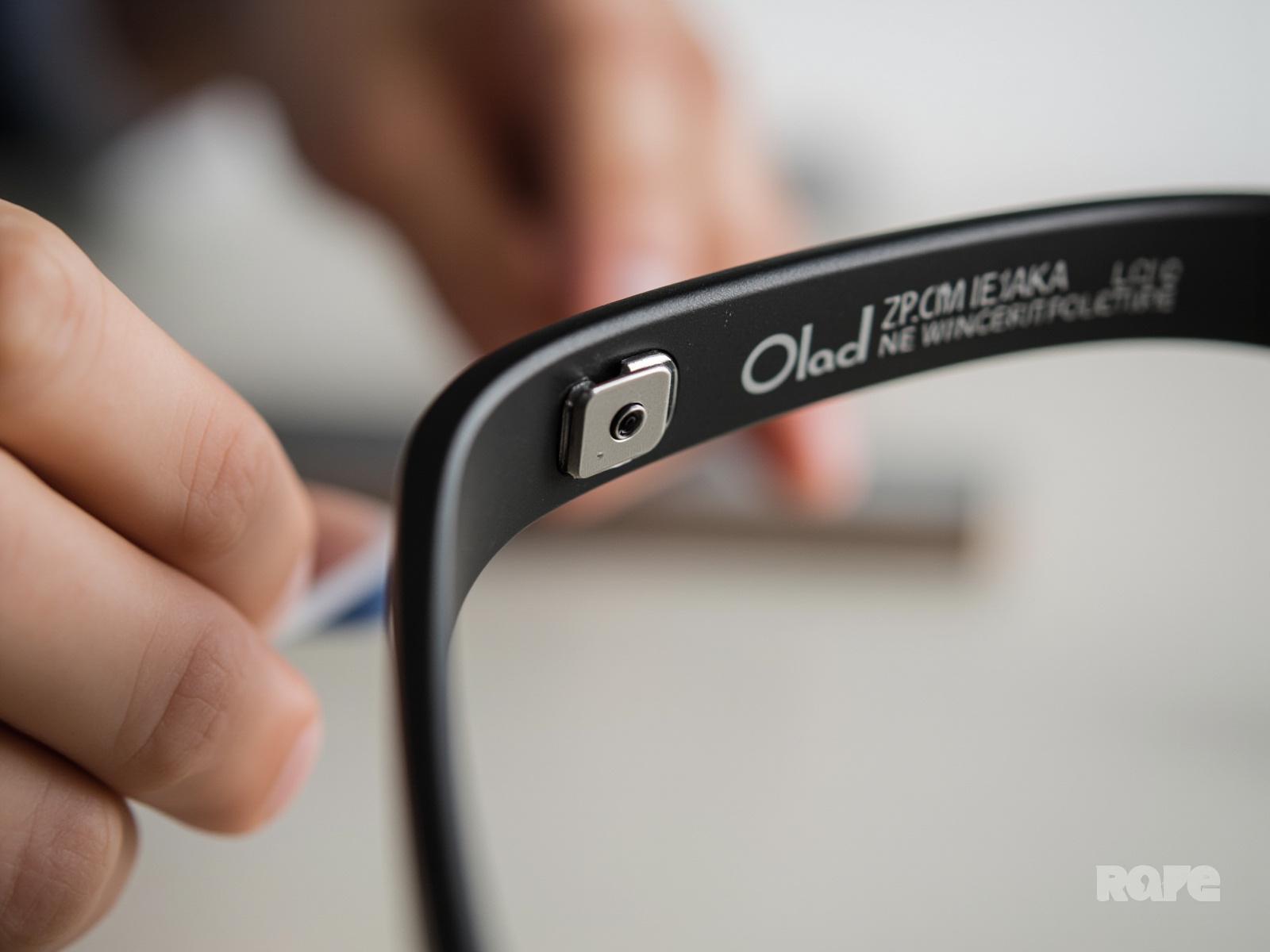
The first is structural. A microphone on a temple has no seal. Sound reaches it through the frame, along the arm, and reflected from the side of the head, and the person's own voice arrives at it at a level that depends on head position and on how the frame sits on that particular head. An earbud microphone sits in a sealed acoustic path a few centimetres from the mouth. The glasses form factor therefore accepts a harder acoustic problem in exchange for leaving the ear open, and a buyer who compares a glasses microphone against an earbud microphone on paper is comparing two products with two different priorities. A supplier that quotes the same figure for both is either quoting an earbud number or quoting nothing at all.
The second feature is about where the value sits in the chain. On a camera model, most of the bill of materials is visible in the published rows: the sensor class, the cell configuration, the charging time, the rated runtime. On a microphone, almost none of it is. The capsule, the preamplifier, the port geometry, the chamber volume and the tuning all sit inside a line that reads "intelligent noise reduction", and that line costs almost nothing to print on a quotation. The microphone is therefore the cheapest part of the product to under-specify and one of the most expensive to get wrong commercially, because a call that fails does not arrive as a warranty claim. It arrives as a support stream and a review that says nothing precise enough to be actionable.
The buyer's negotiating space sits nowhere near the unit price. Unit price is set by the visible rows — the sensor, the cell, the frame — and the microphone is a rounding error inside it. The negotiating space is in the share of units taken at a pilot tier, the right to run your own protocol against production units rather than engineering samples, the documents you can demand before the deposit, the incoming inspection criteria you write, and the return terms you set for a line where a failed call produces a return rather than a ticket. Each of those is a number that moves, and each of them is larger than the per-unit difference between two quotations that differ only in their acoustic chamber.
The evidence fields that do the work, and the three that do not
The six fields and the closing condition for each
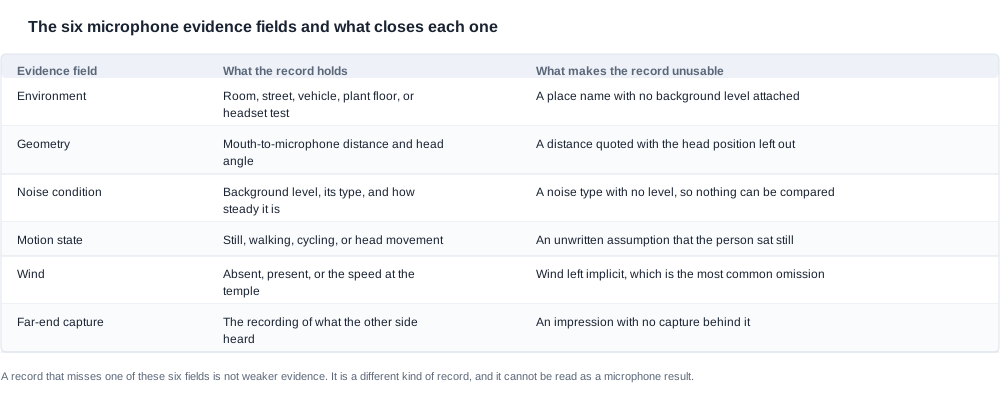
Every microphone record worth keeping carries six fields, listed here in an order that puts the cheap ones first and the decisive ones last.
The environment names the acoustic space, and a name is not enough. A room described as an office can be thirty-five decibels or sixty-five, and the record has to carry the level, the character of the noise and how steady it is. A steady hum, intermittent traffic and wind are three different problems, and noise reduction implementations are generally tuned for one of them. A record that says "office" and nothing else cannot be compared with a record that says "office, steady hum at a stated level".
Geometry is the distance from the mouth to the microphone together with the angle of the head, and it matters more in this form factor than in a headset, because the effective distance changes every time the person turns their head, which during a call is constantly. A record that carries a distance but omits the head angle has fixed the more stable parameter and left out the more variable one.
The noise condition is the background level, its type and how steady it is. This is the field that separates a measurement from a demonstration, and it is the one most often left out because the person running the test assumes everyone knows the room.
The motion state is still, walking, cycling, or head movement. It is the field most often left implicit, because the person running the test is sitting down. A microphone that is clear while somebody is stationary can be unusable while that same person is moving, and the difference is not marginal: airflow over the temple and frame movement against the cheek both change the acoustic path at once.
Wind is present or absent, with the speed at the temple if it is present. This is the most common omission in the whole category and the most expensive, because wind is the condition no firmware change can rescue.
The far-end capture is the recording of what the other side of the call received. It is the only field that produces a result rather than a description of the conditions, and every other field in the record exists to make this one interpretable.
The three that carry the result, and what each one rules out
Of the six fields, three do most of the work, and it is worth being precise about which three, because the temptation in any template is to treat all six as equally binding and then quietly drop the inconvenient ones.
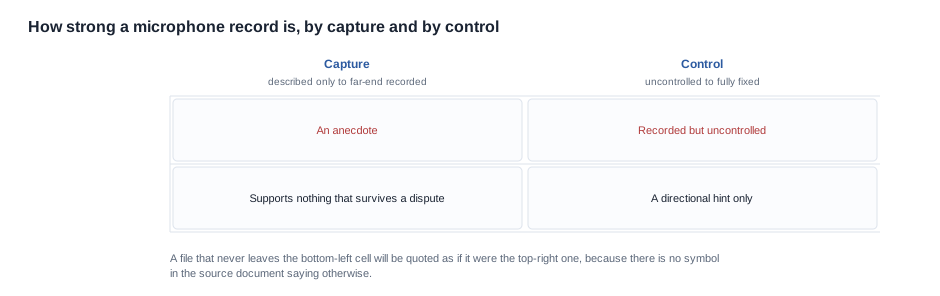
The far-end capture rules out the substitution argument. It is the difference between asserting that a product is acceptable and demonstrating that it was acceptable on a named unit on a named date, and only the second survives a customer complaint.
The noise condition rules out the quiet-room result, which is the most common number in this category and the least useful. Any open-ear product passes in a quiet room. A record that does not state the background level cannot be compared with a record that does, because a thirty-decibel difference in the room is larger than most of the differences a buyer is trying to resolve.
The motion state rules out the demonstration. The product shown in a showroom and the product delivered into a warehouse are the same product and behave differently, and the only field that records that difference is the one stating whether the person was moving.
The other three — environment, geometry and wind — are not optional, but they are supporting. They do not produce a result; they make a result readable. A buyer who collects them and stops has a well-documented test with no outcome in it.
Why two records of the same product are not comparable
One warning belongs on every record, and it is the warning most often left out of the template: figures from two suppliers, two runs or two models are not directly comparable until the conditions are matched, and the mismatch is usually the measurement rather than the product.
A pickup figure measured at conversational distance in a quiet room and one measured at the same distance with a fan running are two different measurements sharing a label. A runtime quoted from a full cell and a runtime quoted from a partly discharged cell are two different measurements. Even the distance row stays ambiguous until the head angle is fixed, because the effective distance changes with the angle.
The catalogue itself demonstrates the problem, because the same cell value appears with different ratings. The G07 and the YK12 both carry 55mAh × 2 cells, both charge magnetically, and both are V5.4, but both are rated at roughly six hours of use; the LC-105-1 and the LC-105-2 share that cell and that charging method and are rated at roughly eight hours. Two models that match on three published rows differ on the fourth, and a buyer comparing on the cell alone has no way of knowing which rating applies. That is the general case in miniature: without the conditions, two numbers in one row are two different measurements.
The rule that follows is simple, and it is the one most often broken. A figure without its conditions is not a weaker figure — it is not a figure. Record it as absent, and keep it absent from the comparison rather than carrying it into the table as a zero. The cost of getting this wrong is not a wrong decision; it is a decision that cannot be defended later, because the file supporting it has a hole in it and the supplier knows where the hole is.
How to collect microphone evidence so a second engineer can repeat it
The five steps, and the one that invalidates the rest
Collecting the evidence is five steps, and the order is deliberate because each one narrows what the next one can be. A skipped step does not weaken the record; it changes what the record is about, and it does so silently.
Step one is to write the use case in a single sentence before any equipment is touched: where the product will be used, and what counts as good there. That sentence sets the bar and sets it before anybody can argue about a number. A quiet room sets a low bar, a street sets a high one, and the sentence is the only thing that tells you which test is worth running at all.
Step two is to fix the protocol in writing: the phrase, the distance, the head angle, the background level and its reproduction, the number of attempts, the judge, and the receiving device. Write it before the first run, because a protocol designed afterwards is a description of what happened rather than an instruction for what to do.
Step three is to run it in the target environment rather than in the lab, and to capture the far end on every run without exception.
Step four is to repeat the run on a second unit from the same batch. This is the step that most often changes the conclusion rather than merely confirming it, because a batch with a placement variation shows that here and nowhere else. It is also the step most often skipped, because a second unit reads as a cost rather than as a control.
Step five is to file the record with its conditions, the unit count, the batch reference and the date, and to state plainly what the record does not cover.

The questions to ask a supplier before the sample ships
The questions to ask a supplier are worth putting in a single message, before the sample ships rather than after, and each one has a reason attached.
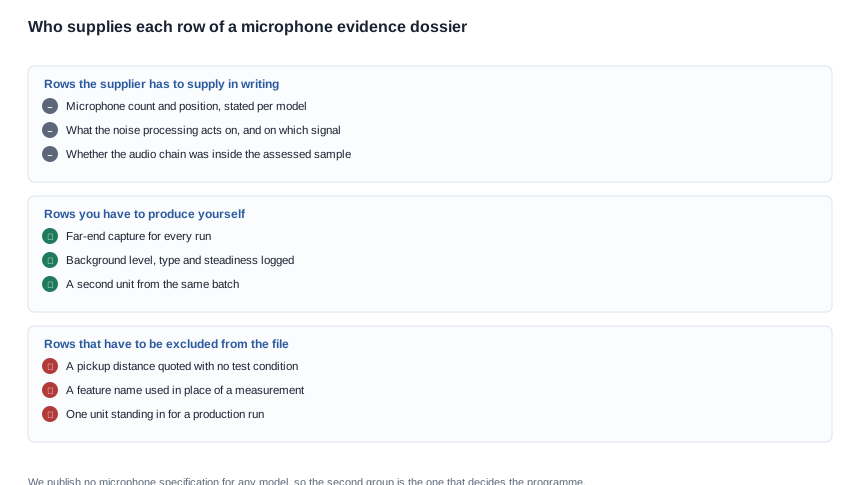
- How many microphones are fitted, and where are they positioned on the frame?
- What sits between the capsule and the application — a preamplifier, any analogue path, any digital path?
- What does the noise reduction act on, and what is its stated behaviour on a voice at conversational distance?
- Is there a tuning fixture at the end of the line, and is the tuning performed per unit, per batch, or fixed in firmware?
- Was the audio chain inside the sample used for the radio and electromagnetic compatibility assessment?
- Can the microphone be disabled, and what does the device do when it is?
- Which profiles and codecs does the product negotiate, and which one by default?
- What was the state of charge on the unit in every run, and is that recorded?
- Will you run our protocol against production units rather than engineering samples, and will you supply the raw recordings?
We can answer the first four from the catalogue in the sense that we can tell you what our documentation states and, more usefully, what it does not state. We cannot answer the fifth through the ninth for any model, and we will not answer them with a typical value taken from a different programme.
Writing the record so it survives a dispute
A record is only useful if a second person can repeat it and reach the same conclusion, and that means the record has to carry what a test note normally omits: the unit or batch reference, the state of charge, the network and the receiving device, the date and time, the firmware version, and the judge. A record without the receiving device is worthless in a comparison, because the far end has at least as much influence on the result as the microphone does.
Two habits decide whether the file survives. The first is to write the protocol once and never edit it afterwards; a changed protocol starts a new record, and the old one stays on file with its own date so that the history reads correctly. The second is to keep the raw recordings rather than the summary, because a summary is written in the light of the conclusion while a recording is not.
The test of a finished record is simple. Hand it to an engineer who has never handled the product and ask them to predict the result of the next run. If they cannot, the record is a description, and a description is exactly what a supplier would have sent you in the first place.

What collecting the evidence costs, and who is carrying it
Where a microphone evidence programme breaks down
Four breakdowns account for most of the failures, and each has a symptom you can see before the cost lands.
The first is a protocol written after the first run. The symptom is that the second run used a different script from the first, so the two results cannot be set beside each other, and the team concludes that the product is inconsistent when the method was. The prevention is one page, written before the first run, and left alone.
The second is a record with no far-end capture. The symptom is a customer dispute that cannot be settled, because the only thing on file is an internal opinion. The prevention is a recording rule that applies to every run without exception.
The third is a single unit standing in for a production run. The symptom is a cluster of returns from one batch in the first month, with a customer explanation that names the product rather than the delivery. The prevention is the second unit, every time, at the cost of one unit and an afternoon.
The fourth is a chamber that changed after the assessment. The symptom is a documentation question arriving from a broker, a marketplace or your own compliance team. The root cause is that the acoustic arrangement was treated as a cosmetic change when it is a change to the product description. The prevention is a change-control obligation covering the chamber, the port positions, the seal and the capsule, with an obligation to notify before any of them moves.
The costs that are quoted as one-off and are not
Separating the cost lines before comparing two quotations is the single most useful thing you can do with an acoustic budget, because four of them are quoted as one-off and are not.
The tuning fixture and the calibration reference are a recurring cost per unit and a recurring time cost on the line, and neither appears in a tooling quotation. The acoustic tuning labour is the same: if the tuning is performed per batch rather than as a one-off engineering task, it belongs in the production cost. The firmware carrying the processing is a development cost, while its tuning data, its configuration and its calibration are not. And the evaluation units are a programme cost rather than a sample cost, because a microphone programme needs a reference unit to compare against and more than one unit to compare with, and both stay on the factory's books for the life of the programme.
Separated this way the commercial picture changes shape. Two quotations that differ by fifteen per cent on unit price can differ by a factor of two on the programme once the recurring lines and the re-validation exposure are counted, and a buyer who negotiated only on unit price has negotiated the smaller number.
The commercial lines that can move on a first order
Five lines are worth spending negotiating capital on, and one is worth putting in the agreement before anything else.
The per-unit price and the volume tiers are the obvious ones. Beyond them: the share of units taken at the pilot tier rather than the run tier; whether the first run is split into two deliveries against a staged payment; whether the supplier will run your protocol against production units and supply the raw recordings so that you can re-judge them; whether the incoming inspection applies to every delivery or only to the first; and the return terms for a line where a failed call produces a return rather than a ticket.
The line to write into the agreement is the evidence itself. Specify the microphone count and positions, the processing description, the intelligibility result per environment with its conditions, the far-end capture requirement, and the unit count and batch the result was taken from. Attach the record. State that a change to the acoustic arrangement voids the record and requires a re-run, and that the acceptance criteria for incoming inspection are the same protocol applied to each delivery. That clause is worth more than any of the price lines, because it is the one that decides what happens when a delivery is worse than the sample that was approved.
The line that is not negotiable is the certification itself: the cost and the time follow the process and the testing body, and pressing on either produces a longer schedule rather than a shorter one. Tooling is a one-off usually amortised across the first order, so the useful questions are over what volume it is amortised and what happens to it if the programme is discontinued.
Turning one microphone evidence record into a case study the channel can use
A hypothetical case: a brand opening a call-led line
This is a constructed scenario, not a client project, and it is written to show the order of the decisions rather than to report an outcome.
Assume a brand with an existing camera platform that wants to add a call-led variant for a field-service channel, shipping into two markets, at a target quantity small enough that an acoustic investment cannot be amortised across the run, with a channel that escalates any voice complaint within a fortnight. The constraint that matters is not the sensor or the cell. It is that the brand has no voice test of its own and no one internally who owns it.
Step one, the use-case sentence: the customer's environment is a vehicle cabin and a plant floor, so the bar is intelligibility against a moving background, and the wind case is in scope because the channel includes an outdoor segment.
Step two, the protocol: a fixed phrase, a stated distance and head angle, a background level reproduced with a reproduced source, a stated attempt count, a fixed receiving device and network, and the far end recorded on every run.
Step three, the collection: two units from the same batch, run in the vehicle and on the floor, with the quiet-room result captured as a sanity check and filed separately so that it cannot be mistaken for the decision.
Step four, the file: the record travels with the purchase order, and the incoming inspection criteria are written as the same protocol applied to every delivery, so that drift between the approved sample and the run shows up at goods-in rather than at the customer's desk.
Step five, the claim: the listing says the microphone is specified for intelligibility in a stated background level, and it does not say the product cancels noise, because no measurement supports that phrase. The listing reviewer accepts the narrower claim, and that is the point — the claim is now smaller than the evidence behind it.
The result is a programme with one agreed number, one attached record and one inspection rule, rather than a feature name and a demonstration. Nothing in that sequence required a different product from what the supplier already builds. What changed is that the microphone was specified rather than inherited.
The limits of a microphone case study template
What we can and cannot tell you about our own microphone position
The boundary we hold: we publish the audio technologies exactly as the catalogue states them — open-ear acoustic structure, directional audio and intelligent noise reduction across the Bluetooth audio family, with Bluetooth V5.3 on the K01 and the K02 and V5.4 on the YK12 and the LC-105-2, the G07 and the D11, and the D12 and the LC-105-1 — and we publish no microphone specification for any model. The sport models publish the same technologies on Bluetooth 5.4, and the same position applies to them. There is no pickup distance, no signal-to-noise figure, no capsule type, no microphone count, no described processing implementation and no leakage figure anywhere in our documentation, and we will not fill any of those gaps with a typical value taken from another programme. A typical value is a number that no test in your programme produced, and it is exactly the kind of number that ends up on a retail box and then on a review.
What we can do is tell you which models sit in the audio family, what the catalogue states for each of them, and where the catalogue is silent. We can tell you which of the six evidence fields a given use case actually needs, because that follows from the environment rather than from the product. What we cannot do is fill an evidence field on your behalf, supply a record you did not produce, or rank two products on acoustic performance that has not been measured on either of them.
The four actions that follow from the template
Four actions, in order, and none of them requires a purchase order.
- Write the one-sentence use case and the bar it implies.
- Send the nine questions in a single message, before the sample ships.
- Run the protocol on two units from the same batch, in the target environment, with the far end recorded.
- Attach the record to the purchase order and write the same protocol into the incoming inspection criteria.
The design questions behind these records sit on noise control and microphone pickup, the acoustic arrangement is covered at open ear audio, and the sample-handling side is at sample evaluation. The vocabulary that trips buyers up is set out in the open ear audio glossary. Send us the environment, the channel and the two models you are holding against each other, and we will tell you which of the six evidence fields decide between them, which of the nine questions the catalogue closes today, and which have to come from the engineering and compliance teams.
Related reading
- Acoustic claims beside microphone claims — open ear audio manufacturer claims
- Why an audio claim goes unverified — open ear audio glossary
- Running the template properly — sample evaluation
Tell us the environment your customer will use and we will tell you which of the six evidence fields are the ones that decide it.


