

Microphone cost in smart glasses is dominated by a decision that is made once, at the design stage, and is invisible in the published price: whether the product uses a single microphone with processing, or an array of microphones positioned relative to the mouth. The second costs more in hardware, more in tooling and more in development, and it is worth considerably more in the environments that generate complaints.
That decision cannot be made from a specification, because the published position across our range is that no third-party acoustic measurement supports any model. There is no published microphone specification, no pickup distance, no frequency response, no signal-to-noise figure and no cancellation depth. The catalogue describes the audio as open-ear acoustic structure, directional audio and intelligent noise reduction, and the technology names are the same across the range even where the underlying designs plainly differ.
So smart glasses microphone quality smart glasses cost factors is a question about what drives the cost when the specification cannot be used to compare. The answer is not the capsule. It is the chamber, the temple geometry and the recurring cost of keeping the assembly in tune — and those three are the lines most often missing from a quotation.
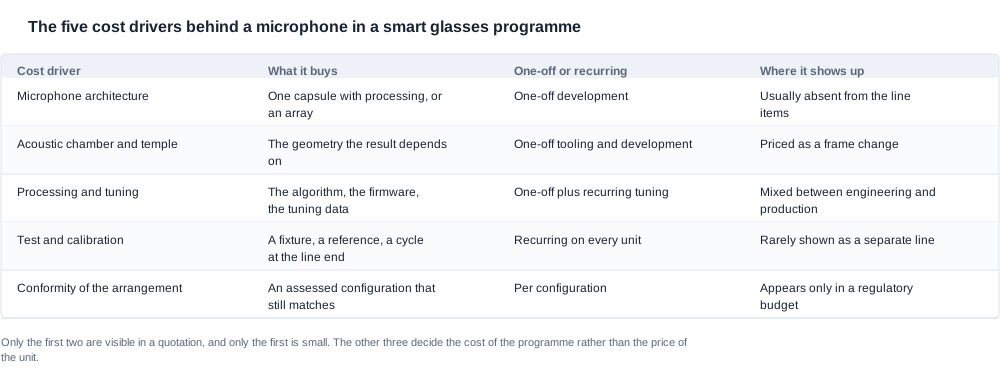
Smart glasses microphone quality: where the cost actually sits
The five cost drivers, in order of weight
1. The microphone architecture. A single microphone with noise processing, or an array with beamforming. The hardware cost difference is modest; the development, the tuning and the tooling cost is not, because an array needs specific positions relative to the mouth and relative to the acoustic chamber, and that constrains the temple design before anyone has measured anything.
2. The acoustic chamber, and therefore the temple. The temple geometry determines the chamber, and the chamber determines the acoustic result. In our range the G07 publishes a slim and detachable temple, the YK12 a slim temple with a surround sound configuration, and the LC-105-1 and the LC-105-2 no temple description at all. Each of those is a different chamber and therefore a different tooling and development path. This is the cost driver buyers consistently underestimate, because the temple is a frame cost and the microphone is an electronics cost, and in this category the two are one decision.
3. The processing. What the product does with the signal: the algorithm, the firmware, the tuning, and the test equipment needed to tune it. In a product with an AI feature, the processing budget competes with the model running on the device, and the published position is that which models are supported and where the processing happens is not published for our range.
4. The test and the calibration. A product with a tuned microphone has a tuning fixture, a calibration reference and a test cycle at the end of the line. This is a recurring per-unit cost and a recurring time cost on the line, and it appears in the production cost rather than in the tooling quote.
5. The certification of the acoustic arrangement. A changed chamber can change the assessment result, and a changed result can require a new conformity assessment. This is the cost driver that surprises people most, because it appears in a regulatory budget rather than in an engineering one, and it arrives after the order rather than before it.
Where the money hides between the quotation and the goods-in
The five drivers above are the engineering view. The commercial view is different, because most of them land on the buyer rather than on the quotation.
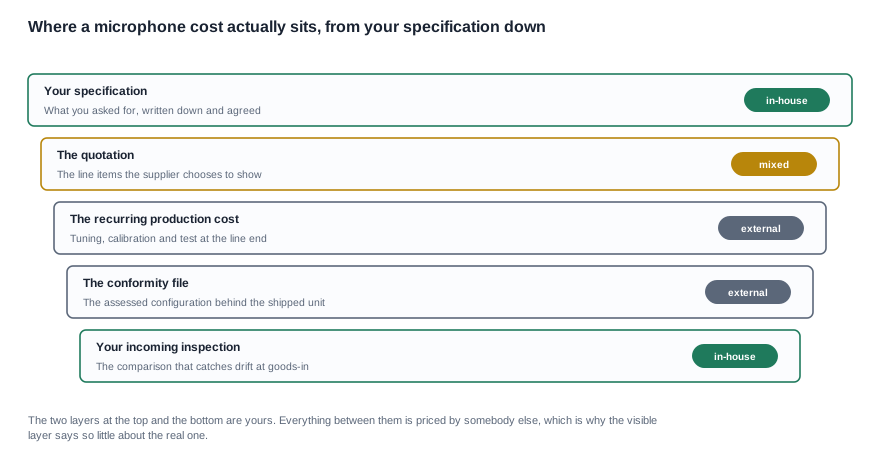
The top layer is the specification, and it is entirely yours. The layer below it is the quotation, and it shows only the items the supplier has a reason to show. The two layers below that — the recurring production cost and the conformity file — are real, continuous, and almost entirely invisible from the outside. The bottom layer is your incoming inspection, and it is yours again, and it is the layer that decides whether a delivery that has drifted is caught at goods-in or by a customer.
A buyer who reads the second layer as the whole picture will make the wrong decision about the third, the fourth and the fifth. That is the practical reason to ask for the cost lines separately rather than accepting a bundled unit price.
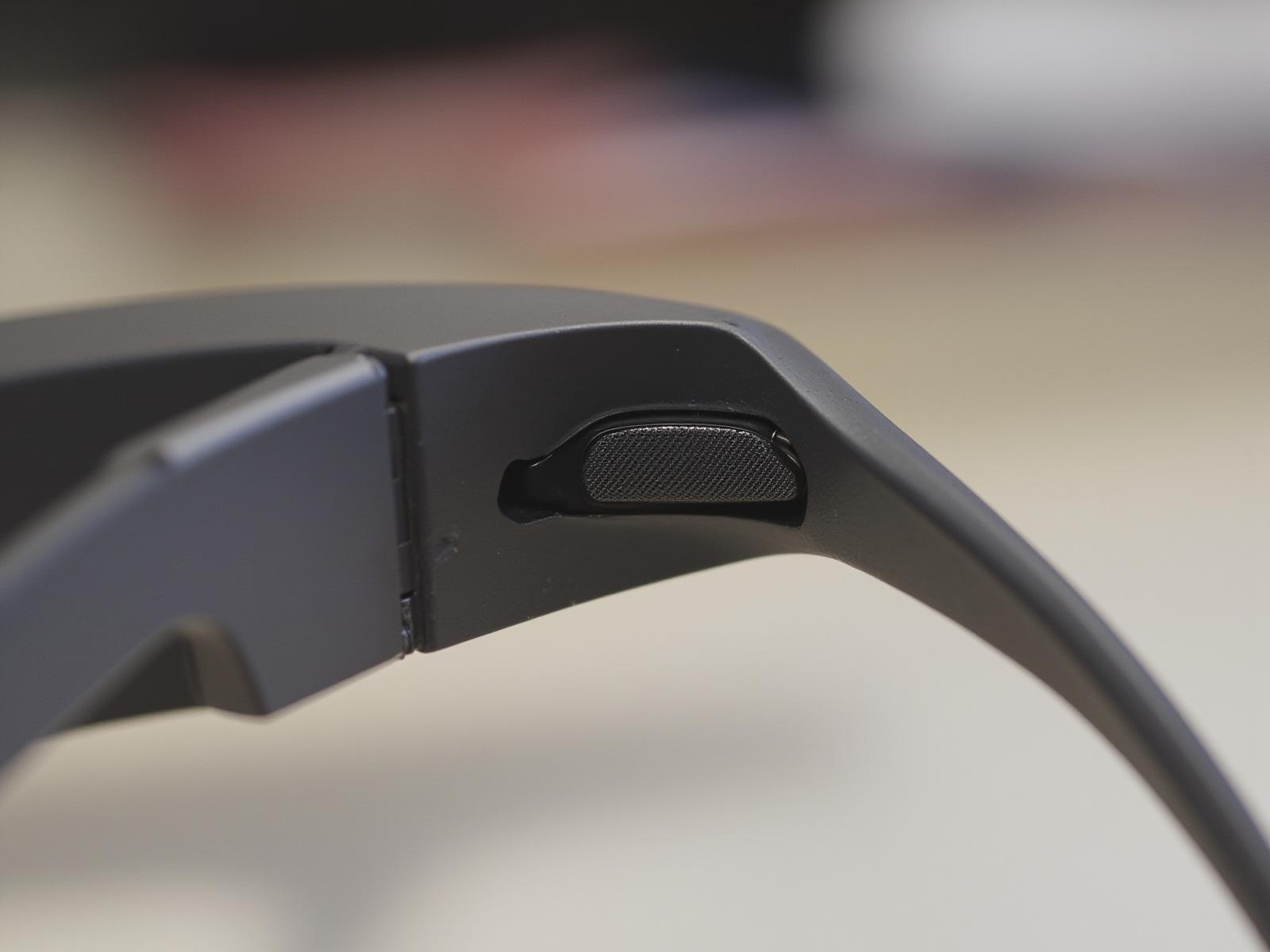
The cost drivers buyers underestimate and suppliers price in
The chamber is the microphone, in cost terms
The single most useful reframe in this category is that the acoustic chamber is the microphone. A buyer who thinks of the microphone as a component bought from a vendor will price it as a line item of a few cents, and will negotiate on that line. A buyer who thinks of the chamber as the microphone will understand that the temple geometry, the port positions, the seal and the capsule have to be designed together, and that changing any one of them changes the result.
The commercial consequence is direct. It means the microphone architecture is settled at the design stage, which is the cheapest point at which it can be settled and the most expensive point at which it can be changed. It means the quotation for a microphone-led programme contains a tooling line that the buyer will read as a frame change and the supplier will price as an acoustic development. And it means the difference between two quotations for the same product can be a difference in chamber design rather than a difference in capsule, which no line on either quotation will show.
This is also why the temple descriptions in our catalogue are not styling information. A slim and detachable temple, a surround sound slim temple and no temple description at all are three different acoustic chambers with three different development costs, and a buyer comparing the G07 with the LC-105-1 on price alone is comparing two products that were never going to have the same result.
The recurring cost that appears on the line and not on the quote
Four lines are quoted as one-off and are not.
The fixture and the calibration reference. A recurring cost on every unit and a recurring time cost on the line. It does not appear in a tooling quotation because tooling is a one-off and this is not.
The acoustic tuning labour. If the tuning is a per-batch activity rather than a one-off engineering task, it belongs in the production cost, and it moves every time the batch size changes, which means it penalises small orders and rewards large ones in a way the unit price does not.
The firmware for the processing. The algorithm is a development cost. The tuning data, the configuration and the calibration are not.
The sample and the evaluation units. A microphone programme needs more units than a non-acoustic one, because the tuning requires a reference and the evaluation requires comparison units. These stay on the factory's books for the life of the programme rather than for the life of the order.
What the published temple rows do and do not tell you
Three temple descriptions in our catalogue are worth reading as cost information rather than as styling information, and it is worth being precise about how far they go.
The G07 publishes a slim and detachable temple. The YK12 publishes a surround sound slim temple. The LC-105-1 and the LC-105-2 publish no temple description at all. In each case the temple is part of the acoustic arrangement, so each one implies a different chamber and therefore a different tooling and development path, and a buyer comparing prices across those three entries is comparing three different acoustic designs without being told so.
What the rows do not tell you is just as important. They do not give the chamber geometry, the port positions, the seal, the capsule, the microphone count or any measured result, and the absence of a temple description is an absence rather than a statement that the temple is standard. So the published rows are enough to know that the acoustic designs are not the same, and not enough to know what any of them costs.
That gap is exactly why the chamber question belongs in the first supplier message rather than in the quotation review. The rows you can read for free tell you that the comparison is not like for like; what they cannot tell you is what the difference is, and only the supplier can put a number on that.

One-off cost and recurring cost, separated before you compare quotes
The four questions that make two quotations comparable
- How many microphones, and where are they positioned? A hardware answer, and the one that tells you whether the noise reduction is a processing claim or an array.
- What is the acoustic configuration of the temple — the chamber geometry, the port positions, the seal? This is the row that decides the result and it is the row most often absent from a quotation.
- Is the noise processing tuned per unit, per batch, or fixed in firmware? This determines whether there is a recurring calibration cost at all, and therefore whether the unit price is the real cost.
- Has the acoustic arrangement been included in the conformity assessment, and what happens if the chamber changes? This is the cost that arrives later and it is the reason to ask the question early.
Separated this way, the commercial picture changes shape. Two quotations that show as a fifteen per cent gap on unit price can be a factor of two apart on the programme once the recurring lines and the re-assessment exposure are counted. A buyer who negotiated only on unit price has negotiated the smaller number, and has done so at the point where the two numbers are least comparable.
The cost lines to ask for as separate items
The request is short, and it is worth making it before the quotation rather than after it, because a request made afterwards reads as a complaint about the price.
Ask for the tuning and calibration on every unit, as a per-unit figure. Ask for the tooling with the volume it is amortised over, not as a single number. Ask for the sample and evaluation units as a count, because a programme that needs a reference unit and two comparison units is a different programme from one that needs a single sample. Ask for the number of configurations that were assessed, because a configuration is a cost unit in a way that is rarely treated as one. And ask what happens to the documentation if the chamber changes, because the answer has a price attached to it even when nobody quotes it.
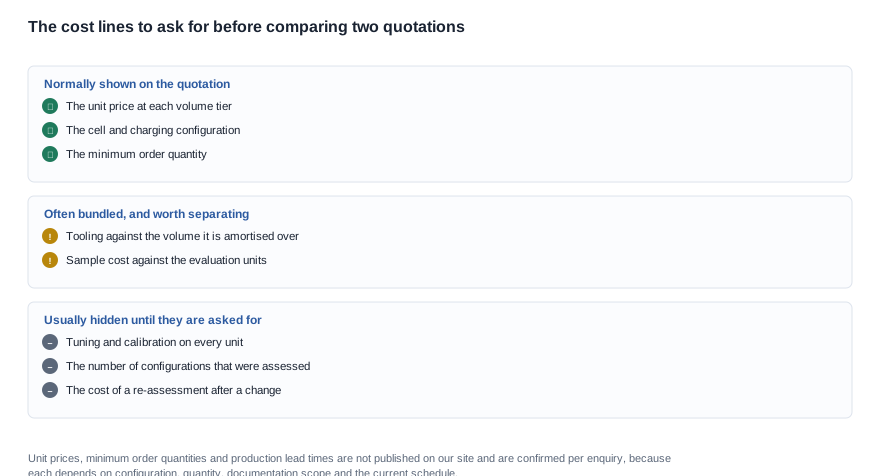
The checklist below sorts the same request by what a normal quotation shows, and the point of the sorting is to show that the lines a buyer spends their negotiating capital on are usually not the lines that decide the cost.

Why two quotations for the same microphone specification are not comparable
Four reasons a unit price comparison fails here
The architecture is not stated. A quotation that says "with noise reduction" does not say whether there is one capsule or several, and the price difference between those two designs is a fraction of the development difference. Comparing them on unit price compares two different products.
The chamber is not stated. The temple description is sometimes the only hint, and it is often absent. Two quotations for the same nominal model can therefore be for different acoustic designs, and neither will say so.
The scope of the conformity work is not stated. One supplier's price may include a file covering the shipped configuration and another's may cover a reference configuration only. The difference shows up months later as a document question, not on the quotation.
The recurring work is not stated. A supplier who tunes per unit and a supplier who tunes per batch will quote similar unit prices and produce very different programme costs, and neither will normally volunteer the distinction.
The general rule is that a unit price in this category is not a comparable number unless the quotation says what the unit is. That is a higher bar than most buyers apply to any other component, and the reason is that the acoustic arrangement is the product.
The four things a buyer should not do with two quotations
1. Compare quoted prices for products with different microphone architectures. The cheaper product may have the array and the more expensive one a single capsule with processing, and the price is not the variable.
2. Assume a cheaper product is a compromised one. A single capsule with good processing can be entirely adequate for a call-focused product, and it is a legitimate architecture rather than a fallback.
3. Treat "intelligent noise reduction" as a description of the hardware. It is a description of a behaviour, and a behaviour has to be tested. The red flags to watch for in a supplier's language are set out at microphone quality red flags.
4. Negotiate the unit price while the acoustic architecture is still open. The architecture is the largest cost driver and it is settled at the design stage, so it is the cheapest thing to change and the most expensive to change late. This is the mistake with the worst ratio of effort to return, because the negotiation feels productive and the cost is incurred anyway.

The cost factors that only appear once the order is placed
The costs that arrive after the purchase order
Three of the five cost drivers are paid for after the order, which is unusual and worth planning for.
The re-assessment after an acoustic change is the first. If the chamber, the port positions, the seal or the capsule moves after the file is written, the file has to be revisited, and the lead time belongs to the testing body rather than to the supplier. The prevention is a change-control obligation with a notice requirement attached, and it costs nothing to write.
The drift detection cost is the second. A supplier who changes a component without telling anyone produces units that are acoustically different from the approved sample, and the cost of finding that out at goods-in is an incoming inspection that did not exist in the original plan. The prevention is a retained golden unit and an inspection criterion written before the first production delivery.
The sampling cost of the field is the third, and it is the one that is easiest to under-budget. A microphone programme produces complaints in a low but non-zero proportion, and each complaint consumes a unit, a freight booking, a support cycle and a root-cause investigation. The rate is not published for this category by anyone, which is why it belongs in the total cost calculation as a range to be tested against your own first deliveries rather than as a number to be assumed.
The commercial structure that makes these costs visible
The negotiation that pays back in this category is rarely about the unit price. It is about the following.
Whether the supplier will run your protocol against production units rather than engineering samples, and whether it will supply the raw recordings. Whether the incoming inspection applies to every delivery or only to the first. Whether the first run is split into two deliveries against a staged payment, which converts a large commitment into two smaller ones at the point where the second one is informed by the first. Whether the share of units taken at the pilot tier can be set independently of the run tier. And whether the cost of a re-assessment after an acoustic change is quoted as a fixed line or absorbed silently into the next order.
Each of those is a number that moves. The unit price on a two-thousand-unit order is worth less in real terms than any one of them, and it is also the number the supplier can move least.
The cost figures we publish and the cost figures we do not
Where our own documentation stops
The working rule we apply: the catalogue's audio technologies are published exactly as they stand, and the rows a buyer needs in order to compare two microphones — a pickup figure, a profile list, a cancellation depth, an acoustic measurement — are blank for every model in the range, because none of them is published to us. "Intelligent noise reduction" is a catalogue phrase and we will not promote it into a specification, and we will not rank two products on acoustic performance that has not been measured on either of them.
The cost side is the same. Unit prices, production lead times and minimum order quantities are not published on this site and are confirmed per enquiry, because each depends on configuration, quantity, documentation scope and the current schedule. A quote that does not say which architecture it covers, which chamber it was built for and how many configurations were assessed is a quote for a different product, and comparing it to another quote on unit price alone is comparing two programmes on the one number that is least informative.
What we will do is tell you the published configuration accurately, and tell you which of the five cost drivers is likely to dominate a given programme — which is usually the temple and the chamber rather than the microphone itself. The models referred to here are in the Bluetooth audio glasses range, the questions to put to a supplier are listed at microphone specifications to request, and the underlying technology position is on noise control and microphone pickup.
Send us the use case and the environment, and we will tell you which cost driver to expect to dominate.
Related reading
- Noise control and microphone pickup
- Microphone specifications to request
- Microphone quality red flags
- Bluetooth audio glasses range
Send the use case and the environment and we will tell you which cost driver to expect to dominate.


