

Red flags in a microphone claim are unusually easy to spot, because the claim has almost nothing to hide behind. There is no published microphone specification anywhere in this range — no pickup distance, no frequency response, no signal-to-noise ratio, no cancellation depth, no microphone count — and a supplier making a performance claim in a category where the performance data does not exist is telling you how they operate before the first sample arrives. That is the whole subject of smart glasses microphone quality smart glasses red flags: not a list of bad suppliers, but a list of the substitutions that make a microphone claim unfalsifiable, and the question that catches each one.
For a sourcing team the practical value of this list is that it converts a vague unease into a checklist. Every red flag below has a question attached, and every question has an answer shape that is either present or absent. A supplier who answers all of them precisely is one whose other claims can be evaluated. A supplier who answers with adjectives has told you the quality conversation will be conducted on impressions, which in a voice channel is a category of risk you cannot manage with a sample.
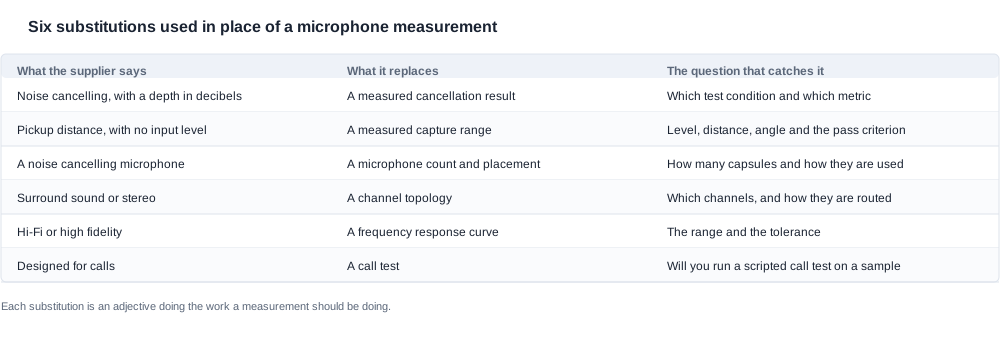
Smart glasses microphone quality: six substitutions used when a measurement is missing
The catalogue row for our own models reads open-ear acoustic structure, directional audio and intelligent noise reduction, sitting alongside Bluetooth versions, cell configurations, charge times, rated runtimes and charging methods. There is no number attached to the audio behaviour anywhere in the range. That is the backdrop against which the substitutions below are read: a buyer who cannot find a figure in the published material has no reason to expect one in a quotation, and a supplier who supplies one anyway has decided to manufacture it.
Cancellation depth in decibels, with no condition
Noise cancellation is a system behaviour, not a property of a component. It depends on the microphone count, the placement, the algorithm, and what happens to the signal downstream. A cancellation figure quoted without the test condition, the environment and the metric has replaced a number with an adjective. This is the most common substitution in the category and the one most likely to be wrong in a way that matters commercially, because a headset test condition and a street test condition produce entirely different results from the same platform.
The question that catches it: which test condition and which metric.
Pickup distance with no input level
Pickup distance is measured against a reference signal at a stated level, with a stated criterion for what counts as captured. A number without a level and a criterion is not a measurement of anything; it is a distance. The figure can be entirely honest and still be meaningless, which is what makes this substitution so effective.
The question that catches it: the level, the distance, the angle and the pass criterion.
A noise cancelling microphone, in place of a microphone count
The microphone count and its arrangement are hardware facts, and they are verifiable on the product. If a supplier is describing a single capsule, then the noise cancelling description is a processing claim sitting on top of it — a much weaker thing than the phrase implies, and one with a different ceiling in every environment.
The question that catches it: how many capsules, and how they are used.
Surround sound or stereo, in place of a channel topology
Several models in this range publish surround sound or surround audio as a configuration description. That phrase does not establish whether the output is two channels, how they are routed, or whether the ambient environment is included in the mix. It describes an impression rather than a topology, and readers routinely treat it as though it settles the question.
The question that catches it: which channels, and how they are routed.
Hi-Fi or high fidelity, in place of a frequency response
A frequency response is a curve with a stated range and a stated tolerance, and it is one of the few figures in audio that is genuinely standardised. A supplier willing to publish a response curve has the measurement infrastructure to produce one. A supplier offering hi-fi instead has made a decision that the number was not worth obtaining.
The question that catches it: the range and the tolerance.
Designed for calls, in place of a call test
A call test is a specific, repeatable procedure, and it is the one measurement a buyer can run without a factory relationship, on a sample, in the buyer's own environment. A supplier who declines to have one run has told you what they expect to find.
The question that catches it: will you run a scripted call test on a sample.
Why a microphone claim with no number is easier to fake than a camera claim
The reason the microphone is the easiest claim in this product to fake is that the evidence is not visible at the point of sale. A camera specification is legible: a buyer can compare two resolution tiers on a listing page, check that the numbers match, and spot a mismatch between two suppliers' pages in seconds. A microphone claim has no comparable public anchor. Nothing about the finished carton, the packaging, the printed specification block or the unboxing tells a buyer whether the claim is backed.
That asymmetry has a commercial consequence that a sourcing team should price in. Where a camera figure is wrong, the customer can usually see it themselves, and the return arrives with a photograph. Where a microphone claim is wrong, the customer cannot evaluate it either — they simply experience a bad call and describe it as a bad call. The complaint arrives as a general product complaint, sits in the returns data mixed with sizing and battery issues, and is resolved by discounting or by blaming the network. Nobody upstream ever learns that the acoustic claim was never measured.
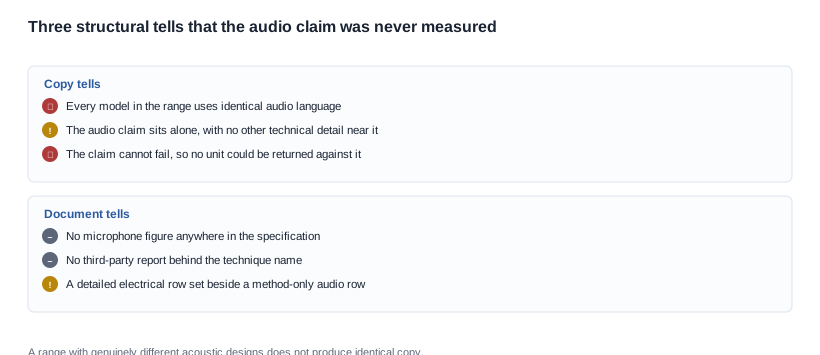
Three structural tells that have nothing to do with audio
Every model in the range uses identical audio language. A range with genuinely different acoustic designs does not produce identical copy. The G07 publishes two 55 mAh cells and a rated window of roughly six hours, with a slim and detachable temple; the YK12 publishes the same two 55 mAh cells and the same shorter window, with a surround sound slim temple; the LC-105-1 and the LC-105-2 publish two 55 mAh cells with roughly eight hours; the K01 and the K02 publish 90 mAh per cell across two cells with roughly eight hours and Bluetooth 5.3; the YKC02 publishes two 70 mAh cells with roughly eight hours. If the audio paragraph is identical across all of them, the paragraph is marketing copy rather than a description of a design.
The audio claim sits alone, with no other technical detail near it. A detailed description that includes a Bluetooth version, a cell configuration, a charge time and a rated runtime, and then describes the audio as intelligent noise reduction, is showing you the shape of its own evidence. The absence of measurement is visible in the document even when the absence of measurement is not visible in the product.
The claim cannot fail. This is the test for a red flag that works on any category, and it is worth applying to a microphone claim before anything else. Could a bad unit be returned against this claim? If a customer cannot be heard in a noisy street, and the listing said intelligent noise reduction, they have a reasonable complaint. A claim that cannot fail is not a specification.
The document tells, which are the ones a buyer can act on
Where a copy tell says the supplier is not careful, a document tell says the supplier has nothing. No microphone figure anywhere in the specification. No third-party report behind the technique name. A detailed electrical row set sitting beside a method-only audio row. These are the three conditions that tell a sourcing team the acoustic question will have to be resolved with a test rather than with a document, and that changes the schedule and the cost before the first order rather than after it.
The six red flags and the question that catches each one
Read as a list, the red flags read like complaints about marketing. Read as a list of substitutions, they become a specification for the request you send. The table below is the working version: what the supplier says, what the phrase is standing in for, and the question that either produces a measurement or produces an admission that no measurement exists.
| What the supplier says | What it replaces | The question that catches it |
|---|---|---|
| Noise cancelling, with a depth in decibels | A measured cancellation result | Which test condition and which metric |
| Pickup distance, with no input level | A measured capture range | Level, distance, angle and the pass criterion |
| A noise cancelling microphone | A microphone count and placement | How many capsules and how they are used |
| Surround sound or stereo | A channel topology | Which channels, and how they are routed |
| Hi-Fi or high fidelity | A frequency response curve | The range and the tolerance |
| Designed for calls | A call test | Will you run a scripted call test on a sample |
The useful property of this table is that every question is answerable by a supplier who holds the measurement. A supplier who does not hold it will answer with a restatement, a deflection, or a longer version of the original phrase. That is the signal, and it is available before a deposit is paid.
The question list, in the order that produces useful answers
- How many microphones contribute to the capture path, and where are they placed? A specific answer about placement is a good sign; a count with no placement detail is a partial one.
- What is the measurement condition behind any figure quoted? Level, distance, orientation and criterion. A supplier holding data has all four; a supplier holding adjectives has none.
- Can we run a scripted call test on a sample in our own environment? A supplier who agrees without hesitation usually has a device that performs.
- Which environment is hardest for this model? A specific answer is worth more than a general one, and the honest answer is often the one that limits the channel.
- Is the noise handling automatic or user-switchable? Manual control in a product sold for sport or field use suggests the automatic setting is not sufficient for that use.
These five questions are the operational form of the table above, and they are the same questions the microphone manufacturer claims page expands on.
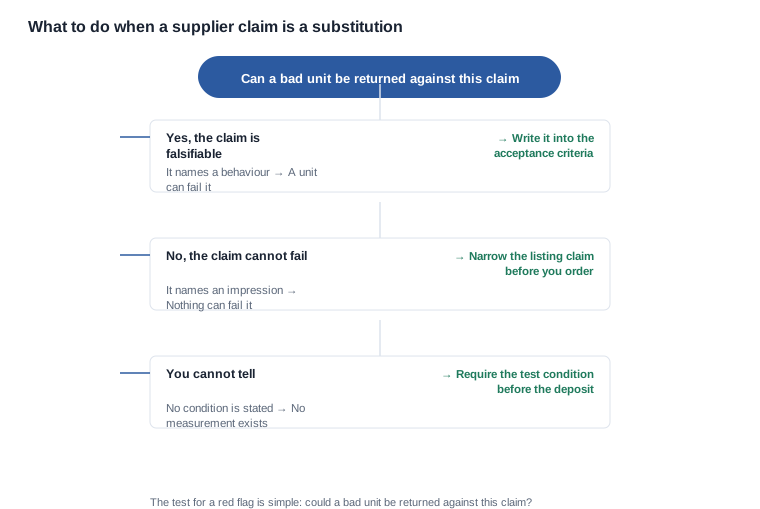
Testing a supplier's answer for whether it is a number or an adjective
There are only three possible shapes of answer, and a buyer should recognise each one quickly because each one leads somewhere different.
The claim is falsifiable and documented. The supplier names a behaviour, a condition and a method, and a unit can fail the claim. That means the claim can be written into the acceptance criteria, the second unit can be tested against the same condition, and a returned unit can be argued on the evidence rather than on recollection. This is the only shape that turns a claim into a purchase criterion.
The claim names an impression and cannot fail. Nothing can be returned against it, because no unit can be shown to have violated it. The action is not to reject the supplier but to narrow the listing claim before the order, so that the marketing copy and the enforceable criteria describe the same thing.
The condition is not stated, so there is no measurement. Here the action is procedural and has to happen before the deposit: require the test condition, in writing, and make it a condition of the order. If the condition cannot be supplied, the buyer has learned that the acoustic claim will never be evidenced, and should price that into the decision rather than discovering it at the returns desk.
Turning a red flag into a criterion the supplier has to meet
The last of the three answer shapes is the only one that ends in something a factory is accountable to, and the route from there is short. Name the environment the product is sold into. Write the judgement in the words a customer complaint actually uses, because a criterion phrased in the buyer's language can be tested by the buyer's own team. Attach the background level, the distance and the scoring rule, so that the criterion is reproducible rather than impressionistic. Put the criterion and the protocol into the purchase order, where it is enforceable rather than advisory. And state the failure path in advance: re-inspection, rework, or a stated concession.

A criterion written against a behaviour is satisfiable by the product, not by the documentation, and that distinction is the whole point of the sequence. A criterion written against an adjective can only be satisfied by a better adjective.
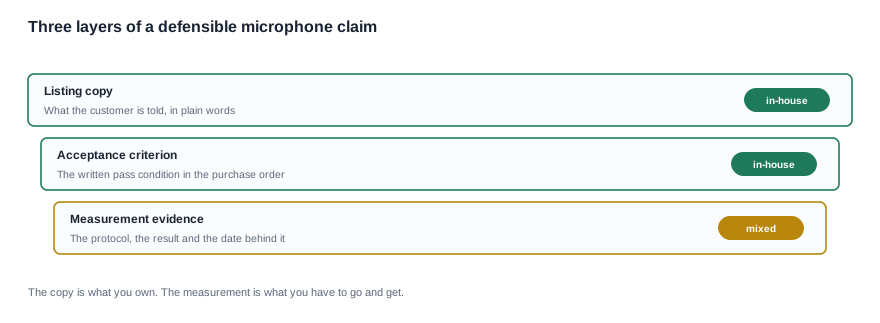
The three layers a defensible claim needs
The layers are distinct, and suppliers routinely confuse them. The listing copy is what the customer is told in plain words, and it is owned by the brand, not by the factory. The acceptance criterion is the written pass condition in the purchase order, and it is the only layer that is enforceable. The measurement evidence is the protocol, the result and the date behind it, and it is held by the factory or by the buyer, not by the brand.
Most red flags are the result of the brand using the first layer to imply the third. When the copy says intelligent noise reduction and no measurement exists anywhere in the chain, the buyer's brand is carrying the risk of a claim it never substantiated, and it cannot point to anything when the first customer complains.
The awkward middle case: a real number with no condition
Somewhere between a bare adjective and a complete measurement sits the case that causes the most argument, because it resembles evidence. A supplier quotes a pickup distance, or a cancellation depth, or a signal-to-noise figure, and the number is real. It came from a measurement. The measurement simply never had conditions attached to it, and the conditions are exactly the four things that would let a buyer reproduce it: the input level, the distance, the angle and the pass criterion.
This case is more dangerous than the adjective, because it survives a quick review. A number on a quotation resembles diligence. The questions to ask are therefore specific rather than general. Ask what the number was measured against, at what level, at what distance, at what angle, and what constituted a pass. If the supplier can answer all five, the number is usable and the condition can be written into the acceptance criteria. If the supplier answers with a description of the technique, the number was a decoration, and it should be treated exactly like the adjective case: the listing claim gets narrowed, and the acceptance criterion is written from a test the buyer runs.
The distinction that governs both cases is the same one, and it is the reason this list exists: a figure with no condition is not better than a phrase with no figure. It is only harder to recognise, because it has the shape of the thing the buyer is hunting for.
What a red flag costs at the point of sale rather than in the laboratory
The cost of a red flag is not the cost of the acoustic shortfall. It is the cost of the response to the acoustic shortfall, and that response is always the same: a return, a support conversation, and a discount or a goodwill replacement.
Let the arithmetic run on a modest voice channel. A three percent return rate on a unit with a thin margin, where the returns are attributed to general product quality rather than to a specific acoustic fault, produces a blended defect cost that the supplier will not carry and the brand will. The same three percent, correctly attributed, becomes an acceptance criterion, a lot rejection at incoming inspection, and a supplier conversation before the next order rather than after it. The acoustic performance is identical in both cases. The commercial outcome is not, and the difference is entirely attributable to whether a claim was falsifiable.
There is a second cost, and it lands on the channel rather than on the brand. A voice product whose reviews are about the voice does not get judged on the rest of its specification. An audio platform in this range publishes a cell configuration, a Bluetooth version, a rated runtime, a charge time and a charging method — the LC-105-1 and the LC-105-2 publish two 55 mAh cells with roughly eight hours of rated use and magnetic charging, and the D11 and the D12 publish a single 100 mAh cell with roughly seven hours on Type-C. The sport models publish the same rows, and the YKC02 publishes two 70 mAh cells with roughly eight hours. Those rows are perfectly good and none of them rescues a product whose calls do not work. Where the microphone claim is unsubstantiated, the electrical rows cannot carry the listing.
A buyer question that finds red flags faster than any list
Ask the supplier which of their models is the worst performer acoustically, and why. A supplier with measurements can answer and will usually volunteer the conditions. A supplier without measurements answers with a general statement about noise handling, because the question is unanswerable. This works because it is difficult to bluff and easy to recognise: the answer either names a configuration and a condition, or it does not.
Narrowing a listing claim instead of narrowing the range
The conclusion of this subject is not that suppliers are dishonest. Most are not. The conclusion is that a microphone claim without a condition cannot be enforced, cannot be compared and cannot be defended, and that the buyer has three honest options when they find one.
Narrow the claim. Replace intelligent noise reduction with a description of the published configuration — the acoustic technique names and the electrical rows — and drop the performance implication. This is the cheapest option and it costs nothing in tooling. What it costs is the marketing advantage the phrase was carrying, and in most channels that phrase was not carrying much.
Narrow the environment. State where the product has been established, and keep the listing to that environment. A product established for indoor operational use should say so. This option preserves a performance statement and limits its scope, which is a defensible position provided the scope is written down.
Narrow the batch. Order a pilot tier, run the scripted protocol on two units from that batch, and hold the balance of the order until the result exists. This option costs time and money and is the right answer when the acoustic performance is the reason the product exists.
What is not available is the fourth option, which is to keep the phrase and rely on the customer not to test it. In a voice channel the customer tests it constantly, without instruments, by making a call.
Our own position on the same subject
We publish the microphone claim as the catalogue states it — open-ear acoustic structure, directional audio, intelligent noise reduction — and we do not attach a number to it. No third-party acoustic measurement supports any model in this range, and we will not manufacture one or quote an industry figure against our own products. That is also why this article can be written: the published data in this category is genuinely thin, and the correct response to thin data is better questions rather than a better adjective.
We will also be direct about the limit. We cannot tell you which of our models performs best in a noisy street, because we do not hold that measurement. What we can do is give you the published configuration accurately, state which models carry which published rows, and help you design a test that produces a number you can rely on — including the questions to put to another supplier, and the questions to put to us. The related ground is at microphone common mistakes to avoid, the channel suitability is at Bluetooth audio glasses for calls, and the technical background is at noise control and microphone pickup.
If you tell us the environment, we will tell you what to test, what to ask for, and which claims to narrow before the order rather than after it.
How to read a claim
- Noise control and microphone pickup
- Microphone manufacturer claims
- Microphone common mistakes to avoid
- Bluetooth audio glasses for calls
Tell us the environment your users are in and we will tell you which claims to test and what to ask the supplier.


