

The decision, in the order it should be taken: decide which environment the product is sold into, measure the microphone requirement for that environment, and only then decide what to spend. The spending that matters is not in the unit price. It is in whether you commission a measurable acoustic design or accept whatever the platform happens to provide, and whether you can defend the difference afterwards. The short version: for a quiet-office use case, microphone differentiation is not worth a price premium; for anything sold into noise, it is the single most valuable item on the specification.
The buying task behind this article. The reader is a brand buyer or a channel buyer who has to decide where to put the money in a product line where the specification sheet says nothing about the microphone. The specific problem is that microphone quality is invisible in a quotation, so it tends to inherit whatever the platform provides, and the decision never gets made deliberately. The buyer's task is to convert the use case into a measurement requirement, price that requirement against the returns it prevents, and make the decision explicit rather than accidental. The commercial risk being managed is over-investing in a feature the customer's environment does not reward, or under-investing in the one it does.
Smart glasses microphone quality: the order in which money should be spent
Three decisions that have to come before any spend
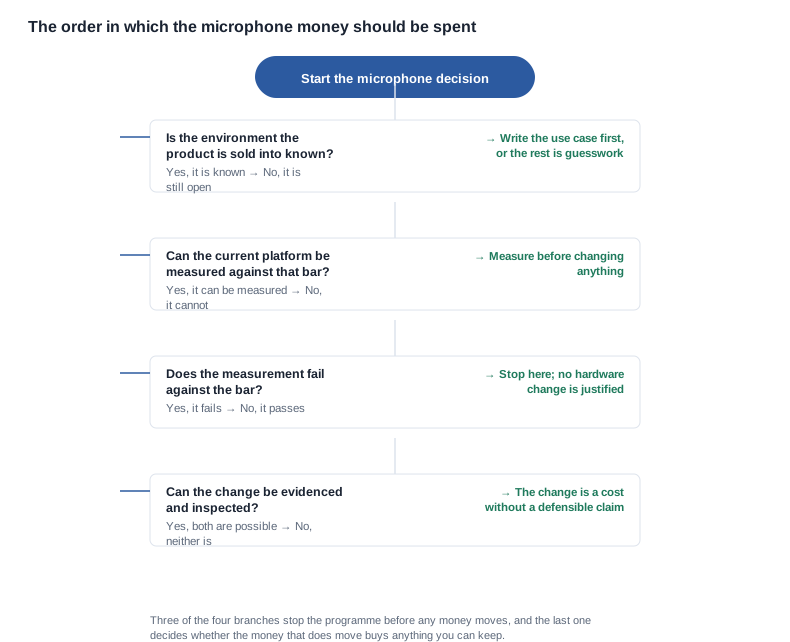
There are three decisions, and each one can remove the need for the one after it. A programme that skips them does not spend less; it spends on the wrong thing.
The environment decision. Where is this product going to be used, by whom, at what background level? This is a sentence, not a study, and it is worth writing it down before anything else because every later decision depends on it. A quiet office and a windy site produce different requirements that are not variations of each other, and a programme that has not chosen between them will end up paying for the union of both and using one.
The measurement decision. Can the current platform be measured against that bar? This sounds obvious and it is where programmes stall, because the answer requires a unit, a script, a judge and an afternoon, and none of those is a purchase order. The answer also decides the next step: if the current platform cannot be measured, then no comparison of two candidates can be trusted either, because you will not know which of them is better.
The evidence decision. If the measurement fails, can the change be evidenced and inspected? A change that cannot be measured after it is made has cost you money and bought you a feature name, and a feature name cannot be defended in a review, inspected at goods-in, or argued with a supplier when a customer says the calls are worse.
What the order is actually protecting
The order protects the most expensive mistake in this category, which is spending on hardware before anyone has established that hardware is the problem.
A platform that is adequate in a quiet room is not a compromised platform. It is an adequate platform, and buying a different acoustic design for a quiet-room product is money spent on something the customer will never hear and the reviewer will never verify. The reverse mistake is more expensive: keeping a platform that fails in the environment the customer actually works in, and discovering it in the first month of the run.
The order also protects the budget from the most common form of procurement drift, in which a supplier proposes a solution and the buyer's job becomes to evaluate it. When the environment and the bar are written first, the supplier's proposal is tested against a standard rather than adopted by default, and the questions that follow are much shorter.
What has to be measured before a microphone premium is justified
The five environments, and what each one demands
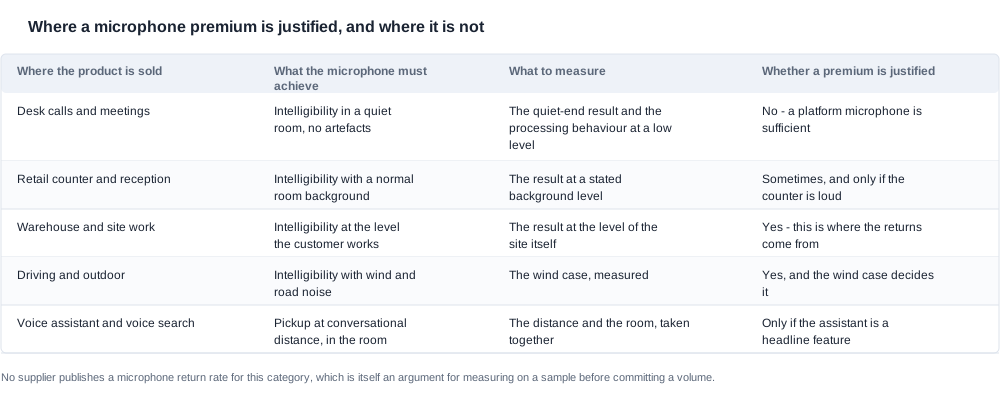
The table below is the criterion set, and it is the thing to hold a supplier against. It is not a scoring system; it is a set of five different bars, and a product either reaches the bar for the environment it is sold into or it does not.
| Where the product is sold | What the microphone must achieve | What to measure | Whether a premium is justified |
|---|---|---|---|
| Desk calls and meetings | Intelligibility in a quiet room with no processing artefacts | The quiet-end result and the processing behaviour at a low level | No — a platform microphone is sufficient |
| Retail counter and reception | Intelligibility with a normal room background | The result at a stated background level | Sometimes, and only if the counter is loud |
| Warehouse and site work | Intelligibility at the level the customer is working | The result at the level of the site itself | Yes — this is where the returns come from |
| Driving and outdoor | Intelligibility with wind and road noise | The wind case, measured | Yes, and the wind case decides it |
| Voice assistant and voice search | Pickup at conversational distance, in the customer's room | The distance and the room, taken together | Only if the assistant is a headline feature |
Two things about this table are worth stating explicitly, because they are where the argument usually goes wrong.
The "yes" in the warehouse row is not a claim that a premium microphone is good in a warehouse. It is a statement that the environment rewards the microphone enough to justify paying for it, because the failure mode there is the one that generates returns. The "no" in the desk row is not a statement that a cheap microphone is fine everywhere; it is a statement that a desk product does not need the difference.
And the last row is conditional in a way the others are not. A voice assistant is a headline claim, and a headline claim that fails is worse than no claim at all, so the measurement in that row has to cover the distance as well as the room, because an assistant that works across a desk and not across a room is a support stream rather than a feature.

The two figures a supplier should be willing to produce
Before the price conversation, there is a simpler test of whether a premium is real: ask the supplier for two numbers, each with the conditions attached, and see what comes back.
The first is the far-end result in the environment you have named. Not a capability statement, not a technology name, but a measured intelligibility outcome with the background level, the distance and the unit count stated. The second is the same result on a second unit drawn from the same batch, because a single unit is a measurement of a unit rather than of a product.
A supplier who produces both has a measurement capability, and a premium bought from that supplier is defensible. A supplier who produces one of them has a lab result but no process control. A supplier who produces neither is quoting a feature name, and the price difference between that quotation and a measured one is not a quality difference at all — it is the difference between a claim and a fact, and it should be negotiated on that basis rather than on unit price.
The test costs one question and it is worth sending before the sample order, because the answer tells you what the rest of the negotiation is about.
Where a performance figure has to be measured, and where it cannot be
Two of the five columns can only be settled by a supplier's measurement, and they are the two that decide most programmes: the far-end result and the wind result. A supplier who has tuned a product for a specific environment will have a number for those, and a supplier who has not will have a technology name.
The other three columns can be settled by a buyer, on a sample, with a script, in an afternoon. The quiet-room result, the background-level result and the distance-and-room result are all protocol questions rather than laboratory questions.
That split has a commercial consequence worth holding on to. The expensive half of the decision is the part you can do yourself, and the part you cannot do yourself is the part that is usually quoted as the reason to spend. A buyer who inverts that — who asks the supplier to produce the evidence instead of producing it — pays for a number without owning the method, and cannot repeat the measurement when a delivery drifts.
The cost side of the microphone decision, including the cost of measuring
Where the money actually goes
The cost of a better microphone is not in the unit price of the device. It is in the number and the placement of the capsules, the processing implementation, and the test and measurement work to prove either. That third item is the one buyers forget, and it is the one that determines whether the investment can be defended later. A microphone improvement that cannot be measured cannot be claimed, cannot be inspected on arrival, and cannot be argued about with a supplier when the customer says it is worse.
Four lines belong in the total cost of the decision.
The measurement and qualification work. The units, the protocol, the judge and the time. This is a one-off on the first order and it is the line that makes the rest defensible.
The sample rounds. A microphone programme needs more units than a non-acoustic one, because a reference unit and comparison units stay on the books for the life of the programme.
The incremental unit price. The smallest and the least interesting of the four.
The cost of being wrong. A premium microphone in a quiet-office product is a cost with no commercial return, and an under-specified microphone in a site product is a cost that arrives as returns, support time and review content. The second is the more expensive error and the less visible one.
The total cost view, and the honesty problem in it
Add the measurement work, the sample rounds and the incremental unit price, and compare the result against the expected cost of the returns it prevents.
The comparison is only as good as the assumed return rate, and the honest position is that nobody has published a microphone return rate for this category — ourselves included. That is not a reason to skip the calculation; it is a reason to treat the return rate as a range to be tested against your own first deliveries rather than as a number to be assumed. A programme that measures its own first hundred deliveries and compares the result against its assumption has a decision framework. A programme that assumes a rate has a spreadsheet.
There is a second honesty problem, and it is about what the premium buys. A premium that buys an acoustic chamber is worth paying for in a noisy environment and is worth nothing in a quiet one. A premium that buys a processing algorithm is worth paying for if the algorithm does something the environment requires, and the test of that is the measured result in the environment. Neither premium is worth paying for on the strength of a feature name, and a supplier who cannot produce a measurement in your environment is, in effect, selling you the second one without evidence.

Where a microphone premium stops paying back
Five ways the argument fails commercially
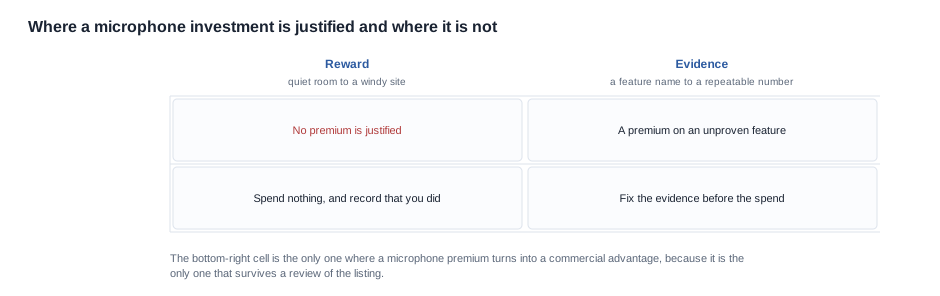
Paying a premium for a feature the environment does not reward. A quiet-office product with an expensive microphone is a product that has spent money the customer cannot see and the reviewer cannot verify, and the money is recoverable from nobody.
Not measuring at all. The most expensive outcome, because the money is spent and the benefit cannot be demonstrated — in a listing, in a review, or in a dispute with the supplier.
Confusing a processing feature with a hardware result. "Noise cancellation" describes a stage. A buyer who negotiates hard on the feature name gets a better feature and the same product.
Treating the microphone as a fixed cost across the range. The same platform sold into a quiet-office channel and into a site channel has two different microphone requirements, and the second one may need a different design rather than a different setting. Spreading one cost across both channels is how a programme ends up with a product that is wrong for one of them.
Letting the supplier write the claim. Whoever writes the claim in the listing owns it, and a claim of that kind needs a number behind it. A supplier who will confirm a measured result is worth more than a supplier who supplies a feature name.
The point at which the premium stops paying back
There is a useful way to frame the payback, and it does not require a return rate.
A microphone premium pays back when it removes a class of failure that your channel generates. It stops paying back when it removes a failure that your channel does not generate, which is a different and much easier question to answer — because it can be answered from your own support data rather than from an estimate.
If most of the voice complaints in your channel are of the "could not hear them in a loud room" type, the microphone is the premium that pays back. If most are of the "the call dropped" type, then the profile, the codec and the host device are where the money belongs, and the microphone premium buys nothing. If most are of the "I did not know it was recording" type, then the product position is where the money belongs, and no microphone in any configuration will fix it.
This is a question about your own ticket data, it costs nothing, and it is more decisive than any general argument about acoustics. It is also the question a buyer should ask before the specification is written, because it is the one input that cannot be bought from a supplier.
The clauses and documents that carry a cost against performance argument
The eight documents that close a cost argument
Eight documents, and each one closes a specific part of the argument.
- The measurement results with their conditions — the environment, the background level, the distance, the unit count and the batch.
- The microphone count and placement, per model designation.
- The processing description, with the signal it acts on.
- The model designation table, so that the certificate register has something to point at.
- The certificate register, which is the format set out at certification checklist.
- The packaging artwork proof, checked against the model designation rather than approved in isolation.
- The agreed incoming inspection criteria, with the tolerance stated and the unit count fixed.
- The battery transport documentation for the fitted cell.
The clause language for the agreement is at contract terms, and the commercial structure of a first order is at pricing. The background technology is at noise control and microphone pickup, the open-ear architecture is at open ear audio, and the measurement procedure is at how to measure smart glasses microphone quality.
The clauses to write into the purchase order
Six clauses, and they are worth more than the unit price difference between two quotations.
The acceptance criteria. Attach the measurement protocol, its conditions and its sample size, and state that a lot failing them is a lot that can be refused. Without this, a microphone result is a reference rather than a standard.
The inspection clause. The same protocol, applied to each delivery, with a stated tolerance and a stated unit count. This is the clause that converts the investment into something that protects the run rather than something that protected a sample.
The change notification. Notice before any change to the chamber, the port positions, the seal or the capsule, because each of those invalidates the result and the file.
The claim clause. No call quality, noise cancelling or intelligibility claim may be made beyond the measured result, and the result travels with the listing copy. This is the clause that stops the claim from outrunning the evidence.
The measurement access clause. The right to run the protocol against production units and to receive the raw recordings. It is the clause that makes the inspection clause enforceable.
The remedy clause. What happens when a delivery fails the inspection criteria — rework, credit, or rejection — stated in advance rather than negotiated after a shipment is on the water.
What a cost against performance decision needs from us
What we can and cannot tell you
The working rule we apply: we publish no microphone specification — no sensitivity, no capture response, no noise floor, no cancellation depth and no beamforming pattern — and we will not present a processing feature as a measured result. We will also not quote a typical performance figure for the category, and we will not tell a buyer that a premium is worth paying without knowing the environment, because the honest answer differs by use case and the difference is large.
What we will do is take your environment and your price band and tell you which of the five criteria rows decides it, what has to be measured before a purchase order is signed, and which of your commercial lines are worth negotiating first. We will also say plainly when the answer is that no microphone premium is justified in your case, because that is a more useful answer than an expensive one, and it is the answer that protects the programme from spending money on a difference nobody will hear.
Send us the environment, the channel, the price band and the models you are considering, and we will tell you whether microphone differentiation is worth anything in that combination, which measurements would settle it, and what to write into the inspection criteria.
Related reading
- The underlying technology — noise control and microphone pickup
- The measurement procedure — how to measure microphone quality
- The architecture it sits in — open ear audio
- The commercial structure of a first order — pricing
Tell us the environment, the channel and the price band, and we will say whether microphone differentiation is worth a premium there.


