

Microphone quality is the specification that decides whether a voice product is returned, and it is the hardest one to defend from a datasheet, because a datasheet describes a microphone rather than a call. A repeatable test needs six steps, a completion criterion for each, and three environments, and it takes under an hour. The procurement conclusion is this: put the microphone test into the incoming inspection criteria as a pass-or-fail line, not into a product page as a marketing claim, and set the line per environment rather than once. A criterion set in a quiet office is a criterion that every product passes and no channel is protected by.
The buying task behind this article. The reader is a brand product manager, a sourcing buyer or a channel buyer who has to decide whether a voice product is good enough to put under their own label. The specific problem is that every supplier in this category has a microphone story — noise cancellation, beamforming, wind resistance — and none of it survives comparison, because the comparisons are done in a quiet office where every microphone works. The buyer's task is to design a test that fails the wrong products, because a test that passes everything costs an hour and protects nothing. The failure being managed is a launch in which the first hundred returns are all the same complaint, and by then the packaging, the listing copy and the application have all been built around a product that does not work in the environment it was sold for.
What the published position is. We publish no microphone specification: no sensitivity figure, no frequency response for the capture path, no noise floor, no cancellation depth and no beamforming pattern. The published material on the technology side is descriptive rather than numeric, and the background is at noise control and microphone pickup. The reading of a supplier datasheet is covered at how to read a datasheet, the specification rows are set out in the spec sheet explained, and the trade-offs behind a voice product are at advanced considerations.
Smart glasses microphone quality: criteria set in a quiet room protect nothing
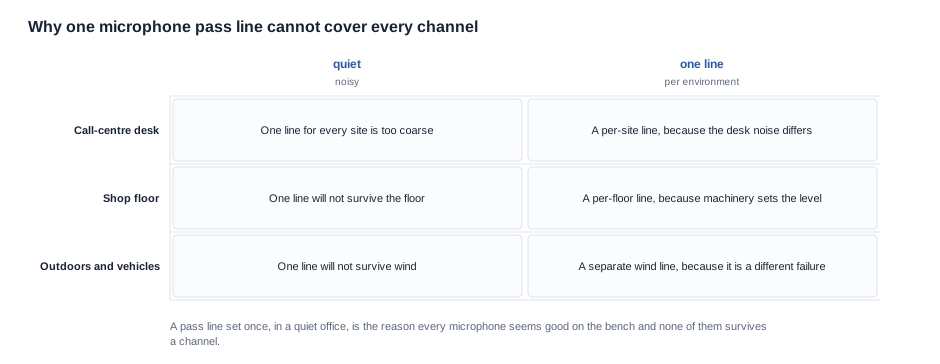
Why one pass line cannot cover three environments
What you are measuring is the intelligibility of the far end of a call, judged by a person who is not on the call, against a fixed criterion, in a fixed environment, at a fixed distance. That definition matters because it is the only version of the question a customer actually asks, and because it is the version that can be written into a purchase order. The criterion has to be set per environment: a shop floor, a call centre and a cyclist face three different noise profiles, and one line cannot cover all three.
Who is running the test, and what they are holding
A product manager is building a voice proposition for a channel with a known acoustic environment, and needs to know whether the supplier's noise story survives a defined condition.
A procurement manager is comparing candidates that all claim noise cancellation, and needs a protocol that discriminates between them rather than a protocol that confirms all of them.
A channel buyer is deciding whether the product can go into a call-led channel at all, or only into a private-listening channel. That is a question about the environment, and it is decided before the microphone is chosen.
The failure each of them is managing is the same: a launch in which the returns are all one complaint, discovered after the packaging is printed and the copy is live.
What the test needs before it starts
Two units, not one. A single unit tells you the product is acceptable; two units of the same model tell you whether the difference is the design or the manufacturing, and that distinction is worth a great deal when a defect rate is later disputed.
You also need a second phone to make the call from, a fixed phrase recorded in advance, a quiet space, one noisy space, and a windscreen source for the wind test. The phrase should be something with no emotional content and no proper nouns, because the far end has to transcribe it, and a phrase that a person can guess from context will pass a test the microphone failed.
The three environments, and why one line cannot cover them
The quiet reference. A room with a stated background level, used to establish that the capture path works at all. If a product fails here, nothing else needs to be run.
The target environment. The actual environment the product is sold into, with the background level recorded. This is the only environment that produces a pass or a fail that means anything commercially, and it is the one that has to be identified before the protocol is written.
The stress environment. A deliberately harder condition, used to establish margin rather than to accept or reject. A product that passes the target environment with margin is a product that will not generate complaints from a customer in a slightly different environment.
The completion criterion for each environment is a single pass line, expressed as a count: the far end correctly repeats the phrase, in a stated number of attempts out of a stated number. "The far end could hear it" is not a criterion, because it is not repeatable between two engineers and it cannot be used to refuse a lot.
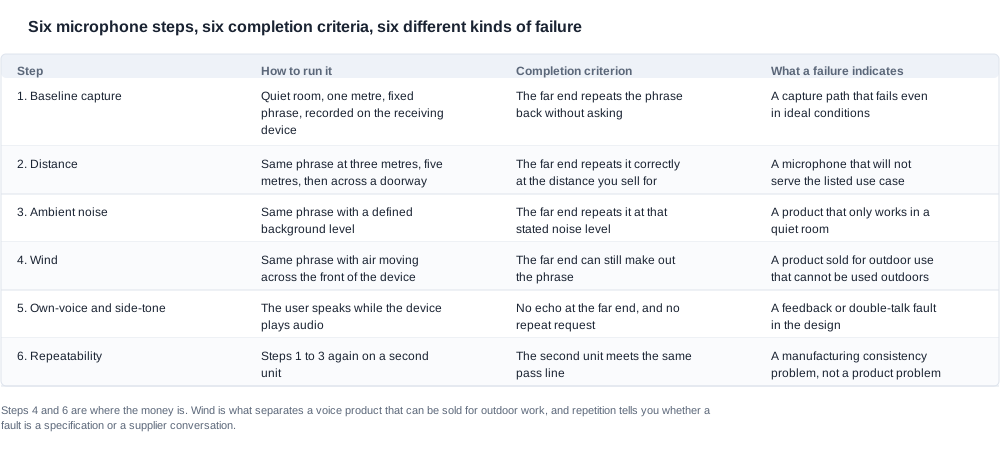
The thresholds that turn a voice feature into a pass or a fail
| Step | How to run it | Completion criterion | What a failure indicates |
|---|---|---|---|
| 1. Baseline capture | Quiet room, one metre, fixed phrase, recorded on the receiving device | The far end can repeat the phrase back without asking | A capture path that does not work even in ideal conditions |
| 2. Distance | Same phrase at three metres, five metres, then across a doorway | The far end repeats the phrase correctly at the distance you sell the product for | A microphone that will not serve the use case the listing claims |
| 3. Ambient noise | Same phrase, with a defined background level, at a stated level | The far end repeats the phrase correctly at that noise level | A product that only works in a quiet room |
| 4. Wind | Same phrase with air moving across the front of the device | The far end can still make out the phrase | A product sold for outdoor use that cannot be used outdoors |
| 5. Own-voice and side-tone | The person speaks while the device plays audio | The far end reports no echo, and the person is not asked to repeat | A feedback or double-talk problem, which is a design fault |
| 6. Repeatability | Run steps 1 to 3 again on the second unit | The second unit meets the same pass line | A manufacturing consistency problem, which is a supplier conversation, not a product conversation |
Two of these six are where the money is. Step 4, the wind test, is what separates a voice product that can be sold for outdoor work from one that cannot, and it is the step most often skipped because it is inconvenient to set up. Step 6, repeatability, is what tells you whether a problem is a design characteristic or a production inconsistency — and it is the difference between a specification change and a supplier claim.
The distance row is the row the listing depends on
Step 2 is the measurement that connects the microphone to the claim a retailer writes. "Works for calls" is a distance claim in disguise, and the distance the far end can hear at is a number that can be published and a number that can be refused. A product that fails step 2 at the distance you intend to sell it for is a product whose listing has to be narrower than the one you wanted, and that is a decision to make before the copy rather than after the first complaint.
The ambient noise row is where the supplier's story is tested
Every supplier in this category has a noise story, and the story is usually expressed as a feature: noise cancellation, beamforming, dual microphones. The testable version of the same claim is a background level and a repeat count. If the supplier will not state a level they have tested at, the claim is a feature name, and a feature name cannot go into an acceptance criterion.
The own-voice row catches a fault that no specification lists
Step 5 is about the interaction between the microphone and the audio the device plays. A device that lets the far end hear the audio it is playing back produces echo, and the person then gets asked to repeat themselves. It is a design fault, it appears in call quality immediately, and it is entirely invisible in a microphone datasheet, which describes the microphone and not the acoustic loop.
Repeatability is the row that turns a complaint into an argument
Step 6 is what makes the result usable in a commercial dispute. If both units pass, a complaint from the channel is about an environment you did not test, or about a unit outside the population the supplier's control covers. If one unit passes and the other fails, the fault is in the manufacturing consistency and the conversation is with the factory. If neither passes, it is the design. Three different conversations, three different commercial responses, and the distinction costs one repeat of three steps.
Running the microphone protocol and writing it into incoming inspection
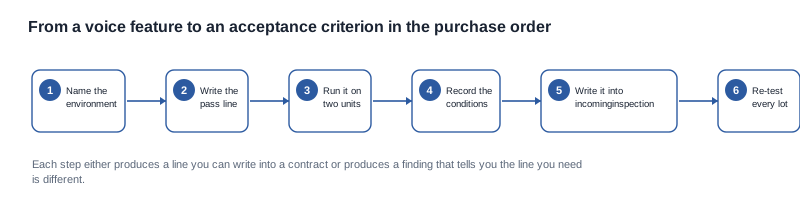
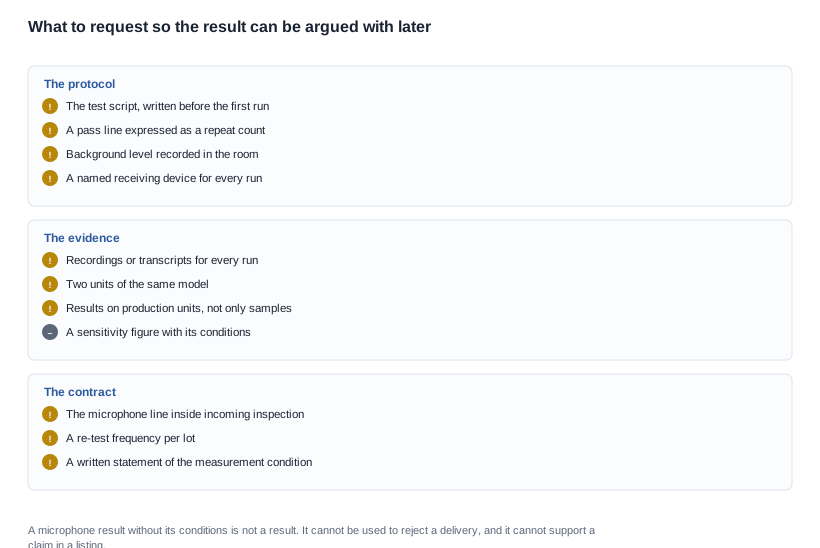
1. Name the environment first. The channel, the place, the acoustic profile. This is the step that decides the pass line, and it has to happen before the protocol is written, because the pass line for a shop floor is not the pass line for a call centre.
2. Write the pass line as a count. Three attempts, three transcriptions correct, at a stated distance, at a stated background level, in a stated environment. A pass line expressed as a number can be given to an inspector; a pass line expressed as a judgement cannot.
3. Record the conditions for every run. The background level, the distance, the phrase, the number of attempts, the receiving device, the date, and the units tested. A result without those fields is an opinion with a number attached, and it cannot be used to reject a delivery or to support a claim in a listing.
4. Run it on two units, and on production units if you can. A sample is a hand-built unit and the population is not. Whether the supplier will run the protocol on units pulled from the production line rather than on the pre-production units it keeps on a shelf is a commercial request, and the production line is where an assembly inconsistency in the capture path shows up.
5. Ask for the recordings or the transcripts. If the supplier supplies them, the result can be re-judged by somebody else, which is what makes it usable in a dispute. A verbal summary of a test cannot be re-judged by anybody.
6. Write the criterion into the incoming inspection, not into the listing. The inspection criterion is a pass-or-fail line an inspector can apply. The listing is a claim, and a claim has to be narrower than the evidence.
7. Agree the re-test frequency. Per lot, per campaign, or per supplier-requested sample. A criterion with no frequency is a criterion that quietly stops being applied after the first month.
What this test will and will not tell you
It will tell you whether the product is fit for the environment you are buying for, whether the outcome is repeatable between two units, and whether the supplier's claims survive contact with a defined condition. That is enough to write an inspection criterion, which is what a procurement decision needs.
It will not tell you how the product compares to a competitor's microphone in absolute terms, because the far end's device, the network and the room all differ and none of them is controlled. It will not tell you how the product behaves with a specific customer's own software, because a client application applies its own processing. And it will not tell you the total noise floor, because the test measures intelligibility rather than a signal level. Those are separate questions, and a supplier that quotes a figure for them is quoting a laboratory condition you do not have.

Where a voice programme breaks in the channel
The microphone is compared in a quiet office and the channel is noisy. The symptom is a returns cluster from one channel only, while the product performs acceptably in the buyer's own environment. The root cause is that the pass line was set in a quiet reference room and applied to every environment. The prevention is to set one line per environment and to run the target environment at the frequency the channel actually operates in.
The wind row is skipped because it is awkward to set up. The symptom is a complaint cluster that appears only in the season or only in the region where the product is used outdoors. The root cause is that the test was never run, not that it was run and failed. The prevention is to run it once on the sample, with a defined air movement and a stated distance from the front of the device, and to record the result as a buyer-run measurement.
The product passes on one sample and fails on the second. The symptom is a defect rate that cannot be reproduced. The root cause is that only one unit was tested, so a design characteristic and a manufacturing inconsistency are indistinguishable. The prevention is the repeatability step, and it is the cheapest step in the whole protocol.
A feedback fault is discovered in a customer call rather than in the sample session. The symptom is a complaint about echo and about being asked to repeat, which reads to the customer as a network problem. The root cause is that the own-voice row was never run, and it is invisible in a microphone specification. The prevention is to run step 5 on every candidate.
The listing claims noise cancellation that no measurement supports. The symptom is a claim that a customer cannot verify and that your own team cannot reproduce. The root cause is that a feature name was published as a performance result. The prevention is to describe the feature in words in the copy and to keep the measurable claim for the inspection criteria.
A firmware update changes the capture behaviour and the returns move. The symptom is a return rate that moves with a release rather than with a shipment. The root cause is that the capture pipeline was never in the change-control list. The prevention is a notice obligation before any change to the capture firmware, the microphone component or the noise-processing configuration.
What the microphone evidence is worth at the first order
Negotiable, and this is where the effort belongs. Whether the supplier will run the protocol on units drawn from the production line rather than on the pre-production units it keeps on a shelf. Whether they will supply the recordings or transcripts so the result can be re-judged. Whether the microphone test is included in the incoming inspection criteria for the first shipment only or for every shipment — the first shipment is where an inconsistency shows up, so a single-shipment inspection is the cheaper option that leaves the second shipment uncovered. Minimum order quantity tiers, the accessory and charging set minimums, packaging and logo configuration, and splitting a first run into two deliveries against a staged payment, which matters more in this category than in a quieter one. The warranty period with a stated response time is worth negotiating here, because a voice fault that generates support contacts rather than returns is expensive in a way that is easy to underestimate.
The capture hardware and the listening fixture are the fixed part. The microphone component, the port geometry and the processing chain set the achievable performance, and the listening fixture the supplier uses to score a result sets the number the programme will be judged against. Ask whether the fixture is a calibrated rig or a telephone in a quiet room, because the same product reads differently on each, and ask who keeps the recordings that the fixture produces. A supplier who will not change the transducer, the port geometry or the processing configuration is telling you the microphone behaviour is fixed, and the programme should be built around that.
Documents to request before a deposit. The test protocol with its pass lines, per environment. The results for the samples, with the conditions attached. The microphone specification with whatever measurement conditions the supplier is willing to state. The model designation table. The packaging artwork proof. The incoming inspection criteria that include the microphone test. The clause language is at contract terms, the commercial structure of a first order is at pricing, and the sampling procedure that makes the results usable is at samples.
Clauses to write into the contract. The pass lines per environment as acceptance criteria, with the conditions written beside each. A clause requiring notice before any change to the microphone component, the capture firmware or the processing configuration. A clause on the frequency of the incoming re-test and on who bears the cost when a lot fails. And a clause stating that any acoustic claim in the listing is limited to the environments and levels that were measured.
A worked scenario: a call-centre channel with a noisy floor
A call-centre channel with a measurable background level is the situation this sequence is written for, and the environment has to be named before the protocol exists; the five steps below are the order in which it gets named.
Assume a brand product manager selling into a call-centre channel where agents work in an open-plan office with a measurable background level. The binding constraint is that the previous product in this channel generated support contacts about calls being unintelligible, and the channel will not fund a second one.
Step one is naming the environment. The manager establishes the target environment from the channel's own description of the floor, records a background level, and confirms that wind is not a factor indoors. That removes step 4 from the protocol for this channel and moves the effort into step 3, which is the correct trade.
Step two is the pass line. The manager writes the line as a repeat count at a stated distance, in the target environment, on two units. The line is set at the level the channel operates in rather than at the level the supplier's demonstration used, and it is written into the incoming inspection criteria before the first order.
Step three is the comparison. Two candidates run the protocol. One passes at the target level on both units. The other passes at a lower level and needs the background turned down. The manager does not ask for the second candidate's noise cancellation explanation, because the explanation is not what the criterion measures.
Step four is the commercial response. The manager negotiates a split first shipment against a staged payment, adds the microphone line to the incoming inspection for every shipment rather than the first, and asks the supplier for the transcripts so the result can be re-judged if the channel disputes it.
Step five is the listing. The copy describes the product as tested in a defined environment at a defined level and makes no general noise claim, because a general noise claim would be wider than the evidence.
The decisive decision was the environment, made before the protocol existed.
What we publish about microphones and what we do not
No microphone specification is published, because none is published to us, and a feature name such as noise cancellation is not a measured result. We will also not quote a typical performance figure for the category, because a typical figure is exactly the kind of number that produces a customer expectation the product cannot meet.
What we will do is tell you which of the six steps we can support from our documentation, which need a sample, and which need a written confirmation from the factory, and we will review a test protocol you have written so that the pass lines are unambiguous before the first purchase order rather than after the first dispute. We will also say plainly that a protocol with one pass line for every environment will pass in a quiet office and protect nothing in a shop floor, and that setting one line per environment is the part of the work that decides the programme.
Next step. Send us the environment your product is sold into, the platforms your customers call from, and the models you are evaluating. We will tell you which of the three environments above is the one that decides the project, which published rows apply, and what has to be written into the inspection criteria before you commit to a volume.
Related reading
- The technology in short — noise control and microphone pickup
- Reading a supplier datasheet — how to read a datasheet
- The published entries — spec sheet explained
- The trade-offs behind a voice product — advanced considerations
Tell us the environment and the platforms, and we will say which test decides the project and what has to be written into the inspection criteria.


