

What buyers most often ask to know about: six questions worth putting in writing
The microphone in an open-ear audio product is the part of the specification that is almost never written down, and it is the part that decides whether the product can be sold into a business workflow or only into a consumer channel. The reason it is rarely written down is that the terms available are all vague: pickup distance, noise reduction, echo cancellation, signal to noise ratio. Each of them names something real, and each of them can be made to mean whatever the party using it prefers, which is exactly why a buyer needs to convert them into conditions before the quotation rather than after the first complaint.
Six questions are worth putting in writing, and the order in which they are written decides how much of the problem is solved by the time the sample arrives.
- Where does the capsule sit relative to the mouth? A geometric fact, and the one thing about microphone quality that cannot be fixed late in a programme.
- What source level is the product designed for? A microphone specified for a quiet office and one specified for a vehicle are different products, and the supplier has designed for one of them.
- What is the noise floor, and how was it established? A floor without a method behind it is a number that cannot be compared with another supplier's.
- What does the noise reduction remove, and what does it leave behind? A mechanism can be required in the order; an outcome cannot.
- What happens in wind? A design question about port geometry rather than a processing question, and the answer decides whether the figure survives a firmware update.
- What does the far end experience? A call is a two-sided system, and the measurement most often stops before the interesting half.
Our catalogue publishes no microphone figures for any model. That is the honest position rather than an omission: we do not hold a verified pickup distance, a noise floor, a frequency response, a wind figure or a signal-to-noise measurement for any product in the range, and we would rather say that than publish a number that a buyer's test would contradict. What the catalogue does publish is the electrical position around the microphone — the cell configuration, the rated runtime, the charging method, the Bluetooth generation — and in two cases a structural fact that affects the acoustics directly, such as the detachable temple on G07 and the surround-sound slim temple on YK12. Those are the published facts, and everything else is a question to a supplier.
The commercial framing is what makes this worth the effort. A product sold into a consumer channel can tolerate a mediocre microphone, because the alternative the customer holds is a phone. A product sold into a contact centre, a logistics operation, a field service or a vehicle fleet cannot, because the microphone is the product. The questions below are written for the second case, and the open-ear audio questions to ask a supplier covers the acoustic side of the same conversation from the other direction.
The pickup distance question, and why the answer is not a number
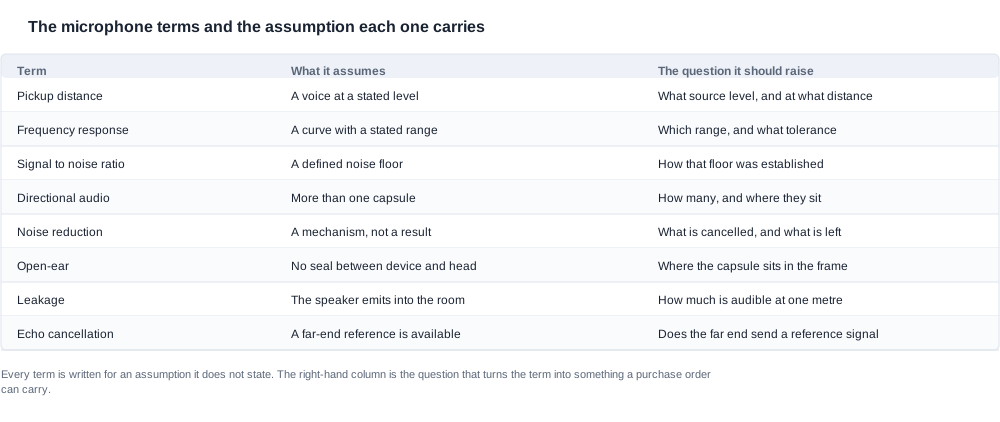
Pickup distance is the most quoted microphone specification in this category and the least usable, because a distance without a source level describes nothing. A capsule that captures a voice clearly at 400 mm may miss it entirely at 800 mm, and a capsule that is unusable at 400 mm in a quiet room may be adequate at 200 mm in a vehicle, because the vehicle supplies a signal that the quiet room does not. The same number describes two different products depending on the two variables the number leaves out.
The threshold to hold is therefore a triple: a source level, a distance and a criterion. "A male and a female voice at a stated level, at a stated distance, with a stated intelligibility score at the far end" is a specification that can be failed or passed. "Picks up clearly from 5 metres" is a claim about a condition that does not exist in the customer's environment, because nobody holds a conversation with a pair of glasses from five metres.
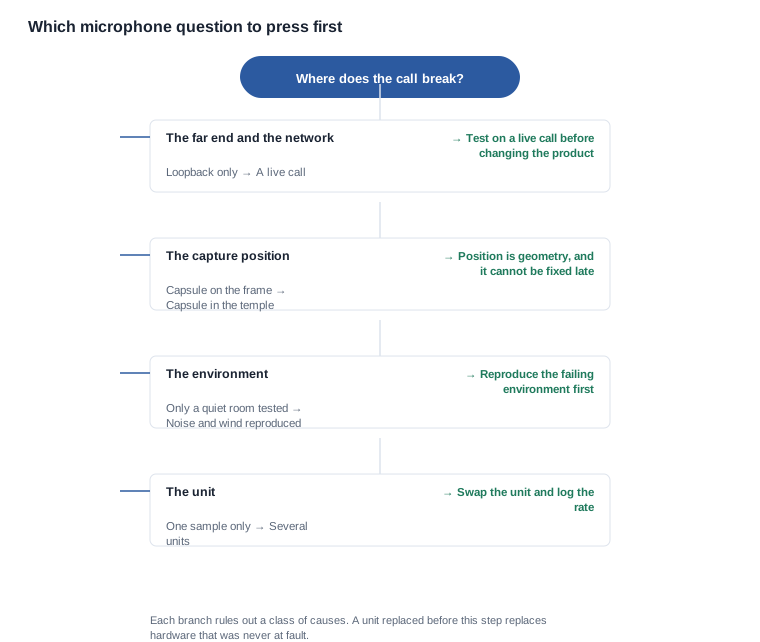
There is a second reason the number is unsafe as a purchasing criterion, and it is the one that decides the shortlist. The capture position in the frame is the dominant factor in pickup, and it is a structural decision that comes out of the industrial design. A capsule in the temple near the front of the face behaves differently from one in the bridge, and differently again from one in the rear of the temple. Once the frame is designed, the position is fixed, and no supplier can improve the pickup distance without moving the electronics. A buyer who realises this mid-programme has a product they cannot change and a specification they cannot meet.

Pickup, noise floor and cancellation, treated as three separate buys
Most microphone arguments in this category are really three arguments run together, and separating them makes the whole conversation shorter. Pickup is about geometry: where the capsule is and how far the source is. The noise floor is about the electronics: what the microphone hears when there is no source, and therefore how much of the call budget is spent on the source rather than on the room. Cancellation is about processing: what the chain removes, and what it leaves behind.
The reason this matters commercially is that the three have completely different commercial consequences. Pickup is a design decision, and it is fixed by the time the sample exists. The noise floor is an engineering and component decision, and it is what a specification should be written against. Cancellation is a software and firmware decision, and it is the one that can be changed late, which is also why it is the one most often over-claimed.
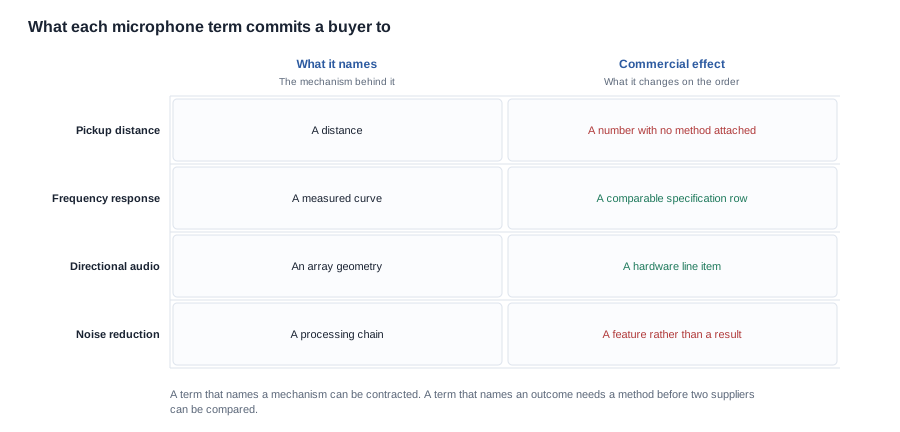
The matrix above is the purchasing version of that separation. A term that names a mechanism can be contracted: a directional array is a hardware line item, a processing chain is a software configuration that can be required in the order, and a measured curve is a specification row that can be compared between suppliers. A term that names an outcome cannot be contracted without a method, and a method is what the buyer has to supply.
The noise floor is the row that deserves the most attention, because it is the one that is usually absent and the one that is most often assumed to be excellent. A noise floor is not measured against a signal; it is the level the electronics produce on their own, and the figure that matters to a buyer is the ratio between the source and that floor in the condition the product is used in. Ask for the floor in a stated condition, ask how it was established, and ask what the method excludes. A figure produced with the device stationary on a table is not the figure that will be produced in a vehicle, and the difference is usually the difference between a usable product and a support queue.
The wind question, which is a design question
Wind is the microphone failure that a buyer is most likely to meet in the field and least likely to have specified, because it is usually presented as a processing capability rather than as a physical problem. A wind-rejection figure in a product description tells the buyer that some processing exists. It does not tell the buyer where the port is, how it is covered, or whether the processing can work on a signal that has already been distorted by the airflow itself.
The distinction is practical. If the port is protected by a membrane or covered by a filter that is part of the frame, the product has a physical answer to wind, and that answer is testable in a wind tunnel or in a documented field procedure. If the answer is processing alone, the product is relying on the algorithm to reconstruct a signal that the airflow has already damaged, and the result will degrade with wind speed in a way that is hard to predict and harder to specify. Both approaches are legitimate. Only one of them is a property of the product rather than of a software version, and the difference matters when a firmware update arrives.
The threshold to hold is a wind condition, a method and a criterion: a stated wind speed at a stated distance and angle, a stated source level, and a stated intelligibility or signal measure at the far end. A wind figure with no wind speed is a claim that the product is unaffected by wind, which no microphone is.
The second wind question is about what the product does in the case where the wind is not the problem but the environment is. A vehicle cabin, a loading bay and a hospital corridor all produce low-frequency noise that wind processing is not designed for, and a microphone specified against wind can be poor against those. The specification that covers both is a noise-condition test with the environment named, not a feature name.
The regulatory line a microphone feature crosses
Most microphone features in this category are ordinary audio features and carry no special regulatory weight. Two situations are different, and a buyer should know which one applies before the claim is written rather than after it is challenged.
The first is a device that is marketed with a hearing-related benefit. Our catalogue includes one bone-conduction entry published with a 35 dB amplification gain figure. That is a catalogue parameter and it belongs in a technical conversation, but a product positioned around an amplification gain sits close to the line where a device can be treated as a medical device rather than as an audio product, and the regulatory consequences of that line are serious: the marketing surveillance rules for medical devices, the conformity assessment route, and the claims that may lawfully be made. A buyer who is tempted to build a listing around the gain figure should establish where the product sits before the artwork is written, not after a listing review rejects the claim. We do not make any hearing or health claim for any product in our range, and this article is not a route to one.
The second is the cybersecurity and radio route, which applies to every product with a radio and becomes relevant when a microphone is involved because an audio path that leaves the device carries data. The Radio Equipment Directive (EU) 2014/53/EU sets the frame, and the EN 18031 standards series supports its cybersecurity requirements, with the assessment covering the radio equipment that processes personal data. For a buyer, the practical consequence is that the microphone's data path has to be covered by the product's conformity documentation rather than treated as an accessory concern. The relevant route is on the certification checklist page.
A microphone test protocol you can repeat
Microphone quality is measured at the far end of a call, and that is where the protocol has to start. A buyer who records their own voice while speaking into a device at a desk is measuring their own voice; the measurement that matters is the signal arriving at the other end of a call, in the condition the product is used in.
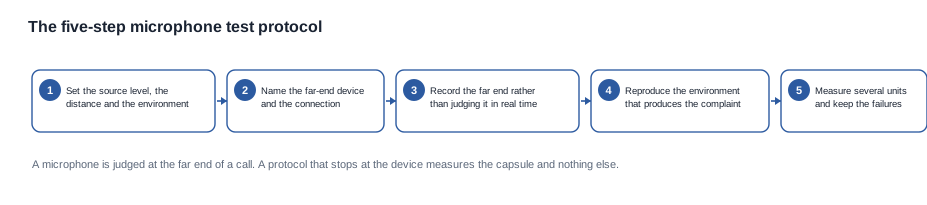
Step one: set the source, the level and the environment. A stated source level at a stated distance, in a stated environment, with a stated male and female voice if the product is sold to a mixed population. Anything less and the result cannot be reproduced by the supplier or compared with another candidate.
Step two: name the far end and the connection. The handset, the network and whether the test is a live call or a recording played at a known level. The far end is where a microphone's quality is actually judged, and a test that stops at the device measures the capsule and nothing else.
Step three: record the far end rather than judging it in real time. Play the recording back, or have a second person score it, and record the score. A subjective judgement made during a live call is affected by the caller's voice, the connection and their attention, and it is not repeatable. A recorded file with a score attached is a measurement.
Step four: reproduce the environment that produces the complaint. A vehicle, a loading bay, a corridor with a hard floor, a shop floor with a music system. If the product is sold into an environment the test never reproduces, the test is measuring a product that does not exist in the customer's hands.
Step five: measure several units and keep the failures. A single unit that performs well proves that the product works. Several units from a production lot, with the weakest one recorded, is what a warranty is priced on and what a return rate is forecast from.
The call-quality failures that only show up at a distance
Four microphone-related failures recur after launch, and each of them is an information failure rather than a hardware fault.
The product is clear in the demonstration and unusable in the field. The symptom is a cluster of contacts from one environment with no technical detail in the description. The root cause is that the test was run in a quiet room and the product was sold into a noisy one. The prevention is to reproduce the failing environment at the sample stage and to attach the environment to the acceptance criterion.
The customer blames the microphone and the cause is the far end. The symptom is a report that the other party cannot hear, filed against a product that is actually fine. The root cause is that the test was a loopback, so the codec, the network and the far-end device were never exercised. The prevention is to test on a live call with a named far-end device, and to keep the far-end configuration in the test record so that a later complaint can be assessed against the same conditions.
The voice is captured, and the voice assistant cannot use it. The symptom is that the audio is fine for a human on a call and unusable for an automatic transcription or recognition feature. The root cause is that a human intelligibility score and an automatic recognition score are different measurements, and the product was specified against the first. The prevention is to run the actual downstream feature in the test, with the actual downstream condition, and to state the downstream score as the acceptance criterion.
The specification is written and the claim is not. The symptom is a listing review, a marketplace query or a customer expectation that the product cannot meet. The root cause is that the claim was written from the feature list rather than from the acceptance criterion. The prevention is to write the copy from the criterion and to keep the criterion in the file that the copy was written from.
A microphone evaluation for a contact-centre deployment
The sequence below is hypothetical and is set out to show how the decision would be reached, not to report a client result. Assume a channel buyer supplying a uniform and dispatch product to a logistics operator, where staff speak through the device to a central desk, and where the operator has already rejected one supplier for complaints about people on the other end not being able to hear.
Step one: the environment is written down first. The deployment is a depot, a vehicle cab, and a warehouse aisle, with a hard floor and a radio environment that is not quiet. That description establishes the noise condition before any supplier is asked a question, and it makes the pickup requirement concrete: a voice at a stated level, at the distance a person naturally speaks to a temple-mounted capsule, in a stated noise condition.
Step two: the shortlist is cut on the published rows. The buyer eliminates on the cell configuration against the shift, on the charging interface that the depot can support overnight, and on the Bluetooth generation, since the desk side and the field side are separate devices that have to coexist on a network the operator already runs. Two products survive, and neither is selected on a microphone figure, because none is published.
Step three: the protocol is written before the samples arrive. The source level, the distance, the two environments, the far-end device, the connection and the scoring method. The buyer also decides what the pass criterion is: an intelligibility score at the far end, a level above the noise floor, and a score on the automatic downstream feature that the operator intends to use.
Step four: the samples are measured in the failing environment. The test is run in the vehicle cab and in the aisle, not in a meeting room, and the recording is scored from the far end. The weakest of the units is the one that decides the result, and the failures are kept, because the failures are what the support script will be answering.
Step five: the order carries the criteria. The acceptance environment, the source level, the distance, the far-end device, the scoring method, the pass rule and the number of units. And the marketing copy is written from the same criterion, so that the claim a customer reads and the test the supplier signed up to are the same statement.
The walk-through did not settle which microphone is better. It settled the conditions under which the two candidates could be compared, and it did so before the samples existed, which is the only point at which the comparison is still cheap.
What a microphone requirement is worth in the order
A buyer comparing two microphone proposals should work through a short checklist before comparing any prices: which terms are stated with a method behind them, which are stated only as a feature, what the acceptance environment is, which far-end device the result was taken on, and how many units were measured. How to compare two suppliers in this category is therefore a matter of reading the test conditions side by side rather than the feature lists, and a shortlist built against those criteria is comparable; a shortlist built on the feature list is not. The trade-offs the buyer is actually making are explicit at that point — a wider capture against more room noise, a stronger processor against more processing delay, a higher source level against a shorter usable distance. And the red flags are short: a pickup distance with no source level, a noise figure with no condition, and a test run on one unit in a quiet room.
A microphone requirement is worth writing into the order because it is one of the few requirements in this product that changes the commercial shape of the purchase rather than only the technical description. A specified microphone lets a buyer sell into a business workflow, and an unspecified one limits the product to a consumer channel; the price the channel will pay and the volume it will reorder depend on that distinction. It also changes the accessory and service lines, because a product that is sold on call quality carries a higher support expectation and a higher inspection cost.
Three clauses are worth having. The first names the acceptance environment, the source level, the distance, the far-end device and the scoring method, with the pass rule and the number of units — a lot that fails it is a lot the buyer can refuse. The second requires the supplier to disclose the capture position and the capsule count, because those are design facts that determine what the specification can achieve and they should not be a late surprise. The third sets the claim in the documentation, so that the listing, the packaging and the technical file describe the same product.
Two costs are fixed in a way that is worth naming early. The conformity work for a radio product runs through the Radio Equipment Directive (EU) 2014/53/EU, with the EN 18031 series supporting the cybersecurity requirements where the audio path leaves the device; the cost and the duration are a property of the assessment route rather than of the order size. The battery transport documentation under UN 38.3 is a per-cell and per-product exercise with the same structure. The useful question in both cases is not whether a supplier can make them shorter but whether the documents cover the exact model, the exact cell and the exact markets the buyer is shipping into.
Where our microphone answers stop
We publish the electrical rows for twenty-four of the twenty-eight models in the range: cell configuration, rated runtime and charge time for all of them, the charging method for those twenty-four, magnetic or Type-C, and, where the catalogue states it, the Bluetooth generation. Four camera models publish no charging method at all: the MT6 and the CY03, and the CY05 and the L1 Pro. Alongside them we publish the two structural facts that bear on the acoustics directly, the detachable temple on G07 and the surround-sound slim temple on YK12. We do not publish pickup distances, noise floors, frequency response curves, wind figures, capsule counts or signal-to-noise measurements, because we do not hold verified figures for them. We would rather say that than quote a number a buyer's own test would contradict.
We do not publish a frame weight for any of the audio models either. The only weight our catalogue states belongs to a different product in a different family, and copying it into a microphone conversation would be a factual error rather than a useful approximation.
What we will do is walk through the published rows, confirm which configurations exist, and tell you plainly where a microphone requirement in your brief is one we cannot answer from the catalogue. If the requirement is specific, the productive next step is to write it as an environment, a source level, a distance, a far end and a pass rule, and to put it to a supplier who is willing to be measured against it. That is the only version of microphone quality that can be bought rather than assumed. The microphone and noise control page is where the position behind these questions is set out, the Bluetooth audio glasses range is where the configurations are listed, and the battery life page is where the runtime figures behind a shift-based deployment are published.


