

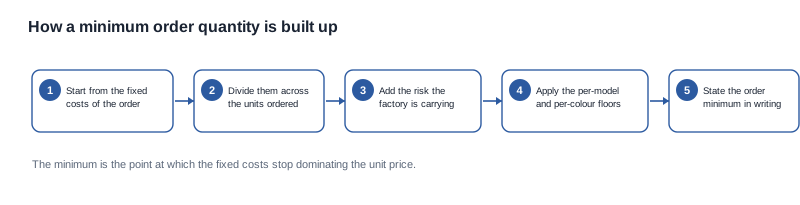
A minimum order quantity in smart glasses is not a factory being difficult. It is the arithmetic of setup. A mould, a first-article approval, a packaging print run, a file set entry and a batch of long-lead materials are all costs that are largely fixed, and a minimum is simply the point at which those fixed costs stop dominating the unit price. A buyer who understands that is halfway to negotiating well, because the minimum becomes a question about which fixed costs are being opened rather than a number to be argued about.
We publish no minimum order quantity, and the reason is specific rather than evasive: three readings of our own minimum order policy have not been reconciled with each other, and we will not print a quantity we cannot defend. What follows is the structure, which is more useful than a number and survives the next revision of the policy.
Smart glasses MOQ: why a minimum exists in the first place
The buyer asking the beginner question
The first-time buyer in this category is usually a brand owner or a channel buyer with a demand plan, a budget and no purchase history. What they are often told is that there is a minimum, and what they are rarely told is what the minimum is a function of, which means they cannot tell whether the number they have been given is the right one, a high one, or a number for a different order altogether.
The consequence is a negotiation that cannot succeed. A buyer who does not know the structure cannot tell the supplier which part of the structure to change, so the only move available is to push on the number itself, and pushing on a number that exists because of arithmetic is a way to lose the relationship without changing the outcome. Knowing that the minimum is a function of the number of production items, the setups, the document sets and the fixed costs is what turns that conversation into a useful one.
There is also a question underneath the question that matters more commercially: a minimum is a commitment of cash, and a minimum on a short lead time is a much smaller commitment than the same minimum on a long one. The deposit is the largest single payment in a smart glasses transaction and it is paid before anything exists, so a buyer who accepts a minimum without asking what lead time sits behind it has committed cash without knowing how long it is tied up.
There is a third thing a first-time buyer usually has not considered, and it changes how a quotation should be read. A minimum is a statement about a specific order structure, not about the product. The same model at the same unit price can carry two different minimums, because one order is one colourway in one case option and the other is four colourways across two models. Buyers who compare two quotations on the unit price alone are frequently comparing two different order structures and concluding that one supplier is cheaper. The correct comparison is the total cash commitment of each order as it is actually written, including the one-time costs, and that comparison has to be made after the order structures have been made identical or the comparison means nothing.
The arithmetic underneath the floor
The way to think about a minimum is as a set of fixed costs divided across the units in the order, with a floor applied where the division stops making sense. The fixed costs in this category are recognisable.
Tooling. A mould or a new temple shape is a one-time cost, and it is the largest single item on the list when it applies. A programme built on an existing platform carries none of it.
The first-article approval. One production unit built and checked against a written specification, and the engineering and quality time that goes into writing the script and reviewing the result. It does not scale with the order at all.
The packaging print run. A carton is printed for a configuration, and the print run is a fixed cost. It is also the item most often forgotten when a buyer counts, because the carton is sized by the charging case — so a model with two case options needs two cartons, and a model with no charging case needs a different carton again.
The file set entry. A model that is not already in the file for the destination market is an entry, and an entry is documentation work rather than a production cost.
The long-lead material batch. Certain components are bought in batches with a minimum of their own, and the order has to be large enough to justify opening one.
A minimum is the point at which those five, spread across the units, are no longer dominated by the per-unit cost. That is why a minimum is not a round number chosen for commercial convenience, and it is also why it is not adjustable by negotiation alone — the fixed costs have to change, which means the order structure has to change.

The three floors, and which one your order touches
Most buyers in this category know that a minimum exists and are entirely unaware that there are three of them. Each applies to something different, and the difference between them is the difference between a comfortable commitment and a launch budget that has been committed twice.
The order minimum is the floor on the order as a whole. It is the one most people mean when they use the phrase.
The per-model minimum is the one that surprises people. Whether a mixed order counts against the total or against each model is a policy question, and the two policies are far apart in cash terms. An order of two models at two hundred units each is one order of four hundred under one policy and two orders of two hundred under the other, and the gap between those two readings is the whole of a first launch budget.
The per-colour minimum is the one that is never covered by the order total, because each colour is a separate item on the production schedule with its own floor. The V06 publishes four colour options, which is a genuine asset for a brand running a kit strategy and also four separate commitments at once. The V03 Pro publishes three. The L2 Utral publishes two charging case options, and the case option behaves like a colour in this respect because the carton is sized by it.
The practical consequence is that a buyer who has negotiated a single number has negotiated one of the three floors and is probably carrying the other two unexamined. Establishing which floor applies to which part of an order, before the negotiation rather than after it, is the single most useful question to ask.
The three floors also combine, and the combination is where the real number lives. An order of one model in one colourway at a volume that clears the order floor is a straightforward commitment. The same order with two models and two colourways is now subject to the per-model floor twice over, the per-colour floor twice over, a doubled setup count, a doubled packaging requirement and possibly a second document set. None of those changes the unit price, and all of them change the total cash required on day one. The arithmetic is not complicated, but it has to be done, and it has to be done on the order as written rather than on the order as hoped for.
The order floor is the one most often quoted and the least often examined, because it is the only one that can be satisfied by a single number. It is also the least binding in practice, which means a buyer who negotiates hard on it and leaves the other two alone has spent the negotiation on the least valuable part of the commitment.
What pushes a minimum up, and what brings it down
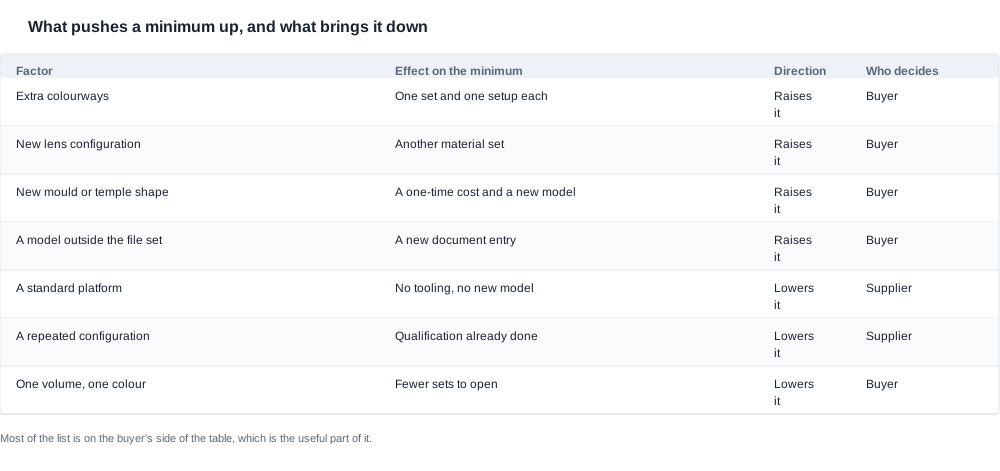
The two lists below are the same list read in opposite directions, and the useful observation is that the buyer controls most of it. That is not a criticism of the factory; it is simply that the structure of a smart glasses order is a commercial decision rather than a physical constraint.
What raises the minimum. More colourways, because each is a new set and a new setup. More lens configurations, for the same reason. A new mould or a new temple shape, which adds a one-time cost and a new model. And a model that is not already in the file set, because every model is an entry and every entry is documentation work with a lead time attached to it.
What lowers it. The opposite list, and each item is worth testing. One volume, one colour, one configuration is the largest lever available and it costs nothing except launch ambition. A standard platform that already exists carries no tooling and no new model. A repeated order of the same configuration is usually on easier terms, because the qualification stages are behind you and the factory is ordering against a history rather than a forecast.
The category's published configuration data makes the first lever concrete rather than abstract. The V06's four colourways are an option set that a buyer can choose from — one of them, or four of them. The V03 Pro's three colourways and the L2 Utral's two case options work the same way. The L1 Pro and the CY05, and the CY03 each publish a 1400 mAh case, the MT6 publishes a 1200 mAh folding case, and the KY06 and the MT5 carry a case whose capacity is not published — so a buyer who is choosing a case option has fewer documented options on some models than on others, and the difference affects the carton, the setup and the material count.
There is one more item on the lowering list that is not a buyer's decision at all, and it is worth naming because buyers frequently assume it is. A configuration that has already been built can usually be built again, and the question worth asking is which of the sets in your order are reorders. A set the factory already buys is a different proposition from one it has never bought, and the difference between the two is the difference between a predictable wait and an unpredictable one. The cell figures published per model make that question answerable — a 265 mAh line on the MT6, a 290 mAh line on the CY05 and the L1 Pro, and the CY03 or the L2 Utral, a 220 mAh line on the V03, the V03 Pro or the MT5 — because each of those is a specific purchase with its own supply history.

The three numbers a first order commits you to
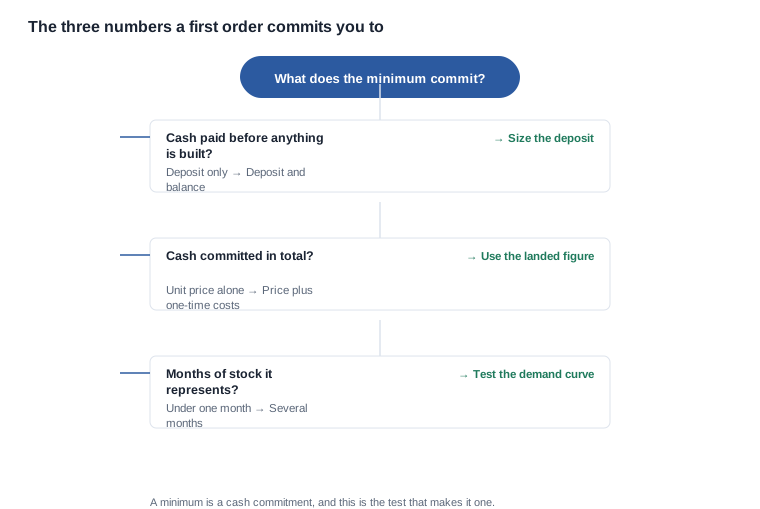
A minimum is easy to accept and easy to regret, because it is one number when it should be three. Any buyer should be able to produce all three before signing anything.
The cash committed at the start. The deposit is the largest single commitment in the transaction, it is paid before anything exists, and on a first order it is usually a larger proportion of the order than on a repeat. It is also the number that is hardest to recover if the order does not work.
The cash committed in total. The unit price multiplied by the quantity, plus the one-time costs, plus the packaging, plus the freight and the duty. This is the number the business case should use rather than the unit price, and the gap between the two is where first orders become expensive. A buyer who evaluates a smart glasses minimum against the unit price alone is evaluating the smallest component of the commitment.
The months of stock it represents. This is the one that is easiest to skip and the one that decides whether the first order was a good decision. A large minimum against an untested demand curve is a bet, and a bet should be one that can be afforded to lose. The published runtime figures are relevant here, because they set the pace at which stock turns in the market: the camera models in the range publish runtimes from about five to eight hours for the V03 Pro and the S7, and the V03 and the V06, through six to eight for the KY06 and the MT5, to around seven for the MT6 and the L2 Utral, the L1 Pro, the CY05 and the CY03, and the audio models publish different figures again with the 55 mAh × 2 group at six to eight hours and the K01 and the K02 at around eight. Runtime is a product characteristic rather than a demand forecast, so it does not answer the question on its own — but it sets the scale, and a buyer with a minimum representing eight months of cover and no demand history should know that before the order rather than after it.
The three numbers together are the actual size of the commitment, and the one that most often gets skipped is the third. A minimum is a cash commitment expressed in units, and the units are the part that has to be sold.
Once the three numbers exist, the trade-off becomes visible, and it is a trade-off rather than a calculation with a right answer. A larger minimum buys a better unit price, a more predictable material position and a lower amortised setup, and it costs working capital, shelf time and forecast risk. A smaller minimum buys flexibility and costs unit price and production efficiency. There is a fourth option that beginners rarely consider and that is frequently the best one: splitting the order — across two shipments, across two suppliers, or across a staged colourway rollout — so that the first commitment is sized to what the business can actually absorb. Splitting carries its own costs, in freight, in duplicated document work and in a smaller first run attracting a less favourable price, and those costs have to be priced too. But it is often the only way to hold the commitment below the level the demand plan can carry.
The decision framework that falls out of this is short. Establish the three numbers, establish the demand curve you are actually betting against, and then compare the two. If the minimum can be sold through inside the period your forecast is credible for, the minimum is a normal purchase. If it cannot, then the size of the minimum is a bet on the forecast, and the right response is to size the bet deliberately — a smaller first order, a split shipment, a staged rollout — rather than to take the larger number because it was presented as the only available one.
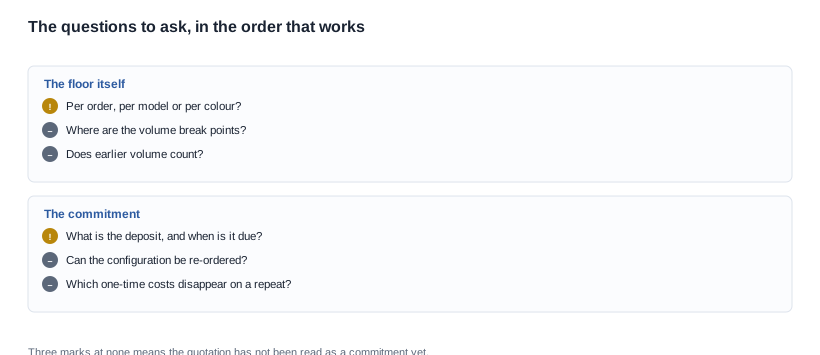
The questions to ask, in the order that works
These are the questions that answer the beginner's question, and the order matters because each one is easier to answer than the one after it, and because the answers are only useful if they arrive in a sensible sequence.
Is the minimum per order, per model or per colour? All three exist in practice, and the answer changes the plan. This is first because nothing else can be interpreted until it is known.
What are the volume break points? A quotation that shows the ladder of thresholds is usable. One that shows a single price is not, because there is no way to tell which threshold the order is currently at or what it would take to reach the next one.
Does earlier volume count? And across models, and over what period. This is the question that decides whether a second order can be smaller than the first, which is one of the few ways a programme can reduce its own exposure.
Which of the one-time costs disappear on the second order? This is what tells you what a repeat is actually worth, and it is the question that converts a minimum from a number into a decision.
What is the lead time attached to it? A minimum with a long lead time holds the capital for longer, which makes it a bigger commitment than the same number with a short one, and it is the question that most changes the calculation.
Two more belong in a first-order conversation, though they are about the order rather than the minimum. What the acceptance criteria will be, and who signs the first article. And whether the configuration can be re-ordered later at a similar volume, because that single fact determines how much of the volume has to sell through before the rest of it is committed.
What Cynrin can and cannot tell you about a minimum
The working rule we apply: we would rather hand over the structure than the number, because three internal readings of our own policy have not been reconciled. We will not bundle the three floors into one figure, because a buyer who cannot tell them apart cannot plan against them, and we will not print a quantity we cannot honour. That is not a negotiating position and it is not a way of being vague; it is the actual state of our record, and printing a number that two of our own people would contradict would be worse than printing nothing.
What we can do is take a range plan and show you, configuration by configuration, which floors it creates. We will count the production items in your order — model strings, colourways, case options, quantities — and tell you how many sets it implies. We will tell you which of the sets are reorders and which would be opened for the first time, because that is the difference between a predictable wait and an unpredictable one. We will say what the document set requires for the models and the markets in the order, and we will be clear that the euro radio requirement sits under the Radio Equipment Directive (EU) 2014/53/EU with the electromagnetic compatibility requirement under a separate directive, so the route is more than one obligation.
What we will not do is quote a tier ladder we have not reconciled, describe a configuration as reorderable without checking the bill of materials behind it, or imply that a minimum is the same thing as a recommended order size. The first is a figure we do not have, the second is a claim we have not checked, and the third is a confusion that costs buyers money.
The minimum order framework is under smart glasses MOQ, the cost structure behind the numbers is in procurement pricing, the customisation interaction is in how customisation options affect the minimum, and the buyer's version of this list is in the MOQ buyer checklist.
Related reading
- The buyer's version — MOQ buyer checklist
- The cost structure — procurement pricing
- The customisation interaction — customization options MOQ impact
- The framework — smart glasses MOQ
Send us your range plan and we will show you which three floors it creates.


