

The smart glasses minimum order quantity mistakes that cost buyers the most are not about negotiating a number. They are about which number was being negotiated. In this category a minimum order quantity is quoted in at least four different senses, the four senses are routinely presented in the same format, and a buyer who treats them as one thing agrees to something that is unachievable for the configuration they actually want. The eight mistakes below are organised around that distinction rather than around a list of generic procurement errors, because the generic list is well covered elsewhere and the specific one is where the money is.
Our published position on our own side is that minimum order quantities are not published in the catalogue, and that three conflicting internal statements on the subject have not been reconciled. That is an honest description of the category as much as of our company, and it is why the first question is not "what is your MOQ" but "what is your MOQ a minimum of".
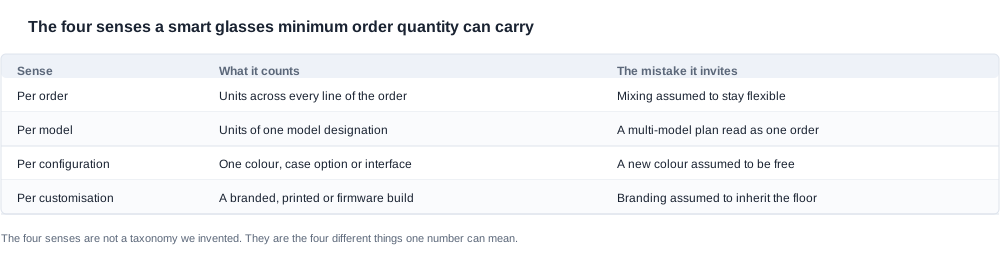
Smart glasses MOQ: the four senses a minimum can carry
What the four senses have in common
The four senses are not a taxonomy we invented for the sake of an article. They are the four different things a single number can mean when a supplier says "our minimum is X", and a buyer who has never seen all four will read the sentence in whichever sense matches their plan.
A per-order sense means X units across the whole order, whatever the order contains. A per-model sense means X units of any one model designation, so an order of three models has to satisfy it three times. A per-configuration sense means X units of one colour, case option, interface or lens combination, so a plan with three options has to satisfy it three times. A per-customisation sense means X units of a branded, printed or firmware-customised build, which is a separate floor sitting on top of whichever of the other three applies.
All four are legitimate, and they are not in competition — a supplier may apply more than one at once, which is exactly what makes the question hard. The only way to tell them apart is to ask for the figure on each level and compare, because the numbers are not comparable until they are on the same level.
Order, model, configuration and customisation
The published configuration rows in our own catalogue show immediately why the distinction has teeth. The V03 Pro is published in three colours and the V06 in four, so a two-colour launch on the V06 is two configurations under a per-configuration sense and one model under a per-model sense. The L2 Utral is published with either a 900 mAh or a 1400 mAh charging case, which is two configurations of one model rather than two finishes of one line. The CY05 and the CY03, and the L1 Pro are published with a 1400 mAh case; the MT6 is published with a 1200 mAh folding case; and the V03 Pro and the V03, and the V06 and the S7 publish no charging-case row at all.
Take a buyer who wants one colour of the V06 and one L2 Utral with a 1400 mAh case, under a per-model sense. That plan is two commitments of the same size. Take the same buyer under a per-configuration sense, and the plan is still two commitments. Take a buyer who wants three colours of the V06 and two L2 Utral case options, and the per-model sense gives two commitments while the per-configuration sense gives five. The plan has not changed. The floor has multiplied by two and a half, and the only thing that changed is which sense the supplier was using.

How a number quoted in the wrong sense creates a false comparison
The comparison that fails silently
The failure mode is quiet. Two quotations arrive, each with a single figure, each with a unit price, each with a lead time. They are put into a spreadsheet in two columns and the lower figure wins. If one supplier quoted per order and the other quoted per configuration, the comparison is not merely imprecise — it is meaningless, because the two numbers are counting different things.
The arithmetic makes the magnitude easy to estimate. Take the brand case again: three V06 colours and two L2 Utral case options is five configurations. A per-configuration figure of, say, 200 applied to that plan is a commitment of 1,000 units, against a per-order figure of 200 for the same plan. The quotation with the smaller number is the one that costs three times as much cash, and the spreadsheet is telling the buyer the opposite.
The same failure occurs in a second form, which is comparing a per-order figure against a per-model figure. A buyer with a single-model plan will see no difference and will draw the conclusion that the category is settled and simple. The conclusion does not survive the first launch of a second model.
What the false comparison costs
The cost does not appear on the purchase order, because the purchase order records quantities and the error is in what the quantities mean. It appears in three places.
It appears in the cash planning, where the deposit is calculated against a figure that will not hold. It appears in the schedule, because a commitment that was never actually made leaves the production slot unreserved and the launch date provisional. And it appears at renewal, where the buyer who signed a per-configuration commitment believing it to be per-order arrives at the second order with a different understanding of the arrangement and no document that settles it. The total cost of that sequence is roughly the difference between the two commitments, and it is paid once, in cash, at the moment the programme discovers which sense it was actually buying.
There is a fourth cost, which is reputational inside the buying team. A buyer who has already been wrong once about the level of a minimum is slower to act on the next quotation, because the next quotation is now something to be checked rather than something to be read. That is a cost that compounds quietly and is never attributed.
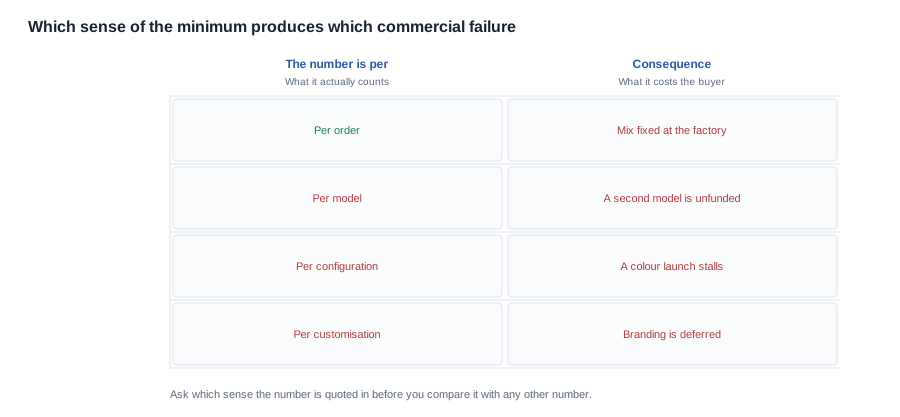
The eight mistakes that follow from an unnamed sense
The four that happen before the quotation
Mistake one: asking for the minimum without naming the configuration. The question "what is your MOQ for the L1 Pro" has a different answer from "what is your MOQ for the L1 Pro in a 1400 mAh case with printed packaging". A model name is a family; a family cannot carry a floor.
Mistake two: treating a mixed order as clearing the minimum. A factory quoting a per-model minimum is quoting a per-model minimum, and a mixed order in which each model is below its own threshold is below every threshold. If mixing is genuinely permitted, it belongs in writing with the arithmetic shown; the calculation is at can I mix models to meet MOQ.
Mistake three: treating a custom colour as free. Colour is a material and finish question rather than a paint layer, and the published colour options are narrow precisely because the option set is controlled. Asking what happens to the floor when you pick a colour outside the published list is the only way to find out, and the answer is frequently that a new floor applies.
Mistake four: planning a range without counting the configurations in it. A range that looks like three products in a launch deck is frequently five to nine configurations once the published colour and case options are written against it, and the count is the number that determines the size of the commitment. The count takes about ten minutes with the published option lists, and it is the single highest-value ten minutes in a first-order planning cycle, because it is the only step that can reveal a commitment the budget has not been set for.
The four that happen after the quotation
Mistake five: comparing two figures that are on different levels. This is the mistake the whole article is about, and it is the one that most often survives review because each figure on its own looks entirely reasonable.
Mistake six: reading a sample order's flexibility into the production order. A sample in this category is often one unit, with its own handling and its own price. A production order with a one-unit minimum is a factory running a different business, and the sample price is not the price of that business.
Mistake seven: agreeing a minimum and then negotiating the quantity down afterwards. A minimum is a commitment device. A buyer who has already used it once will be quoted a different number the second time, and the second number will reflect the new precedent rather than the original logic.
Mistake eight: not asking what happens at the second order. Whether the minimum is a first-order condition or a standing one, and whether repeat business attracts a different structure, is the question that matters for a recurring programme. A buyer who never asked will renegotiate from scratch, with no document to point at.
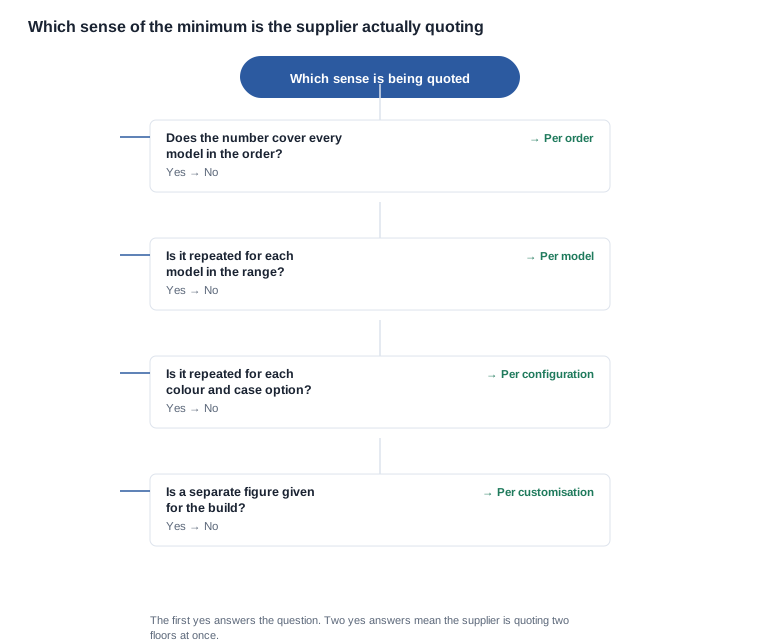

Identifying the sense from the quotation itself
Five questions and what each one reveals
A quotation usually contains the answer, but not in a form that announces itself. Five questions applied to the document itself will extract it, and they work on a printed quotation as well as on a conversation.
- Is the figure repeated for each model in the quotation? If it is, the sense is per model. If it appears once at the foot of the quotation, it is probably per order.
- Is a separate line present for each colour or case option? If the quotation has one line per configuration, the figure is per configuration. If the configurations are listed inside a single line, the figure is at the model or order level.
- Does the deposit appear as a percentage of the order value or as an amount? An amount reveals the minimum directly, because a deposit computed on a floor is bounded by it. A percentage reveals nothing.
- Does the break schedule step at figures that are multiples of something? A break at exactly twice a figure that also appears elsewhere is a configuration floor. A break at a figure with no other occurrence in the document is more likely a value threshold.
- Does the document say what the figure is a floor on? If it does, there is nothing to infer. If it does not, the four questions above are the substitute, and the inference should be confirmed before the order is placed.
The red flags
There are four statements in a quotation that reliably indicate the sense has not been settled on the other side. "Our MOQ is flexible" means nothing until it is attached to a configuration and a quantity. "We can do a mixed order" means nothing until the arithmetic is written out. "The setup fee is waived above a certain quantity" means nothing until the quantity is named. "We do not have a minimum" means nothing until the supplier can explain what happens to a single unit — and a supplier who can will say so.
The first three are all promises that cannot be checked. The fourth is a claim that, if true, would be unusual in this category, and it is usually made by a supplier who has not decided what the floor is. A document that requires the buyer to infer the sense is a document that will be re-interpreted at renewal, and the re-interpretation will not favour the buyer.
The questions to ask when the sense is still unclear
When reading the document does not settle it, these are the questions to ask, in this order, because each one is a harder question to answer vaguely than the one before.
- Is the quoted figure per order, per model, or per configuration? Completion: one of the three, named on the quotation.
- If per configuration, what counts as a distinct configuration? Completion: a rule about colour, case, interface and packaging.
- Does a colourway sit inside the model figure or on top of it? Completion: a yes or no, with the figure it applies to.
- Does a mixed order count against the figure? Completion: the arithmetic written out.
- What changes if the same configuration is ordered again? Completion: a number, and whether it is lower.
The reason to ask them in this order is that each answer narrows the space of possible quotations. A supplier who has answered the first question with "per configuration" and the second with "colour, case and packaging each count" has, whether they intended to or not, told the buyer how many commitments the plan will create. The buyer can then check that number against the plan before any money moves.
Correcting a minimum that was quoted in the wrong sense
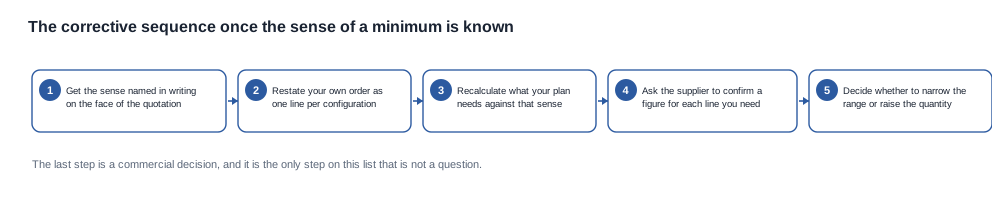
The corrective sequence
The correction is not a complaint. It is a request to re-express an existing figure on a stated level, and it works far better than a complaint because the supplier has not usually made an error — the buyer has simply not established the level. The sequence below is the one that turns an ambiguous quotation into a comparable one.
- Get the sense named in writing on the face of the quotation. Not by implication from the layout, not from a conversation, but stated.
- Restate your own order as one line per configuration. The published option counts make this quick: three colours on the V03 Pro, four on the V06, two case options on the L2 Utral.
- Recalculate what your plan needs against that sense. The multiplication is simple and the answer is usually the moment the problem becomes visible.
- Ask the supplier to confirm a figure for each line you actually need. Per line, on the stated level, in writing.
- Decide whether to narrow the range or raise the quantity. This is a commercial decision and it is the only step in the sequence that is not a question.
When the correction is not available
There is one case where step five cannot be executed, and it is worth being honest about. If the supplier's floor is genuinely per configuration, and the plan contains more configurations than the budget supports, then the range has to narrow or the programme has to change. A buyer cannot negotiate a per-configuration floor down to a per-order floor by asking more forcefully, because the floor is a consequence of how the factory builds.
What a buyer can sometimes do is change which configurations exist in the plan without changing which products the programme sells. Holding back the two unused V06 colours, deferring the second L2 Utral case option, and moving the custom printed build to the second order each remove a configuration without removing a product. That is a decision the buyer can take alone, and it is usually the cheapest one available.
Why the sense is the one thing we will not guess at
What we publish and what we do not
We publish the things the floor is applied to, because those are what make the question answerable rather than merely askable. The published range covers twenty-eight models, of which eleven carry a camera, split into two published resolution tiers: eight at 8 MP — the V06 and the MT5, the MT6 and the CY03, and the CY05 and the V03 Pro, and the KY06 and the V03 — and three at 13 MP, the S7 and the L2 Utral, and the L1 Pro. The published colour options, the published case capacities, the charging method on the twenty-four models that carry one and the charge time for all twenty-eight models are all on the record.
We do not publish a minimum order quantity for our own operation. The reason is that three internal statements on the subject have not been reconciled, and we would rather say that than hand over a figure we cannot defend. A buyer who has a number from us that we cannot defend is worse off than a buyer who knows to ask for the level, because the second buyer knows the question and the first one does not.
We also do not publish the Bluetooth version for any of the camera models, the weight of any model other than the MT6, ingress test report numbers, acoustic measurements or cycle life ratings. Those are not published because they are not ours to publish, and the correct answer to a request for them is a question to the supplier rather than a number from us.
What we can do with a plan
What we can do is take a range plan, count the configurations it contains against the published options, and tell the buyer how many separate material sets it creates and what a per-configuration basis would mean against it. We will also say which configurations in the plan are launch-critical and which are held back, and what narrowing the range would remove.
We can also read a supplier's quotation and say which of the four senses it appears to be using, and where the document is silent. That is a reading, not a guarantee — the reading is only as good as the document, which is exactly why the correction sequence above starts with getting the sense named on the face of the quotation rather than with inferring it from the layout.
The wider set of questions that force a supplier to state the level is at MOQ supplier verification, and the framework this article sits inside is under smart glasses MOQ.
The action to take now. Send the range plan as one line per configuration and the quantities, and we will tell you how many separate commitments the plan creates and which of them the floor is most likely to attach to.
Related reading
- The forcing questions — moq supplier verification
- The mixing arithmetic — can i mix models to meet moq
- The working framework — smart glasses moq
Send the range plan as one line per configuration and we will count the commitments it creates.


