

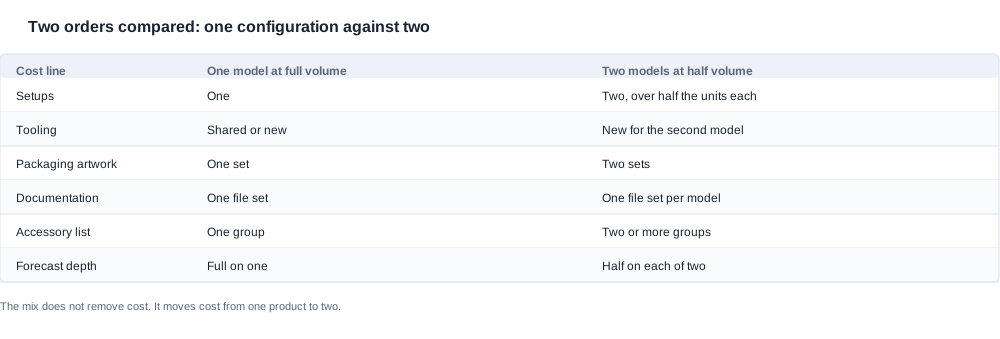
Yes, mixing models is possible in this category, and the useful part of the answer is that mixing does not lower the cost of getting into production. It moves the cost. The setup that one configuration would have carried is now carried twice, over half the units each, and the fixed costs that sit on top of it — tooling, firmware, packaging artwork, documentation — do not shrink at all. In exchange, you get two products to sell, two configurations to forecast, and a wider assortment per unit of capital.
That trade is worth making in some situations and is a mistake in others, and the deciding variable is not the arithmetic of the order. It is whether the models you are adding share tooling, firmware and packaging with the model you already planned. Two models that share a chassis and a build are a different commercial proposition from two models that merely share a brand, and the difference shows up in every line of the quotation.
Buyers who arrive at this question are usually trying to solve one of three problems: they have a demand estimate that is below a threshold, they want to widen the range for a marketplace listing without doubling the cash commitment, or they have been told a minimum and want to know whether they can spread it. The three have different answers, and only the first is really about the minimum.
It is worth being clear about what "meeting the minimum" actually means in a negotiation, because the word covers several different levers and a buyer who does not know which one they are pulling will get an answer to a different question. A minimum can be flexed by changing the quantity in one configuration while holding the others, by changing the configuration itself so that it reuses tooling and artwork, by changing the timing so that the order is placed in a period when capacity is open, or by changing the commercial structure so that the risk sits with a partner instead of with the buyer. Only the first of those is a change to the arithmetic; the other three are changes to the circumstances, and they are frequently the better lever because they do not cost you a second product you did not want.
The uncomfortable truth underneath all four is that the threshold is set by the fixed costs of a configuration. A factory takes a minimum because there is a setup, a packaging set, an accessory set and a document set, and the minimum is what makes those recoverable. If your proposal removes one of those fixed costs, the minimum moves on its own. If it keeps all of them and simply splits the volume, the minimum does not move, and the order you end up with is a smaller order with more of everything.
can i mix models to meet moq: the conclusion first
Three things are true at once, and the first one is the one that matters most.
The threshold is usually per configuration, not per order. Our own minimum order quantity is not published on this site, and the reason is set out in its own section below, but the structural point stands regardless of what the number turns out to be: a minimum attaches to a configuration — a model, a colourway, a charging method, a packaging treatment — because that is the thing a factory has to set up. If you order two models, you are usually clearing two thresholds, not one. A buyer who treats a mixed order as a way of "reaching" a single threshold is usually raising the effective threshold rather than meeting it.
Adding a model adds fixed cost and does not reduce any. The setup is a fixed cost per configuration. Splitting 1,000 units into two configurations does not halve the setup cost; it doubles it and halves the units over which it is spread. On top of that sit the costs that are fixed per configuration regardless of volume — the packaging artwork, the accessory list, the documentation set, and the parts of the firmware that differ between models. The unit price of the mix is therefore higher than the unit price of the concentrated order at the same total volume, and that is not a penalty for mixing; it is the price of having two products.
What you get for it is assortment, and assortment has a carrying cost. Two models means two forecasts, two sets of shelf-facing assets, two spares positions, two aftersales paths, and two product descriptions that have to be kept correct. A range is a bet that the second model sells as fast as the first.
The conclusion, stated in one line: mixing to meet a threshold is a way of raising the effective minimum while buying more product, and it is worth doing when the second model was already in your plan, and rarely worth doing when it was added only to clear a number.

Where the cost actually moves when you add a model to reach a threshold
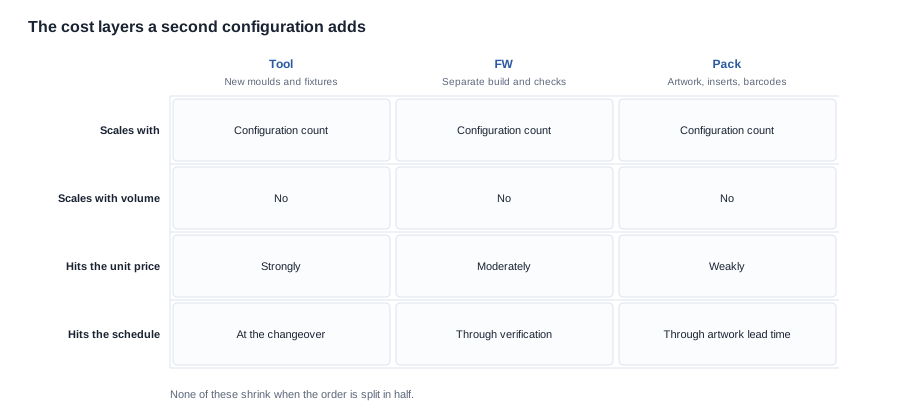
Tooling is the least flexible line. Anything requiring a new mould or a new machining fixture is a fixed cost that does not halve when the volume halves. Lens geometry, temple shape, hinge design, the geometry of the charging case — all of these sit in this category. If your two candidate models differ in any of them, you are paying twice for the privilege of a smaller first order, and the tooling cost itself is not published on our side; it is quoted per project, because it depends on what has to be new.
Firmware and app work is a fixed cost too. If both models run the same build with only a colour or a name difference, the marginal cost is close to zero. If one of them needs different behaviour — a different control scheme, a different battery profile, a different pairing flow — you are looking at a separate engineering and verification cycle, and that is where timelines slip. The published data gives you one clue about how much the range varies: the charging method alone is magnetic on 17 models, Type-C on 7, and not published for the CY05, the CY03 and the L1 Pro, and the MT6. Different charging paths mean different firmware behaviour and different accessory lists, and that is a genuine engineering difference rather than a cosmetic one.
Packaging is where mixes look reasonable on paper and hurt in the warehouse. A shared outer carton, a separate inner box, a separate insert, a separate barcode. Run three models and you are carrying three sets of artwork, three sets of inserts and three sets of shelf-facing assets. Our catalogue publishes colour options for two models only — three on the V03 Pro, four on the V06 — but the absence of a published colour count for the rest of the range is not the same as the absence of colour variants, and a mixed order needs the variant list per model whatever the catalogue says.
The accessory list multiplies. Cases are separate moulded components: our published case capacities run at 900, 1200 and 1400 mAh, with the KY06 and the MT5 carrying a case whose capacity is not published, the V03 and the V06, and the S7 having no case row at all, and the V03 Pro being explicitly a no-case product. A mix that crosses those lines carries several accessory groups, and each one is a separate line in the quotation and a separate thing to pick correctly in the warehouse.
The compliance scope is the trap. Conformity documentation is issued against a product and a market, not against an order. Our catalogue publishes no per-model certification row at all, the export certification page is a picture page showing ten patent certificate images with no conformity mapping attached, and the catalogue body does not mention CE, FCC, RoHS, RED or EN 18031. So for every model in the mix, the file has to be requested in writing for that model. A mixed order multiplies the number of files, and the cost of that multiplication lands in your compliance team's calendar rather than in the unit price.
Inventory, which is where a threshold-motivated mix does most of its damage. Splitting an order into two configurations halves the depth on each. If the demand estimate was uncertain to begin with, halving the depth on each of two products roughly quadruples the relative impact of a forecast error. That is the arithmetic people miss: the risk of a mix is not that one model sells badly, it is that one model sells badly and the other one does too, and you have two lines of stock instead of one.
Quality sampling, which follows the configuration and not the units. Each configuration in a mix needs a first article and a verification against its own specification, and the published data shows how much of that specification varies. Twenty-six models publish a charge time of two hours or less, with only the D17 and the ZH12 publishing about one hour, so a charge-time check is not the same check on every model. For a camera model the rated runtime is about five to eight hours and the batteries run from 220 to 290 mAh, with no test condition stated for either figure, so a runtime check on a camera model is a check against a number that carries no method. Two models that share a chassis still need two first articles, and the verification effort does not halve when the volume does.
Spares and the long tail. A mixed order creates two products, and products have lives. When a model is eventually discontinued — and in a range where the camera tier alone carries eleven models, it will be — the remaining obligation converts into a spares question: a case size, a cell format, a firmware version and a packaging artwork that have to be kept for as long as you support the product. A threshold-motivated mix creates a second of these permanently, on the strength of a number you wanted to meet.
When adding a model helps, and when it makes the order worse
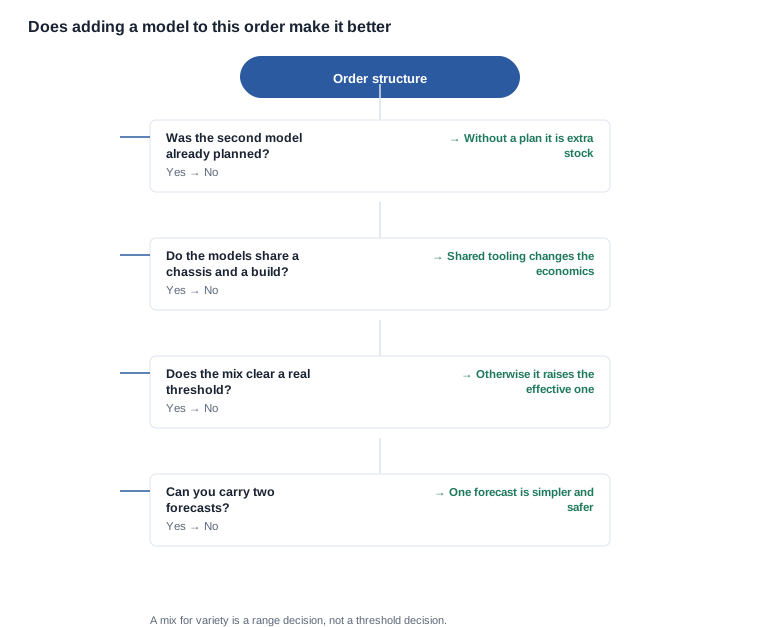
Adding a model to a small order is worth doing in a short list of situations, and they have a common feature: the second model was already going to happen.
The assortment is the point. If you are launching on a marketplace that rewards variety, or if your channel partner wants a range rather than a single item, then a mixed order is buying the thing you actually wanted, and the minimum is a constraint on the way to it rather than the reason for it.
The models share a platform. Two configurations off the same chassis, the same firmware build and the same box artwork behave very differently from two unrelated models. The setup count is still two, but the incremental fixed cost is small, the accessory list is shared, and the documentation is close to identical.
The order is a first run and you expect a reorder. A first run is where you learn the real demand. A mix gives you two data points instead of one, and if the reorder comes, you already know something about both.
The situations where adding a model makes the order worse are the mirror image, and they are more common.
The second model exists only to clear a number. You are buying stock you did not forecast, on a product you have not validated, in a configuration that needs its own setup, its own artwork and its own file. Every one of those is a cost attached to units you may never sell.
The second model needs a different platform. Crossing from the audio range into the camera range, for example, brings a different cell format, a different case design, a different camera module and a different runtime band into the same shipment. For our camera models the published battery figures sit between 220 and 290 mAh, alongside a rated runtime of about five to eight hours with no test condition stated; the sport range includes the YKC02, which is a sport model built around a pair of 70 mAh cells. Those are not variants of each other. They are separate products with separate supply chains, and mixing them does not share a setup — it creates two of them.
The threshold you are clearing is a per-configuration threshold anyway. In this case the mix has not solved the problem it was meant to solve, and it has added a second order's worth of complexity to it.
There are two commercial contexts where the mix question looks different, and both of them are common enough to be worth separating out. The first is the distributor who buys for a channel partner. Their constraint is not only the minimum but the shelf: a channel partner will often take a narrow range if the terms are right, and will take a wide range only if the second product is one they can move. In that case the mix is a negotiation about the range rather than about the threshold, and the quantity split should follow the channel's demand plan rather than the factory's minimum.
The second is the marketplace seller. Their constraint is usually the opposite of the factory's: the platform wants variety, so the mix buys them a listing position, and their cash is the scarce resource. That makes a mix genuinely attractive to them — and it also makes them the buyer most likely to end up with two slow-moving configurations and no reorder. If you are advising a seller in this position, the single most useful piece of guidance is to make the second model the one you are most confident about, not the one that happens to fit the threshold.


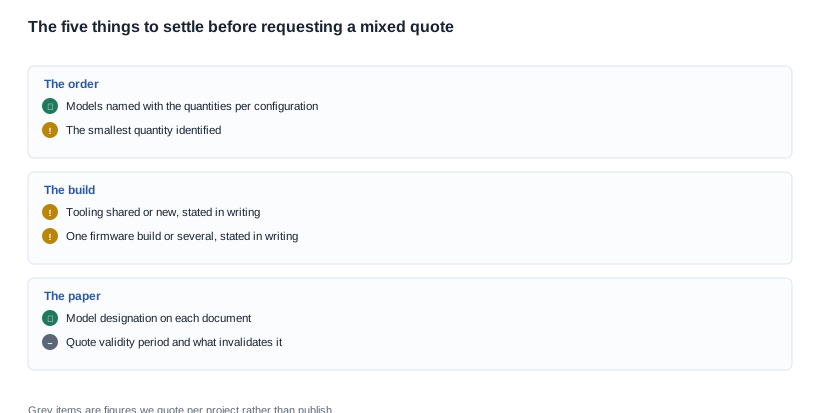
The five things to settle before you ask for a mixed quote
- Which models, and by how much of the total. A quote for two models with no split is a quote for one model. Send the split, and send the quantities per configuration, because the configuration with the smallest quantity is the one that usually determines the unit price.
- Whether tooling is shared or new. This single answer determines whether the mix saves you anything. Two models on the same tooling with a different insert are a different commercial proposition from two models with different moulds.
- Whether one firmware build covers all of them. Ask for the answer in writing rather than inferring it from the fact that both models connect to the same app. The catalogue publishes a Bluetooth version for 14 of the 28 models it lists and marks it as not published for the rest, so the radio and pairing behaviour is not uniform across the range and should not be assumed to be.
- How many documentation sets result, and which model designation appears on each. A declaration is issued for a product and a market, not for a colourway or an order. Ask whether the mix ships under one document per model or one document covering the order.
- The quote validity period and what invalidates it. Tooling availability, component pricing and configuration decisions all move. A mixed quote with a short validity is normal; a mixed quote that does not state one is a quote you will be asked to honour later.
The shortlist criteria that come out of these five are about how the supplier handles the split. A supplier who asks for the quantities per configuration before quoting, who identifies the shared tooling explicitly, who names the model designation that appears on each document and who states the validity period is a supplier whose mixed-order price you can plan around. A supplier who quotes a blended unit price for "two models" has not counted the setups, and the number is not a price yet.

Why we do not publish a minimum order quantity
Our own minimum order quantity is not published on this site, and the reason is not evasiveness. A minimum is a function of the configuration, the tooling, the packaging treatment and the market, which means there is more than one figure in circulation internally for different scenarios, and publishing any of them without the scenario attached would be publishing a number we would have to walk back.
The cost of that walk-back is worse than the cost of not publishing. We have seen a lot of buyers compare a published figure from one supplier against a quoted figure from another, discover that the first was a restock threshold for an existing build and the second was a first-production-run threshold for a new configuration, and conclude that somebody is being evasive. Both suppliers were being precise. The comparison was not.
There is a second reason, which is a commercial one rather than an administrative one. A published minimum invites ordering to the threshold. It rewards a buyer for taking stock they did not need in order to reach a number, and it quietly penalises the buyer who wants less. Since the minimum is not published, the conversation starts from demand and configuration instead, which is the conversation that produces an order someone can actually sell through.
Comparing minimums fairly is easier once you know what a minimum actually contains, so it is worth putting the question to every supplier you speak to in the same form: what does this figure cover? A minimum that includes tooling and new packaging artwork is not comparable with one that assumes existing tooling and a plain box. A minimum that assumes the standard accessories is not comparable with one that includes a custom case. A minimum that is quoted for the standard configuration of a model is not comparable with one quoted for a new colourway. And a minimum that is quoted for one destination market is not comparable with one quoted for several, because the packaging and the document scope both change. When two suppliers give you two numbers and the numbers differ, the first question is not which is lower — it is what each one assumes.
This is also the reason a mixed order is often proposed to a buyer as a way of "reaching" a threshold and frequently turns out to be a way of raising one. If the threshold is per configuration and the mix contains three configurations, the order has to clear three figures. The buyer who was aiming at one number is now aiming at three, and the third is the one that decides whether the order goes.
What we will do is give you a number with its conditions attached, once we know the market, the configuration and the quantities. Ask us directly and we will either quote it or tell you that the conditions are not yet settled either.
What we will put on the quotation
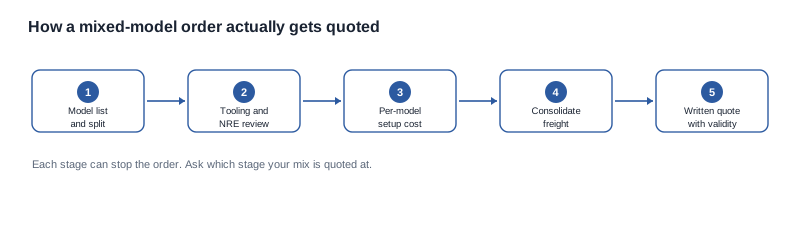
For a mixed order, we will itemise by configuration rather than blending, so each configuration carries its own unit price, its own effective minimum and its own production lead time, with the changeover count stated so that the schedule consequence is visible. We will also state it plainly when a mixed order costs more than a concentrated order at the same total volume, because the setup cost is charged per configuration and the total does not move with order size.
The mechanics of a single-configuration first run are on the MOQ and lead time page. For how the customisation side of a mixed order gets scoped and where the risk sits, see engineering customization risk assessment, and for the boundaries that no amount of negotiating moves, what is not possible to know about engineering customization. How a development actually runs once the order is placed is covered in development process how it works, and the platforms a mix can be built from are under OEM-ready smart glasses.
Send the model split, the target market and the required configuration, and we will tell you what it costs, which parts of it are still being confirmed, and whether the models you have chosen actually share a platform.
Related reading
- What we cannot tell you, and why: what is not possible to know about engineering customization.
- How a development actually runs once the order is placed: development process how it works.
- Product range overview: OEM-ready smart glasses.
Send the model split, target market and required configuration and we will tell you what it costs and which parts of it are still being confirmed.


