
A minimum order quantity in this category is not a number a supplier picks; it is the quantity at which a component becomes worth ordering, a production slot becomes worth opening and the compliance work becomes worth repeating. That definition has a consequence most buyers meet later than they should: the number exists because of documents, and a document set is the only thing that proves what the number means. A buyer who has a quotation but no evidence file can act on the number; a buyer who has both can act on the programme.
What follows is the document set itself — what each document proves, what it has to answer, and where a file that is technically complete still fails a market. The distinction between the four senses of a minimum is covered in is MOQ per model or per order, the mechanism behind the number is at how MOQ works, and a worked sequence is at the smart glasses MOQ case example.
The document stack behind a smart glasses MOQ
The four layers and why they are in that order
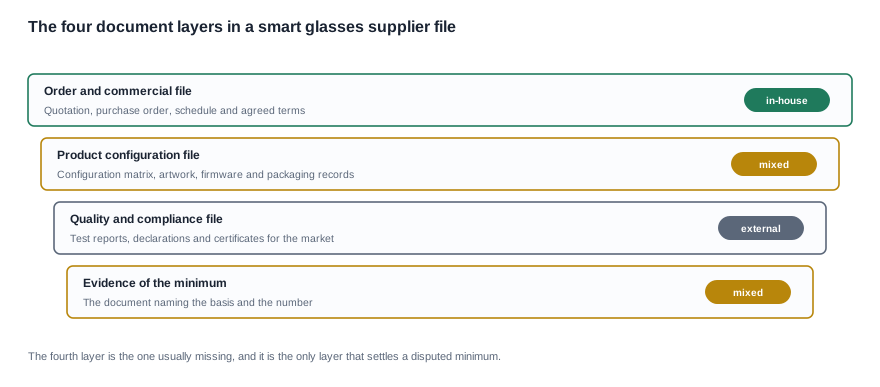
A supplier's file in this category is not one collection. It is four layers, and they stack in a specific order because each one answers a question the one below it creates.
The bottom layer is the product and configuration file: the model, the colour, the case option, the interface, the firmware build, the packaging. The layer above it is the quality and compliance file: the test reports, the declarations and the certificates, each scoped to a product and a market. The layer above that is the order and commercial file: the quotation, the purchase order, the schedule and the agreed terms. The top layer is the one this article is about — the evidence of the minimum itself, the document that names the basis and the figure.
The order matters because a dispute is resolved from the top down. If the commercial file is complete and the evidence of the minimum is not, the dispute is about a number and there is nothing under it to appeal to. If the evidence of the minimum is complete, the same dispute is about a clause and both parties can see what they signed.
Each layer also has a different relationship to the buyer's own operation, and that difference is worth being explicit about. The configuration layer is the layer the buyer controls most: it is the buyer's own specification, and the buyer decides it, changes it and records it. The compliance layer is the layer the buyer controls least: its content is set by the requirements of the destination market, and the buyer's only lever is the choice of route and the accuracy of the request. The commercial layer sits between the two, and it is the layer that both sides write.
The evidence of the minimum is the odd one out, because it is the only layer that is jointly owned and frequently absent. It belongs to neither party alone, which is precisely why it has to be written down: a term that is jointly held and verbally agreed will drift, and the drift will be interpreted later by whoever holds the evidence at the moment of the disagreement.
The layer that is usually missing
The fourth layer is the one almost always absent, and its absence is why minimum order quantity disputes are so expensive. A supplier's file normally contains a product specification, a quality file, a set of certificates and a signed agreement. It rarely contains a document that says: this figure applies at this level, to this configuration, from this date, until that date.
The consequence is not that the number is wrong. It is that the number is undefinable, and an undefinable term is renegotiated every time the relationship touches it. A buyer who discovers this at renewal has already lost the moment, because the only way to settle it is to reach an agreement that both sides could have reached on day one at no cost.

Which document proves which term
The six terms and their proving documents
Each of the six terms below has exactly one document that settles it, and in every case the document is the one nobody asked for.
| Term | The document that proves it | A weak version reads like |
|---|---|---|
| The basis | A quotation clause naming the level | A figure with no level named |
| The number | A quotation line for each configuration | One total for the whole range |
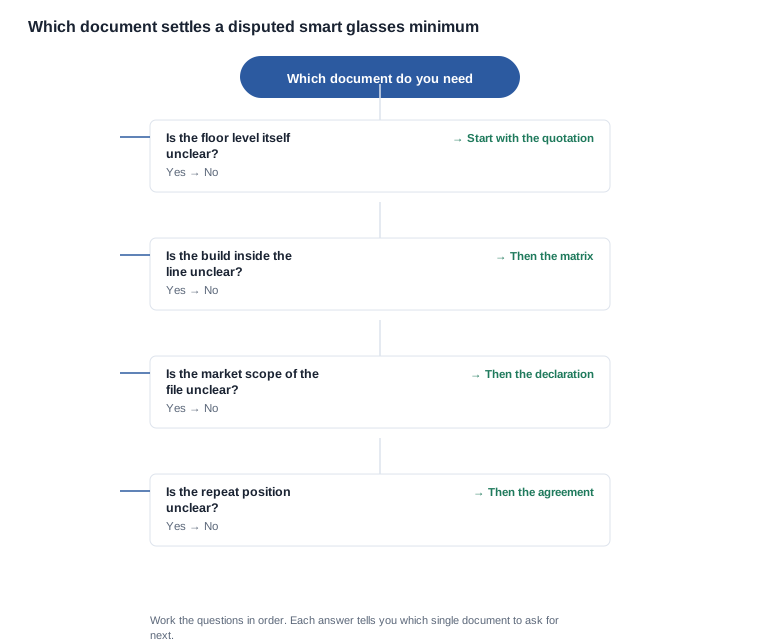
| The configuration | The matrix attached to the order | A model name, not a build |
| The repeat position | A written second order clause | Left to a later discussion |
| The compliance route | A declaration scoped to your model | A generic certificate list |
| The weight of a claim | A report carrying a number on it | A promise inside a catalogue |
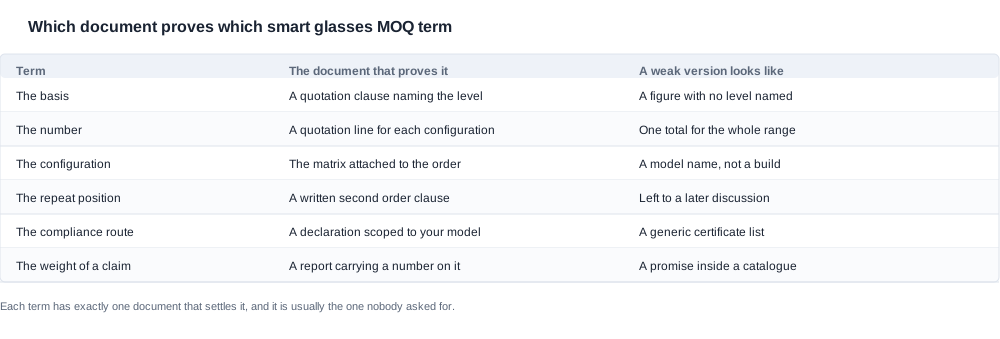
The last row is the one that causes the most trouble, because a promise inside a catalogue reads exactly like a specification until someone has to decide whether to ship against it. A catalogue statement about a marking, a charge time or a capacity is a description of what the supplier believes to be true; a report carrying a number is a measurement that a third party or a defined protocol produced. Only the second can be put into an acceptance rule.
The question each document has to answer
A document is worth having if it answers one question that the buyer is otherwise going to have to guess at.
The configuration matrix answers: what exactly is in each line of the order? Without it, "the L2 Utral" is a model name, and a model name cannot be inspected because it covers two published case options and at least one published colour set. The quotation line answers: what is the figure for this specific line, at this specific level? The compliance document answers: which market, which model, and which variant inside that model does this cover? The second order clause answers: what happens to the same configuration when it is ordered again?
The test for whether a document is adequate is straightforward: take a question the buyer will have to answer in a meeting with a distributor, an inspector or a bank, and check whether the document contains the answer in writing. If the answer has to be given from memory, the document is not adequate, no matter how many pages it has.
Building the evidence file before the first order
The three groups of the evidence file
The file has three groups, and the third is the one that is normally skipped because it only becomes relevant later.
The commercial group holds the quotation with the basis and every line, the volume break schedule with its thresholds, the deposit and its trigger, the validity window and a written position on a second order. The configuration group holds the matrix with the quantity on each line, the artwork and packaging approvals, and the firmware build reference. The compliance group holds the declarations scoped to the buyer's own model, the test reports carrying report numbers, and the transport documentation for the cell.
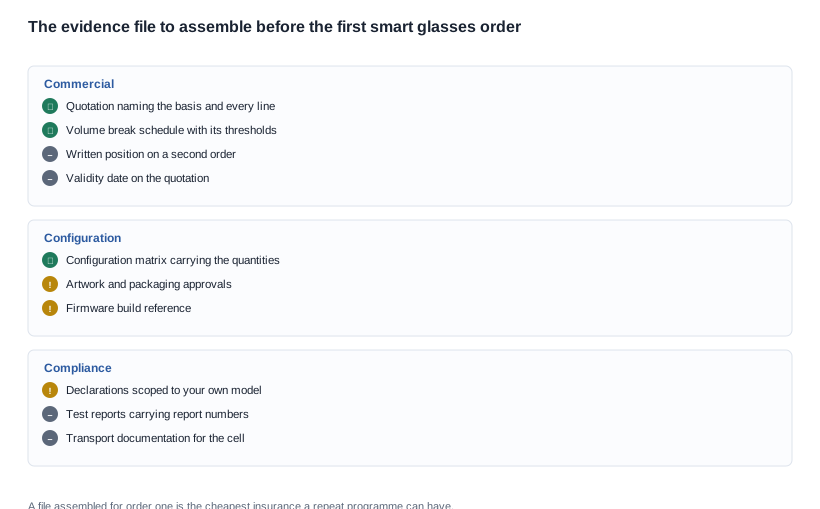
Each group has a different shelf life, and that is worth noting. The commercial group expires on a date the supplier sets. The configuration group is superseded every time the range changes. The compliance group expires on a schedule the buyer does not control, because it depends on the market's own requirements and on the validity of the underlying documents.
The file that makes a repeat cheap
The purpose of assembling the file before the first order is not to be able to answer a question later. It is to be able to place the second order without a negotiation, and that depends on one document more than the others: the configuration matrix.
A matrix is a short document with a line per configuration, a quantity on each line, and the model, colour, case option, interface, packaging and firmware build named on the line. It is the document that lets a buyer say, at renewal, "this is what we ordered last time and this is what we are ordering now", and it is the document that turns a repeat into a re-order against an established build rather than a fresh negotiation with a new specification.
The matrix is also the document that catches the most common scope drift, because a comparison between the matrix on file and the live range is the only way to see that a colour has been added informally. That comparison is a five-minute exercise and it is the difference between a renewal that is a check and a renewal that is an argument.
Indexing the file so that it survives the person who built it
A file that is thorough and unindexed is functionally a file that does not exist, because the buyer who needs it will not know which of forty documents is the one that answers the question. The indexing discipline is unglamorous and it is the difference between a file that works in year one and a file that works in year three.
Each document in the file needs four things attached to it: what it covers, which model designation and variant it is scoped to, which market it is scoped to, and a date with a stated expiry or supersession rule. A file indexed on those four fields can answer a question without being read in full, and it can answer the harder question — what has to be refreshed before the next order — by sorting on the date.
The second half of the discipline is that nothing is deleted. A superseded document is moved to a sub-folder and marked with the document that replaced it and the date of the change. A file that only contains current documents cannot show how a configuration evolved, and a buyer who cannot show that evolution is the buyer who gets renegotiated at renewal. It also means the change history of the product is available when a supplier asks why a configuration differs from one they quoted two years ago, which is a question that gets answered badly when the evidence has been thrown away.

The questions each document has to answer
Scoping the compliance route
The compliance document is the one that most often turns out to be scoped to something other than the buyer's product. A generic certificate list says that the factory has produced certified products; it does not say that the buyer's model, in the buyer's variant, for the buyer's market, is covered by that certificate. The question that closes the gap is always the same: does this document cover the model designation on our purchase order, in the variant we ordered, for the market we are shipping into?
The published catalogue rows make the scoping question sharper rather than simpler. Eleven models in the range carry a camera, split into two published resolution tiers — eight at 8 MP and three at 13 MP — so a file that covers "the camera model" covers nothing in particular. The catalogue's IP54 marking appears on two models only, the V06 and the S7, and it is a catalogue annotation rather than a report-backed claim, so it cannot be used as a specification for the other nine. The catalogue does not publish the Bluetooth version for any of the camera models, so a file covering a camera model's radio characteristics has to be requested and read rather than assumed.
Scoping a document to your own model
Three questions settle whether a document can be used, and they apply to every certificate, every report and every declaration in the file.
First, is the model designation named? A document that says "our smart glasses" or that lists a family without a variant cannot be applied to a purchase order that names one configuration out of a range with published colour and case options. Second, is the variant inside the scope — the colour, the case option, the interface, the firmware build? Third, is the document current, and what would make it expire?
The fourth question is the one buyers forget, and it is the most valuable: what would have to change for this document to stop applying? A change notification clause that covers components, processes and sub-suppliers answers that question for every document in the file at once, which is why it is worth more than any single certificate.
The four questions also work on a document the buyer has drafted, which is the case for the evidence of the minimum itself. Does it name the level, does it name the configuration, is it dated, and what would invalidate it? A document that answers the fourth question is one the supplier can hold a buyer to; a document that does not is a page in a file that gets superseded every time the conversation restarts.

Where documentation goes wrong on the way to market
Four failures reach a buyer as a surprise, and each of them is a document that was requested in the wrong form rather than a document that was refused.
The file that covers a sibling model. A document arrives, it is genuine, and it does not cover what was ordered. The cause is that a family-level document was accepted for a variant-level requirement. The control is to require the model designation and the variant on the face of the document, and to treat a document that names neither as not applicable.
The file that is current but was written for the wrong market. A declaration is presented as covering the destination, and it covers a different destination entirely. The cause is that the market was not named on the request. The control is to put the destination market on the request line rather than assuming the file was prepared for the buyer's market.
The report that describes a run rather than a process. A test report demonstrates that one production run met a requirement. The cause is that a single-run document was accepted as evidence of a stable process, and the two are not the same claim. The control is to ask for evidence spanning more than one production lot, with dates, before the report is used to accept a production run.
The file that is complete and the programme is still not ready. The whole set is present, dated and scoped, and the shipment is still held. The cause is almost always the one thing that is not a document: the compliance route for the destination market was never scoped against the actual product. A complete file proves what has been done. It does not prove that what has been done is the right set of things for the market the goods are entering.
What a complete document set does and does not settle
What it settles
A complete set settles the terms. It settles what was ordered, at what level, at what figure, and on what basis. It settles what the supplier has committed to and what has been demonstrated. It settles what will have to be re-established at renewal and what will simply carry over.
That is a large share of what a procurement relationship in this category has to defend, and it is worth more than it sounds because the alternative — reconstructing terms from quotations, invoices and memory — produces an answer that cannot be shown to anybody else. The wider framework this sits inside is under smart glasses MOQ, and the product range the file describes is at AI camera glasses.
It also settles something that is easy to underestimate, which is the buyer's own position internally. A programme whose terms are documented can be handed to a colleague, defended in a budget review and explained to a bank or an insurer without anyone having to reconstruct it. A programme whose terms are not documented can be defended only by the person who remembers them, and that person is also the person who is most likely to leave.
What it does not settle
A complete document set settles nothing about whether the supplier can hold a configuration across production lots. That is a question about a factory's process, and the evidence for it is a unit from a later lot compared against the approved unit, not a document in a file. A complete file also does not settle the defect rate, because no defect rate is published for any model in the range and a documented one is a supplier's own record rather than an independent measurement.
Most importantly, a complete document set does not settle a term that was never written down. It is entirely possible to assemble a thorough file containing a product specification, a quality record, a set of declarations and a signed agreement, and still have no document that says what the minimum order quantity means. The check for that is simple and worth running before the first order: take the number, and find the sentence that says what it is a floor on. If there is no such sentence, the highest-value document in the file is the one that has not been requested.
The action to take now. Send the models, the configurations and the destination market, and we will list the documents the file needs, which of them come from a supplier's own file, and which of them we can already answer from published rows.
Related reading
- The basis question — is moq per model or per order
- The mechanism — smart glasses moq how it works
- The worked sequence — smart glasses moq case example
- The product range — ai camera glasses
Send the models, the configurations and the destination market and we will list the documents the file needs.


