

Two quotations that describe different things cannot be compared, and no spreadsheet fixes that. What a spreadsheet can do is make the difference visible, force the comparison onto one basis, and stop the loudest number on the page from deciding the outcome. That is what this template is for: seven columns, one normalisation pass, and a scorecard that is weighted before the numbers are read.
The template is deliberately small. A comparison sheet with twenty columns is a document nobody completes accurately, and an incomplete comparison sheet is worse than none, because it produces a decision with the appearance of rigour behind it.
We do not publish unit prices, minimum order quantities or production lead times, and the template reflects that: the money columns are empty until a supplier fills them, and the columns that make them comparable are all things the buyer controls.
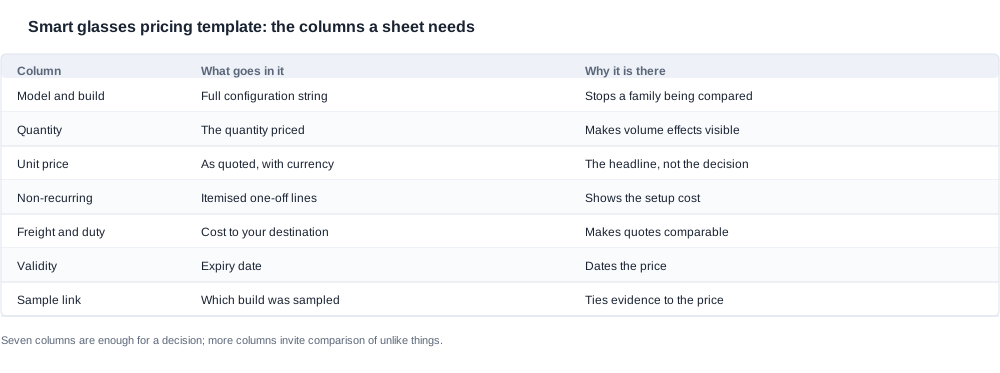
Smart glasses pricing template: the columns a comparison sheet needs
The seven columns, and why each one is there
The first column is the one that decides everything else, and it is the one most often left informal.
- Model and build. The full configuration string, not a model name.
- Quantity. The quantity the price assumes, with the currency and the date.
- Unit price. As quoted, with the currency stated rather than implied.
- Non-recurring. Each one-off itemised, with its trigger.
- Freight and duty. The cost to your destination at a named incoterm.
- Validity. The issue date and the expiry date.
- Sample link. Which build was sampled, and where that record sits.
Two quotations that differ in the first column are not comparable, and the sheet is designed so that a reader notices that before reaching the money columns.
What the sheet looks like before it is filled
An empty comparison sheet is worth describing, because the order of the empty columns is what shapes how the meeting goes. There is a row per supplier rather than a column per supplier, which sounds like a small decision and is not. With rows, the buyer reads across a row to compare one build; with columns, the buyer reads down a column and compares suppliers on a single field before knowing whether the fields are equivalent.
The empty sheet also carries its own headers for the missing information, and those headers are the questions. A column headed "incoterm" with nothing in it asks for the incoterm. A column headed "non-recurring trigger" asks for a trigger. The sheet is as much a request for information as it is a place to put information, and it is worth sending the empty version to a supplier as part of the enquiry.
The columns that are for the buyer's benefit
Columns one, two, five and seven are not part of the supplier's offer. They are the fields that turn two offers into one comparison, and they are the fields a buyer fills in or insists on before the money is read. A sheet where only the money columns are populated is a receipt, not a comparison.
The validity column earns its place on its own. Two quotations issued on different dates for the same build are different offers, and a sheet that does not record the dates will eventually put a stale number against a fresh one and call it a price difference.

The configuration column and why it comes first on a smart glasses pricing sheet
What a configuration string actually contains
The configuration string identifies one buildable product. In our own range that means at minimum: the model, the camera the cell capacity, resolution tier where the model publishes one, the case capacity where a case ships in the box, the charging method where it is published, and the number of colourways.
Those fields are not decorative. The L2 Utral publishes a choice of 900 or 1400 mAh case, so "L2 Utral" identifies two products. The V03 Pro publishes three colours with a photochromic lens configuration and no charging-case row at all. The V06 publishes four colours, a detachable inner frame and an IP54 marking. A quotation that names any of those three models without the additional fields has not identified a product.
Why it is the first column rather than a footnote
The order of the columns is an argument, and the argument is that the configuration is what the price is about. Everything after the first column is a property of a build. A sheet that leads with the unit price invites the reader to compare before checking that the builds match, and the reader who has already compared will not go back.
Who fills which column
A workable allocation is worth fixing before the first quotation arrives, because the columns are usually divided along lines the team already has.
- The supplier fills the unit price, the non-recurring items and the delivery terms, and it fills them on its own document.
- The buyer fills the quantity, the destination and the review date, because those are the programme's requirements rather than the offer's properties.
- The buyer computes the landed cost and the amortised one-off total, because those are the buyer's own arithmetic and nobody else will do it.
- Both record the configuration string, because it has to be agreed rather than asserted by one side.
- The sample record fills the last column, and it is the only column that can be checked against a physical object.
A team that assigns these differently ends up with a sheet where half the columns are empty and nobody knows who was going to fill them, and the sheet then becomes a record of what the supplier happened to offer.
The build that is not in the catalogue
Sometimes the build a buyer wants is not one the catalogue publishes, and the column still applies. A private label configuration with a different colourway count, a bundle with a specific accessory list, or a model with a case omitted all exist as combinations rather than as catalogue entries, and a supplier can quote them.
The point is that the buyer must describe them. A buyer who writes "our configuration" in the column and expects the reader to infer the rest is the reason two quotations end up being compared across different products.
The recurring and non-recurring columns of a smart glasses pricing sheet
Recurring lines
The recurring column carries the unit cost of the build as configured, and it should be as decomposed as the supplier will allow. Three sub-lines are worth separating if they can be: the electronics, the case where one is included, and the packaging. Their proportions tell a buyer where the specification decisions have the most effect.
Non-recurring lines, and the trigger
Each one-off item gets its own row, its own amount and, critically, its own trigger. The trigger answers the only question that matters about a non-recurring line: will it appear again on the reorder?
- Artwork and packaging development: no, unless the artwork changes.
- New tooling: no, unless the mould is replaced, and the tooling statement should say who owns it.
- Firmware or software work: usually no for a re-order, and yes if the function set changes.
- Compliance work for a new market: no for the same markets, yes for each additional one.
- Sample and development units: no, but they are frequently quoted at a rate that hides the setup.
The unit price column and the currency problem
The unit price column carries more traps than its simplicity suggests. The currency has to be stated on the sheet rather than inherited from the quotation header, because two quotations in different currencies with no rate attached produce a comparison that is arithmetic rather than commercial. The date has to be recorded for the same reason: a quotation issued three months earlier reflects a component market that has since moved, and comparing it with a fresh quotation without noting the dates converts a time difference into a supplier performance difference.
The rate itself should be a stated rate on a stated date, written into the sheet, rather than whatever the finance system shows on the day the sheet is printed. The purpose is not precision. It is to make sure that two people reading the sheet later arrive at the same number, which is not guaranteed if the rate is implied by a live lookup.
The question the column answers on a reorder
On the second order, the non-recurring column is the most informative part of the sheet, because it tells the buyer what the reorder will actually cost. A sheet that records a one-off with no trigger will show a unit price that appears to drop and a total that does not. A sheet with triggers shows both correctly, and it is the sheet that lets a buyer forecast a reorder before making it.

Landed cost, validity and the scorecard columns in smart glasses pricing
Building the landed cost
The landed cost column is not a quote from the supplier. It is the buyer's own arithmetic, and it is the only column on the sheet that the buyer owns outright.
The build is straightforward: the recurring unit cost, plus the amortised non-recurring total, plus freight, plus duty, plus destination charges, plus tax treatment, plus a returns and replacement reserve, divided by the quantity. The reserve is the line teams omit, and it is the line that decides whether two quotations are comparable on total cost.
The validity column and the review date
Validity has two dates, the issue date and the expiry date, and a buyer should add a third of their own: the review date. The review date is when the buying team will look at the sheet, and a price that expires before it is a price that has to be re-confirmed before the meeting where the decision is taken.
The sample link column, and why it is the one most often left blank
The last column records which build was sampled and where that record sits. It is the column most often left empty, and it is the one that would have prevented the most expensive common error in this category: a sample approved against one build being treated later as evidence for a quotation against a different one.
The repair is cheap. Write the configuration string of the sample in the cell, and give the location of the sample record. It takes a minute at the point where the sample is approved, and it is the only defence available when someone asks, six months later, whether the approved unit was the approved unit for this quotation.
The criteria for declaring a sheet usable
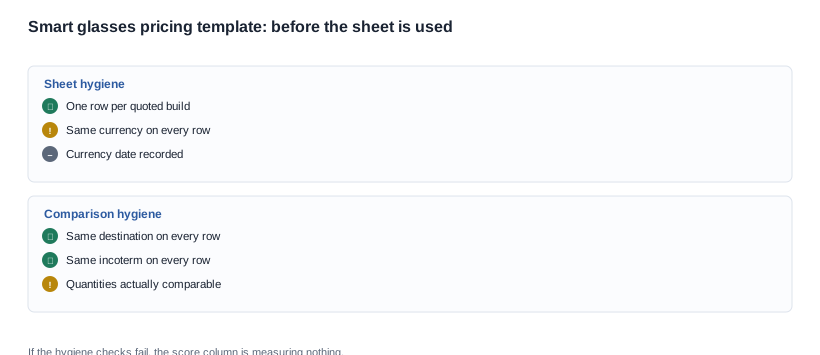
Before a sheet is used to make a decision, it has to meet a small set of criteria. These are not style preferences; they are the conditions under which the numbers on the sheet mean what they appear to mean.
- Every row carries a configuration string, so that no row is comparing a build with a family.
- Every row states a quantity and a currency, so that no row is comparing a unit price with an order total.
- Every row names an incoterm and a destination, so that no row is comparing a factory-gate price with a delivered price.
- Every row carries a validity date, so that no row is comparing a live offer with a stale one.
- Every row states what it excludes, so that an omission is not read as a zero.
A sheet that fails any of these criteria can still be used, but the failed criterion has to be written on the sheet as a known limitation, and the decision has to be taken with that limitation in view. The alternative is to discover the limitation later, when the reason for the decision is no longer available.
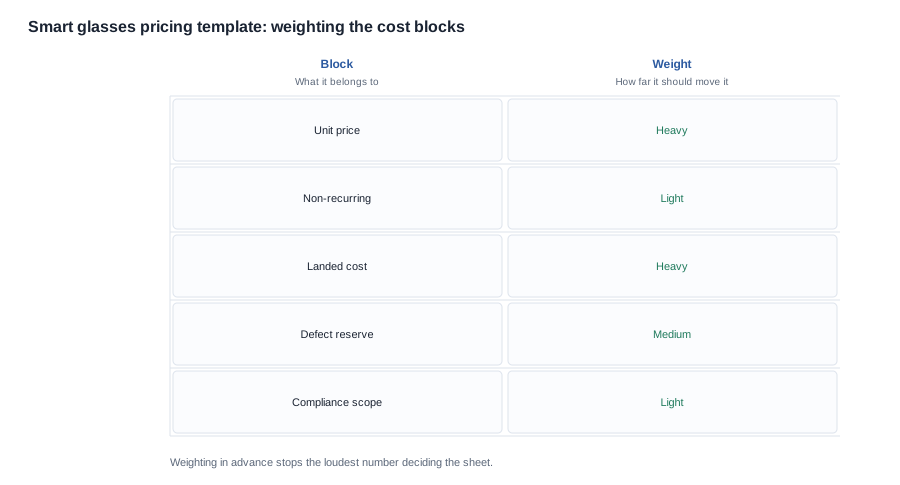
The scorecard, and weighting it before the numbers
The scorecard is the part of the sheet that turns a comparison into a decision. Five cost blocks are usually scored: unit price, non-recurring, landed cost, defect and returns reserve, and compliance scope. Weight them before reading any figure, and write the weights down.
Weighting in advance is what stops the loudest number deciding the sheet. A unit price is the loudest number on the page, and it is not necessarily the most important one for a programme whose constraint is a launch date rather than a margin. A sheet where the weights are decided after the numbers are read is a sheet where the weights were decided by the numbers.

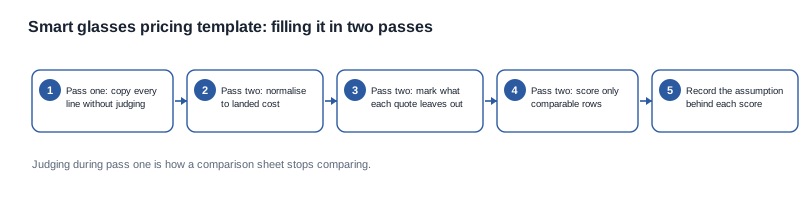
Filling the smart glasses pricing sheet in two passes
Pass one: copy without judging
Pass one is transcription. Every quotation becomes a row, every line becomes a cell, and nothing is compared, scored or summarised. The purpose of the pass is to get the raw material onto one page without the reader's judgement interfering, and to make any gap visible: a cell that cannot be filled from the quotation is a question, and the question should be written down at the moment it is found rather than reconstructed later.
Pass two: normalise, then score
Pass two does three things in order. Normalise every row to landed cost at the same destination on the same incoterm. Mark what each quote leaves out, because an omission and a zero look identical on a sheet and are not the same thing. Then score, and only score rows that are genuinely comparable, because scoring an incomparable row produces a number that will carry an authority it has not earned.
A monthly discipline that keeps the sheet usable
The sheet decays in a predictable way. Quotation dates move out of the validity window, the configuration on an old row is superseded, a currency rate becomes stale and a supplier changes its price basis without telling anyone. Each of those is small, and together they make the sheet quietly wrong.
A short monthly pass prevents that. Check which rows are still inside their validity period and mark the ones that are not. Check whether any configuration string has been superseded by a newer one. Check that the currency rates used are the ones written on the sheet rather than live ones. And check which rows have a sample record against them, because a row without one is a row where the build has never been seen.
The pass takes a few minutes per sheet and it is the difference between a comparison tool and an archive.
How to score the columns that are not money
Three of the five blocks on a scorecard are not amounts at all, and they are scored on a different basis from the two that are. The defect and returns reserve is scored on whether it exists, whether it is quantified and whether the quantification comes from the channel's own history rather than from a general figure. The compliance scope is scored on whether it names the models and markets in the order, whether it carries a date, and whether the scope covers the configuration actually quoted. The documentation handover is scored on whether the files that travel with the goods are listed.
These blocks are scored as criteria rather than as amounts, and the criterion is simply whether the question was answered in writing. A supplier that names the models covered has answered it. A supplier that says the file exists has not, and the difference between those two is worth more than the difference between two quoted unit prices on a small order.
Recording the assumption behind each score
Every score carries an assumption, and the assumption belongs on the sheet next to the score. A score of "defect reserve: medium" rests on an assumption about the channel's returns behaviour, and a reader in six months needs to know that the assumption was made rather than measured.
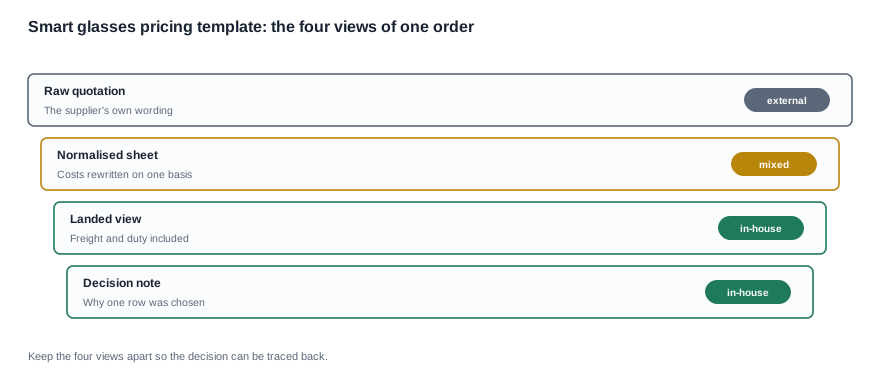
Where a smart glasses pricing template breaks and what to do instead
Four ways the sheet fails
The template breaks in four characteristic ways, and each has a known repair.
- Unequal quantities. Two rows priced at different volumes are not comparable at the unit level. Repair: ask both suppliers for their price at your quantity.
- Different currencies or dates. Repair: convert at a stated rate on a stated date and record both.
- Different incoterms or destinations. Repair: ask for the delivered price, or normalise both to the factory gate before comparing.
- Different compliance scope. Repair: exclude the compliance line from both rows and treat it as a separate programme cost.
Why the exclusions are recorded rather than ignored
The last repair is the one teams skip, and skipping it is how a comparison sheet produces a false result. If the compliance scope differs, the two rows are pricing different obligations and the unit price difference is partly an artefact of that. Excluding the line from both rows and handling it separately is not convenient; it is the only way the remainder of the sheet means anything.
When to stop using a template at all
A template is a tool for comparing several options on one basis. It stops being the right tool when there is one option, or when the options differ so much that a common basis would have to be invented rather than found. In that case the right comparison is a checklist of what each option commits you to, not a scored sheet, and forcing the second into the first produces false precision.
For the questions behind the numbers, the pricing FAQ covers what buyers ask most often, the pricing myths article covers the beliefs that distort a comparison before it starts, the payment terms section covers the commercial terms that usually sit alongside the unit price, and the MOQ section covers the quantity basis. The pricing section sets out the structure behind the quotation.
Send us the quotations you are comparing and we will tell you which columns can be filled from published data, which have to be completed by the supplier, and where the comparison should be split in two.


