

The advice that matters in this category is short, unglamorous and mostly about order of operations: fix the configuration before you ask for a number, ask for the same things from every supplier in the same form, get the setup charges separated from the unit price, and put a validity period on the offer. Four steps, and none of them is a negotiation technique. They work because they remove the ambiguity that a minimum order quantity is made of, and once the ambiguity is gone the number becomes arithmetic that can be checked.
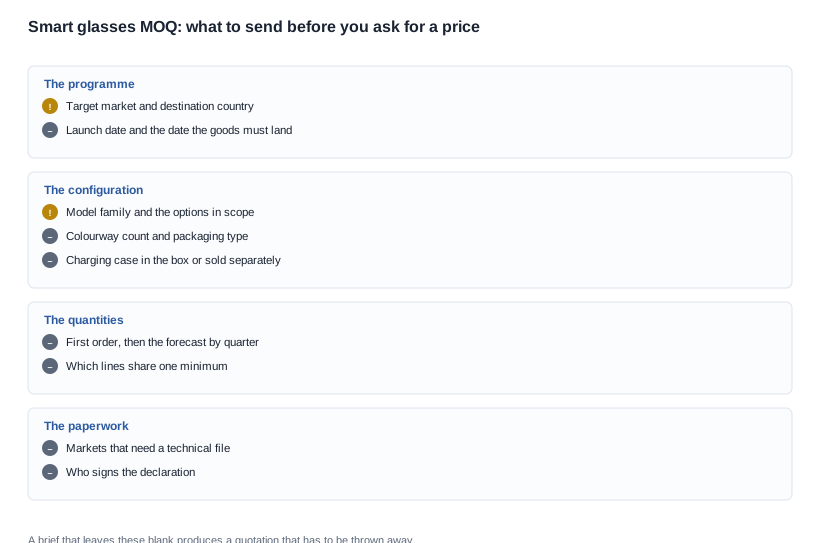
The conclusion: the highest-value action available before you order is not pressing for a lower minimum, it is writing down the configuration precisely enough that the answer means something. Send the pack on the checklist above and the conversation starts from a specification rather than from a guess.
Smart glasses MOQ: the six fields a first enquiry must carry
The conclusion, in one paragraph
Before you ask any supplier for a minimum order quantity, write six things down: the model family and the options in scope, the colourway count, the packaging type, whether the charging case is in the box or sold separately, the destination market, and the quantity with the forecast behind it. Send them as one message and ask for five things back: the minimum with the level it applies to stated, the unit price with setup charges itemised separately, the price tier boundaries, the validity period of the offer, and the binding milestone on the schedule. Everything else is refinement. A buyer who has done this has already done most of the due diligence that a first order needs.
The buyer this advice is written for
This is written for a procurement manager or a channel buyer who has a product idea, a target market and a date, and who is about to open a conversation with several suppliers at once. It is not written for somebody who already has a supplier relationship and a repeat order; the standing checklist covers the renewal case, where the job is to check a number against a record rather than to build one from nothing.
What makes this stage different from a repeat order is that nothing is known yet. The configuration does not exist, the documentation scope has not been assessed, the material position is unknown and the schedule is a guess. Every question a buyer asks at this stage is therefore a question about somebody else's internal state, and the quality of the answer depends almost entirely on how precisely the question is asked.
There is a second reason this stage is different. The first order sets the terms of every order after it, because the configuration, the approved sample, the packaging artwork and the documentation file all get created once and then reused. A buyer who is casual about the specification at this point has made a decision that will be inherited by whoever places the second order, and the person inheriting it will not know which parts were deliberate.
That inheritance is why the effort spent on the brief is not wasted effort, even when the brief itself is thrown away once the order is placed. What the brief produces is a set of decisions that were made consciously: this colourway, this case position, this market, this schedule. Each of them becomes the default for the repeat order, and a default that was chosen is worth a great deal more than a default that was inherited from whichever supplier answered first. The record of those choices is also what makes a renewal a review rather than a fresh negotiation.
There is a third thing this stage decides, and it is the least visible: what kind of supplier you are dealing with. A supplier who answers a precise brief with a precise answer has a process. A supplier who answers it with a range and a duration has a catalogue, and a catalogue is fine for a catalogue order and awkward for a programme. Neither is better in the abstract, but a buyer who cannot tell which one they are talking to until the deposit is paid has skipped a stage.
Why the first message decides the answer you get
The answer a supplier gives is shaped by the precision of the request, and the shaping happens in the first exchange rather than the fifth. A message asking for the minimum and the lead time for smart glasses invites a range and a duration, because that is the level of detail the question carries. A message that names a configuration, a market, a quantity and a date invites a specific figure with a level attached, because anything less would not answer the question.
The difference matters commercially, not just in terms of tidiness. A range across configurations cannot be used to plan anything, so the buyer will ask again, and the second exchange starts from a weaker position than the first. A specific figure can be compared against the other quotations and against the buyer's own forecast, so the negotiation starts from a number that both sides can check.
There is also a cost to vagueness that is easy to miss. Every supplier who answers a vague question differently produces a comparison sheet full of numbers that describe different things, and the reconciliation work falls on the buyer at the end rather than at the beginning. The whole point of writing the brief is to move that work to the front.

The brief, field by field
Six fields and what each one changes
The model family and the options in scope. This is the field that decides everything downstream. Our catalogue holds twenty-eight entries across seven families, and the camera models alone split between two published resolution classes — eight of the eleven at 8 MP and three at 13 MP — and across three charging interfaces, with the interface magnetic on seventeen entries across the catalogue, Type C on seven, and unpublished on four. A request that names the family without naming the configuration leaves the supplier to decide what you meant.
The colourway count. The V03 Pro is published in three colours and the V06 in four, so the count is not a detail but a driver of the variant total. The question to include with it is whether a second colourway is in the first order or planned for the second, because that is what determines whether the minimum applies per configuration or per order.
The packaging type. Retail box, bulk carton or a channel-specific pack, and whether the packaging artwork is your own or the supplier's. This field changes the setup position and the material set, and it changes the inspection scope.
The charging case position. Whether the case is in the box, sold separately, or not part of the product at all. In our catalogue the L2 Utral is published with either a 900 mAh or a 1400 mAh case, the L1 Pro and the CY03, and the CY05 — each with a 1400 mAh case, the MT6 with a 1200 mAh folding case, the KY06 and the MT5 with a case whose capacity is not published, and the V03 Pro with no case at all. The case is a separate line with its own quantity logic, and whether it is inside the minimum changes the shape of the order.
The destination market. Because the documentation scope follows the destination, and because the scope is a fixed cost per configuration rather than per unit. The radio side of these products sits under the Radio Equipment Directive (EU) 2014/53/EU, and a destination outside the European Economic Area brings its own set of questions. We publish a company-level export certification page in the catalogue rather than a per-model certification row, so a per-model position is something to request in writing rather than to read off a sheet.
The quantity and the forecast behind it. Both, and the forecast is the more useful of the two because it is what lets a supplier tell you which parts of the answer move with volume and which do not.
The fields people leave blank
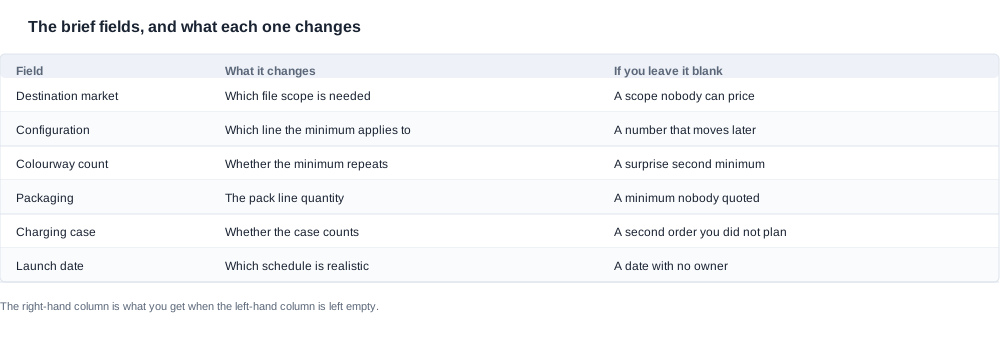
The right-hand column of that table is the answer to a question buyers ask constantly: why does the quotation have to be sent back? It is almost always because the configuration, the market or the accessory position was never stated, so the number that came back was for a different order.
There is one field that is blank more often than any other, and it is the forecast. A buyer who asks for a minimum without a forecast gets a number for a one-off order, and then discovers at the renewal that the figure was not a tier but a single point. Supplying the forecast costs one paragraph and it changes the kind of answer you get.
The sequence from brief to purchase order
Six steps and what each one produces
- Send the configuration, the market and the quantity in one message. One message rather than several, because the supplier who receives three partial requests has to reconcile them itself, and the reconciliation is done on assumptions.
- Ask for the minimum, the tier and the schedule in writing. Three answers, one source, one date on them.
- Ask what changes if the quantity halves or doubles. This is the step most buyers skip and it is the one that tells you the shape of the deal: which parts of the answer are tiered, which are fixed, and whether you are near a break.
- Compare the answer against your own sell-through estimate. The minimum only has meaning relative to how fast the units move. Divide the quantity by your planned weekly sell-through and check the result against a season.
- Freeze the variant list before the deposit is paid. One page, dated, with the colourway count and the accessory position on it.
- Write the minimum, the tier and the dates into the order. Not into an email, and not into a purchase order that leaves the commercial terms undefined. The order is where the terms have to exist.

The step most buyers skip, and what it returns
Step three is the one that gets skipped, usually because it feels like asking for a discount and it is not. What it returns is the elasticity of the answer: which parts of it move with your quantity and which do not. A supplier who answers it plainly has told you where the negotiation is and where it is not, and a buyer who has that information can allocate the negotiating effort correctly instead of spending it on the number that was never going to move.
It also protects step four. Without it, a buyer comparing a quotation against a forecast is comparing a figure whose relationship to volume is unknown against an estimate whose relationship to volume is assumed. The two do not meet, and the mismatch is usually discovered at the second order rather than the first.
There is a fourth reason to ask the question in this order rather than in a batch at the end. A buyer who asks for the minimum, the tier, the schedule, the elasticity, the comparison and the freeze all at once gets one answer with six parts in it, and the parts tend to be answered to the level of detail the question implied. Asking in sequence lets each answer be checked before the next question is asked, and it means the answer to question four is shaped by the evidence in answers one to three. The cost of that is one more exchange. The benefit is that the reply becomes a set of usable terms rather than a description of a supplier's operation.
The gate that most programmes forget
Between step four and step five there is a gate that does not appear in most order checklists, and it is the point at which the forecast is confirmed. A quotation is normally produced against a plan as it stood when the enquiry was sent, and the plan is the thing most likely to have moved in the meantime. Confirming it costs one message and it is the cheapest way to catch an order whose quantity no longer matches the reason it was placed.

Working backwards from the date the goods must land
The gates and their offsets
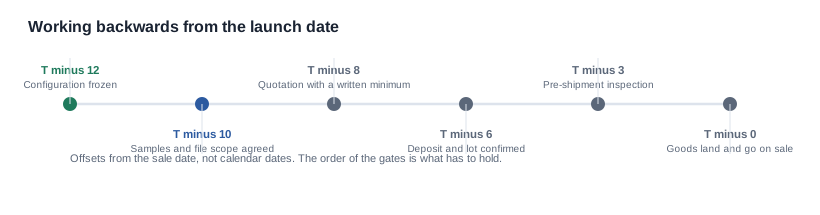
The date that matters commercially is the date the goods are available to the channel, not the date the factory says they are finished. Working backwards from it produces a sequence of gates, and each gate has to be given a date before the order is placed rather than discovered after it.
The offsets in the chart are relative rather than absolute, because the absolute dates depend on your plan. What the sequence shows is that the specification freeze has to happen first, then the samples and the file scope, then the quotation with a written minimum, then the deposit and the lot, then the pre-shipment inspection, and only then the goods land. Each of those has an owner, and the owner is not the same person in every case.
The two questions about the date
The first is which milestone is binding rather than indicative. A schedule that lists six milestones with no commitment attached to any of them is a description of a process rather than a plan, and the difference shows up the first time something slips. The second is who holds the buffer: a supplier who builds buffer into a schedule has planned for the ordinary slips, and a supplier who does not has assumed none will happen. Both are legitimate positions, and a buyer who knows which one they are dealing with can decide whether to hold buffer themselves.

What to do with the answers you get
Comparing two quotations that describe different things
The comparison most buyers attempt is price against price, and it is the comparison least likely to hold, because two quotations for the same product family can describe different builds. The V03 Pro at three colours and the V06 at four are different orders; a magnetic-charging build and a Type C build are different orders; a build with a published case option and a build without one are different orders.
The way to compare them is field by field, in this order: configuration and variant set, accessory and pack position, market and documentation scope, then unit price with setup separated, then the minimum with its level, then the schedule with its binding milestone, then validity. When two quotations survive that comparison with the same configuration, the price comparison that follows is meaningful. When they do not, the cheaper one is cheaper for a different order, and the difference is a scope difference rather than a pricing decision.
The pricing reference covers where the tiers sit, and the comparison guide covers the field-by-field frame in more detail.
The three checks before you sign
The criteria are short: is the configuration on the order the same as the configuration that was quoted, is the minimum in the order stated with the level it applies to, and does the schedule name a binding milestone with a date. Three checks, and each one closes a specific way for the order to differ from what was agreed.
There is one more check that is not on the list and matters more than any of them: does the order still match the forecast you used to justify it? A quotation that took four weeks to obtain may represent a plan that has moved since the enquiry went out, and the number can be perfectly correct while being based on a forecast that no longer holds.
What to send us, and what you will get back
What a dated, per-enquiry answer contains
We do not publish prices, minimum order quantities or lead times as fixed numbers, because all three are confirmed per enquiry and depend on the configuration. What we publish is the model data: the rated use times, the cell capacities, the interfaces, the case options, the resolution classes and the charge times, the ingress marking on the two models that carry it, and the weight on the one model where it is published. That is enough to build a brief and to check a specification, and it is deliberately more than we publish about the commercial terms.
What we will do with a complete brief is quote against it: the minimum for that configuration with the level it applies to stated, the unit price with setup charges itemised separately, the tier boundaries, the validity period and the binding schedule milestone. The MOQ section describes the structure behind the figure, and the ODM development options and customisation pages cover the parts of the brief that change the answer.
The message to write
A workable first message is short. It has four lines: the model and the options in scope with the colourway count, the accessory position for each line, the destination market, and the quantity with the forecast behind it. It then asks for five things back — the minimum with its level, the unit price with setup itemised, the tier boundaries, the validity period, and the binding milestone — and asks that the reply be in writing so it can be compared against the other suppliers on the same basis.
Send it to more than one supplier, in the same form, on the same day. The value of doing so is not the lowest answer; it is the evidence of which answers describe the same order, which is the only way to know which answer to act on.
Related reading
- How a minimum actually works — the chain your brief has to hold constant
- Red flags in a quotation — what to watch for in the reply
- Quality implications you should price in — the specification clauses worth adding


