

Smart glasses oem contract considerations are settled earlier than most buyers expect them to be, because a clause agreed while the specification is still open costs almost nothing to write, and the same clause renegotiated after the first shipment has left the building costs a great deal. The agreement does not create the requirements. It records them, assigns them to named people, and decides what happens to the money when one of them is not met.
The document is therefore read by two audiences at once. A sourcing manager needs to know which line of the catalogue a clause points at, which is the first of the questions to ask when a draft arrives. That answer decides whether an annex can be assembled from material that already exists or from material that has to be argued into being. A finance reviewer needs to know which obligation triggers which payment, because a payment schedule with no trigger is an invoice schedule with no discipline.
What follows is written for the person who carries the consequence of a decision: a procurement lead, a sourcing manager, a brand owner preparing to sign a first order. It works from the published specification set rather than from a price list, because the published set is the only thing an annex can genuinely attach to. Where the catalogue carries a row, the clause can point at it. Where it does not, the clause has to create the figure, and the party that creates it has to sign beside it.
The deliberate omission here is any number for the things a catalogue does not publish. Unit prices, minimum order quantities, production capacity, lead times, warranty periods and certificate numbers are all absent from our published material, and that absence is the entire reason those items belong in a signed document with a defined validity rather than on a page that anyone may read at any time.
What an OEM agreement in this category has to carry
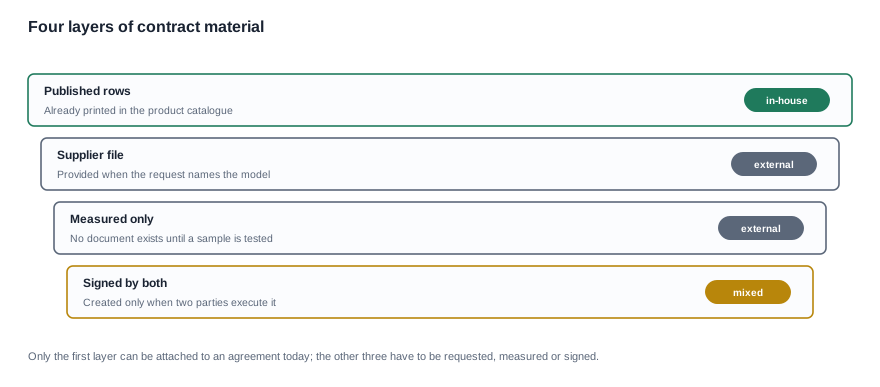
Four kinds of material can appear in an OEM agreement, and only one of them can be produced without anybody else's participation. That distinction decides how the drafting gets organised, because a clause attached to the wrong kind of material is a clause that will fail later.
- Material the supplier has already published. Model designations, cell capacity and cell count, a charge time, a rated runtime, a charging interface on the rows where it is printed, a Bluetooth version on the rows that carry it, a resolution class on the camera models, a charging case capacity on the models that print one, a colour row on two models and an ingress marking on two more. This kind can be annexed today.
- Material the supplier holds in a file. Test reports, declarations, technical files, labelling artwork, per-configuration statements. It exists, it is not public, and it is released when a request names the exact model and the exact configuration.
- Material that only a physical unit can produce. Charge behaviour under load, radio behaviour in the environment you actually ship into, acoustic output, what the hinge does after a season of daily use. No document exists for this kind until somebody measures it.
- Material that exists only once two parties sign. Ownership of the design, the artwork, the tooling and the accounts. Delivery commitments, remedies, defect periods, and the rules for what happens when the programme ends. These clauses are not documents you obtain; they are documents you create.
A clause belonging to the first kind can be drafted on a Tuesday. A clause belonging to the fourth kind is written by the act of signing, which is precisely why those clauses get skipped and then missed most.
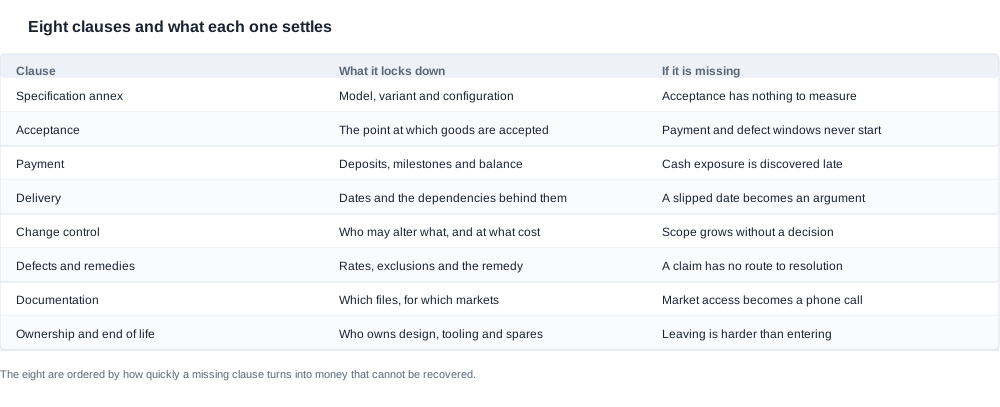
The eight clauses that carry most of the value are set out in the table above. None of them is exotic. A specification annex, an acceptance point, a payment structure, a delivery structure, a change procedure, a defects-and-remedies clause, a documentation clause, and a clause covering ownership and the end of the programme. What makes them easy to leave out is that each one seems to belong to a different conversation — the specification to engineering, the date to logistics, the remedy to quality, and the consequence of all three to the same invoice.
Who decides each clause
Three questions have to be answered before a clause can be drafted at all, and all three are answered by facts rather than by opinions. Who owns the decision on this clause? Which published row does it point at? What happens if that row never arrives? These are the criteria a clause has to meet before it is worth drafting, and a clause that cannot survive them is not a clause; it is a sentence that two parties will read differently once money is at stake.
Assigning an owner per clause is unglamorous and it is the single change that most reduces the number of disagreements later. In a typical programme the specification is owned by engineering, the delivery commitments by the production plan, the documentation by a compliance colleague, the remedy structure by a commercial manager, and the ownership clause by whoever noticed it needed to exist. Five owners, one document, and no written statement of how the five relate. The agreement is where that statement belongs.
The purpose of the document
The agreement is not a product description. A product description already exists in a form that can be compared across suppliers without any of them talking to each other. The agreement converts a description into obligations with named owners and a date attached to each, so that when a discrepancy appears there is a document that records which side was supposed to do what, by when, and what follows if it was not done. Buyers who treat the agreement as a formality end up with two parties who each believed the other had decided something.

The clauses that decide the money when they are missing
The clauses are not equal in consequence. A missing clause about artwork ownership is an argument in year four. A missing clause about acceptance is an argument in year one, when the first invoice is due and nobody can say whether the goods were accepted, when the defect window opened, or what the buyer should have inspected. The order below runs from the clause that loses money fastest to the one that loses it slowly, which is also a reasonable order for a drafting meeting, and the first three on the list are the red flags that appear in most drafts.
- Acceptance. Nothing else starts until this starts. Without a named acceptance point there is no date on which a payment instalment falls due, no date on which the defect period opens, and no document recording what the supplier was asked to build. The units arrive, nobody can say whether they were accepted, and the payment discussion becomes a discussion about facts rather than about terms.
- The specification annex. Every other clause is measured against it. If the annex is a description rather than a document, then a change to the goods reads as a change to the agreement rather than a change to a specification, and the difference in cost between those two readings is very large.
- The payment structure. The deposit is the real commitment and it is the line most often planned around badly, because on the invoice it is the smallest figure. A schedule that names what each instalment buys, and the event that triggers it, is the cheapest control in the whole document.
- Delivery and its dependencies. A date on its own is a guess. A date with the cell, the tooling, the compliance position and the shipment mode named beside it is a plan. Only one of those two can be managed by anybody.
- Change control. Without a priced change procedure, scope grows one small request at a time and each request is too small to be a conversation. The clause converts a discussion about scope into a decision with a number attached.
- Defects and remedies. The clause that governs the longest period after launch, and the one most often reduced to a single vague sentence. The failure rates, the remedies, the exclusions and the process all belong in it, and the exclusions need to be visible to the customer at the point of sale rather than buried in a document the customer never sees.
- Documentation. Which files, for which markets, in whose name, issued when, and handed over with the goods rather than on request. This clause is the one that decides whether a market-access question is answered by a document or by a telephone call.
- Ownership and the end of the programme. Who owns the design, the artwork, the tooling and the accounts, where the tooling sits, and what happens to the spare parts when the model stops. These are the clauses that decide whether leaving is cheaper than entering.
The three clauses buyers skip most often
Acceptance is skipped because it feels procedural, and it is the clause that determines when the payment falls due and when the defect window opens. It is also the clause that lets a buyer reject a batch that does not match the approved sample, which is worth considerably more than the sentences it replaces.
Change control is skipped because it sounds like administration, when in fact it is the mechanism that stops a conversation about scope turning into a schedule argument. If nobody may authorise a change without a price, then every request becomes a priced decision rather than an accumulation.
Ownership is skipped because the answer feels obvious, and the answer is not obvious. A private-label programme may involve a design the buyer supplied, a firmware branch the supplier wrote, artwork the buyer produced and a tool the supplier cut. Those four things have four different owners unless a document says so, and only one of them is usually written down.
The three clauses suppliers leave vague
Capacity commitment is the first: how many units can be produced in a period, and what happens when that cannot be met. The number is known internally and is needed by a buyer planning a channel, and it is almost never in the document. It is also the question that tells a buyer most clearly whether the supplier has done the capacity due diligence for that model, and the answer that comes back is a better risk signal than any general statement about manufacturing quality.
The second is the component substitution rule — what may be changed without a re-assessment and what may not. A substitution that touches the sealing path or the radio path is not an engineering detail, it is an event that invalidates material the buyer was given, and the rule should say so rather than leaving it to judgement on the day.
The third is the end-of-life position: when the model stops, how long support is provided, and what happens to the spare parts. A product carrying a published Bluetooth profile and a long support expectation is a contradiction, and it is far cheaper to resolve on paper than in a warehouse.
A drafting table to work from
The three questions per clause can be turned into three columns, and the drafting session becomes a matter of filling the right column rather than remembering what was said last week. Use it as a shortlist: anything left blank is a clause that is not yet drafted, whatever the current draft appears to say about it.
| Clause | Draft it as | Attach this beside it |
|---|---|---|
| Specification | "The goods are exactly the annexed description" | The catalogue rows for the model selected |
| Acceptance | "Accepted when these named checks pass" | The approved sample record and the check list |
| Payment | "Each instalment is triggered by this event" | The quotation that carries the same figures |
| Delivery | "Each date depends on these named items" | Written confirmation of the dependencies |
| Change control | "A change is priced before it is made" | The signed change record |
| Defects | "A claim runs to this remedy inside this period" | The published limitation rows |
| Documentation | "These files are handed over with the goods" | The document index with its issue dates |
| Ownership | "This asset belongs to this party from this date" | The asset list with its locations |

What the catalogue lets you attach to the agreement
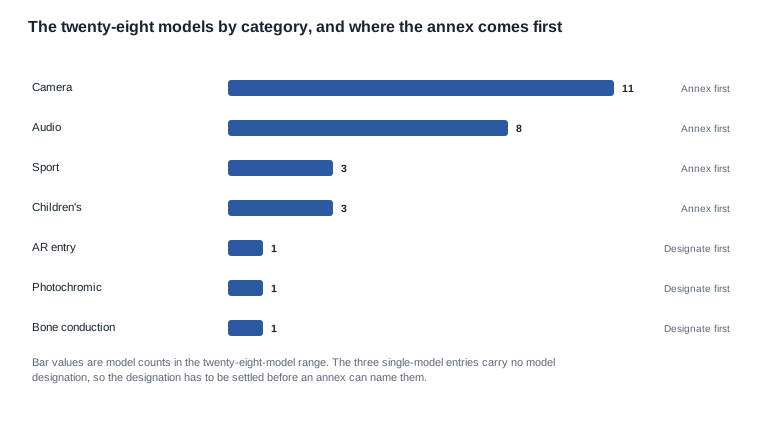
The catalogue's twenty-eight entries sit in seven groups: eleven camera models, eight audio models, three sport models, three children's models, and three single entries — the AR model, the photochromic model and the bone-conduction model. Those groups behave very differently as contract material, and the difference is not about how popular they are. It is about how much of the specification each one actually publishes, and that published coverage is the criterion a buyer should apply when deciding how to evaluate a candidate before an agreement is drafted: the more a group publishes, the more of the annex can be assembled without asking anyone for anything.
The camera group publishes the resolution class on all eleven, the charging interface on seven of them, the case capacity on five, and the Bluetooth version on none. The eleven resolution figures sit in two tiers: eight models at eight megapixels and three at thirteen megapixels — the L2 Utral and the L1 Pro, and the S7. Five of the eleven publish a magnetic charging interface, two publish a Type-C interface, and for the remaining four — the CY03 and the CY05, and the MT6 and the L1 Pro — the catalogue prints no charging interface row whatsoever. The case position splits three ways rather than two. The CY03 and the L1 Pro, and the CY05 publish a case capacity of 1400 mAh, the L2 Utral publishes two case capacities in a single row without stating which belongs to which of its two variant names, and the MT6 publishes a folding case of 1200 mAh. The KY06 and the MT5 have a case with no published capacity. The V03 Pro and the V03, and the V06 and the S7 carry no case row at all. Those are three different states, and an annex that collapses them into "has case" and "no case" has introduced an error of its own, and the total cost of that error is a case that arrives in the wrong configuration. The annex should name the case position per model instead, and mark the four silent rows as unresolved.
The audio group is narrower and quieter. The eight models publish a Bluetooth version in every case, at 5.3 for the K01 and the K02 and at 5.4 for the remaining six, but the Type-C interface appears only on the D11 and the D12 while magnetic charging is the default for the rest. As a group the eight carry no charging case row and no ingress marking row. The three sport models publish a Bluetooth version, and the D17 and the ZH12 also publish a charge time of about one hour, where twenty-six of the twenty-eight entries publish a charge time of two hours or less — a ceiling, not a promise of a faster result.
Two further rows are worth checking before an annex is built. Only the V03 Pro and the V06 publish colours at all, three and four respectively. Only the V06 and the S7 carry an ingress marking, and the MT6 is the only entry in the range with a published weight of 158 g for the glasses themselves, excluding its folding case. An annex that lists colour for the whole range, or ingress for the whole range, or weight for anything other than that one model, has invented three specifications the catalogue does not carry.
The rows that do not exist anywhere
Some rows are absent for every model, and a clause that quietly assumes any of them will fail. No entry publishes a sensor model, a field of view, a frame rate, a video format, a stabilisation figure, a storage capacity or a low-light claim. No entry publishes an acoustic measurement. No entry publishes a touch row of any kind. No entry publishes a frame weight apart from that single figure on the MT6, and that figure is the weight of the unit with its cell and camera, not of the bare frame.
The three entry-level pages need particular attention. The AR model publishes an indicator light and button control, and no touch row. The photochromic entry publishes a cell, a runtime, a charge time and a charging interface, and no optical performance figure of any kind. The bone-conduction entry publishes an amplification gain of 35 dB, which is a catalogue figure and can be quoted as one, though it cannot be turned into a hearing-aid or medical-device claim, and because the catalogue publishes no certification position for any model, the market-access clause for that entry has to be drafted as an open item.
The naming rows that break documents
Naming is the least glamorous clause and the one that most often produces a document that cannot be used. The L2 Utral page prints two variant names side by side and two case capacities in one row, with no statement of which capacity belongs to which name; an annex that pairs them by assumption is wrong in a way that is invisible until a delivery arrives. The A05 and the A06 publish identical parameter rows, so a document that names one of them does not cover the other. The three single entries carry no model designation at all, which means a request for "the file for the AR model" has nothing to quote, and the designation has to be settled before an annex can name the goods.
The catalogue also uses three different labels for the runtime row on the camera pages, and on three of those pages the label that reads as a charging duration is in fact pointing at the runtime. That is a small detail with a large consequence for drafting: a clause that refers to a row by its position in a table is fragile, and a clause that refers to it by the figure it prints is not.
The certification position, stated exactly as it is
This is the area where the temptation to overstate is strongest, so the position needs stating precisely. The catalogue carries a single company-level export certification page and it holds images rather than text, and those images are ten patent certificates — eight appearance-design patents and two utility-model patents. The catalogue text contains no reference to CE, FCC or RoHS, and there is no per-model certification row anywhere in the range.
What can be written is the framework, and the position of each document in the file. A market-access file is normally organised around the Radio Equipment Directive (EU) 2014/53/EU and the EMC Directive 2014/32/EU, with the radio assessment, the electromagnetic compatibility assessment, the test reports behind them, the technical file and the declaration of conformity sitting in defined places inside it. The two frameworks name the structure of the file; they do not state the outcome for any model, and no clause should imply that they do.
The clause that resolves this is the one that lists which documents a file has to contain, who produces each, who holds the role of the party making the declaration, and what happens to the file when the configuration changes. What it must not contain is an assertion that a certificate exists, a number for a certificate, or a claim about a model's status. A certificate number that was never issued is worse than an open item, because the open item can be chased and the number cannot.
What to write when a row is absent
Where a specification row does not exist, the answer is not a guess and not a silence. Four fields go into the annex instead: the requirement stated as a measurable condition, the method by which it will be checked, the party who performs the check, and the date by which the result will be attached to the programme file. A clause in that form is honest, actionable, and survives the arrival of the real figure.
The alternative, and the one most programmes choose, is to leave the requirement out of the annex because it is not in the catalogue. That converts a visible gap into an invisible one, and the gap is discovered at the point where the buyer has the least ability to act on it.

The order to settle the clauses in
Clauses are settled in the order of the material they depend on, and the material itself is arranged in four layers. The layer at the bottom can be assembled today. The layers above it have to be requested, measured, or created, and each one takes a different amount of time and a different amount of leverage.
Stage one — the specification annex
Nothing else can be written accurately until the specification annex exists, so it goes first and it is written as a document rather than as a description. It names which model, the variant, the configuration and the published rows for that combination, and it separates what the catalogue prints from what a supplier has confirmed in writing. The V06 and the S7, for instance, both publish an ingress marking, a removable inner frame and a resolution class; the V03 Pro publishes a Type-C port, a photochromic lens and three colours. An annex that says "an AI camera model" is useless; an annex that says "the model named on page one of this annex" is the basis for everything downstream, and the stage-by-stage version of that basis sits in the development process checklist.
Stage two — the money clauses
Once the goods are fixed, the clauses that move money can be drafted without hedging: acceptance, payment, delivery and change control. These four are the ones that decide what happens if anything goes wrong, and they are the ones that a supplier is most able to commit to, because they are about the supplier's own behaviour rather than about a third party's file.
Stage three — the clauses that depend on evidence nobody holds
Documentation, defects and remedies come next, and they are drafted as open items rather than as answers. The question at this stage is not what the document will say but who is going to produce the evidence it refers to, by when, and what the agreement does if that evidence does not arrive. This is the stage where a supplier's position on a specific certificate number, a specific test report and a specific configuration needs a written answer rather than a verbal assurance.
Stage four — the clauses only the two parties can create
Ownership, end of life, confidentiality and the exit conditions are settled last, and they are the ones that cannot be drafted from any catalogue row. They come from the relationship, the investment each party has made, and the length of the programme, and the risk factors a programme handover carries are mostly written in this part of the document rather than in the earlier stages. The tooling question is the sharpest of them: a tool is a physical asset located in somebody else's building, and where it sits, who owns it, who services it and what happens on the last order are all decisions rather than facts.
The sequence, as a checklist you can run
The sequence compresses into a short list, and it is the version worth carrying into the drafting meeting. Read it as a decision checklist rather than as a summary: each line answers a question a buyer should be able to answer before you commit to a configuration.
- Fix the goods in an annexed specification, separating published rows from confirmed-in-writing rows.
- Draft acceptance, payment, delivery and change control, in that order, with a named owner against each.
- Draft documentation, defects and remedies as open items with an owner and a date against each one.
- Draft ownership, end of life and exit conditions last, when the investment and the programme length are known.
- Re-read the whole document against the annex and check that every clause points at something that exists.
- Record the items that remain open, with the date each one is due to close, so the list survives the meeting that produced it.
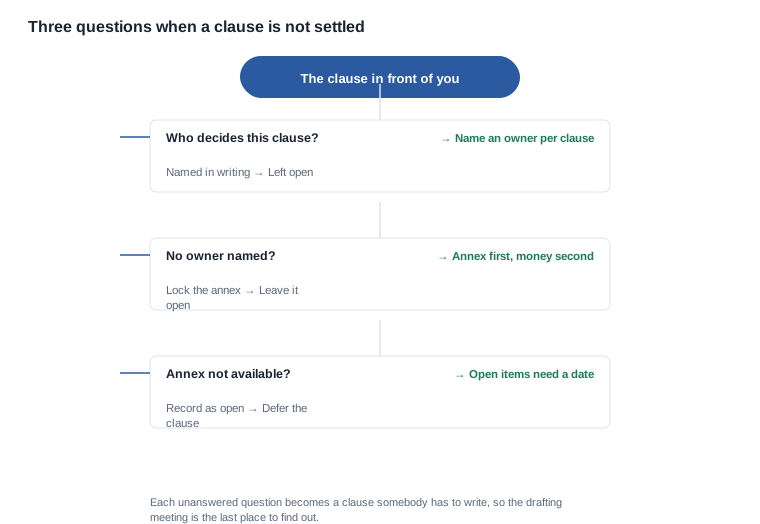
The three questions on the diagram are the ones that decide what happens at each stage. Where the owner of a clause is named, the drafting proceeds. Where no owner is named, the specification annex is locked before anything else, because every other clause is measured against it. Where even that is unavailable, the gap is recorded as an open item with a date, and the agreement says what the position is while the gap remains open. A clause left without any of those three answers is the one that produces the expensive dispute, and knowing when to escalate a gap — as an open item with a date, rather than as a second round of email — is what keeps the schedule intact.
The smart glasses oem contract considerations
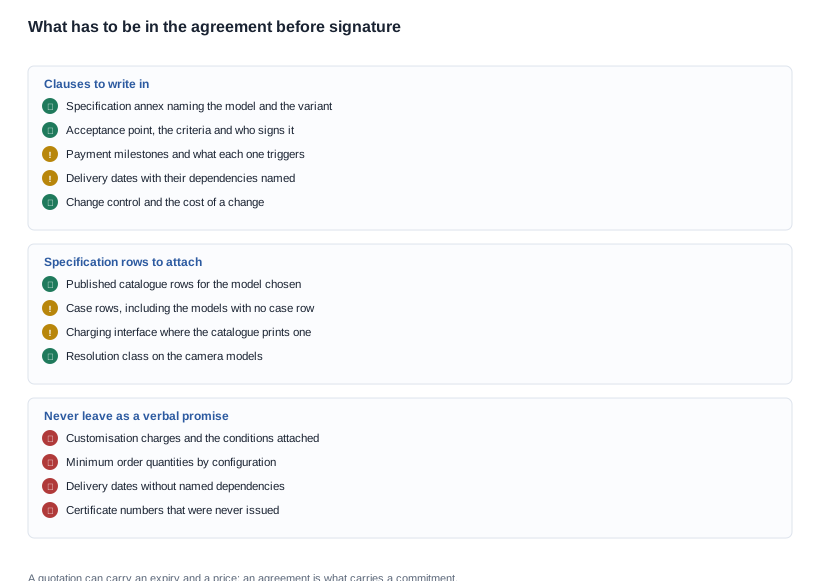
What follows is the working set. It is the same material the earlier sections argue for, arranged as the list a procurement lead actually takes into the room, and the order is the order the clauses should be drafted in.
Questions to ask the supplier before the draft
- Which published rows apply to the exact model and configuration we have selected, and can we have them in a form we can annex?
- For every row that is not published, what is the position and when can it be closed in writing?
- What does the quotation treat as a separate line, and what conditions attach to each of those lines?
- What is the minimum order quantity for this configuration, and does it vary by configuration or by artwork?
- What is the production capacity for this model, and what happens in writing when it cannot be met?
- Which documents will exist for this model and this market, who produces each, and who hands them over with the goods?
- On what named event does acceptance occur, and who signs it?
- What is the position on a component substitution, and which changes require a re-assessment of the file?
None of these questions asks for a number that the catalogue does not publish, and none of them can be answered from a catalogue row. They are the questions that turn an agreement from a formality into a document with obligations in it, and they are the reason the sequence above matters more than the wording of any single clause. The pitfalls in a draft are rarely in the prose; they are in the rows nobody was asked to supply.
What we will and will not put in writing
There are two things this article will not do, and it is worth being explicit about both before the list of questions above is used. The first is to fill an unpublished row with an estimate. The second is to present a figure nobody has measured as though it were a specification. Our position is that the agreement should carry the commitments and the catalogue should carry the description, and we will draft against published rows rather than against estimates. Where a row exists, we will put it in the annex and name it. Where a row does not exist, we will say so in the annex and record it as an open item with an owner and a date, and we will not fill the gap with a figure that nobody has measured. On the figures the catalogue does not publish — price, minimum order quantity, capacity, lead time, warranty period and certificate numbers — those belong in the signed document, and we will negotiate them there, because a number that changes every week does not belong in an annex. The signs that a draft is in this state are simple: every clause points at a row, every open item carries a name and a date, and no figure appears that nobody has measured.
The closing position
A contract in this category is short or it is useless. The value is in the annex and in the eight clauses, not in the length of the preamble. Send the model, the configuration and the destination markets, and we will tell you which clauses our published rows can already settle, which ones need a written answer from the supplier, and which ones only exist once both parties have signed. If you are deciding whether a draft is ready to sign, the test is simple: every clause should point at something that exists, and every gap should have a name and a date against it.
Related reading
- what a programme needs in its file
- how a configuration change reaches the certification position
- the standard OEM engagement
- the stages behind an ODM programme
- what after-sales support covers once it ships
Send the model, the configuration and the destination markets, and we will tell you which clauses our published rows can already settle.


