
The decision behind payment terms and lead time is not a question of which product is better. It is a question of which configuration can be built, quoted, documented and shipped without the programme being rebuilt in the middle — and in this category the payment schedule is not a separate document from the production schedule. They are two views of the same sequence, and a buyer who negotiates one without the other is negotiating half of the arrangement.
Smart glasses payment terms affect lead time in one specific way: each payment milestone sits at a point where a piece of work is waiting to start, and money that arrives after that point does not buy the work back. A deposit that clears on day nine releases the material order; a deposit that clears on day nineteen releases a material order that will be placed in the following week. Nothing else about the schedule changes, and the schedule is now two weeks longer.
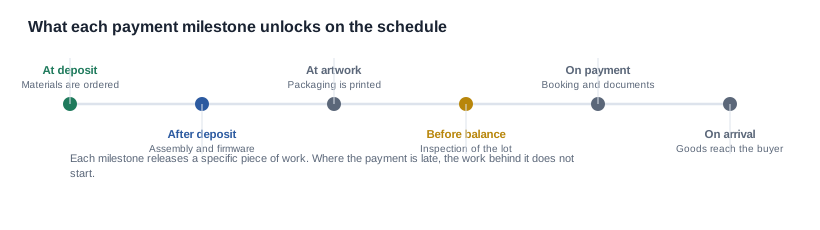
Smart glasses payment terms: what the deposit unlocks
The mechanism is simple and it is worth stating before anything else. In a production schedule, every stage has a start condition, and most of the start conditions are one of two things: money or a decision. The money is usually the deposit; the decision is usually the artwork approval or the configuration freeze.
When the start condition is money, the schedule has a dependency on the buyer's payment, and that dependency is invisible in a quoted lead time. A quoted lead time is normally stated as the number of working days from the order, and the assumption inside that number is that the order is paid for on day one. When the payment lands later, the lead time does not stretch — it starts later. The two are often confused, and the difference between them is the whole subject of this article.
The consequences compound in a specific order. Materials cannot be ordered until the deposit clears, so a late deposit moves the material date. The material date governs the assembly slot, so the assembly date moves with it. The assembly date governs the inspection date, which governs the shipping date. One late deposit therefore moves four dates, and the last one is the date the buyer actually cares about.
There is a second effect that is easier to miss. A supplier who is waiting for a deposit cannot commit to a production slot, because a slot held for an order that has not been paid for is a slot they cannot fill with anything else. So a late deposit does not merely delay this order; it can also remove the slot that this order was going to occupy, and put the order into a queue behind other buyers whose money has arrived. The distinction matters commercially: a schedule that slips by days because of a payment is a different problem from a schedule that slips by weeks because the order lost its place.

A lead time is a sum of waits, not one number
A quoted lead time is a single figure, and it is the sum of at least five distinct waits. Separating them is the first useful thing a buyer can do with a supplier's date, because each wait has a different owner and a different remedy.
| Wait | Who owns it | How it is shortened |
|---|---|---|
| Payment clearance | The buyer | Paying on time, or paying by a method that clears faster |
| Material procurement | The supplier | A configuration that uses in-stock components |
| Configuration freeze | Both | Fixing the model code, the colour and the packaging early |
| Artwork approval | The buyer | A single named approver and a stated response time |
| Inspection and documentation | Both | An agreed scope produced without a round trip |
The third row is the one that surprises buyers, because it is a wait rather than a cost and it sits inside the buyer's own organisation. Every hour that passes between the artwork proof leaving the factory and the approval coming back is an hour added to the schedule, and it is an hour the buyer controls entirely. In a category where the specification genuinely moves during production, an approval cycle that runs to three rounds can add more to the schedule than the whole assembly stage.
The fourth row is a wait that belongs to the supplier and is controlled by the agreement. If the artwork approval response period is stated, the factory knows when to chase and the buyer knows when the slot is at risk. If it is not stated, the factory waits until it is convenient and the slot is held in the meantime.

The fifth row is the one most often treated as an afterthought. An inspection scope that has not been agreed means the inspector arrives with no criteria, the findings take longer to turn into a report, and the report arrives after the shipping window that the factory has already committed to. Agreeing the scope with the order — scope, sample count, comparison basis, report format — removes a wait that is invisible in the quoted date and reliably reappears in the actual one.
Turning the five waits into a schedule you can manage
A single number cannot be managed against. What can be managed is a schedule with the waits named, and building one from a supplier's date takes less work than buyers expect.
Start from the date the goods are needed and work backwards. Subtract the transit time on the route you intend to use. Subtract the time for the carrier booking and the document set. Subtract the inspection window, including the time for the report to be issued. What remains is the time the factory needs from the start of production, which is the figure worth discussing, because it is the only part of the total the factory controls.
Now put the payments on the same axis. Mark the deposit, the artwork milestone and the balance as points on the same line as the production stages, and two things become immediately visible. The first is the gap between the date the production could start and the date the money arrives — the gap is the buyer's exposure. The second is the gap between the last production stage and the date the balance is paid, which is the point at which the buyer is funding finished goods.
Those two gaps are the numbers worth negotiating. Everything else in the schedule is either fixed by the route, fixed by the destination market or fixed by the product, and a buyer who spends negotiating capital on those has spent it badly. A schedule built this way also has a useful property: it survives contact with a slip. If the artwork approval takes two days longer, the schedule shows exactly which dates move and by how much, rather than presenting a new completion date that nobody can account for.
Two disciplines keep the schedule useful. The first is that every stage has an owner — "the factory" is not an owner, "the artwork approver" is — because a stage without an owner is a stage nobody chases. The second is that every date on the schedule is either committed by one party or derived from a committed date, and the two are marked differently. A derived date that is treated as a committed date is where a plan quietly becomes a guess.
Milestone, trigger, and the work each one releases
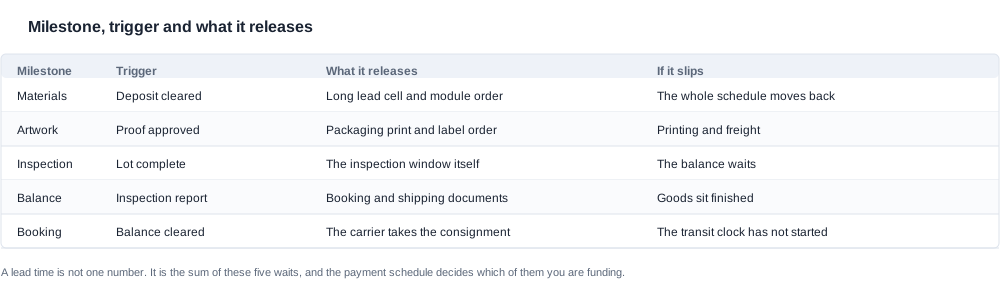
The relationship between money and work is not arbitrary, and the pattern in this category is consistent enough to be worth learning.
The deposit releases procurement. It is the money that buys the cell, the camera module and the case, and in a camera configuration it is the only stage at which money is actually converted into materials. Everything after it is labour on materials already committed.
The artwork milestone releases packaging. Packaging is ordered against a destination and an artwork approval, and it is usually a short-lead item relative to the electronics — which is why an approval delay here is especially expensive. The materials are ready, the assembly is ready, and the goods cannot ship without the box.
The inspection milestone releases shipping. The inspection report is what permits the consignment to move and what evidences the balance. It sits between the two, which is why it is the trigger that carries the most weight in a schedule.
The balance releases the carrier. Payment clearance is what allows the booking, and the booking is what starts the transit clock. A balance paid on time against a carrier who is already holding the goods saves days; a balance paid late against goods already at the port costs storage on top of the delay.
One observation follows from this pattern, and it is the practical answer to "which trigger should I be pushing on". The trigger that has the most schedule impact is the one that releases the longest downstream chain, and in this category that is the deposit. It releases procurement, which releases assembly, which releases inspection, which releases shipping. A week late on the deposit is a week late on the delivery; a week late on the artwork is usually a week late on the delivery but sometimes not, because the box can be reordered quickly.
The counter-argument is fair and worth stating. A buyer who is not certain of the configuration should not accelerate the deposit, because the money is buying materials against a specification that may still change, and a component bought for the wrong configuration has no second buyer in this category. Accelerating a deposit into an unfrozen configuration buys a schedule and loses the material. That trade is only worth making when the configuration is genuinely frozen, and the way to know is to check whether the model code, the configuration string and the quantity are named in one line of the order.

Where the schedule and the cash diverge
The divergence between the schedule and the cash plan is the part of this subject that gets noticed late, usually when a buyer's own cash is tight and an invoice has been raised.
The divergence has three sources. The first is timing: the schedule moves in working days and the cash plan moves in weeks, and a two-week slip in a schedule is a two-week slip in the funding requirement. The second is the shape of the payments: a schedule that releases a large balance early creates a cash peak that the schedule itself does not describe. The third is the arrival of the goods against the sale of the goods, which is a sell-through question rather than a procurement question, and which is the one a buyer cannot fix by negotiating the schedule.
The method for seeing all three at once is to put the payment schedule and the production schedule on the same axis and read the gaps. Where a payment precedes a piece of work, the buyer is funding that work. Where a payment follows a piece of work, the buyer is funding the supplier. Where a gap appears between a payment and the point at which the goods can be sold, the buyer is funding inventory, and the size of that gap is the real cost of the structure.
The comparison worth making is between the two structures on offer, at the same unit price, with the same dates and the same assumptions. The payment terms hidden costs article sets out the cost side of that comparison, and the lead time discussion covers how the schedule itself is put together.
There is one point where the two schedules should not be aligned, and it is worth naming because it is the opposite of the usual instinct. Aligning every payment date with a production date produces a schedule that looks tight and behaves badly, because it removes the buyer's ability to stop. A structure that keeps one payment after the goods have arrived gives the buyer a decision point — the point at which the inspection happens — and a decision point is what converts a schedule from a description into a control.
What to ask a supplier that quotes a single number
Most quotations in this category state a production lead time as one figure, and the figure is usually correct. The problem is not accuracy; it is that a correct number carries no information about what happens if it is wrong, or about which party is responsible for which part of it.
Five questions convert that number into something usable, and they are worth asking before the order rather than during the delay.
- What does the number start from? The date the order is confirmed, the date the deposit clears, or the date the configuration is frozen. The answer is usually the second, and it is usually not stated.
- What is inside it, and what is outside? Whether the artwork approval cycle, the inspection window and the document preparation are inside the quoted figure or additional to it.
- Which stage is the longest, and what changes it? A supplier who knows which stage dominates will negotiate on that stage rather than on the total.
- What is the effect of a quantity change? Whether a larger quantity shortens the schedule because it fills a slot, or lengthens it because it needs a second production run. Both behaviours are common and they are opposite.
- What happens to the date if the payment is late? The answer is normally that the schedule moves by the same amount, which is worth confirming rather than assuming.
The fifth question is the one that connects this article back to the payment structure, and it is the one most often skipped because it sounds like a hypothetical. It is not hypothetical: in this category the deposit is routinely approved by a finance team while the schedule is being managed by a procurement team, and the two are rarely the same person with the same information.
The answer also tells a buyer something about the structure itself. A supplier who says that a late payment moves the date is telling the buyer that the date is downstream of the money. A supplier who says the slot is held and the date will not move is telling the buyer that the slot is reserved independently of the payment — which is a stronger position for the buyer and is worth knowing, because it means the schedule and the cash are less tightly coupled than the structure suggests.

Reading a supplier date against the published rows
A quoted lead time is a claim, and it can be tested against the product's own published rows. This is unusual in this category, because most of the commercial detail is not published — but the electrical detail is, and it constrains the schedule in ways a buyer can check.
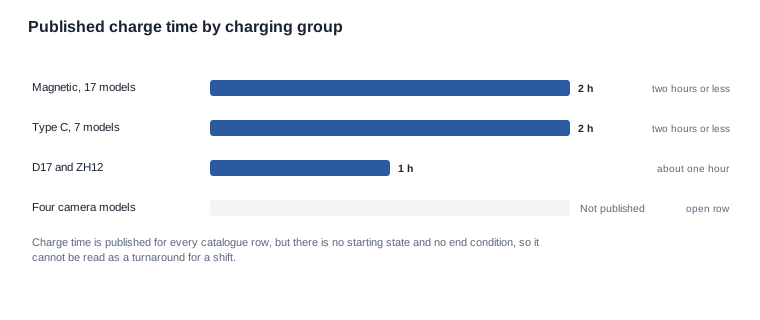
Charge time is published for every catalogue row. Most models are at two hours or less, and two models are at around one hour. What a buyer takes from this is a constraint on the inspection and packing cycle rather than a production date: the goods have to be charged before the battery behaviour can be checked, and a unit with a 290 mAh cell and a two-hour charge time occupies a charging fixture for two hours. In a sample-based inspection that matters; in a full-lot inspection it decides whether the inspection can be done in one shift or two.
Charging method is published for most rows. Magnetic charging, Type-C, and a small set of camera models where the method is not published. A published method tells the buyer what infrastructure the receiving site needs — how many cradles, how many cables, how much bench space — and an unpublished method is a question that has to be asked before the goods arrive rather than after.
Case configuration is published for most camera models, with exceptions. Some camera models carry a case of a stated capacity, one offers two capacities, some carry a case whose capacity is not published, and four publish no charging-case row at all. The scheduling consequence is concrete: the case is a separate packing item, it changes the carton, and it changes the unit count per carton. An order for a case configuration has a packing step that an order without a case does not.
Weight is published for one model only. For a product shipped by sea or air, unit weight and carton weight are the inputs to freight and to handling, and a published weight on one model tells a buyer very little about the rest. The honest conclusion is that weight is a request rather than a published row, and it belongs in the first round of questions.
None of this makes the quoted date verifiable on its own, and it would be misleading to suggest otherwise. What it does is narrow the range of questions: a buyer who has established the charging method, the case configuration and the inspection scope can reason about the schedule with far fewer unknowns than one who is working from a single number.
What we commit to, and what depends on the order
Our production lead times are not published, and they are confirmed per enquiry against a configuration, a quantity and a destination market. That is not an evasion. A lead time in this category depends on the material position for the specific configuration, on the case and packaging setup, on the current slot availability and on the destination's documentation route, and a number published without those four conditions would be a number that a buyer could not use.
What we will commit to, in writing, for a specific order, is a schedule with the stages named, a date against each stage, and an owner for each stage. What we will not do is quote a single number detached from those stages, because a single number cannot be managed against and cannot be held to anything.
What we will also do is be explicit about which parts of the schedule depend on the buyer. The configuration freeze and the artwork approval are two of them, and they are the two that most often move a delivery date without anybody at the factory having done anything wrong. Saying that plainly at the quotation stage costs nothing and prevents the argument later.
Send the models, the quantities, the destination market and the date the goods are needed, and we will give you a schedule with stages, dates and owners, and say which stages depend on the payment and which depend on the approvals.
Related reading
Send the configuration, the quantity and the market, and we will say which parts of the schedule are ours to commit to and which are yours.