

The unit price is the part of an order that gets negotiated, and it is usually the smallest part of the total cost of getting goods from a factory into a warehouse. Smart glasses payment terms are where those other costs get decided, because every payment trigger is also a moment at which a cost is either named or deferred. A buyer who negotiates the unit price hard and then accepts a trigger that fires late will find that the saving has been spent several times over on the things nobody priced.
The eight costs below are the ones that arrive after the unit price has been agreed. They are not exotic and they are not the result of a supplier acting badly. They are the ordinary consequences of a product that carries a lithium cell, a camera module, a moulded charging case and market-specific packaging, and of a transaction that crosses at least two borders and one customs authority.
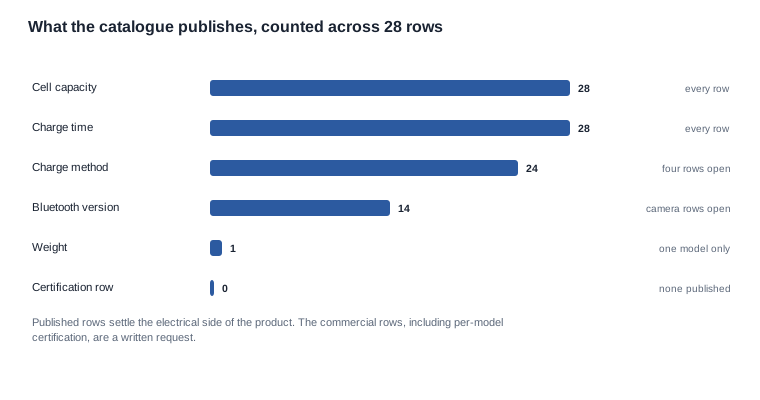
The first chart below is the useful starting point for a buyer in this category. It counts, across the catalogue rows we publish, how much of the commercial information is available and how much has to be requested. That ratio is the reason hidden costs are so common in this category rather than merely so irritating: most of what a buyer needs in order to price the order correctly is not on the page.
Smart glasses payment terms: costs that arrive later
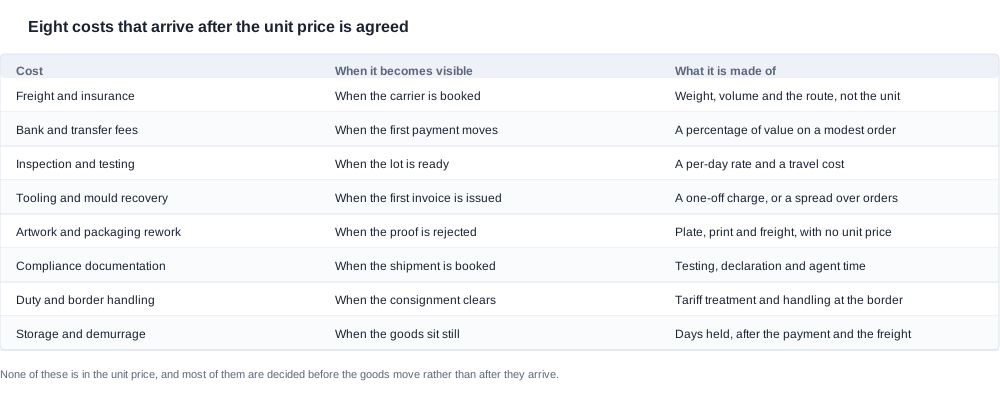
The eight costs are freight and insurance, bank and transfer fees, inspection and testing, tooling and mould recovery, artwork and packaging rework, compliance documentation, duty and border handling, and storage and demurrage. Each of them is decided at a different point in the transaction, each becomes visible at a different moment, and each is invisible in a unit price that was quoted before it existed.
Freight and insurance is decided when the carrier is booked, and it is a function of weight, volume and route rather than of the unit. In this category the volume is the surprise: a camera configuration with a charging case ships a different carton from the same model without one, and the carton dimensions determine the freight as much as the unit price determines the goods.
Bank and transfer fees are decided when the first payment moves, and they are a percentage of value. On a modest order they are a real percentage, and the question of which side pays is a question most buyers never ask because it feels too small to matter. It matters more than it feels, because a fixed fee absorbed on a small order is invisible in the unit price and visible in the margin.
Inspection and testing is decided when the production lot is ready. The cost is a per-day rate plus travel, and the amount of it depends entirely on whether the inspection scope was agreed before production or improvised at the end.
Tooling and mould recovery is decided when the first invoice is issued, and it is the largest of the eight in a small first order. Whether it is recovered once or amortised across orders is the difference between a first order that looks expensive and one that is simply carrying the programme's setup cost.
Artwork and packaging rework is decided when the proof is rejected. It is a plate, a print run and freight, and it has no unit price because it is not per-unit at all.
Compliance documentation is decided when the shipment is booked. Testing, declaration work and agent time are all real costs, and the scope of them varies by configuration and destination market.
Duty and border handling is decided when the consignment clears. The tariff treatment depends on the origin and the destination, and handling charges at the border are charged per consignment rather than per unit.
Storage and demurrage is decided when the goods sit still. This is the cost that appears when something else has already gone wrong — a documentation delay, a missed booking, a rejected consignment — and it compounds the original problem.

Where the leakage starts, and why it is not in the quote
The reason these costs are not in the quote is structural rather than opportunistic. A quotation is produced against a configuration, a quantity and a destination. Any cost that cannot be calculated from those three things — because it depends on a route, a market, an agent, a document or a delay — cannot be in the quotation, and a competent supplier will not pretend otherwise.
That is the good version of the answer, and it is worth stating plainly because it means the problem is not that suppliers are hiding costs. The problem is that a buyer comparing two quotations is comparing two package prices that contain different subsets of costs, and neither quotation says which subset.
There is a second and more awkward reason, and it is about timing. Several of these costs are decided after the moment at which the buyer would want them. The artwork rework is decided when the proof is rejected, which is after the packaging order was placed. The demurrage is decided when the goods sit still, which is after the consignment was booked and the balance was paid. The duty treatment is decided at clearance, which is after the freight was paid and the balance released. In each case the cost is a consequence of a decision that was made earlier, and it lands later.
The practical consequence is that the buyer's only defence is to move the decisions earlier. Costs that are decided before the order can be quoted or excluded. Costs that are decided during the order are absorbed or disputed. Costs that are decided after the order are simply incurred. The payment structure is the mechanism for that, because a payment trigger placed after a cost is decided is a trigger that assumes the cost has been priced.
This is why the payment terms and the hidden costs are the same subject rather than two adjacent ones. A trigger that fires against a copy bill of lading assumes that freight, duty and demurrage have been settled, because the balance has already been released. A trigger that fires on arrival, after checking, does not make those costs go away — but it keeps the buyer in control while they are decided.
Which side of the line each cost falls on
Not every one of the eight costs is the buyer's problem, and a buyer who assumes they all are will over-insist on terms that the supplier cannot accommodate. A useful division is by the point at which the cost becomes knowable.
Costs the supplier can price at the quotation stage are the ones that depend only on the configuration, the quantity and the destination: packaging to an agreed specification, the standard document set, and the assembly work. These belong inside the unit price, and a buyer who pushes for them to be itemised is usually asking for a breakdown the supplier is not set up to produce for a one-off order.
Costs that need information neither party has yet are the inspection scope, the compliance scope for the destination market, and the tariff classification. These become knowable during the enquiry, which means they belong in the first round of questions rather than in the order. A buyer who asks for the inspection scope at the quotation stage gets it; a buyer who asks at the pre-shipment stage gets an estimate and a negotiation.
Costs that are decided during the order are the freight basis, the bank fee allocation and the artwork approval, and they are the costs most often left vague. Each of them can be settled by a clause in the agreement at no cost to either side, and each of them is worth a line.
Costs decided after the order are the rework, the demurrage and the consequences of a rejected consignment. These cannot be eliminated; they can only be made visible early enough that the buyer can see them happening. That is the real function of a late payment trigger: it does not prevent the rework, but it keeps the buyer solvent and informed while the rework is being done.
The division is worth doing because it tells a buyer where to spend negotiating capital. The middle category is where a clause costs nothing and saves real money. The first category is where pushing hard produces a worse relationship and a thinner quotation. The last category is where the answer is a contingency in the budget rather than a term in the contract.
Eight costs, and the moment each one becomes visible
| Cost | When it becomes visible | What it is made of | Can it be quoted in advance |
|---|---|---|---|
| Freight and insurance | When the carrier is booked | Weight, carton volume and route | Yes, against a stated route |
| Bank and transfer fees | When the first payment moves | A percentage of value | Yes, as a rate |
| Inspection and testing | When the lot is ready | A day rate plus travel | Yes, against an agreed scope |
| Tooling and mould recovery | When the first invoice is issued | A one-off charge or an amortisation | Yes, as a recovery schedule |
| Artwork and packaging rework | When the proof is rejected | Plate, print run and freight | No, only a probability |
| Compliance documentation | When the shipment is booked | Testing, declaration and agent time | Partly, against a market |
| Duty and border handling | When the consignment clears | Tariff treatment and border charges | Yes, against a tariff code |
| Storage and demurrage | When the goods sit still | Days held after the payment | No, only as a contingency |
The last column is the one that changes how a buyer works. Six of the eight can be quoted in advance if the buyer asks for them with enough precision, and one of the remaining two — the compliance documentation — can be scoped in advance for a given market even if it cannot be priced to the last unit. Only two genuinely cannot be quoted, and both of those are consequences rather than components, which is a useful distinction: it tells the buyer where to spend attention.
The artwork rework deserves a note, because it is the cost most often underestimated. A reprint is not a percentage of anything; it is a plate, a print run, freight and a second approval cycle, and the approval cycle is the part that costs time rather than money. The prevention is not a better artwork brief but an earlier one — a proof that goes to a named approver, with the revision number written on it, and a rule that a change after approval is a change with a cost attached to it.

The published row and the request it forces
The counting exercise behind the first chart is worth doing explicitly, because it turns a vague worry into a specific list of requests. Across the catalogue rows we publish, the cell capacity, the charge time and the charging method are published for the great majority of rows; the Bluetooth version is published on fourteen of the twenty-eight entries and for none of the eleven camera models; the weight is published for exactly one model; and there is no per-model certification row at all.
Each of those published rows is a fact a buyer can check against the goods on arrival, which is why they matter. Each of the unpublished rows is a request, and a request that is not made before the order is a cost that arrives later.
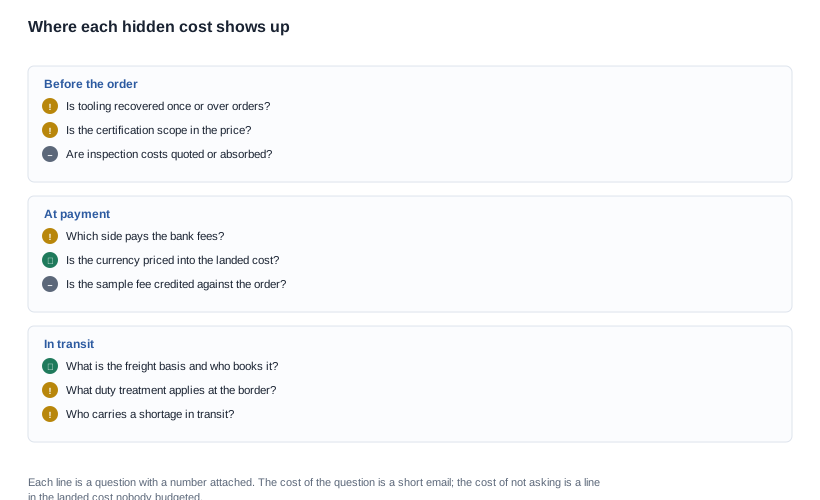
The rule that follows is simple enough to apply to any category: every fact the supplier has and the buyer does not is a cost that has not been priced yet. The buyer cannot price it, cannot budget it and cannot compare it against a competing quotation. It will be paid, somewhere, usually by the buyer, usually at the point where there is least choice.
This is also where the difference between a published specification and a published commercial position becomes obvious. A published cell capacity settles a question about the goods. A published unit price settles a question about the deal. This category publishes the first and not the second, deliberately — our minimum order quantities, unit prices and production lead times are confirmed per enquiry — and the practical consequence for a buyer comparing quotations is that the comparison has to be done on the schedule and the cost structure rather than on the headline.
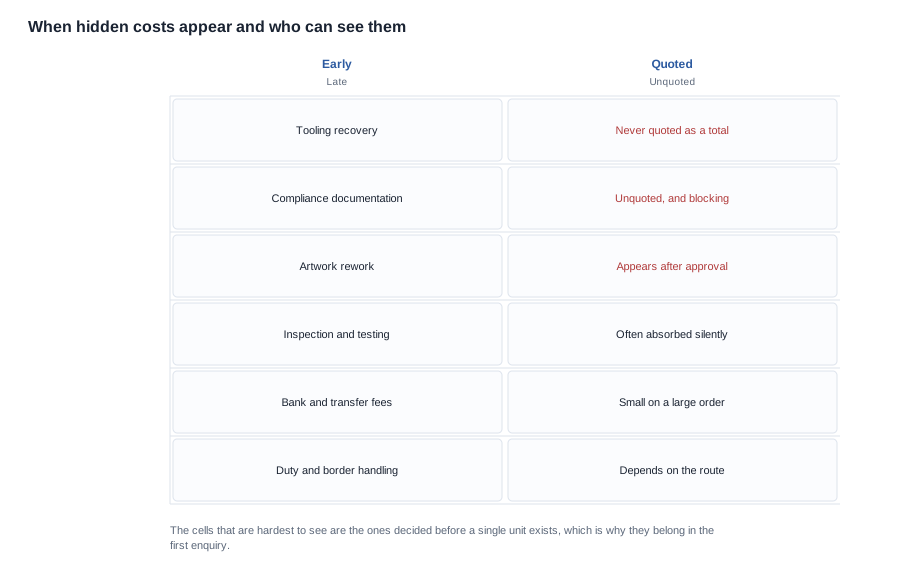
The matrix shows the two properties that make a cost dangerous: when it appears, and whether it is visible. The worst cells are the ones in the upper half — costs decided early and not quoted — because they are also the ones most likely to be shared by every supplier in the field. A cost that every supplier includes in the package is invisible; a cost that every supplier excludes from the package is invisible too, and it lands on the buyer in both cases.

The arithmetic behind the landed cost
A buyer can defend against the six quotable costs without a supplier's help, because the question is not what the supplier will say but what the buyer will budget. The method is a landed-cost sheet with one row per cost and one column per source of cost.
The structure is straightforward:
- The unit price, as quoted, for the configuration and quantity.
- The one-off lines, separately: tooling, artwork, certification work, initial packaging plates. Each with its recovery schedule rather than a merged figure.
- The variable lines: freight and insurance per unit, duty and border handling per unit, bank fees as a rate on the payment values.
- The contingency lines: inspection, rework and storage, each with the rate and the assumption that produced it.
- The commercial lines: the cost of the cash the schedule funds, and the cost of a schedule that funds it longer than necessary.
The fifth line is the one that connects this article to the payment terms themselves, and it is the one buyers most often omit. A deposit structure that funds twelve weeks of inventory has a carrying cost, and that cost belongs in the landed-cost sheet next to the freight. It is also the line that makes the hidden costs comparable between two quotations, because a quotation with a lower unit price and a longer funding cycle can be the more expensive arrangement overall.
The second point about this sheet is that it should be built before the order, not after. The purpose of building it early is not accuracy — early numbers will be wrong — but comparability. Two quotations described on the same set of lines can be compared even when the numbers in some of them are still estimates, because the structure is the same. Two quotations described on different sets of lines cannot be compared at all, however accurate each is.
Three questions that make the sheet defensible
A landed-cost sheet built by a buyer is only as good as the assumptions behind it, and the assumptions are what a supplier will challenge first. Three questions decide whether the sheet survives that challenge.
What is included in the unit price? A buyer who compares a unit price that includes packaging with a unit price that excludes it will draw the wrong conclusion, and the correction will feel like the supplier has moved. The question to ask is simply which of the one-off and variable lines the quoted price already contains, and the answer should be written into the sheet next to the figure.
What is the basis of each estimate? An estimate with a stated basis — a carton volume times a rate per cubic metre, a percentage of the order value, a day rate times a number of days — can be challenged and revised. An estimate with no basis is a number that will not move, which makes the whole sheet look arbitrary. In this category the carton volume is the basis most often missing, because the case configuration changes the carton and the carton changes the freight.
What changes if the assumptions are wrong? This is the question that turns the sheet from a budget into a decision aid. If the estimate for storage is wrong by a factor of five, does the order still work? If the certification scope turns out to require a second test run, which line absorbs it? A sheet that answers those two questions tells the buyer where the decision is fragile, and a sheet that does not simply tells the buyer a total.
The fourth question, which is not a question but a discipline, is to keep the sheet in the order file. A landed-cost sheet built once and stored where the next order can find it is the starting point for the next quotation, and it is the difference between buying by comparison and buying from a baseline.
What we will include in a quote, and what we will not
We will quote a configuration at a quantity for a destination market, and we will state what the quotation includes and what it excludes. In practice that means the goods, the packaging to the agreed specification, and the standard document set. It will also state the points where the arrangement depends on information we do not hold: the route, the tariff treatment, the inspection scope and the certification scope for the destination market.
We will not publish a unit price, a minimum order quantity or a production lead time on a web page, because they depend on the configuration, the quantity and the market, and a published figure would be read as a commitment it is not. We will not quote a landed cost for a route we have not been asked about, and we will not fold freight, duty and bank fees into a unit price, because that hides the point at which the buyer is actually spending the money.
What we will do is tell you which of the eight costs above the quotation settles, which it excludes, and which we cannot see from our side at all. That is the list worth carrying into the negotiation, and the lead time page covers the schedule that determines several of them.
Related reading
Send the configuration, the quantity and the market, and we will say which parts of the landed cost are settled and which are yours.


