

Smart glasses payment terms in this category follow a set of conventions that are widely known to both sides of the table, and knowing them is genuinely useful: it tells you when a supplier's schedule is normal and when it is unusual. But a benchmark is a range, not a decision, and the range is wider than it appears because the same convention costs very different amounts at different order values. The useful operation is not to memorise a benchmark. It is to take the benchmark, run the arithmetic of this specific category against it, and see which end of the range survives the arithmetic. That is what this article does, and it is the reason a benchmark alone has never settled a payment schedule.
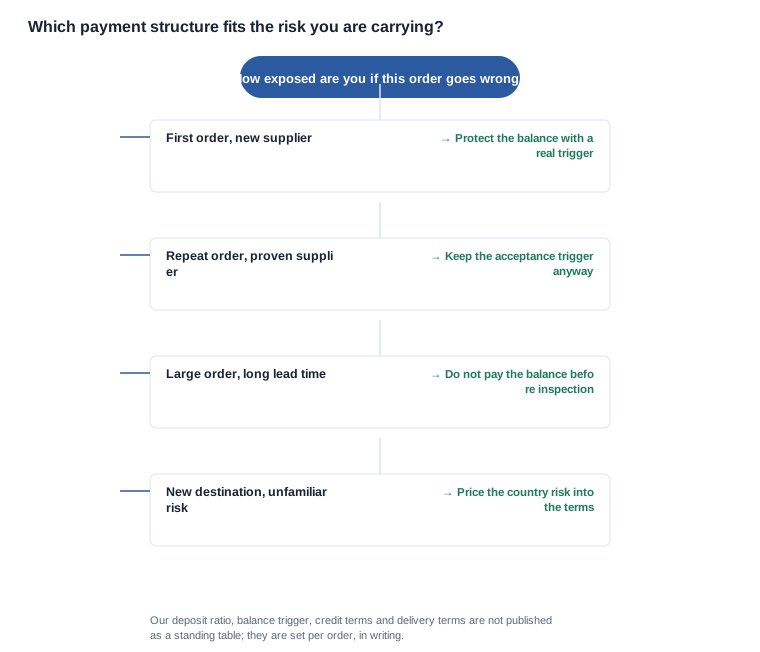
Smart glasses payment terms: what the market generally works to
The range a benchmark gives you, and what it leaves out
The conventions that recur across this category are these: a deposit is taken at the order, the balance falls due against documents rather than against cash on delivery, an inspection is either absent or undefined, the currency of the invoice and the currency of the bank are usually the same, and freight is arranged by the supplier. A first order from a factory the buyer does not know usually carries a larger deposit share than a repeat order, and an open-account arrangement is rare until a payment history exists.
That is the benchmark in its conventional form, and every experienced buyer in this category recognises it. What it leaves out is more important than what it contains, and there are four things it never tells you.
- It never tells you the total cost of the arrangement. A benchmark expressed as a deposit percentage says nothing about the bank charges, the courier cost of moving original documents, the inspection fee, or the internal cost of processing a payment.
- It never tells you what the structure is worth at your order value. The conventions were not written for one order size, and a letter of credit that is sensible at one value is absurd at another.
- It never tells you where the risk sits. Two schedules can carry identical percentages and distribute the risk in opposite directions, depending on whether the release event is a date or an inspection.
- It never tells you whether the supplier can perform it. A benchmark is a description of what is normal, not a statement about this supplier's bank, its document process or its ability to produce a specific piece of paper.
A benchmark is therefore a first filter, and it is a good one. When a supplier's schedule sits outside the convention, you know to ask why. When it sits inside the convention, you know you still have to check the arithmetic.
Why the conventions exist in a category with a low unit value
The conventions are not arbitrary; they are the result of the economics of the product. A smart glasses unit is inexpensive enough that a fixed cost of a few hundred currency units can be a meaningful share of the order value, and a structure that would be routine in a higher-value category can be uneconomic in this one.
That single fact explains most of what buyers find unusual. A letter of credit is the classic example: the instrument exists to make an unknown counterparty safe for a large transaction, and the fixed cost of the arrangement scales with the number of transactions rather than with their value. The same is true of third-party inspection, of courier movements of original documents, and of any bank process that sits between the order and the cash. In a category where the value per unit is modest, the fixed costs are not small, and a structure that appears conservative on paper can be the most expensive option available.
The second reason the conventions take the shape they do is that a factory's exposure in this category is front-loaded. Components are bought, assembly labour is committed, packaging is printed and freight is booked before the buyer has seen a single finished unit. The supplier is therefore the party that has already spent the money, and the deposit exists to reduce that exposure before it becomes large. Buyers who read a deposit as evidence of distrust are reading it backwards: it is evidence that the supplier has understood the working capital problem and priced it.
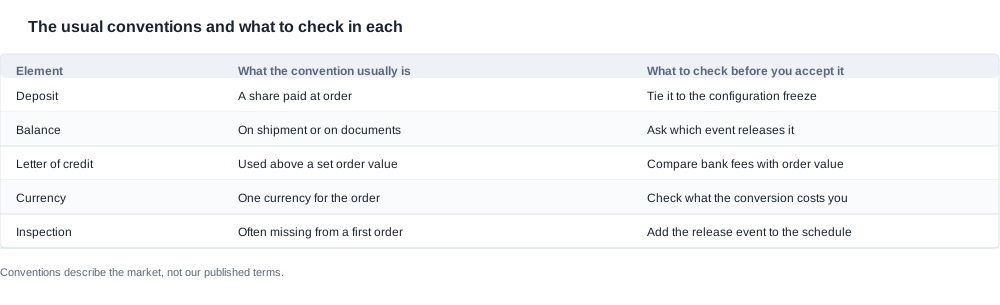

The buyer who uses a benchmark, and the arithmetic behind it
The four fixed costs that decide which end of the range you can use
Before a buyer selects a structure, four cost lines have to be put against the order value, because these are the lines that decide whether the conventional answer is affordable.
- Bank and instrument charges. These are close to fixed amounts per transaction rather than percentages of value, so their share of the order falls as the order grows. A structure that is uneconomic on a test order can be the cheapest option on a repeat order, and a buyer who judges it on the small order will make the wrong decision for the large one.
- The cost of moving documents. Originals that must reach the buyer, and copies that must reach the supplier, are physical movements with a courier cost and a lead time in days. That lead time sits inside the schedule, and it is the reason a document-based release can be several weeks away from the production date.
- Inspection cost and the delay it creates. An inspection at origin, before shipment, adds a day or two and produces evidence. An inspection at destination adds a week and produces evidence after the goods have moved. The difference in cost is smaller than the difference in leverage.
- The internal cost of the payment process. A letter of credit takes a bank relationship, document review and a compliance check on the buyer's side as well. This cost is invisible in the supplier's quotation and it is real.
The arithmetic that matters is the sum of those four against the margin the order is expected to return. This is where the total cost of the structure gets decided, and where a benchmark stops being useful and starts being misleading.
Our catalogue is not uniform, so a benchmark is applied per configuration
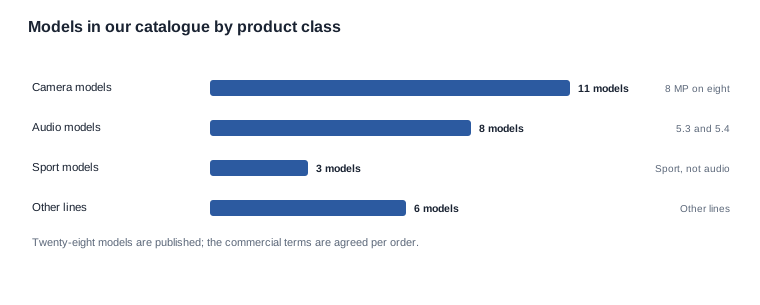
A benchmark in this category is usually quoted at the level of the product line, and the product line is not a single thing. Our published catalogue carries twenty-eight models in four groups: eleven camera models, eight audio models, three sport models and six further lines across children, augmented reality, photochromic and bone conduction. Those groups differ in ways that change the commercial conversation.
- The camera models carry more of the buyer's risk. A camera adds a sensor, a lens, a storage component and a failure mode that a buyer cannot verify from the box. The published camera tiers make the comparison sharper: eight models carry an 8 MP camera, including the MT6, and three carry a 13 MP camera, including the S7. A schedule that has no inspection clause is a much larger problem for a camera order than for an audio order.
- The case option changes what is in the carton. The L2 Utral is published with a 900 mAh or a 1400 mAh case, the MT6 with a 1200 mAh folding case, the CY05 and the L1 Pro, and the CY03 — each at 1400 mAh, and the KY06 and the MT5 with a case whose capacity is not published. The V03 Pro publishes no case at all. A benchmark written against a single carton is a benchmark written against one configuration.
- The charging method is not published for every model. Magnetic charging appears on seventeen models and Type C on seven, while four camera models publish a case capacity and no charging method row. Where the method is not published, it is a question for the supplier, and a question that belongs in the schedule rather than in a later email.
- Some rows cannot be closed by a document. The catalogue publishes no Bluetooth version for any of the eleven camera models, no certificate numbers for any model, and a weight for one model only, at 158 g for the MT6 glasses body including the 265 mAh cell and the camera, excluding the folding case. Rows like these are open by design, and an open row cannot be the event that releases a payment.
Which structure to select for the order in front of you
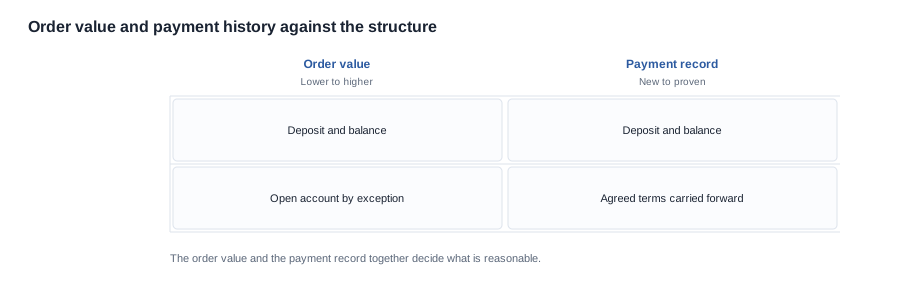
A selection path by order value and payment record
A benchmark becomes a decision once two variables are applied to it: the value of the order and the payment record that already exists between the two companies. Together they produce a small number of sensible positions, and the selection path is short.
If the payment record is new and the order value is small, the conventional deposit and balance schedule is the right answer, and the effort belongs in the trigger event rather than in the percentages. If the record is new and the order value is large enough to absorb a fixed bank charge, the instrument question becomes worth asking, and the questions to ask are about the bank fees and the document process on both sides. If a record exists and the order value is large, the structure can be carried forward and improved, and the negotiation belongs on the inspection link and the remedy window. If a record exists and the order value is small, the cheapest structure available is usually the right one, because the fixed costs have not changed and the value has not grown.
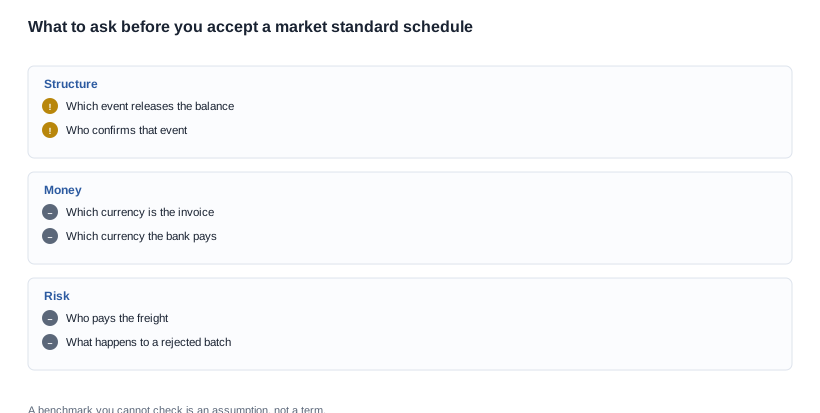
The four questions to ask before you accept a market standard schedule
A benchmark tells you what to expect; these four questions tell you whether the expectation is being met.
- Which event releases the balance, and who confirms it? A date is the convention and a date is weak. A named event with a named owner is the first real improvement available.
- Which document proves the event, and can the supplier produce it? Where the answer is a certificate number, ask for the number and the list of models it covers. Our own catalogue carries a company-level export certification page rather than a per-model certification row, so an unverifiable number cannot be checked against a published scope.
- Who pays the freight, and who carries the risk in transit? Prepaid freight with a balance due on arrival means the buyer has paid for goods still moving.
- What happens to a batch that fails inspection? Silence here means the rejected goods are paid for on the same schedule as the accepted ones.

How to compare two quotations that use different structures
Normalising the two schedules onto the same order
Comparing two quotations that use different payment structures is a routine task and it is frequently done badly, because the two documents are being compared as written rather than as applied to the same order. The procedure that works has three steps.
First, strip the structures back to the same order. Take the configuration string, the quantity, the case option and the destination from each quotation and put them on one page. If the configurations differ, the comparison is not a payment comparison at all and no amount of arithmetic will fix it. If the case options differ, the cartons differ, and the difference in what is financed has to be priced before the terms are compared.
Second, express both structures as a total cost over the same period. That means the deposit, the balance, the fixed instrument and courier charges, the inspection cost, the internal processing cost, and the currency conversion cost where the invoice currency and the bank currency differ. A structure can appear more generous on the deposit and be more expensive overall, and the buyer who compares percentages will miss it.
Third, price the failure case, not just the good one. For each structure, work out who carries a failed batch and what the buyer's exposure is in that scenario. This is the number that rarely appears in a benchmark, and it is usually the largest of the four cost lines.
The cost that is not in the terms
There is a cost that sits outside the terms entirely and is nonetheless part of what the terms are worth: the cost of getting a wrong answer later. Payment terms are the last document in a chain that starts with the specification, and a schedule that quietly assumes a configuration the buyer has not frozen will be applied to whatever the factory actually built. The remedy for that is not a better payment term, it is a configuration string in the schedule.
A second cost sits outside the terms as well: the cost of the supplier learning what you will accept. A schedule agreed once and then applied without review becomes the reference point for every later negotiation with that supplier, and possibly for every other supplier in the category who learns about it. This is the reason to keep the terms specific even when the benchmark is loose. A precise schedule is worth more than a generous one, because it can be defended in the next negotiation.
How to use a benchmark when the supplier pushes back
A benchmark is also the fairest way to frame a disagreement about a term, because it moves the argument away from what a particular supplier is willing to do and towards what the structure normally costs. When a supplier declines a request, the useful question is not whether they will agree, it is whether the request is being priced as a concession or as a correction.
Three responses are available to a buyer, and they are worth keeping distinct.
- Accept the convention and fix the documentation. This is usually the highest-value response in this category, because the missing documentation rather than the missing percentage is what causes the disputes. A schedule that follows the convention exactly but names the trigger event, the owner and the remedy costs the supplier almost nothing to accept and gives the buyer most of the protection a better structure would.
- Trade a convention for a condition. Where the supplier will not move on the deposit share, the buyer can offer something the supplier values: a firmer volume against a rolling delivery, a configuration frozen earlier than the supplier would otherwise assume, or a simpler scope. These are worth more to a factory than a percentage point, and they cost the buyer nothing but a decision.
- Pay for the exception. Where the structure genuinely has to differ from the convention, the buyer can accept the fixed cost rather than the risk: an inspection fee, a courier cost, a bank's charge. A structure that is expensive but that releases the money against a passed inspection is frequently better value than a conventional structure that releases it against a date, and the arithmetic usually settles this faster than the argument does.
The order of those three responses matters. Fixing the documentation first is cheap and usually sufficient, and it preserves the relationship for the second conversation, when a real exception is worth paying for. A buyer who opens with the most expensive request teaches the supplier that requests in this conversation are extreme, and that lesson costs more than the term it won.

A benchmark applied to a hypothetical order
The order, and the benchmark it was tested against
This account is written to show a method. It describes no live project, no named customer and no real order; the model, quantity, market and figures in it are assumed.
The scenario: a brand in a distributor-led market has a conventional deposit and balance schedule in front of it from one supplier, and a letter of credit proposal from a second supplier for the same configuration. The order is an open-ear audio line at a volume where the brand has a payment history with the first supplier and none with the second. The brand's margin on the channel is thin, and the brand's cash calendar has one hard date in it.
The benchmark applied is the conventional one: a deposit at the order, a balance against documents, an undefined inspection, one currency, freight arranged by the supplier.
What the arithmetic changed
The first step showed that the two structures were not comparable as written, because the second supplier's quotation quoted a case option the first had not. That is not a payment question at all; it is a specification question, and it was answered before any term was compared. It also changed the order of the discussion, because a configuration that is still moving makes every payment term provisional.
The second step produced the result the benchmark would have hidden. The letter of credit carried a fixed charge that, on this order value, was a material share of the margin, and the brand would also have carried its own document review and compliance effort. The conventional schedule, with its lower fixed cost, was the cheaper structure for the brand's own order, and the fact that it appeared less protective was irrelevant at that value. The letter of credit would become worth revisiting on a repeat order at a larger volume, where the fixed charge spread over more units.
The third step changed the negotiation itself. With the trigger event identified as the weakest part of the conventional schedule, the brand spent its negotiating capital on moving the balance release to a defined inspection, rather than on the deposit percentage, and it asked for a remedy window measured from receipt rather than from shipment. Neither of those two changes costs the supplier a percentage point, and together they moved more value than the deposit would have.
Where Cynrin stands on market conventions, and the next step
What the catalogue publishes and what stays open
We publish the model line, the configuration options, the case options, the published battery and runtime rows and the published charging methods. We do not publish our deposit percentage, our accepted payment methods, our unit prices, our minimum order quantities or our production lead times, and we will not quote a typical figure that you cannot verify against something. Where the catalogue is silent, such as the charging method on four camera models or the Bluetooth version on the eleven camera models, we say that it is not published rather than filling the gap.
A market convention is a useful reference for judging whether a schedule is reasonable. It is not a substitute for a written schedule that names the configuration, the release event, the owner who confirms it and the remedy that applies when it fails.
The case option and the destination market
Send the model, the case option, the quantity, the destination market and the schedule you have been given, and we will tell you which parts of it we can meet, which parts we would want defined, and what the total cost of the arrangement is against the order value. The payment terms framework sets out the wider structure, the documents to request covers the paperwork behind a release event, negotiating payment terms covers the side of the conversation this article does not, pricing myths covers the unit price, and the AI camera glasses range is where the camera tiers are set out.
Send the schedule, the configuration and the volume, and we will tell you which structure the order can actually carry.


