

Payment terms and supplier documentation are usually treated as two separate subjects, and a buyer who negotiates the first without collecting the second ends up paying a deposit to an entity that turns out not to be the one supplying the goods. The useful order is the reverse: collect the documents first, let them tell you which terms are safe, and only then agree the terms. Six document sets do that work — the invoice that defines what the deposit buys, the registration record that establishes who you are contracting with, the bank confirmation that establishes who gets the money, the export registration that decides whether the goods can be cleared, the conformity evidence that decides what can be listed, and the inspection and acceptance report that releases the balance. This guide sets out those six, attaches a verifiable trigger to each payment milestone, and is explicit about the limits of what our own documentation can evidence.
Smart glasses payment terms: six documents that release each milestone
The buying task behind a payment terms request
The reader is a buyer working for the brand, a channel buyer or an importer who is about to release money for goods that do not yet exist. The situation is almost always a first order in a new relationship, because a second order is negotiated on the back of the first and the first is where the money moves to an entity the buyer has never verified.
That is the whole risk in one paragraph. A deposit is an unsecured transfer to a counterparty, made before there is anything to inspect, on the strength of a document set the buyer has not checked and a configuration the buyer has not yet seen. Every question a buyer asks about payment terms is really a question about how much of that risk the buyer is carrying on day one.
Three things make this category more exposed than the general case. The first is that the goods are new enough that the buyer's own reference experience is thin, so there is little track record to reason from. The second is that the specification is largely unpublished, so the pro forma invoice is often the only place where the configuration appears in writing — which makes it more important to check, not less. The third is that the payment usually arrives before the buyer has any evidence that the goods will be shipped at all.
The fear underneath is not losing the deposit. It is losing the deposit and finding out a month later that the entity that took it cannot supply the goods, that the shipment was never going to be built, or that the payment was made to a third party who was never a party to the contract.
Why payment terms are risk allocation rather than finance
The common framing treats payment terms as a financing decision: how much to pay up front, how much to hold back, how long to take. That framing misses the point. A milestone is a transfer of risk, and the question is not how much money moves but what the buyer receives in exchange for it.
A deposit against a pro forma invoice that states the configuration, the quantity and the price buys something specific: the supplier's commitment to build that configuration. That commitment is real but unsecured, and its value depends entirely on whether the entity is capable of performing and identifiable when something goes wrong.
A balance released against a signed acceptance report buys a different thing: evidence that the goods conform to agreed criteria before the money moves. A balance released against a transport document buys a third thing: evidence that the goods have left. These are not interchangeable, and the difference between them is the difference between a claim and an argument.
This is why the documents have to be collected before the terms are agreed. The documents determine which triggers are even available. If there is no inspection procedure to inspect, then tying the balance to an inspection report is a wish; if there is no export registration for the destination, then a term that promises clearance is a promise the supplier cannot keep; and if the bank beneficiary does not match the contracting entity, then every milestone in the plan is being paid to somebody who is not your counterparty.

The six payment documents, and what each one releases
The six documents, side by side
| # | Document | What it actually proves | How it changes the terms you accept |
|---|---|---|---|
| 1 | Pro forma invoice | That the price, configuration and quantity are real | Defines what the deposit buys |
| 2 | Company registration record | That the supplier is a legal entity, not a trading name | Decides whether you can contract at all |
| 3 | Bank account confirmation | That the payee matches the contracting entity | Blocks the most common payment fraud route |
| 4 | Export registration for the shipment | That the goods can be cleared in your market | Decides who carries the risk in transit |
| 5 | Conformity evidence for the model | What the supplier actually holds, per model | Determines what your listing can claim |
| 6 | Inspection and acceptance report | That the goods were checked before the balance | Is the trigger for releasing the balance |
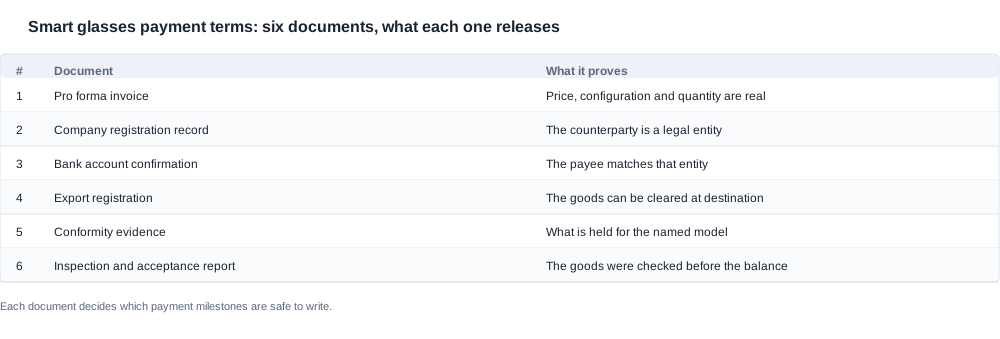
The two rows that most often turn out to be missing are the fourth and the fifth, and they are the two with the longest consequences.
Export registration and the economic operator registration number for the destination market are what allow a shipment to be cleared without delay. A supplier who cannot produce them will either hold up your clearance for weeks or route the goods through a third party whose name ends up on the customs paperwork, which creates a documentation problem at the exact moment a claim has to be made and the wrong entity is named on the document.
Conformity evidence is where the gap between "we are certified" and "here is the document for your model" shows up. In our own catalogue, the position is that a company-level export-certification page exists whose content is images rather than text, that the catalogue text contains no reference to CE, FCC or RoHS, that there are no per-model certification rows, and that no specific certificate number, issuing body or validity date is published for any individual model, the applicable scope for a model and a market being written material to be requested and filed before the order. That is an honest description of what we can evidence, and a buyer should ask every supplier to be equally precise about the difference between a company-level claim and a document for a named model. A model that turns out not to be covered cannot be listed, and discovering that after the packaging is printed costs the packaging.
What each milestone should be tied to
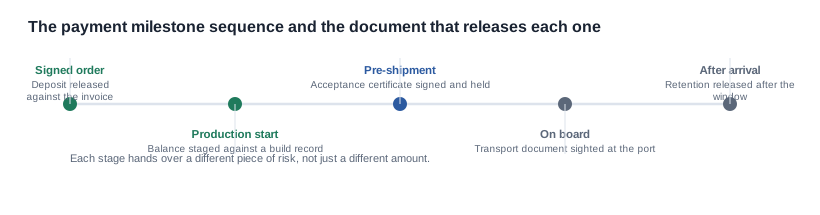
Each payment should hang on one verifiable event, and the events are not interchangeable.
The deposit is justified by a pro forma invoice that states the configuration, the quantity and the price in a form that identifies a product rather than describing one in prose. If the invoice says "AI camera glasses with charging case" rather than a model and a case capacity, the deposit is buying an ambiguity, and the ambiguity is resolved later in the supplier's favour.
The balance should be triggered by something the buyer can verify rather than something the supplier can assert. The three common triggers are a third-party inspection report, a signed acceptance note against agreed criteria, and the transport document. Which one to choose depends on the value and on how much control the buyer has at the goods-in gate. For a first order, tying the balance to an inspection report is usually worth more than a price negotiation.
Payment method should follow the entity check rather than precede it. A corporate account in the contracting entity's name, confirmed by a document carrying the entity's own registration details, is a reasonable requirement. A personal account, a request to pay a third party's account, or a request to change the beneficiary by email after signature are all reasons to stop.
Credit terms should be earned rather than granted. A supplier offering sixty-day terms on a first order is offering to carry the buyer's balance sheet, and the terms of the second order will reflect how the first one went.
Delivery terms are where the documents and the contract meet. Export registration says the goods can be cleared, the insurance arrangement says who carries the loss if they do not arrive, and the acceptance report says when the risk changes hands commercially. The incoterm named in the contract has to be consistent with all three, or one of them is decorative.
The configuration decides the document set
The case, the carton and the transport document
Payment terms are usually discussed as if the goods were a single undifferentiated thing, and in this category they are not. The configuration decides the packing list, and the packing list decides what the transport document says, and the transport document is frequently the trigger for the largest payment.
The charging case is the clearest example. Our range publishes a 1400 mAh case on the CY03 and the CY05, and the L1 Pro, either a 900 mAh or a 1400 mAh case on the L2 Utral, and a 1200 mAh folding case on the MT6. The KY06 and the MT5 ship with a case whose capacity is not published, and the catalogue contains no case row at all for the V06 and the V03, and the V03 Pro or the S7, which is an item to request rather than a line to read. A case is a separate physical object with its own volume, and whether it travels in the same carton as the glasses or in a separate carton changes what the transport document describes.
That matters commercially in two ways. The first is documentary: a payment trigger written as "against the transport document for the shipment" is precise if the shipment is one carton line and vague if it is two, and a vague trigger is a trigger that can be satisfied by the wrong piece of paper. The second is practical: the case changes the carton data, and the carton data changes the freight, and the freight is part of the landed cost the buyer has been calculating on a per-unit basis since the quotation.
There is a related point about the charge test in a pre-shipment inspection. The charging method is published as magnetic on seventeen models and Type C on seven, and is not published at all for four camera models. Charge time is published for all twenty-eight models, up to two hours on twenty-six of them and about one hour on the D17 and the ZH12. A pre-shipment inspection that includes a charge check therefore has a defined step for those models and an undefined one for the four, which is a question to put to the supplier in writing rather than an assumption to carry into an inspection plan.
The model designation on the invoice
The second configuration point is narrower and more consequential. A model designation is a string, and the string has to be the same one on the pro forma invoice, on the acceptance report and on the transport document. If it is not, then the payment has been released against a document that describes something other than what was ordered.
This is not an abstract risk in this category, because the range genuinely contains similar products with different identities. Eight camera models are published at 8 MP and three at 13 MP, and the resolution tier is part of the product's identity rather than a specification option. A 13 MP configuration and an 8 MP configuration of similar appearance are different goods, and an invoice that names one while the acceptance report names the other is a real possibility if the designation is not fixed.
The prevention is procedural and cheap: fix the designation string before the pro forma invoice is issued, and require every document in the payment chain to carry it verbatim. When the case option is part of the configuration, the same applies to the case, because a 900 mAh case and a 1400 mAh case are different products in the same carton.

Building a milestone plan that protects the buyer
The five-step milestone plan
- Verify the counterparty before pricing the milestones. Registration record, and a bank confirmation in the same legal name. If these do not align, nothing else in the plan is worth writing.
- Fix the configuration string, including the case option and the colourway, and require it verbatim on the pro forma invoice, the acceptance report and the transport document.
- Attach each milestone to an event with a document and a holder. The deposit to the pro forma invoice, the balance to an acceptance report signed by a named party, any retention to the closing of the acceptance window.
- Set a release deadline for each milestone after the event, because a document that arrives late is a dispute that has been deferred rather than avoided, and a deferred dispute arrives during the next production run.
- Decide the currency and who carries the exchange risk, in writing, before the first payment, and put a validity period on the quotation so that the price and the currency are not drifting apart silently.

The payment record you keep for each release
Four fields per release, and the file becomes usable when a dispute arrives rather than during it. The milestone and the amount. The document that triggered it, with its date and reference. The date the payment was actually made and the beneficiary account it went to. And the approval — who authorised the release and against which document.
That last field is the one that prevents the most expensive category of error, which is a payment released against a document that was never checked.
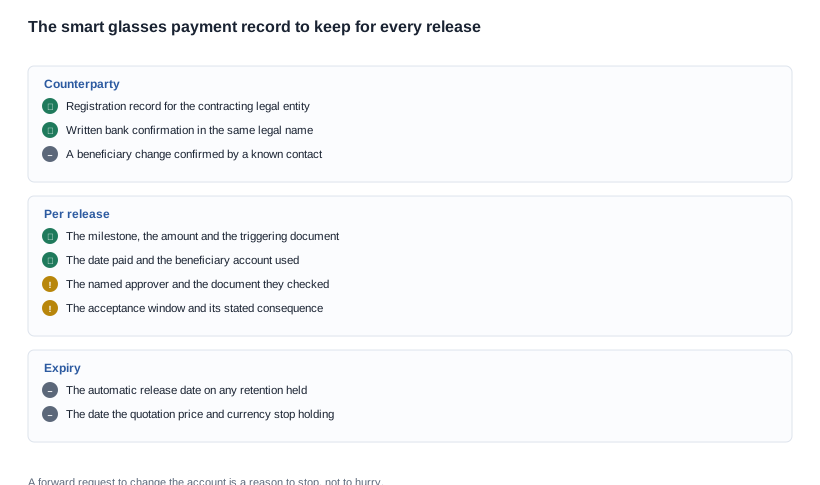 A release without a named approver is a release that anyone can perform, and a supplier who learns that a milestone can be released on a forwarded email will eventually test it.

Where payment disputes actually come from
Three payment disputes and their causes
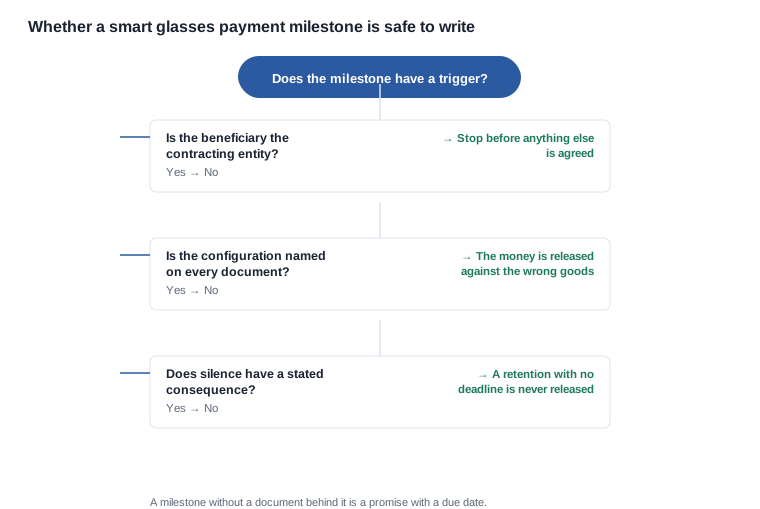
The beneficiary changed after signature. A request arrives to pay a different account, with a plausible explanation and a deadline attached. The cause is almost always an internal accounting change at the supplier, and it is not usually fraudulent, which is exactly what makes it dangerous — it looks routine. The control is the rule that a beneficiary change requires a fresh written confirmation from a known contact on the contracting side, not from the person who requested the change.
The balance was released against the wrong document. The transport document sighted at the port described a different configuration from the one ordered, and the money had already gone. The cause is a designation that was never fixed, or a trigger written loosely enough to be satisfied by any document in the file. The control is the verbatim designation requirement and a release checklist that names the document, not the category.
The retention was never released. A holdback sits with the supplier because the acceptance window closed without a decision on either side, and the buyer believes it should be back while the supplier believes it is still in dispute. The cause is an acceptance window with no consequence for silence, which is the same drafting gap that appears in the quality annex. The control is a stated consequence and an automatic release date.
The terms that move in a payment structure
What moves in a payment structure is the balance between the parties' exposure, not the existence of the stages. A larger deposit buys a lower price and a higher risk transfer to the buyer; a retention buys evidence and a delay in the supplier's cash cycle; a letter of credit or an insurance-backed instrument buys bank approval and a fee. These are genuine trade-offs, and the sensible position depends on how much the buyer can verify before the money moves.
What does not move is the cost of the underlying verification. An inspection procedure, a third-party report and a conformity document all cost money and calendar time whoever arranges them, and a term that pretends otherwise will be repriced at the second order.
The total cost of a payment structure is therefore more than the sum of its stages. It includes the financing cost of the deposit, the instrument fees, the cost of the delay to the supplier's cash, and whatever exchange exposure sits in the quotation currency. A buyer comparing two structures on the percentage paid up front is comparing the least important number.
A payment milestone plan worked through, and what we will confirm
A payment milestone plan reasoned through
What follows is a worked scenario written to carry an argument, not a client engagement report. No customer, order or engagement is described; the model, the quantity, the destination and the currency are assumed so that the reasoning can be followed from the first document request to the final release.
A brand-side buyer is placing a first order for a camera model with a charging case into a European market, and the supplier has quoted a structure with a deposit, a balance against shipping documents and no retention. The buyer has no history with this supplier.
Step one is the counterparty check, which comes before the structure is discussed. The registration record names an entity, and the bank confirmation names a different one. The explanation is that the quoting entity is a sales company and the manufacturing entity is elsewhere in the group. That is a legitimate structure in some markets and an unacceptable one in others, and the buyer resolves it by requiring the payment to be made to the registered entity, with a written confirmation of the account, before anything else is agreed.
Step two is the configuration. The buyer wants a specific colourway and a specific case capacity, and both appear on the pro forma invoice as a designation string agreed in advance. Because the case is a separate physical item, the packing question is raised at the same time, and the transport document trigger is written to describe the shipment rather than to refer to "the documents".
Step three is the balance trigger. The supplier offers a transport document. The buyer asks instead for a signed acceptance report against the agreed criteria, with the acceptance window stated and the consequence for silence stated alongside it, plus a small retention released when that window closes. The supplier does not accept the retention, so the buyer trades it for a tighter acceptance procedure and a release deadline, and records the concession.
Step four is the currency and the validity period. The quotation is in a currency the buyer does not incur its costs in, so the buyer asks who carries the exchange movement between quotation and payment, and the answer is added to the quotation as a validity period with a stated price review point.
Step five is the record. Four fields per release, and a named approver on each one, so that the file can answer a question about a payment six months later without anyone having to remember it.
What we will confirm, and what we keep out
It is worth being precise: we will send a pro forma invoice that states the configuration, the quantity, the price and the delivery basis in writing, and confirm the receiving entity in the same message. We will provide the company registration details and the export registration for the shipment, and we will supply the conformity evidence we hold for a named model — or say plainly that we do not hold it for that model.
What we will not publish is a standing table of our deposit ratio, balance trigger, credit terms and delivery terms, because they depend on the order, the configuration, the destination and the payment history, and a published table would be a promise we cannot keep across all of them.
We will also be clear about the limits of our own file. Our catalogue carries a company-level export-certification page whose content is images rather than text, no per-model certification rows, and no published certificate number, issuing body or validity date for any individual model; what applies to a given model in a given market is written material to be requested and filed before the order. We will not supply a reference we cannot evidence, and we would rather tell a buyer that than let a company-level claim be read as per-model cover. The same applies to production capacity, minimum order quantities and defect rates.
What to send us for a payment structure
Send the model, the configuration including the case option, the quantity, the destination and the currency you intend to pay in, and we will tell you what the payment milestones would be tied to for that combination, which documents have to exist before the first release, and which of our own records are published and which are not. If you have been given a structure, send it with the document set that came with it and we will mark the milestones that have no verifiable trigger behind them.
Related reading
- payment terms section
- contract case example
- Camera and audio smart glasses range
- Reading a contract line by line
- Red flags when a supplier is a trading company
Send the model, the configuration, the quantity, the destination and the currency, and we will show you which milestones of a smart glasses payment structure have a verifiable trigger and which are a promise.


