

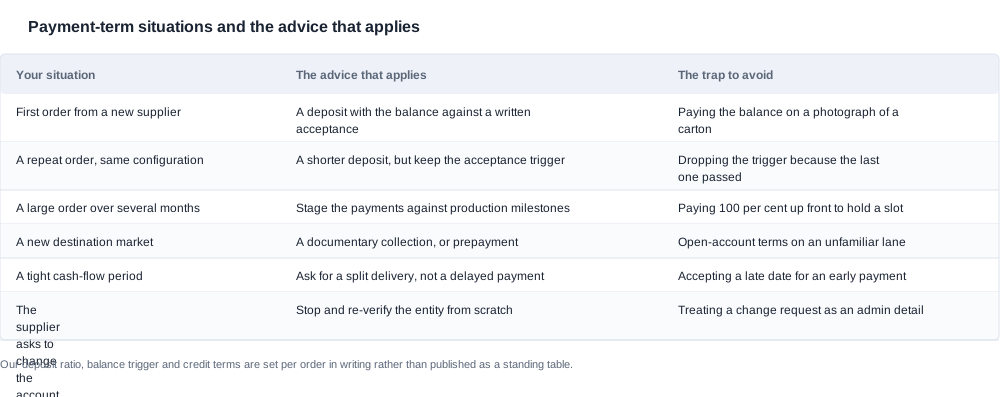
Smart glasses payment terms advice is usually written as a list of principles, and principles are the wrong shape for the problem, because almost every question a buyer brings to a payment conversation is situational. A term that is sensible for a first order from an unfamiliar factory is wrong for a re-order on a configuration that has already shipped four times, and the same deposit share is excellent advice in one case and a trap in the other. The practical way to use a set of terms is to identify which situation you are actually in, find the clause that situation puts under pressure, and ask one question about that clause. This article is organised that way, with six situations that recur in this category, the advice that applies to each, and the trap that most often catches buyers in it.
Smart glasses payment terms: the situation decides which advice applies
How to read the advice in this article
Each of the six situations below carries the same four elements, so that they can be compared against each other rather than absorbed one at a time.
- The situation, described in the words a buyer would actually use internally, not in the language of a contract.
- The term under pressure in that situation, which is the clause the situation puts at risk.
- The question to ask, which is specific enough to be answered in writing and short enough to be asked in a single message.
- The trap, which is the mistake that is easy to make here, usually because it resembles diligence at the time.
The questions are deliberately narrow. A broad question such as whether the supplier is reliable is impossible to answer in writing and therefore never gets answered at all. A narrow question such as which event releases the balance is answerable in one sentence, and the answer is the one that matters.
Why one piece of advice cannot serve two orders
The reason a situational approach is necessary is that the same clause carries different risk depending on what the order is.
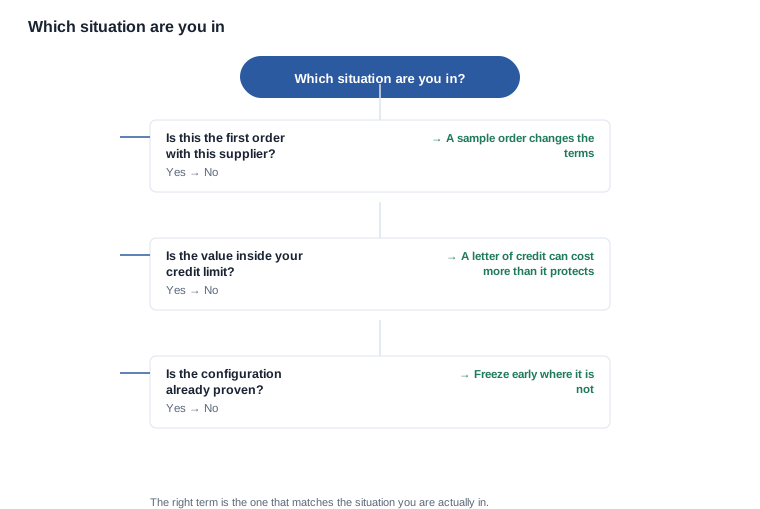
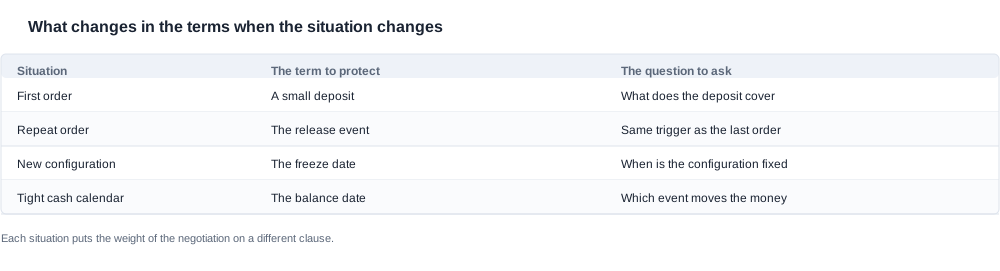
Consider the deposit. On a first order from a supplier you have never worked with, the deposit protects the supplier against a buyer who may not place the order at all, and the practical advice is to keep it modest, pay a sample first, and let the build history earn a better term. On a re-order for a configuration that has already shipped, the deposit has a different job entirely: it funds a production run against a known demand, and the practical advice is to pay more of it earlier, because the factory can plan the component purchase with certainty and that certainty is worth more to both sides than the cash is to the buyer.
The same clause, the same supplier, the opposite advice. The variable is not the supplier and it is not the clause. It is what the buyer knows and what the supplier knows at the moment the schedule is written. Any advice that ignores that will be wrong somewhere, and the somewhere is usually the order that mattered.

Situation one and two: a first order and a repeat order
First order with a supplier you have not worked with
The first order is the situation where advice is most often given and least often followed, because the buyer wants the order to be cheap and the supplier wants it to be safe, and the meeting point is usually a deposit that neither party has interrogated.
The term under pressure is the deposit. On a first order, a deposit is a price on the supplier's risk, and a high one is not evidence that the supplier doubts you; it is evidence that the supplier does not yet know your order will repeat. If it repeats, the next order can be structured differently, and the supplier knows that. A first order is an information purchase, and the information it buys is the production behaviour of that factory on that configuration.
The question to ask: what does the deposit cover, and at which production milestone does the balance become payable? A supplier who answers in one sentence has told you what their risk is and where it sits. A supplier who answers with a percentage has told you a number they read off a template.
The trap is treating a small deposit as the prize. Buyers sometimes push hard on the deposit share of a first order and then lose the thing that actually reduces their risk, which is the sample and the specification. A sample order at a small value, followed by a careful inspection of the sample, tells the buyer more about the final order than a two-point movement in the deposit does. It also costs less to be wrong about, because a wrong sample is a wrong sample rather than a wrong production run.
The practical advice: pay for a sample, keep the unit specification from that sample, and treat the first order's schedule as a template to be tested rather than a price to be won.
Repeat order on a configuration you have already built
The repeat order is the situation where buyers lose money by over-applying first-order caution. Once a configuration has shipped and the returns rate is known, the uncertainty that justified a cautious first schedule has largely gone, and the terms can be revisited.
The term under pressure is the release event. On a repeat order, the question that shaped the first schedule, which event releases the balance, is now answerable with evidence rather than with goodwill. You know what the units should present as, you know what the packaging should present as, and you know what the last batch's defects were. That knowledge converts a vague acceptance statement into a measurable criterion, which is the whole value of a repeat order.
The question to ask: will the same inspection method and the same limits apply to this order as to the last one, and can the inspection report from the previous shipment be used as the baseline? A supplier who treats a repeat order as a fresh start on inspection is telling you that the previous batch was not what they thought it was.
The trap is leaving the trigger event alone because it was signed once. A schedule copied forward from a first order carries a weak trigger indefinitely, and each repeat order then inherits an acceptance rule that nobody has tested. A repeat order is the cheapest possible moment to fix a badly drafted clause, because the sample and the baseline already exist.
Situation three and four: a new configuration and a large order
A new configuration on a model that already exists
Changing the colourway, the case option, the artwork or the packaging on a model that has already shipped creates a situation with an unusual property: the product is proven and the specification is not. The factory knows the build; the buyer does not know what the new specification will produce in the channel.
The term under pressure is the freeze date. The configuration has to be fixed at a point where the supplier can still plan components, and the deposit has to be attached to that freeze rather than to the order. If the deposit follows the order date, the buyer is paying for a product that does not yet exist in any meaningful sense, and the freeze has to happen later, under pressure, with the money already committed.
The question to ask: what is the latest date the configuration can change without a cost, and is the deposit refundable or re-allocable if it changes before that date? This is a narrower question than it appears and it is one a factory can answer precisely, because the answer is set by the component lead time and the packaging print run.
The trap is confusing a configuration change with a specification change. A new colourway on an existing build is one thing; a different camera tier, a different case capacity or a different charging method is a different product, and the payment terms written for the old one do not apply to the new one. Our own catalogue shows how easily these differ in practice: the L2 Utral publishes a case available at 900 mAh or 1400 mAh, the V03 Pro publishes no case at all, and four camera models publish a case capacity with no charging method row. A schedule that says "the L2 Utral" is not a specification.
A large order against a tight cash calendar
A large order usually sounds like it should be easier to finance, and in this category it sometimes is not, because the fixed costs of the protective structures do not scale down.
The term under pressure is the balance date. On a large order, the total amount is larger, the share of the balance that falls due before the goods are inspected is larger in absolute terms, and the working capital cost of that balance is proportionally harder to carry. The advice that follows from that is counter-intuitive: the larger the order, the more the buyer should prioritise moving the release event earlier, not less.
The question to ask: can the order be delivered in stages against a rolling schedule, and does the release event work the same way for each stage? Splitting a large order into deliveries turns one large inspection and one large balance into several smaller ones, and it moves the first release event much closer to the first production run.
The trap is reading a letter of credit as the default answer for a large order. The bank's charges are per transaction, and on a first large order the fixed cost of the instrument can be a serious share of the margin, while the risk it addresses, that a counterparty will not ship, is often not the risk the buyer has. The risk the buyer has is a specification that has not been inspected, and no instrument fixes that.


Situation five and six: a certification requirement and a recovery order
A market that asks for documents you cannot produce yet
Some markets require documentation that the supplier holds, that the catalogue does not publish, and that the buyer has never seen. This is a normal situation in this category and it is where payment schedules most often become fiction, because the schedule names a certificate number that nobody has checked.
The term under pressure is the documentation trigger. If the trigger names a document that cannot be produced, the trigger cannot happen, which means the balance cannot be released, which means the order does not ship. That is not a drafting detail, it is a stopped order.
The question to ask: which document starts the clock, who produces it, by when, and what happens if it cannot be produced? Our catalogue carries a company-level export certification page rather than a per-model certification row, and publishes no certificate numbers and no validity dates, so a number quoted in a schedule cannot be checked against anything we publish. The honest version of the trigger is the document set for the ordered configuration, produced by a named owner with a date attached.
The trap is accepting a trigger that names a document nobody has ever seen, because it appears in a template and the template appears official. A buyer who writes a trigger that cannot fire has written a schedule that either stalls the order or pays for goods that nobody has checked.
Re-ordering after a batch that failed
The recovery order is the situation where the buyer has the most information and is most likely to negotiate the wrong thing, because the memory of the failure is loud and the remedy clause is quiet.
The term under pressure is the defect remedy. After a failed batch, the terms in force were the terms that let the batch through, so the response is usually to change the specification, the inspection or the supplier. Changing the remedy clause is less intuitive and often more effective, because the remedy clause is what determines what happens the second time the same defect appears.
The question to ask: what is the remedy, in what window, and how is it claimed, and does the window run from shipment or from receipt? A window that runs from shipment expires before a slow-moving channel has even sold the first units, which is the ordinary reason a credit arrives after the season has closed.
The trap is negotiating a bigger discount on the recovery order as the visible sign of the failure. A discount on the second batch reduces the cost of the same defect. A remedy clause with a deadline and a defined route changes what the supplier does during production, which is where the defect actually originates.

The advice that holds in every situation
Four rules that do not change
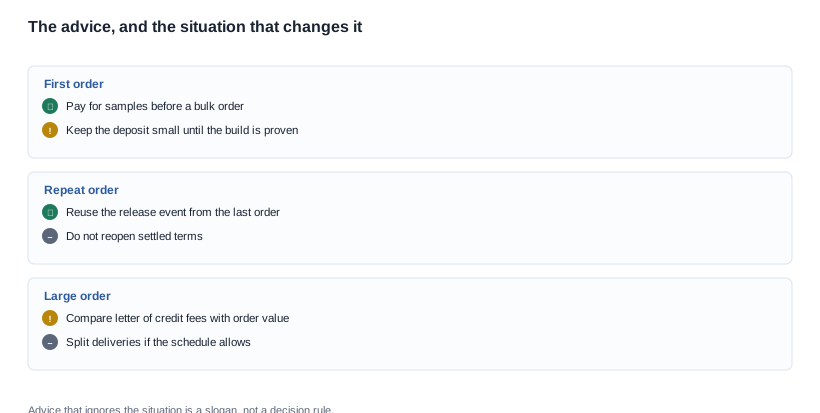
Whatever the situation, four pieces of advice hold in this category without exception.
- Name the configuration before the money. The order, the deposit and the acceptance criteria have to refer to one string, so that a dispute about what was ordered and a dispute about what was paid are the same argument rather than two.
- Make the release event an event. A date is not an event, and an event that only the supplier can confirm is a promise. The test is simple: name the person or the company who signs the release.
- Put the remedy in the schedule, with a date. A remedy without a window is an intention, and a window measured from the wrong point is a window that has already closed.
- Cost the structure, do not just price it. Bank charges, courier costs, inspection fees, currency conversion and the buyer's own processing time are all part of what the terms are worth, and only one of them appears in the quotation.
The questions to ask, whichever situation you are in
If a buyer wants a single message to send, the following nine questions cover every situation in this article, and they are better sent together than one at a time.
- Which event releases the balance, and who confirms it?
- What does the deposit cover, and against which milestone?
- Which document proves the release, and can you produce it?
- What happens to a batch that fails inspection?
- Within what window, and measured from what point?
- What is the remedy, and how is it claimed?
- When is the configuration fixed, and what happens if it changes?
- Who owns the tooling, and what happens to it if the order is cancelled?
- What do the bank, inspection and courier charges add to this order?
The checklist criteria for a usable answer are the same for all nine: a name, a date, and a document. An answer that gives none of those three is a preference, and preferences are what the terms are supposed to replace.
One page, and the order the clauses appear in
Whatever the situation, the terms are easiest to agree when they arrive as one page in a fixed order, because the order is itself an argument about priority. A buyer who wants the release event to carry more weight sends it earlier, and a supplier who reads the page in that order sees the priority without being told.
The order that works in this category is: the configuration, the deposit and its trigger, the milestones, the release event and its owner, the inspection method and its limits, the document that proves the release, the remedy and its window, the warranty period, the tooling ownership statement, the cancellation treatment, and the currency. Eleven items, and each of them is one line.
Two of those lines do most of the work, and it is worth knowing which they are before the conversation starts. The release event is the line that decides who carries a failed batch. The remedy window is the line that decides whether a credit arrives in time to be used. A page that contains those two clearly, and leaves the rest to a sensible default, is better than a page that argues about twelve items and loses the two that matter.
The same page should carry the configuration string, because a configuration is what makes the other lines checkable. Our published catalogue makes the point concrete: a deposit paid against a model that has two case options is a deposit against an option, and the differences between models are not decorative. The L2 Utral publishes a 900 mAh or a 1400 mAh case, the V03 Pro publishes no case, and four camera models publish a case capacity with no charging method row. A page that names the model and stops there has not named the product.
Once the page is agreed, the remaining work is recording. Keep the signed schedule against the order reference, the quotation number and the configuration string together, so that the next person to ask why the deposit was that size has an answer that was written down rather than remembered.
Where Cynrin stands on practical terms, and the next step
What we will do, and what we will not
We will write the terms for your specific order, name the event that releases the balance, tell you which document we will produce to prove it, and put the remedy and its window in the same document as the schedule. We will also say plainly when a structure you have asked for is one we will not accept, rather than agreeing to it on a call and changing it once the goods are moving.
What we do not publish, and will not quote as a range, is the deposit percentage, the accepted payment methods, the unit price, the minimum order quantity and the production lead time. Our payment terms framework sets out the structure of the arrangement, and the terms themselves are a per-order matter because the order size, the configuration, the case option, the destination and the relationship all change what is reasonable.
How to start a conversation about terms
Send the model, the case option, the quantity, the destination market and the schedule you have been given, and we will tell you which structure the order can carry and what the total cost of the arrangement is against the order value. The documents to request covers the paperwork behind a release event, the market conventions covers what the range usually contains, negotiating payment terms covers the negotiation itself, and the AI camera glasses range is where the camera and case options are set out.
Send the situation, the configuration and the schedule, and we will tell you which term the order has to protect.


