Smart glasses payment terms are usually managed as a negotiation, and a negotiation is the wrong container for them. What a buying organisation actually needs is a procedure that produces the same quality of schedule every time, whether the person handling the order is a senior buyer with twenty years in the category or somebody covering the category for a fortnight. A standard operating template does that: it fixes the sequence, the owners, the questions and the record, so that the outcome depends on the order rather than on the day. The template is not a document to send to a supplier. It is the internal machinery that decides what gets sent, who has to agree it, and what is written down afterwards.
Smart glasses payment terms: a standard operating procedure for the buying side
Why the procedure belongs to the buyer
A supplier will send whatever schedule they have. Most factories in this category have a standard terms document that they adapt, and it was written by a sales or finance function rather than by the people who build the product. The result is a document that is commercially coherent and technically thin: it handles the money and says almost nothing about the goods, the trigger event or the remedy.
That is why the buying side needs its own procedure. A buyer with a procedure turns the supplier's standard terms into a set of specific questions, with an owner for each answer and a record of the outcome. A buyer without one negotiates from a blank page every time, and a blank page is won by whoever is more practised at negotiation, which is rarely the person carrying the most exposure.
The procedure has four properties that make it worth writing down.
- It is repeatable. Two buyers, two orders, one standard. The variance between suppliers is useful; the variance between buyers is waste.
- It is auditable. Six months later, somebody has to be able to reconstruct why the terms were what they were, and that requires a record rather than a memory.
- It is fast. Most of the work is a checklist, and a checklist is faster than a deliberation.
- It is survivable. When the person who wrote it is on leave, the procedure keeps working, which is the point of a standard operating template rather than a personal method.
The seven steps
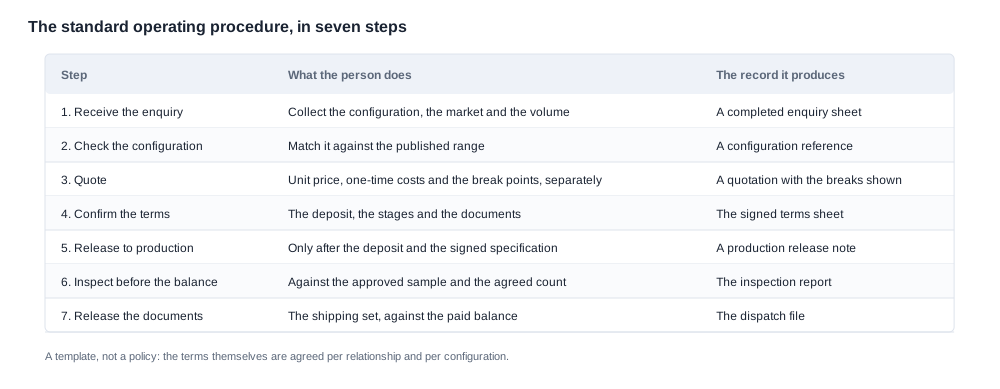
The sequence below is the working version. Each step produces something, and each output feeds the next, so that a buyer cannot skip ahead without producing the artefact the later step needs.
- Receive the quotation and the payment schedule as one document. Two documents produce two sets of facts, and the schedule cannot be checked against a configuration that is somewhere else. If they arrive separately, the first step is to ask for them together.
- Match the configuration string against the order. Model, case option, colourway, quantity, destination. This step either passes or it does not, and if it does not, nothing else should be read.
- Identify the release event and its owner. Not the amount, not the percentage, the event. If the answer is a date, record that and treat the schedule as incomplete.
- Check the deposit against the cash calendar. Not whether the amount is acceptable, but whether the date of the payment can be met without a financing arrangement that the organisation has not approved.
- Run the red flag list and record every answer. In writing, with the date the answer arrived. A verbal answer is not an answer to a red flag question.
- Draft the clause list and send it back. One list, one document, marked against the supplier's own clauses so that nothing has to be found again.
- Record the agreed terms against the order reference. The five fields, filed with the quotation, so that the next order starts from what was agreed rather than from scratch.

Why the procedure is written down at all
The reason a buying organisation writes a procedure for this rather than relying on a good buyer is not distrust. It is that the category produces small, infrequent orders, and a small infrequent order does not generate enough practice to make a person good at it. The same procurement manager may place four smart glasses orders in a year, and in the interval the negotiation skill decays, the questions get shorter, and the schedule that arrives is accepted because reading it properly would take longer than the deadline allows.
A procedure fixes that in two ways, and the second is the more important. It fixes the questions, so the reader does not have to remember them. And it fixes the output, so the outcome does not depend on who is reading. That second effect is the one that matters over a programme, because it is what lets a second buyer take over a line without inheriting a set of undocumented arrangements.
There is a third reason, which is that a written procedure is available to the supplier. A buyer who can say that the schedule has to carry a named release event, a remedy window and a tooling ownership statement has a position that does not have to be argued from scratch in every negotiation, because the requirement itself is the argument. A procedure turns a series of personal requests into a standard, and a standard is cheaper for both sides than a negotiation.
The cost of the procedure is one page and an hour, and the return is that the fourth order in a line is as well-specified as the first.
The roles that have to be in the room
Who owns which clause
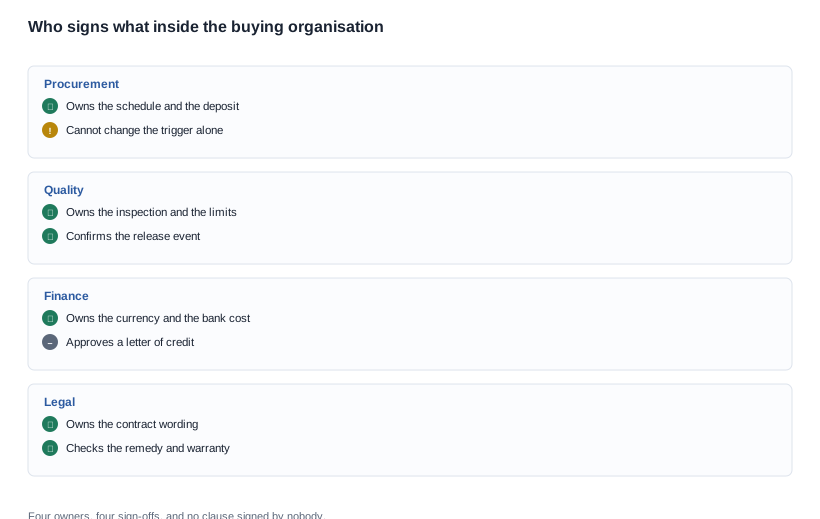
A payment schedule touches four functions, and a procedure that does not name them produces a schedule with gaps in it, because the gaps are exactly the clauses that nobody owned.
| Role | Owns | Cannot decide alone |
|---|---|---|
| Procurement | The deposit, the schedule, the release event | The inspection method and the limits |
| Quality | The critical characteristics, the inspection, the limits | The payment timing |
| Finance | The currency, the bank arrangement, the cash calendar | The specification and the remedy |
| Legal | The contract wording, the remedy, the warranty | The commercial structure |
The rule that makes the split work is that no clause is signed by nobody. If the release event has no owner, it is a date. If the inspection limits have no owner, they are a preference. If the remedy window has no owner, it does not exist.
The order of the review matters as much as the split. Quality has to see the specification before the terms are agreed, because the acceptance criteria determine what the release event can be. Finance has to see the schedule before it is agreed, because the deposit date and the currency decide whether the cash calendar works. Legal has to see the release event and the remedy before the wording is settled, because those two clauses are where a schedule becomes enforceable or merely descriptive.
Where the process usually breaks
Three failures account for most of the trouble, and none of them is a negotiation failure.
- The schedule arrives without the configuration. The process then spends three days reconstructing what was ordered, and the clauses are written against a product that nobody has confirmed. The fix is procedural: the schedule is not opened until the configuration string is on it.
- The answer arrives verbally. A red flag question answered on a call is a red flag still open. The process should require the answer in writing, which is a low bar and the only one that holds.
- The record is not kept. The order runs, the goods arrive, the programme moves on, and the next order in the same line starts from a blank page. The record is what makes the second order cheaper to place than the first, and it is the part of the procedure most often skipped.
The questions that go out with the schedule
A procedure is only as good as the questions it sends, and the questions are worth preparing once rather than composing under time pressure. The list below is what a buying organisation sends alongside a request for terms, and it is deliberately short enough that a supplier will answer it without treating it as an audit.
On the configuration. Which model, which case option, which colourway, and what changes if any of those change. A supplier that cannot answer this in one line is quoting a model family rather than a product, and the quotation cannot be compared with anything.
On the money. What the deposit covers, which milestone it is paid against, which event releases the balance, who confirms that event, and in which currency the invoice and the bank are denominated.
On the goods. What is inspected, by whom, at what sample size, against what limits, and what happens to a batch that fails. If the answer is that the goods are checked by the factory, ask for the characteristics list, because that is the document that turns the check into a measurement.
On the paperwork. Which document proves the release, who produces it, and what the schedule does if it cannot be produced. Where a certificate number is offered, ask for the number and the list of models it covers.
On the exit. What happens to the deposit if the configuration changes before the freeze, who owns the tooling, and what the remedy and its window are.
Sixteen questions, sent in one message, answered in writing. The value of sending them together is that the answers arrive together, and an incomplete answer is visible in the reply rather than discovered three weeks later. The value of asking them before the deposit is that the answers are still free.
The two rules that make a template work
One document carries both the configuration and the schedule
The single most valuable habit in this category is refusing to let a payment schedule exist separately from the order it applies to. The reason is structural rather than administrative: a schedule without a configuration has nothing to trigger against, and a configuration without a schedule has nothing to enforce.
When both sit on one page, four problems disappear at once. The buyer can see immediately whether the release event is something that can happen to that product. The supplier can see which product the money is for. The inspection criteria can be written against the published rows for that model, so the acceptance criteria are objective rather than invented. And the cancellation question has an answer, because the schedule can say what happens to the deposit if the configuration changes before the freeze.
A buyer who insists on one document is not being difficult. The document is short, and the alternative is a schedule that will be re-read by three people and interpreted three ways.
Every trigger has a named owner
The second rule is that every trigger in the schedule names the party who confirms it, and a trigger that names only the supplier is recorded as a date. This is a one-line discipline and it is the difference between a condition and a promise.
The test is short enough to apply while reading: find the release event, then find the name. If there is no name, write one into the clause list. The party can be the factory's quality team, an inspection company, a forwarder, or the buyer's own inspector, and the choice is a commercial one, but the act of naming it is not optional.
Applied consistently, this rule also solves the remedy problem. A named owner for the release event is the same party who will receive the report, and the report is what the remedy claim is built on. A schedule with a named trigger and a silent remedy has half the mechanism; a schedule with both is a document that can be enforced.

The approval record, and how it is kept
Five fields per order
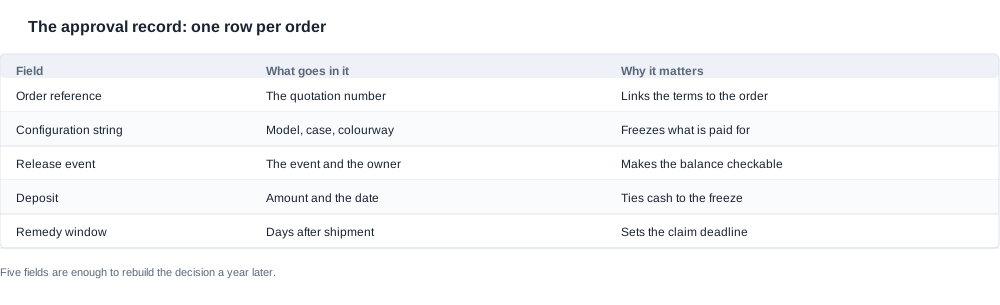
The record does not need to be long. Five fields, filed with the quotation and the signed schedule, are enough to reconstruct the decision and to start the next order from what was agreed.
| Field | What goes in it | Why it matters |
|---|---|---|
| Order reference | The quotation number | Links the terms to the order and the goods |
| Configuration string | Model, case option, colourway | Freezes what the money is for |
| Release event | The event and the named owner | Makes the balance checkable |
| Deposit | The amount and the date | Ties the cash to the freeze |
| Remedy window | The days, and the point they run from | Sets the claim deadline |
What the record is for a year later
The record has a second audience, and that audience is the one that justifies the effort. A year later, somebody will ask a question that the original buyer is no longer there to answer.
The questions have a consistent shape. Why was this deposit at this level, when a comparable order elsewhere was at another? Why does this schedule release on a shipment date when the next order in the same line releases on an inspection? Why was the case option changed after the order, and who agreed it? Each of these is answerable from the record in a minute, and none of them is answerable at all without it.
The record also protects the buyer from the supplier's memory, which is not malicious but is organised around the last negotiation rather than around the last agreement. A signed schedule in a file is the only version of the arrangement that both sides are working from, and in a category where the unit value is modest and the order frequency is low, the file is frequently thinner than the recollection.

How the procedure scales
First order, repeat order, new configuration, new market
A procedure has to survive being applied to orders that are not alike, or it will be used once and then abandoned. Four situations cover most of the work in this category, and each needs a different amount of the process rather than a different process.
- A first order runs the full seven steps, with the red flag list answered in writing before the deposit. This is the situation where the procedure earns its keep, because there is no history to fall back on.
- A repeat order on the same configuration skips the specification matching and goes straight to confirming that the release event, the remedy window and the currency are unchanged. The record from the previous order is the checklist, and the work is a confirmation rather than an investigation.
- A new configuration on a proven model runs the full process again, with the freeze date and the deposit treatment as the focus, because the specification is what has changed even though the model has not.
- A new destination market adds a documentation route, which adds questions rather than clauses. The question to ask is which documents the market requires, which of them the supplier can produce, and what the schedule does if one of them cannot be produced.
The approval sequence and who is holding it
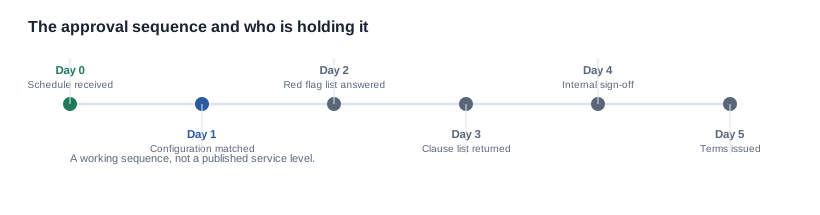
The sequence below is a working example rather than a published service level. The point of it is not the number of days, it is that every step has a holder and a hand-over, and that the hand-over happens at a point where the output of the previous step is available.
The two steps that are most often rushed are the third and the fifth. The third, identifying the release event and its owner, is rushed because the schedule appears to cover it. The fifth, running the red flag list, is rushed because it is a list of questions rather than a document. Both of them are the steps that determine whether the order will be argued about later, and both take less time when the procedure is followed than when it is improvised.
What happens when the procedure is skipped
It is worth being concrete about the failure, because skipping the procedure does not feel like skipping the procedure. It feels like being efficient on a small order.
The order is small, so the schedule is read in five minutes, so the release event is not identified, so the balance is released on a shipment date. The goods arrive and the specification is slightly different from the one that was approved, because the case option was never fixed and the factory built to the quotation. The buyer raises it, and the supplier is sympathetic, and the remedy is a credit note against the next order. The next order is placed with the same five-minute reading, because the programme has a rhythm now and the rhythm is not to read payment schedules.
This sequence is unremarkable, and it is the ordinary way that a payment terms problem is created in this category. The cost of the five minutes was the whole cost. Nothing in it required a negotiation, an escalation or a supplier who was difficult to work with. It required a document of one page to be read properly, once, and the record to be kept.
The countermeasure is not discipline in the abstract. It is a template that fits on one page, a checklist that can be run in ten minutes, and a record that makes the second order cheaper to place than the first. A procedure that is faster than the alternative is one that gets used, and a procedure that is used is the only kind that prevents anything.
What the template does not settle, and where Cynrin stands
The open rows that stay open
A procedure is a method, and a method does not close the gaps in the data. Some rows in this category cannot be closed by the buyer alone, and the honest thing is to say which ones.
Our catalogue publishes twenty-eight models, the camera tiers, the published battery and runtime rows, the published charging methods and the case options. It does not publish unit prices, production lead times, minimum order quantities, certificate numbers, a per-model certification scope, the Bluetooth version for any of the eleven camera models, the charging method for the four camera models whose rows carry a case capacity but no method, the case capacity for the KY06 and the MT5, or the weight for any model except the MT6, where 158 g is published for the glasses body including the 265 mAh cell and the camera and excluding the folding case.
Those rows are not gaps in the procedure. They are the questions the procedure sends, and they are exactly why the template has a step for writing a specification the supplier has to satisfy.
Running the procedure
Send the models, the quantities, the destination market and the schedule, and we will tell you which configurations exist, which parts of the schedule we can meet, and where a published row is open and the specification will have to come from the buyer. The payment terms section sets out the commercial framework, the payment terms checklist is the list to run against a schedule, and supplier verification covers the counterparty checks that come before the schedule is agreed.
Send the configuration, the quantity and the market, and we will tell you which parts of the schedule are settled and which are yours to specify.