

Smart glasses payment terms are an unsecured promise from a counterparty, and a promise is only as good as the entity making it. A schedule can be perfectly drafted, tied to an inspection, backed by a remedy window and released against a document, and it will still be worth very little if the bank account it is paid into belongs to an entity that does not exist, or to a different entity from the one on the contract, or to a trading company with no factory behind it. That is why the counterparty checks come before the terms and not after them: once a schedule has been agreed, a buyer who then discovers a problem with the supplier has already conceded the accommodation, and the only remaining move is to walk away from work already done.
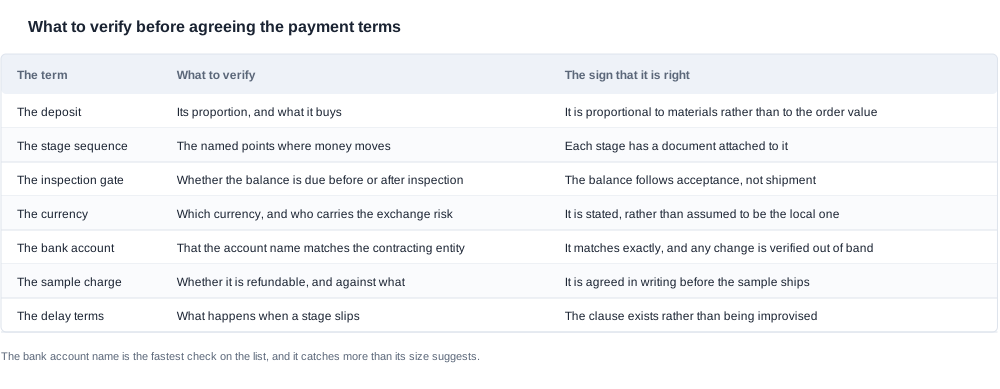
Smart glasses payment terms: what you are really lending money to
A schedule is a promise about a counterparty
Think about what a payment schedule actually is. It is an agreement that a named party will do a set of things at set times, in exchange for money, and it is enforced by the buyer's ability to withhold that money and by the practical consequences of walking away. There is no third party standing behind it. The document set, the inspection report and the remedy clause are all worth exactly as much as the entity that produces them, and that entity is the thing being verified.
This sounds obvious and it is skipped constantly, because the counterparty questions feel like a different activity from the payment conversation. They are not. A payment schedule decides when the buyer stops being able to withhold money, and that decision is only safe if the entity on the other side of it is one that exists, is reachable, and is going to be there when the goods arrive. In this category the order value is usually modest and the relationship is usually new, which is precisely the combination where the counterparty question is the one with the least prior information behind it.
There is a second reason the checks come first, and it is about what a seller learns. A buyer who arrives with a full set of counterparty questions has communicated something about itself, and the supplier's response to them is a signal in its own right. A supplier who answers every question plainly is a supplier who is used to being asked. A supplier who deflects one of them is telling the buyer which part of the arrangement is less solid than the rest, and the buyer now knows where to probe rather than where to guess.
Why the checks come before the terms
The ordering is not a preference and it is not a bureaucratic preference. It is about who holds the concession.
- A check before the terms is free. It is a question, and the answer costs the buyer nothing except the time to ask it.
- A check after the terms is expensive. By then the buyer has already conceded a deposit percentage, a balance date and a currency, and the supplier knows it. The check now costs one of those.
- A check after the deposit is close to worthless. The money has gone, and the buyer's only remaining leverage is the goods, which are in transit.
There is a practical version of the same point. A counterparty check that changes the answer usually changes the structure of the order: a trading company rather than a factory gets different terms, a new entity with no history gets a smaller deposit, and an entity that will not name the party that inherits the tooling gets a different cancellation clause. Those are not adjustments to the terms, they are different terms, and they are much harder to arrange after a schedule has been drafted around an assumption.
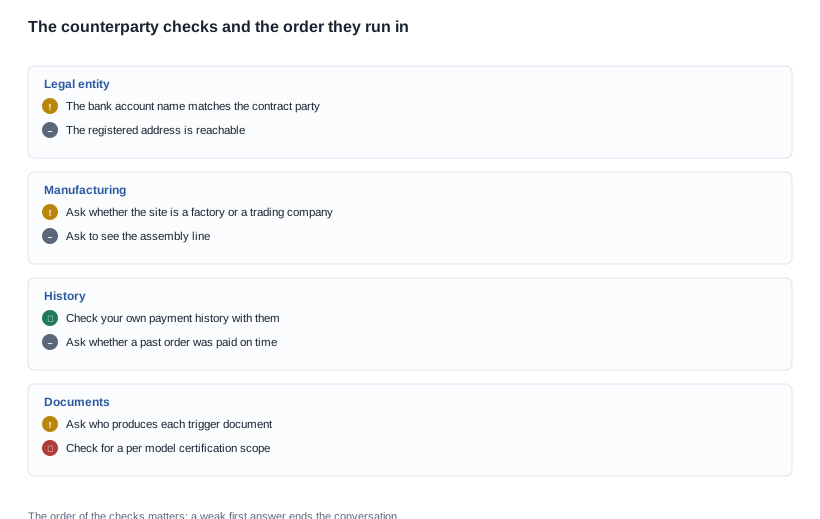
The counterparty checks, in the order they have to happen
Checks one to three: entity, history, who actually builds it
Check one: the legal entity. Get the registered company name, the registered address and the bank account name, and compare them. They should be the same party, and if they are not, ask which one is the contracting party before anything else. This is a short question with a short answer, and it is the single check that most reliably identifies a counterparty problem, because a mismatch is a deliberate feature rather than an oversight.
Check two: how long the entity has been trading and under which name. A new entity is not disqualifying; it is a fact that changes the terms. A first order from a newly registered company is an order where the deposit should reflect that, and where the release event should be an inspection rather than a document. An entity that has traded under a different name and cannot explain the change is a different conversation.
Check three: who actually builds the product. Ask whether the goods are made in the supplier's own plant or bought from a sub-supplier and assembled or resold. This is not an insult and it should not be treated as one; plenty of competent suppliers in this category are traders by structure. It changes the terms because it changes the exposure: a factory that does not build the product cannot stop a sub-supplier's line, cannot explain a defect's root cause, and cannot change a specification quickly.
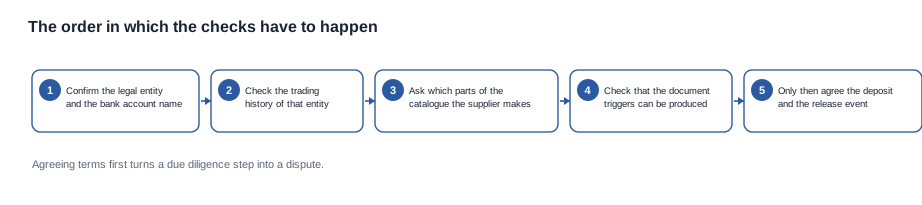
Checks four to seven: catalogue, documents, references, continuity
Check four: does what the supplier claims to build match the published catalogue? A supplier that quotes a camera tier, a case option or a charging method that does not exist in the catalogue is either quoting from a different catalogue or has not read the specification. Either way the quotation cannot be checked, and a quotation that cannot be checked cannot be compared.
Check five: can the trigger documents be produced? Ask for the conformity documentation for the destination market, and ask for the production completion record and the inspection report format. A supplier who cannot say what the inspection report contains has no inspection process, and therefore no inspection to be the release event.
Check six: references and history. Ask for two customers in a comparable market and order size, and ask whether the supplier has ever had an order hold up at a border. The second question is the more useful one, because a supplier with that experience will have a routing habit worth hearing about, and a supplier without it will not have an answer at all.
Check seven: continuity. What happens to the programme if the trading entity changes, is restructured or closes. This check is the one that is asked last and mattered most, and it is the reason the next section exists.
Checking the claim against our own published catalogue
What the catalogue lets you verify
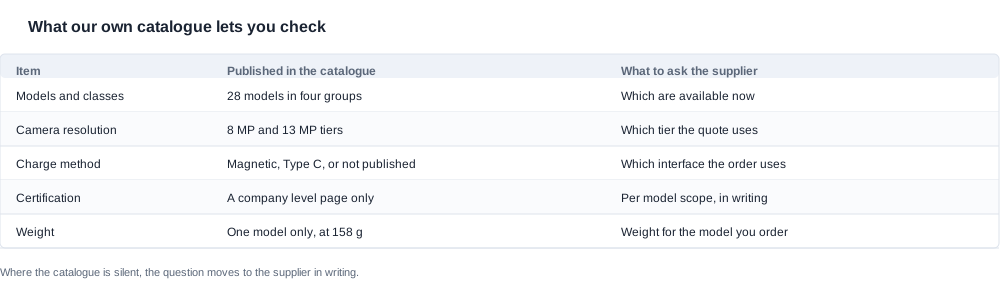
The catalogue is a more useful verification tool than buyers generally realise, because it is specific enough to expose an inconsistency that a general description would hide. It publishes twenty-eight models, the camera tiers, the published battery and runtime rows, the published charging methods and the case options, and it is a yardstick that a counterparty claim can be measured against without visiting the plant.
| Item | Published in the catalogue | What to check against a supplier's claim |
|---|---|---|
| Models and classes | 28 models in four groups | That the quoted model exists and is quoted as the class it is |
| Camera resolution | 8 MP on eight models, 13 MP on three | That the quoted tier is the tier the build carries |
| Charge method | Magnetic on seventeen, Type C on seven, four not published | That the quoted interface matches the model |
| Case capacity | 1400 mAh, 900 and 1400 mAh, 1200 mAh, and two unpublished | That the carton in the quotation is the carton in the box |
| Certification | A company level page only | That the claim is a scope, not a number |
| Weight | 158 g for the MT6 glasses body only | That a weight was quoted from a source, not a habit |
The value of the last column is that it converts a claim into a comparison. A supplier who says the model has a 13 MP camera is making a checkable statement, and the catalogue either supports it or does not. A supplier who says the goods are certified is making an uncheckable statement, and the catalogue is silent on that point, so the buyer has to ask for a scope.
The rows that stay open, and what to do with them
Some rows cannot be closed by comparison, and a procedure that pretends otherwise will fail. The catalogue publishes no Bluetooth version for any of the eleven camera models, no certificate numbers or validity dates, no per-model certification scope, the charging method for the four camera models whose rows carry a case capacity but no method, the case capacity for the KY06 and the MT5, and a weight for one model only, where 158 g is published for the MT6 glasses body including the 265 mAh cell and the camera and excluding the folding case.
For those rows the correct approach is to write the specification and hand it over. The buyer is not verifying a claim any more, they are setting a requirement, and the supplier's response to a written requirement is a second verification in itself: a supplier who can meet it says so and says how, and a supplier who cannot says so as well. Either answer is usable. An unanswered request is not.

The two questions that come later and matter more
What happens if the counterparty changes mid-programme
The first of the two late questions is about continuity, and it is the one that protects a programme that is working. It has three parts.
- Who takes over the contract? If the trading entity is restructured, sold or closed, which entity inherits the schedule, the open orders and the obligations in it.
- Who keeps the tooling and the artwork? Tooling is the physical asset that lets the programme continue at a reasonable cost, and artwork and packaging files are the intellectual property in the carton. Where a supplier owns the tooling and the artwork and the relationship ends, the buyer's next quotation is a new one from zero.
- Who holds the product records? The production records, the inspection reports, the batch identifiers and the defect history are the evidence base for every future claim. If they sit with the counterparty and the counterparty is gone, the buyer cannot prove what was shipped.
None of these three has a commercial answer inside a standard schedule, which is why they are asked separately. The clauses that answer them are short, and they belong in the agreement from the first order, because a buyer who asks for tooling ownership in the second year is negotiating from a position that has already weakened.
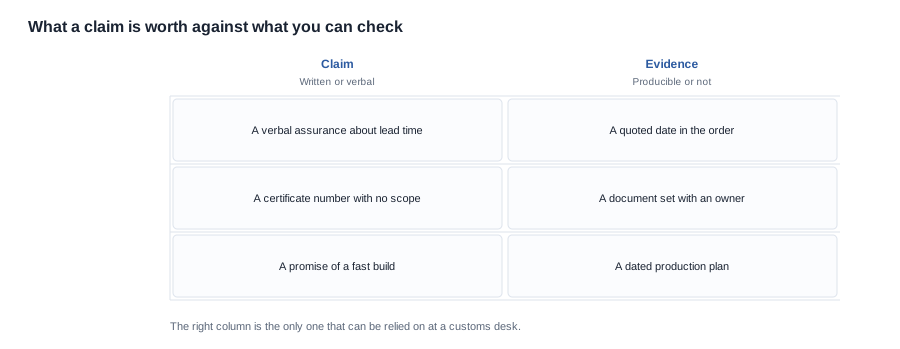
Who inherits the tooling, the artwork and the data
The second question is where the three are usually collapsed into one, and they should be separated because they are three different assets with three different values.
Tooling is worth money only in the sense that replacing it costs money, and its value to the buyer is the difference between the quoted unit price and the price of a new one. Artwork and packaging files are worth more than that to a brand, because they carry the identity of the product, and a supplier holding the files holds an amount of leverage. Product records are worth least to the buyer and most to the supplier, because they are the evidence that a future claim rests on.
A buyer who asks only for the tooling ownership statement gets the cheapest of the three and no more. The question worth asking is all three, in one sentence, in the first order: who owns the tooling, who holds the artwork and packaging files, and who holds the production and inspection records. The answer will usually be the supplier on all three, and that is fine, because the point is to have the answer written down before it matters rather than to win the argument.
What a counterparty check actually costs
A buyer with a checklist for counterparty verification sometimes assumes that the checks are an overhead, because each one is a question that has to be asked, answered and recorded, and none of them produces a product. The arithmetic is worth doing, because it is not close.
Take a first order for a camera model at a mid-sized volume. The total cost of the counterparty checks is a small number of messages and an hour of somebody's time. The cost of being wrong is different in kind. If the entity behind the invoice is not the entity on the contract, the money has been paid to a party that may have no obligation to deliver and no liability for the delay. If the goods are being assembled by a sub-supplier the buyer has never heard of, the defect rate is a sub-supplier's defect rate and the buyer's acceptance criteria have never been given to the party that can fail them. If the trigger document cannot be produced, the balance cannot be released on the agreed event, and the schedule becomes a document that governs nothing.
None of those outcomes is visible in the order, which is what makes them expensive. They surface at the point where the buyer has committed cash, committed to a launch date and committed to a channel, and the cost at that point is a function of how much else depends on the date.
There is a second cost that is easier to under-rate, and it applies to a check that finds nothing. A verified counterparty is an asset in the negotiation, because a buyer who has confirmed the entity, the site, the document process and the continuity position is negotiating from information rather than from a document exchange, and the supplier knows the difference. The checks do not only protect a buyer from a bad counterparty. They are also what turns a good counterparty into a good negotiation partner, because the buyer who asks precise questions is understood to be precise about the things that matter.

The signals that something is wrong
Five signals, and what each one is worth
Five signals appear often enough in this category to be worth naming, and each one has a different weight.
- A bank account name that does not match the contracting party. The heaviest of the five. Either the supplier is a trading entity fronting a manufacturer, or the account details are not what they appear to be. Both are disqualifying until explained.
- A registered address that does not resolve. A virtual office, a residential address or a PO box is not by itself a problem, and a factory in this category may legitimately operate from a unit in an industrial park. It becomes a signal when the address is combined with an unwillingness to state which site builds the goods.
- A quotation far below the others. A price that is materially lower is usually a specification difference rather than a miracle, and the fastest way to test it is to ask what is different. If the answer is nothing, the answer is a different product.
- Reluctance to name the party that inherits the tooling. This is a signal about the expected life of the relationship, which a buyer can take at face value.
- A trigger document that changes between the quotation and the order. Nothing in a payment schedule matters more than the document that releases the money, and a document that moves is a document that was never fixed.
How to test a signal without ending the conversation
A signal is not a conclusion, and the useful move is to test it rather than to act on it. The testing technique is the same in all five cases: state what you observed, ask for the explanation in writing, and set a date for it.
The reason this works better than a direct accusation is that most signals have an innocent explanation, and the written answer is what distinguishes the two. A bank account in a trading subsidiary gets a one-line answer. A bank account in a name nobody recognises gets no answer at all, and the absence of an answer is the finding. A price difference gets a specification explanation in one line. A trigger document that moves gets an explanation about the compliance process, which may be perfectly reasonable and which is worth knowing about before the balance is tied to it.
The discipline is to record the answer with the date, whatever it is, including the answers that are unremarkable. The record is what allows a pattern to be seen, and a pattern of small inconsistencies is the thing that is worth acting on.
Where Cynrin stands on counterparty checks, and the next step
Where our own counterparty check stops
We will put the legal entity, the contracting party and the bank account on the quotation, so that a buyer can run the first check against our own document without asking for anything. We will state which rows of the published catalogue are open for the configuration being quoted, so that a buyer is not left to guess whether a number was omitted or is simply not published.
What we will not do is fill an open row with a typical figure, and we will not quote a certificate scope, a weight or a Bluetooth version for a model where the catalogue does not publish one. A buyer who plans a programme around an estimate we supplied would be planning around our estimate, and the correction would arrive at the worst moment.
A counterparty read
Send the model, the case option, the quantity, the destination market and the schedule you have been given, and we will tell you which configurations exist, which published rows are open for them, which documents we would produce for each milestone, and what we will confirm about our own entity and bank details. The payment terms section sets out the commercial framework, the payment terms checklist is the list to run against a schedule, and contract supplier verification covers the counterparty checks that sit on the contract side rather than the payment side.
Send the configuration, the quantity and the market, and we will tell you which parts of the schedule are settled and which are yours to specify.


