

A smart glasses pricing mistake that looks like a saving is usually a mistake about which product is being priced.
The reason is that the range spans configurations with real cost differences and genuine performance differences, and a buyer who compares two quotations without holding the configuration constant ends up with a number that describes neither product. Unit prices are not published, so a comparison across suppliers happens on the terms of the quotation rather than on a catalogue figure, and the terms are where the mistake hides.
This page sets out five mistakes that recur in this category, works through one of them with two hypothetical quotations, and finishes with the four questions that make two quotations comparable in the first place.
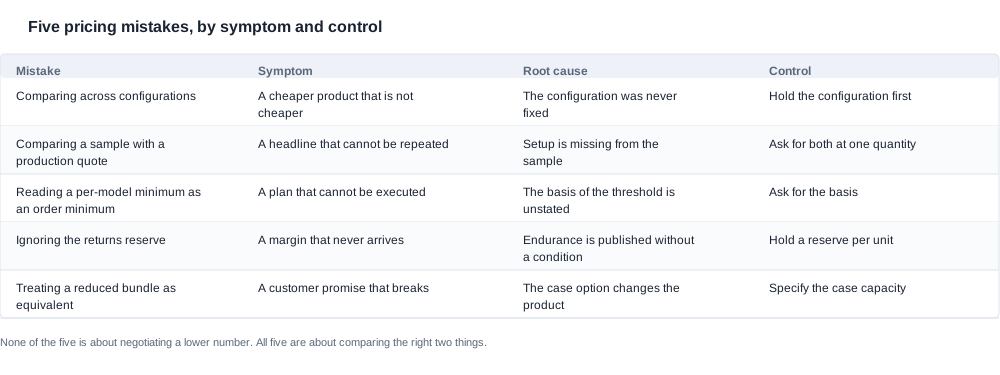
The table is the working list. Each row names the mistake, the symptom it produces, the root cause underneath it and the control that stops it.
Smart glasses pricing: five mistakes, and the argument behind them
Why a saving that looks like a saving is usually a scope difference
None of the five mistakes below is about negotiating a harder price. All five are about comparing the right two things, and the reason they cluster here is structural: in this category the published product data is rich and the published commercial data is non-existent, so the only available comparison is between two sets of terms, and two sets of terms can differ in a dozen ways without either of them being wrong.
A buyer who arrives with a unit price on a piece of paper is therefore comparing the wrong artefact. The unit price is the output of a whole structure — configuration, colourways, packaging, accessories, case, documents, freight, duty — and comparing the output of two structures tells you which structure was built more cheaply, not which product is better value.
The five, in the order they are usually found
The first three are comparison mistakes: comparing across configurations, comparing a sample quotation against a production quotation, and reading a per-model minimum as an order minimum. The last two are costing mistakes: ignoring the returns reserve, and treating a reduced bundle as equivalent to a full one.
The first three are caught by asking better questions. The last two are caught by building a number the buyer currently does not build at all, and they are the more expensive of the two, because a comparison mistake is corrected by re-reading a document and a costing mistake is corrected by giving money back.

A worked comparison: two quotations, one headline number
Supplier A and Supplier B
Here is a worked example, because the arithmetic is simpler than the argument that usually follows it. A buyer wants a camera model for a retail channel and has two quotations.
Supplier A offers an 8-megapixel model on a 220 mAh cell, with a five-to-eight-hour published rated use figure and a charging case whose capacity is not published. Supplier B offers a 13-megapixel model on a 290 mAh cell, with about seven hours of published rated use and a 1400 mAh charging case. Supplier A is quoted lower.
The buyer concludes that A is the better product, and is wrong in three separate ways, none of them about the unit price.
Why the product comparison is the weakest of the three
A 13-megapixel sensor and an 8-megapixel sensor are not a quality tier that a customer perceives without being told. The camera specifications that would justify the difference — field of view, video format, frame rate, low-light behaviour — are not published for either. So the buyer is paying a visible price difference for an invisible one, and the comparison the customer will make in a review is on the things they can see, which are the form factor, the case and the endurance.
The published resolution split is the only part of this comparison a buyer can actually use. The camera range divides into an 8-megapixel group of eight models and a 13-megapixel group of three, out of eleven camera models in total.
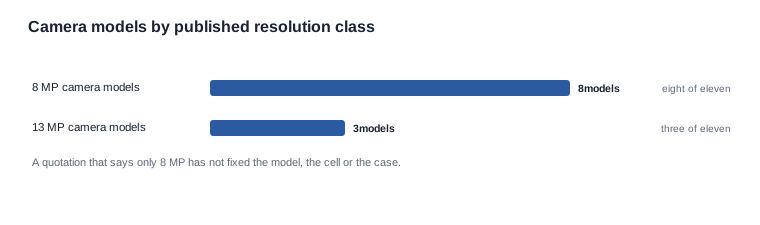
A quotation that says only 8 megapixels has not fixed the model, the cell or the case, because the group of eight spans cell values from 220 mAh to 290 mAh and includes models with no case, a 1200 mAh folding case, a 1400 mAh case and two models whose case capacity is not published. The resolution class is the start of the specification, not the end of it.
Why the bundle comparison is the most common
A 1400 mAh case is a physical object that ships in every parcel, changes the carton, changes the freight band and changes what the customer expects to be able to do with the product. A quote without a case and a quote with a 1400 mAh case are not comparable, and the buyer who treats them as comparable will either ship a worse experience or take a worse margin.
This is the comparison that most often goes wrong in practice, because the case is a line item rather than a product. It is quoted in an inclusions list, it is not in the model name, and a buyer reading the top of a quotation sees a model and a price.
Why the return exposure is the cost that lands on the channel
A 220 mAh model with a five-to-eight-hour published band and an unstated case capacity is the configuration most likely to generate a complaint about endurance. A 290 mAh model with a 1400 mAh case is the configuration least likely to. The cost of a return is not in either quotation, and it lands on the channel.
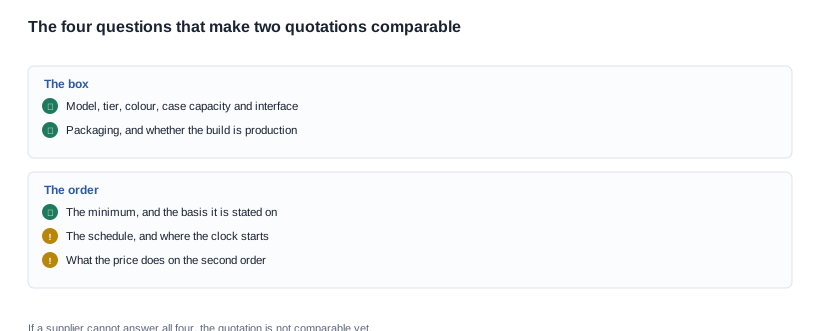
The four questions are the output of the comparison, and a supplier who cannot answer all four has not produced a comparable quotation yet.
The five mistakes, split by how they are caught
Comparing across configurations
Hold the model, the colour, the case capacity and the interface constant, or the comparison is meaningless. The published data makes this concrete: one model in the range is published with a 900 mAh or a 1400 mAh case, so even within a single model name there are two configurations with different bills of materials, and a quotation that says the model name has not chosen between them.
The reason this mistake is so persistent is that the configuration details live on the specification and the price lives on the quotation, and the two are read at different moments by different people. The control is a single line in the enquiry that names the configuration, and a rule that a quotation without that line is not a quotation.
Comparing a sample quotation with a production quotation
A sample price is a one-unit price with no setup, and it is not a forecast of anything. The setup for a configuration, the artwork, the moulded insert and the first-article approval are all amortised across the production quantity, and none of them is in a sample price.
The question that catches it is the simplest one in this category: what is the quantity on this quotation? A quotation for one unit and a quotation for the production volume are different documents, and the difference between them is frequently larger than the gap between two suppliers.
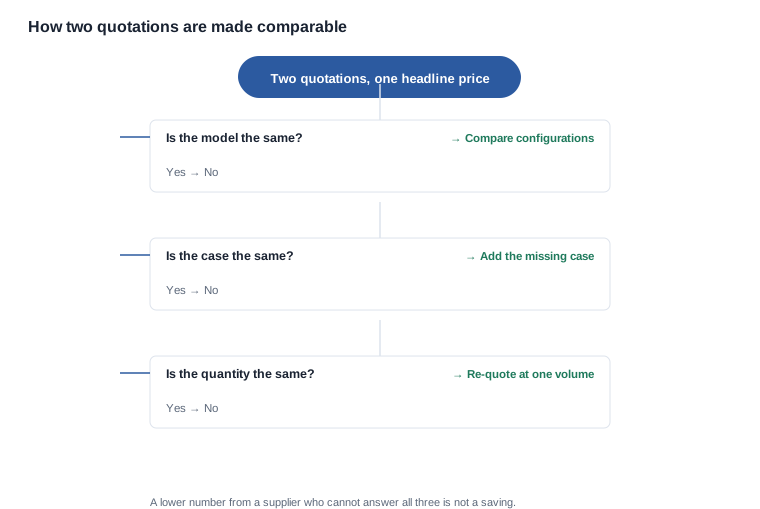
The three branches are the three checks, and each one is a question with a document behind it.
Reading a per-model minimum as an order minimum
A multi-model plan built on a per-model minimum is a plan that may not be executable at all. The minimum a supplier quotes is sometimes per model, sometimes per configuration, sometimes per order, and sometimes per colourway within a configuration, and the basis is what decides whether the plan works.
The control is to ask for the basis rather than the figure. A number without a basis cannot be added up, and a buyer who has a programme with four models needs to know whether the threshold applies four times or once. The pricing buyer checklist has the wording for that question, and the volume mechanics are under minimum order quantity.
The two costing mistakes, and where their cost actually lands
The two costing mistakes are caught differently from the three above, and it is worth being explicit about why. A comparison mistake is corrected by reading a document again, which takes minutes. A costing mistake is corrected by building a number the buyer does not currently build, which takes a day and produces a number that is a judgement rather than a fact. That difference is the reason the second group is the more expensive of the two, even though the first group is the more common.
Calculating a margin with a return rate of zero
A hardware product with an endurance figure that is published without a test condition will return units, and a margin calculated without a reserve is a margin calculated on a return rate of zero.
The cost lands in a place that has no line in the quotation. A unit that comes back has a unit cost, a return freight cost, a handling cost and a channel cost of processing it, and if the channel cannot resell it — because the packaging, the accessories or the market document set did not travel with it — the cost is a write-off rather than a recovery. That last point is what makes the returns provision and the packaging decision the same decision, and it is why the provision has to be written down with a threshold rather than absorbed as a general allowance.
Treating a reduced bundle as equivalent to a full one
The 900 mAh case option on one of the models in this range is a real option at a real difference in cost, and it changes the customer's experience. Discounting it is not the same as discounting the full configuration.
The same applies to every reduction a supplier offers as a way of moving a price: a smaller case, a simpler box, a shorter cable, an unbranded interface, a reduced document set. Each of them is a legitimate configuration at a legitimate price, and each of them is a different product. The error is not in the discount; it is in treating the reduced version as the same product for the purposes of a comparison, a margin calculation or a retail listing.
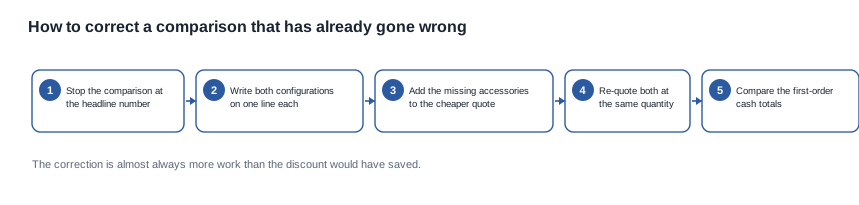
The correction sequence is longer than the mistake, and it is worth doing deliberately rather than in the middle of a negotiation.

Why the five mistakes survive a real quotation
The enquiry document is usually the cause
None of the five mistakes is a pricing failure. They are specification failures, and they enter the process at the enquiry, where the request is written. An enquiry that asks for a price for "camera smart glasses" cannot produce a comparable quotation, whatever the supplier does, because the answer will be a price for a configuration the supplier chose. The same enquiry produces two quotations that are internally consistent and externally incomparable, which is the hardest kind of problem to spot because each document on its own looks fine.
The control is a two-line addition to the enquiry: the model with its option, and the quantity. Everything else in this article is downstream of those two lines.
The comparison happens in a sheet that cannot hold a configuration
Most comparisons are made in a spreadsheet with a column for the price and a column for the supplier. A configuration needs more columns than a spreadsheet usually has, so the extra fields are dropped, and the fields that get dropped are the ones that decide the comparison: the case option, the colourway, the document scope, the packaging. The sheet then reports a confident answer to a question it was never able to hold, and the confidence is what makes the answer survive into the order.
The fix is not a better spreadsheet. It is a fixed column set, agreed before the quotations arrive, so that the fields cannot be dropped when the data does not fit.
The review meeting gets a unit price, because a unit price fits on a slide
Most internal reviews end with a number on a page and a recommendation attached to it. A landed total, a peak cash figure and a returns provision are three numbers, and they do not fit on a slide, so the slide carries the unit price and the other three are discussed afterwards as caveats. The caveats are where the money is, and they are consistently the part that gets cut when the meeting runs late.
The control is to make the recommendation and the caveats the same artefact: a single page that carries the configuration, the landed total, the peak cash and the reserve, and that a reviewer can challenge without opening a second document.
The deadline is a real constraint, and ignoring it does not help
Every one of these five mistakes gets made because there is a launch date. A buyer who spends two extra days building the configuration correctly at the enquiry stage will, in the ordinary case, lose two days at the front and save a week at the back, because the omitted lines arrive later as changes. That is the arithmetic behind the controls in this article, and it is the reason a buyer who is under time pressure should shorten the specification conversation rather than the document requests.
The three controls that actually work
The first is the configuration string: model, options, case, interface, packaging, destination and quantity, in one line, written before any price is requested. The second is the fixed comparison sheet with the columns agreed in advance, so that a supplier who cannot fill a column produces a visible gap rather than an invisible difference. The third is the single-page recommendation, so that the landed total, the peak cash and the returns provision are reviewed alongside the unit price rather than after it.
None of the three requires a supplier to do anything unusual, and all three are free. They are worth more than any negotiation on a unit price, because they determine whether the unit price is a real number.
The four questions that make two quotations comparable
The first question: what is in the box
Model, resolution tier, colour, case capacity, interface, packaging, and whether the firmware build is the production build. The last part is the one most often skipped, and it is the one that decides whether the unit in the box is the unit that was approved.
The second question: what is the minimum and on what basis
Per model, per configuration, or per order, and a stated mix. A minimum without a basis cannot be planned against, and a plan against a wrong basis is a plan that fails at the point the first purchase order is raised.
The third question: what is the schedule and what is in it
Whether the number starts at the purchase order or at a configuration freeze, and whether the documentation route is inside it. The start point determines when the clock starts, and the documentation route determines whether the number is a goods price or a delivered, compliant price.
The fourth question: what happens to the price on the second order
Whether the structure repeats or is renegotiated. This is the question that separates a programme from a transaction, and it is the one that decides whether the business case should be built on the first order's number.
If a supplier cannot answer all four, the quotation is not comparable yet, and a lower number from a supplier who cannot answer is not a saving. It is a number that has not been described, and the description is where the money is. The hidden costs guide is where the margin usually goes once the comparison has been made correctly.
Smart glasses pricing: the rows we publish, and how we read a competing quotation
When the configuration is the product
Concretely, in this category the configuration is the product, because so much of the customer-visible difference lives in the case, the endurance and the firmware rather than in a model number. We publish the configurations, the case options, the endurance figures, the charging methods where the catalogue publishes them and the colour availability, and we do not publish unit prices, because a price without a configuration and a volume is not a price.
We will also say plainly that a channel quoting the 13-megapixel tier because it appears to be an upgrade is buying a resolution figure, and that the published material does not let anyone justify that purchase in a listing. The published rows for the camera group are the resolution tier, the cell value, the charge time, the rated use figure, the case capacity where it is published, the charging method where it is published, and the colour options per model. None of those rows is a field-of-view figure or a low-light figure, and their absence is a reason to test a sample rather than to argue about the tier.
What we will say about a competing quotation
We will read a competing quotation against the same published rows, and we will tell the buyer which of the differences is a configuration difference, which is a scope difference and which is an actual price difference. That is a service and not a courtesy, because the first two are free of charge and they are where most of the apparent savings are found.
Send the specification and the competing quotation, and we will separate the three kinds of difference.
Related reading
- The comparison basis — pricing buyer checklist
- Where the margin goes — pricing hidden costs
- Where the cost sits — procurement pricing
Send the specification and the competing quotation, and we will tell you which differences are configuration differences and which are not.


