

Smart glasses pricing hidden costs that arrive after the order
The visible price of a smart glasses product is the smallest of the numbers attached to it. Everything else arrives later — at the first order, at the first customs hold, at the first firmware revision — and each one is predictable in advance if you know the category well enough to ask the right question.
This is the list of costs that do not appear on a unit-price quotation in this range, and why each one lands when it does. It is written as seven items, and each one has the same three parts: the symptom the buyer observes, the root cause underneath it, and the action that prevents it at the stage where prevention is still cheap. The list is not exhaustive of the costs a programme can carry, but it is exhaustive of the ones that arrive without warning.
The single most important structural point comes first, because it explains the rest. A unit price is a compliant answer to a narrow question — what does one configured unit cost at one volume. Nothing in that answer is wrong, and nothing in it is a lie. The hidden costs exist because the question was narrow and the buyer needed a wide one. A cased configuration is not one product. A shipment into a new market is not one order. A programme that runs for two years is not one purchase.
That is why the prevention step for almost every item below is procedural rather than commercial. There is no negotiation that removes the cost of a second cell in every parcel. There is a decision, taken before the quotation, about whether the case is in scope, and that decision is what removes the surprise.

The buyer who believes the quotation is the cost
The buyer who carries these costs is usually a channel buyer building a first range, or a brand-side procurement manager extending a line into a second market. Both are working from a unit price, because that is what a supplier sends and that is what the business case was built on.
What they have not done is ask what the programme is made of. The programme is a configuration, an accessory block, a packaging block, a logistics block, a compliance block per destination, a working capital position determined by the payment terms, and a returns reserve. Seven things, and the quotation answers one of them.
The reason this matters commercially is that the visible number is also the one that gets defended. When a channel's margin is calculated on the unit price and the true landed cost is higher, the gap does not appear as a cost event. It appears as a channel that is busy and not profitable, which is a much harder problem to diagnose and a much more expensive one to have. Buyers in this category who have run the numbers properly tend to find that the programme was viable all along at a lower volume or a higher resale price — the arithmetic was wrong, not the idea.
The supply chain is the second reason. This category is assembled from sourced components and then built, tested and packed by the factory, and the factory's quotation naturally describes the factory's part. The accessory block, the retail packaging, the artwork, the transport paperwork for a lithium cell, the market access work, the aftersales reserve and the working capital all sit downstream of that part, in the buyer's column, whether or not the buyer has a column for them.
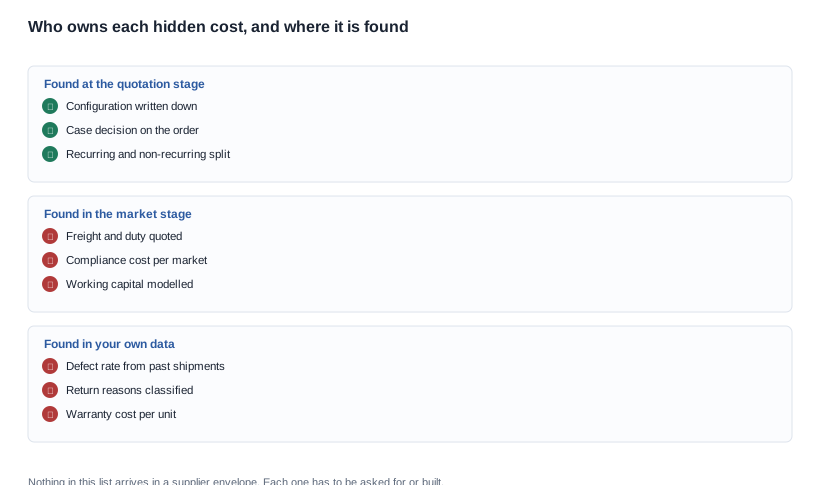
The checklist is organised by who owns the item, because the owner decides where the number comes from. The first group is settled at the quotation stage, with the supplier, in writing, and it is the cheapest place to settle it. The second group comes from the market — your freight broker, your customs broker, your destination compliance partner. The third group comes from your own ledger, your own claims history and your own customer service records. Nothing in the second or third group arrives in a supplier's envelope, and a cost model that expects it to will wait for a number that never arrives.
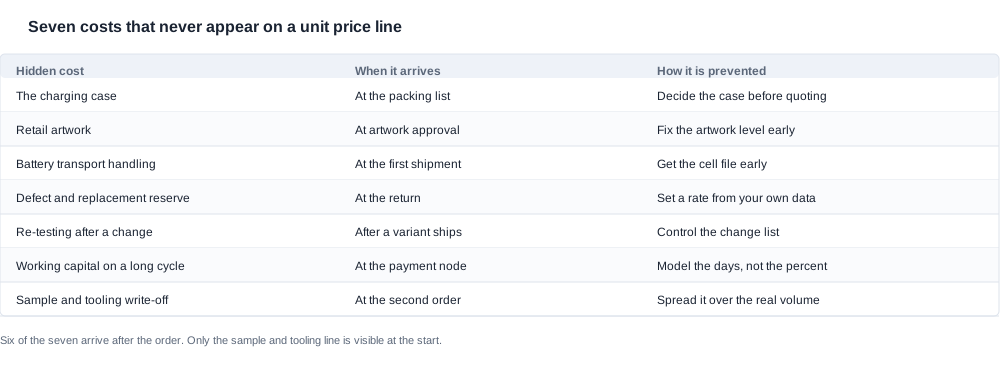
Seven costs that never appear on a unit price line
The charging case. The symptom is a landed cost that is higher than the model was approved at, and a freight weight that was not in the model. The cause is that a cased configuration is a second physical object in every parcel, and it carries a second cell with it. The catalogue publishes the capacities that make this concrete: 1400 mAh cases on the CY03 and the CY05, and the L1 Pro, 900 or 1400 mAh on the L2 Utral, and 1200 mAh on the MT6's foldable case, with the KY06 and the MT5 having a case whose capacity is not published. The prevention is to decide the case before the quotation is requested, and to price the case into the unit that carries it — the parcel, the carton, the freight weight and the transport paperwork.
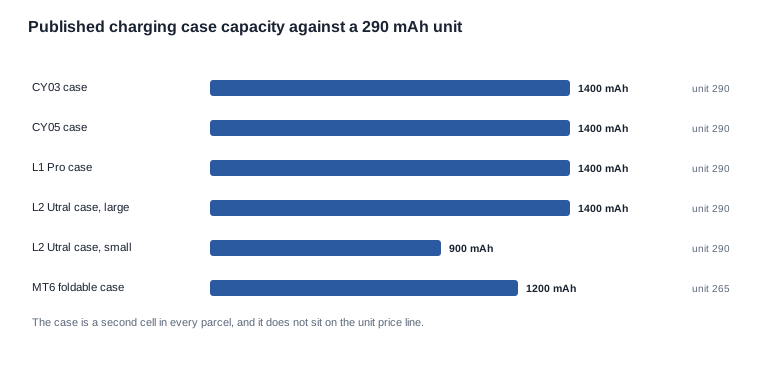
The chart above is the visual version of the point. On a 290 mAh unit, the case adds between 900 and 1400 mAh of lithium to the parcel — roughly three to five times the charge the product itself carries. That is not a rounding error in the freight model. It changes the packing density, the master carton, the parcel tier, the dangerous goods declaration and the returns treatment, and every one of those is a cost that a unit price line has no place to hold.
Retail artwork and packaging. The symptom is a charge at the artwork approval stage, or a delay in the launch date that is attributed to production when it was actually a print round. The cause is that the retail print is a separate workstream from the build, with its own approval cycle and its own number of rounds, and the number of rounds is a function of how early the artwork is started and how many configurations it covers. A model with four published colour options is four print runs, not one. The prevention is to fix the artwork level and the round count in the schedule before the first sample arrives, and to require that any additional round has a cost owner named.
Battery transport handling and paperwork. The symptom is a shipment that is held, reclassified or delayed, and a carrier quote that is higher than the freight estimate. The cause is that the fitted cell determines the transport classification, and the classification depends on the cell value and the cell count together rather than on the cell value alone, and the case adds a further cell to the declaration. The prevention is to obtain the transport file for the exact configuration before the first shipment is booked, not after the booking is made, and to check that the cell description in it matches the model actually ordered.
The defect and replacement reserve. The symptom is a quarter in which the margin disappears, and a business case that cannot explain why. The cause is that the reserve was set from a guess rather than from a rate, and the returns rate in this category is largely a function of the description the seller wrote and the expectations it set — a listing that promises an all-day product against a catalogue figure of roughly six hours on the slimmest temples will generate returns that have nothing to do with the hardware. The prevention is to set the rate from your own shipment history, classify the return reasons, and write the failure criterion so the claims can be settled.
Re-testing after a configuration change. The symptom is a variant that ships and then cannot be moved in its destination market, or a channel listing that is suspended on a compliance question. The cause is that a change to the model, the option set, the charging interface, the case, the colourway or the firmware branch changes the technical file, and the file was only ever reviewed for the original configuration. The prevention is to put the configuration on a change-control list with a notice obligation attached, and to make re-issuing the documentation pack a contractual duty rather than a request.
Working capital on a long cycle. The symptom is a cash position that is worse than the plan, in a month when nothing has gone wrong. The cause is that working capital is the payment terms expressed as a proportion of the order value multiplied by the number of days the inventory is held, and buyers calculate it from the percentage rather than from the days. The prevention is to model the days, and to verify the model against one real invoice from the current programme rather than against the terms on the quotation.
The sample and tooling write-off. The symptom is a second order that does not get placed, because the first one already consumed the budget. The cause is that the sample programme and any tooling are small in cash and large in weeks, and the tooling is amortised over a volume that is a plan rather than a commitment. The prevention is to amortise over the volume you actually intend to buy, to state what happens to the tooling if the programme stops, and to treat the sample stage as the place where the order gets decided rather than as a formality before it.

Finding the hidden costs before the first invoice
The reason these seven are expensive is not that they are large. It is that they are late, and a late cost is a cost that has to be absorbed rather than planned for.
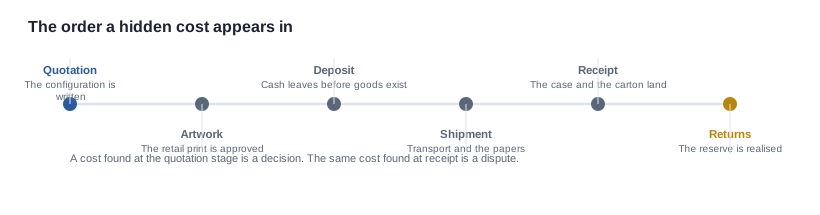
The timeline runs from the quotation to the returns, and it is worth reading it as a countdown on the number of decisions still open. At the quotation stage, the configuration and the case decision are still reversible, and the cost of a different decision is a conversation. At the artwork stage, the print is committed and the cost of a change is a new round. At the deposit stage, cash has left and the goods do not exist yet. At the shipment stage, the paperwork and the freight are what they are. At receipt, the parcel is what it is. At the returns stage, the reserve is realised and the rate is whatever it is.
Three of the seven are still cheap to prevent at the quotation stage, and they are the three a buyer usually defers. The case decision is the clearest. The artwork level is the second. The destination list, which determines the compliance block, is the third — and it is the one most often left to the last minute because it feels like a commercial detail rather than a cost input.
There is a useful diagnostic here, and it is worth keeping because it decides whether a buyer should look for a hidden cost or look for a price change. Take the difference between what the programme is costing now and what it was costing at approval, and ask which of the two it is. If the configuration is the same, the volume is the same and the delivery term is the same, then the unit price has moved, and that is a re-quotation rather than a hidden cost — the causes are a different cell, a different case, a different interface, a different artwork level or a change in the supplier's own input costs, and all five are answerable with a question. If the configuration has changed, the volume has changed or the term has changed, then the difference is one of the seven above, and the answer is in the paperwork that should have been attached to the change. Buyers who apply this test before they start arguing can save weeks, because the two cases have completely different owners and completely different evidence.
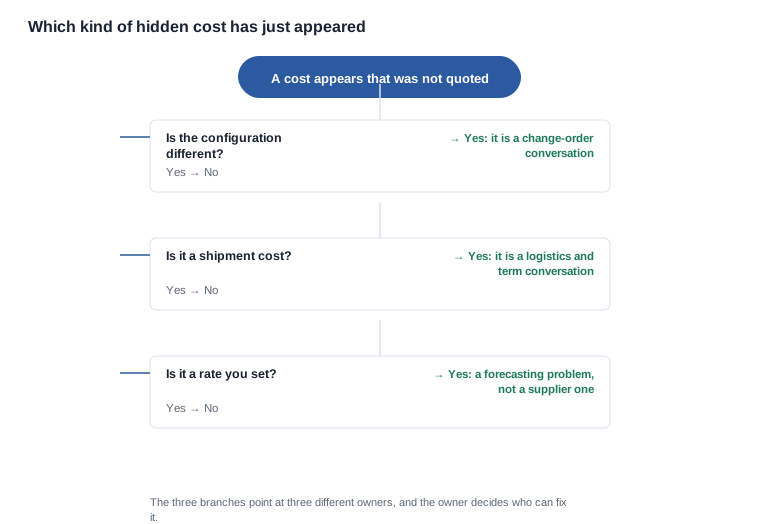
The decision tree is what to do when one of them arrives after the fact, because the first question is always who owns it. A configuration difference is a change-order conversation, and it belongs to whoever approved the change. A shipment cost is a logistics and delivery-term conversation, and it belongs to whoever set the term. A rate that the buyer set — a defect rate, a working capital assumption, a returns reserve — is a forecasting problem, and it belongs to the buyer and cannot be passed to a supplier at all. Passing it to a supplier is the mistake that turns a cost into a dispute.

Where hidden costs become disputes rather than surprises
The distinction between a surprise and a dispute is whether the cost was foreseeable and whether it was written down. A cost that was foreseeable and was not written down is a dispute, because the supplier's position is that the buyer approved a scope and the buyer's position is that the scope was never described. The defence against that argument is procedural, and it is worth setting out.
The configuration is the document. A configuration sheet that names the model, the option set, the cell with its count, the charging interface and the case decision is the thing every later conversation refers back to. Without it, every cost is arguable, because the buyer and the supplier are describing different products in the same meeting.
The delivery term and the accessory scope go on the order. The accessory scope in particular, because a case is not an accessory in a cost sense; it is a second product, and the parcel, the carton and the transport declaration all follow from it.
The artwork level and the round count go on the schedule. A round without an owner is a round that nobody is accountable for.
The destination list goes on the order, per market. One product sold into three markets is three compliance positions, and the cost of the second and third one is not the same as the first.
The returns reserve and the failure criterion go on the agreement. A reserve that was never written down cannot be claimed, and a failure criterion that was never agreed cannot be settled.
The commercial argument underneath is that these items are worth negotiating on, and they are worth negotiating on in a particular order. A buyer who has the accessory scope, the artwork level, the destination list and the configuration on the order has a much stronger position than one who has only a unit price, because the supplier's next quotation has to be built on the same scope. That is the practical benefit of writing the hidden costs down: they stop being hidden costs and become the terms of the next round.
What is not negotiable should be said plainly at the same time. The cost and the queue of a third-party test laboratory are fixed per product family, and pressing on them produces a longer schedule rather than a shorter one. The nature of a lithium cell in a parcel is fixed, and the packaging cannot be negotiated away. The rate at which your own customers return a product is a function of your own description and your own expectations, and no supplier can negotiate it. Naming these as fixed is not weakness in a negotiation; it is what allows the negotiating capital to be spent on the lines that actually move.
What we can price openly, and what stays a request
Concretely, the costs we can see should be visible, and the ones we cannot see should be named as requests rather than quietly estimated. We publish the configuration facts that determine the accessory block, the packaging scope and the transport class: the model designation, the resolution class where a camera is fitted, the cell capacity with its cell count, the rated runtime band, the charge time, the charging interface where the page carries one, the charging case capacity where the page carries one, the IP54 marking on the V06 and the S7, the Bluetooth version where the page carries one, the colour options per model, the 158 g weight of the MT6 glasses unit excluding its foldable case, and the 35 dB amplification gain of the bone conduction entry.
What we do not publish, and will not estimate: unit prices, production lead times, minimum order quantities, tooling and non-recurring engineering figures, frame weights for any model other than the MT6, the weight of the MT6 charging case, sensor part numbers, field of view, video specifications, ingress test report numbers, certification numbers, patent counts, acoustic figures, battery transport test report identifiers, case weights and carton dimensions. We also carry a company-level export certification page and no per-model certification row, and we will not tell you a model is certified for a market on the basis of it. And we make no vision, health, eye-protection or hearing-aid efficacy claim for any product in any market, in any configuration, because a device that captures, notifies and connects is not a clinical intervention.
What we can do is take a buyer's landed cost model and tell them which of the seven lines above it has actually priced, which ones it has priced as a placeholder, and which ones it has not seen at all. Send us the configuration, the destination markets, the channel and the volume, and we will mark the rows the published catalogue answers today and the rows that are requests to a supplier or to your own data. The cost structure is under procurement pricing, the standing checklist is in smart glasses pricing checklist, and the after-sales side that produces the reserve is in after-sales support and supply continuity.
Related reading
- The standing checklist — smart glasses pricing checklist
- The after-sales side — after-sales support and supply continuity
- The commercial structure — procurement pricing


