

Smart glasses pricing mechanics across the cost stack
A unit price is the visible top of a stack that has six layers under it, and two of those layers are the buyer's rather than the factory's. A buyer who negotiates the top layer while ignoring the layers below it is doing the most work for the least effect. That is the whole argument of this article, and it is arranged as the stack, layer by layer, with an honest note on which layers a negotiation can actually move and which ones it cannot.
The six layers, from the top down, are these. Component and cell cost, which is what the factory buys: the cells, the camera module, the electronics, the optics, the housing. Assembly and test, which is what the factory does: the build, the check, the firmware branch, the pack. Packaging and accessories, which is the case, the carton, the artwork and the inserts, and which is shared because the factory buys it and the buyer specifies it. Freight, duty and insurance, which is the buyer's and which depends on the route, the delivery term and the destination. Documentation, market access and the test laboratory, which is a requirement the buyer creates and a cost that lands on whoever commissions the work. And margin and the returns reserve, which are entirely the buyer's own numbers and which no supplier can quote.
Six layers, and the reason this framing is useful is that it tells you which ones to argue about. The bottom two are the buyer's cost of doing business and they are not negotiable with anybody. The top two are the factory's cost and they are negotiable only in the sense that a different published specification produces a different one. The middle two — packaging and documentation — are the genuinely negotiable ones, and they are where a buyer's negotiating capital is worth the most.
This is a guide to how smart glasses pricing works, arranged so that a buyer can use it directly: what each layer contains, which layers a negotiation can move, how to read a quotation from the bottom of the stack upwards, and what we publish about the stack and what we leave open.

The six layers, and the ones that belong to you
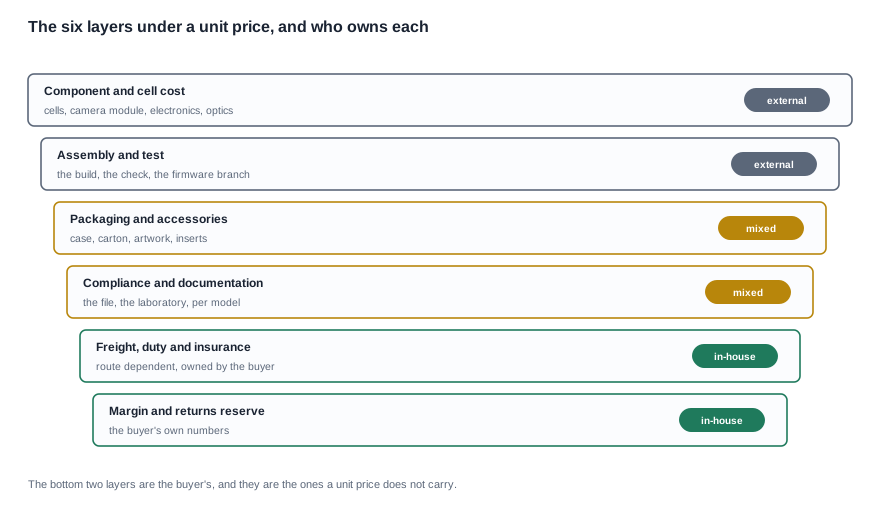
The diagram is the map, and the ownership marks on the right are the important part. Three of the six layers are marked as belonging to the factory, two are shared, and two are the buyer's.
Layer one, component and cell cost. This is the largest single line in the stack and it is almost entirely determined by the specification rather than by the relationship. The catalogue publishes enough of it to be able to reason about it. The camera family carries four cell levels: 220 mAh on the MT5 and the V03 Pro, and the V03; 260 mAh on the V06, the S7 and the KY06; 265 mAh on the MT6; and 290 mAh on the L2 Utral, the CY03 and the CY05, and the L1 Pro. The audio family carries paired cells written 55mAh*2 on the LC-105-1 and the LC-105-2, 90mAh*2 on the K01 and the K02, and a single 100 mAh cell on the D11 and the D12. The sport family carries 70mAh*2 on the YKC02, 115 mAh on the D17 and 100 mAh on the ZH12. The resolution class splits the camera family into an 8 MP group of eight models and a 13 MP group of three. Everything else in this layer — sensor part numbers, field of view, video specifications — is not published, which means the resolution class and the cell are the only handles a buyer has on the largest number in the stack.
Layer two, assembly and test. The factory's labour, its test procedure, its firmware branch and its pack. This is a process cost, and the way to change it is to change what is being built rather than to argue about the rate. The published feature count matters here: twenty of the twenty-eight catalogue entries carry AI function entries, and a larger feature list is a longer firmware branch and a longer validation step. Note also that the volume moves this layer, and it moves it non-linearly, because the fixed part of the set-up cost is spread across the units.
Layer three, packaging and accessories. The case, the carton, the master carton, the artwork, the labels and the inserts. This layer is shared, and the shared part is where the buyer's specification reaches the factory's cost. The published case capacities are the clearest example: 1400 mAh on the L1 Pro and the CY05, and the CY03, 900 or 1400 mAh on the L2 Utral, and 1200 mAh on the MT6's foldable case, with the KY06 and the MT5 having a case of unpublished capacity and the V03 Pro having no case at all. The charging interface is the other item here, and it is where the accessory list is decided: magnetic charging is published on seventeen entries, Type-C on seven, and four cased camera models publish no charging method at all.
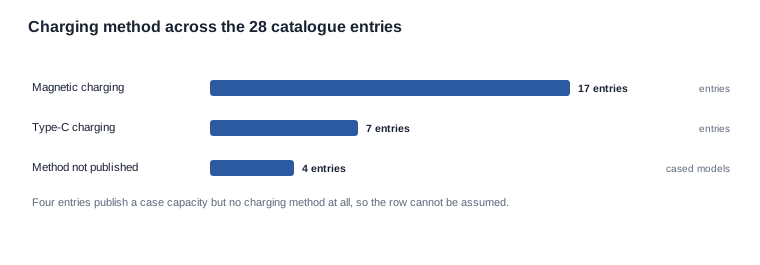
That chart is the accessory layer in one line. Seventeen of the twenty-eight entries are magnetic-charged, seven are Type-C, and four publish a case capacity with no charging method at all — the CY03 and the L1 Pro, and the MT6 and the CY05. A buyer reading a quotation that mentions a case and says nothing about how it charges has four published models where the row is genuinely absent, and the four of them are the ones where the accessory list, the packing and the carton specification are still open.
Layer four, freight, duty and insurance. The buyer's layer, and the one most often mistaken for the factory's. The delivery term decides who owns it, the route decides what it costs, and the destination decides what compliance work has to happen alongside it. The catalogue publishes the charge time for every entry — two hours or less for twenty-six of them and about one hour for the D17 and the ZH12 — but it publishes no charge time with a starting state and no termination criterion, so a charge time cannot be used to work out a shift length or a case turnaround.
Layer five, documentation, market access and the test laboratory. Also substantially the buyer's, because the requirement is the buyer's and the market list is the buyer's. The catalogue presents a company-level export certification page and no per-model certification row, and it publishes no CE marking, no FCC record, no RoHS statement, no REACH statement, no patent count and no certificate number for any model. So the per-model conformity position is a request in every case, and the cost and the queue behind it belong to whoever commissions the work.
Layer six, margin and the returns reserve. Entirely the buyer's. The published runtime bands are the reason this layer is hard: six bands exist across the catalogue, and none of them is published with a test condition, so a returns rate cannot be derived from them. It has to come from the buyer's own shipment history and the description the buyer wrote.
Which layers a negotiation can actually move
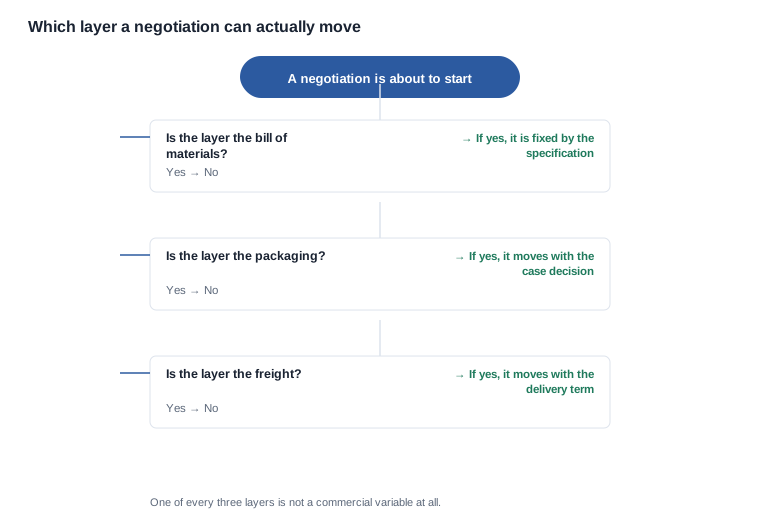
The decision tree is the short version of the argument, and it exists because a buyer who is negotiating the wrong layer is wasting the most valuable conversation they will have with a supplier.
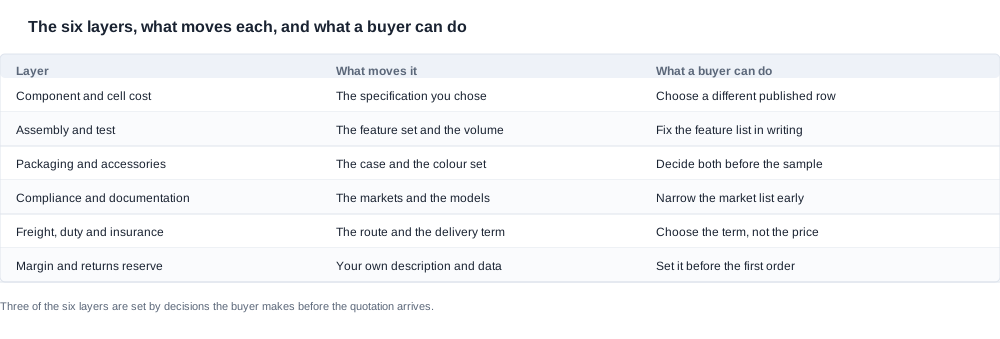
The table above is the same argument in full, with the last column stating the action a buyer actually has. Read the two columns together and the negotiation surface becomes obvious: three of the six layers can be moved by something other than a discount, and only two of those three are decided by the factory.
The bill of materials layer is fixed by the specification, not by the negotiation. Once the model, the resolution class, the cell and the case are written down, the component cost is what it is. The only real movement available here is a decision to specify a different published row — a different model, a different capacity tier, a different case decision — and that is a product decision rather than a purchasing one. It is also the decision with the biggest effect, which is why it belongs at the front of the process rather than in the middle of a negotiation.
The packaging layer moves with the case decision and the colour set. This is the layer where a buyer's specification genuinely changes the cost, and it is negotiable in a way the component layer is not, because the buyer is choosing how many configurations to carry and what travels with each one. A model with three published colour options is three artwork files and three print runs; a model with four is four. A cased configuration is a second object and a second cell in every parcel.
The freight layer moves with the delivery term and the route, not with the price. Two things are negotiable here: the term itself, which decides who owns the freight, the duty, the insurance and the risk, and the packaging decisions upstream of it, which determine the parcel. What is not negotiable is the cost of the route itself.
The documentation layer moves with scope, and the scope is the buyer's to narrow. The number of destination markets, the number of model designations, the number of configurations and the number of document re-issues are all buyer decisions. A buyer who reduces three markets to two, or four configurations to two, has reduced this layer by more than any unit price negotiation would have achieved.
The margin and reserve layer moves with the buyer's own description, and that is the most important sentence in this article. A listing that promises more than the published runtime band supports will generate returns, and the cost of those returns is invisible in every layer above it. A buyer who wants a better margin in this category has to look at what they promised before they look at what they are paying.
The practical order of a negotiation therefore follows the stack. Settle the specification because it dominates. Then settle packaging and documentation, which are where specification decisions become money. Then the delivery term, which is a clean commercial conversation. Then the unit price, which by that point is a number you understand rather than a number you are arguing with.

Reading a quotation from the bottom of the stack up
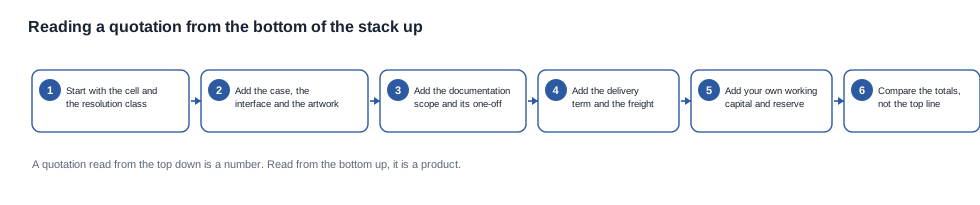
The order of the steps is the argument. A quotation read from the top down is a number with a price attached. A quotation read from the bottom up is a product with a price attached, and the two are not the same thing.
Start with the cell and the resolution class. These two rows set the largest part of the stack and they are the ones the catalogue lets you check. If the cell is written as 55mAh*2 it is two cells, and if the quotation's total is built on the per-cell number then the total is wrong. If the resolution class is 8 MP and the catalogue puts that class across eight camera models, the question to ask is which of them the quotation actually describes.
Add the case, the interface and the artwork. The case decision changes the parcel, the carton and the transport declaration. The interface decides the accessory list. The artwork level is a function of the colour set, and the colour set is a function of the model's published options, with the V03 Pro publishing three and the V06 publishing four.
Add the documentation scope and its one-off. This is the line that most often appears later than expected, and it is the one where the requirement comes from the buyer's market list. Attach it as a scope line with the number of destinations and the number of models in it, and it becomes negotiable in the right way — by reducing scope, rather than by asking for a discount on a fixed scope.
Add the delivery term and the freight. A price with no term has no landed cost. This is a short conversation and it is worth having in writing, because the term decides who carries the risk on a shipment that is being held for inspection.
Add your own working capital and reserve. These are the buyer's numbers, they are the last two layers, and they are the ones that turn a unit price into a cost. A quotation read bottom-up without them produces a number that is smaller than the real one, and the gap appears later as an unexplained margin loss.
Compare the totals, not the top line. Two quotations are only comparable once each has been expanded to the same depth, and the expansion has to be the same for both. This is the point where the smart glasses pricing comparison table becomes useful: it is the instrument for doing the expansion once and applying it to both sides.

Where a stack is quoted in the wrong order
Four quoting habits break the stack, and each one is common enough to be worth naming.
Quoting the top line first. The symptom is a negotiation that keeps returning to a number neither side can explain, because the number is a residual and the buyer has no idea what is inside it. The prevention is to expand the quotation before the meeting rather than during it.
Quoting the buyer-owned layers as if they were included. The symptom is a landed cost that is higher than the approved model, and an argument about whether the freight was in the price. The cause is that a unit price was quoted against a delivery term nobody named. The prevention is to name the term on the quotation.
Quoting a configuration that does not exist in the catalogue. The symptom is a price that is hard to reproduce and a second quotation that appears to be a different product. The cause is usually a description rather than a designation, or a model string with a typo. The prevention is to require the catalogue designation on the quotation line, and to check it character by character.
Quoting a scope that will change. The symptom is a price that moves once the first order is placed, and a supplier that says the original price was for a different scope. The cause is that the quotation was written against a configuration that was still open — a colour set, a case decision, a market list. The prevention is to require a fixed configuration as a condition of the quotation, and to treat a quotation against an open configuration as a starting point rather than an offer.
There is a fifth habit, and it is the one that costs the most in this category: quoting the unit price as though the stack below it did not exist. That is not a supplier failing to be transparent. A unit price is a compliant answer to a narrow question, and the buyer's question is the wide one. The two frames meet at the landed cost, and the landed cost is the only number in this category that is worth defending.
What we publish about the stack, and what we leave open
The short answer: we publish the rows that determine the stack, and we will not publish a number that would be wrong for most of the configurations in it. We publish the model designation, the resolution class where a camera is fitted, the cell capacity with its cell count, the rated runtime band, the charge time for every entry, the charging interface where the page carries one, the charging case capacity where the page carries one, the IP54 marking on the V06 and the S7, the Bluetooth version where the page carries one, the colour options on the models that publish them, the 158 g weight of the MT6 glasses unit excluding its foldable case, and the 35 dB amplification gain of the bone conduction entry. Those rows cover layers one, two and three of the stack, and they are enough to build a bottom-up reading of a quotation.
What we do not publish, and will not estimate: unit prices, production lead times, minimum order quantities, tooling and non-recurring engineering figures, price tiers, frame weights for any model other than the MT6, the weight of the MT6 charging case, sensor part numbers, field of view, video specifications, ingress test report numbers, certification numbers, patent counts, acoustic figures, battery transport test report identifiers, case weights and carton dimensions. Layers four, five and six are not ours to publish. The freight and duty depend on a route and a term. The documentation cost depends on a market list and a laboratory queue. The margin and the returns reserve are the buyer's own numbers and are a function of the buyer's own description.
We also make no vision, health, eye-protection or hearing-aid efficacy claim for any product, in any market, in any configuration. A device whose function is to capture, notify and connect is not a clinical intervention, and a claim of that kind is a regulatory exposure in the destination market rather than a marketing decision. If your channel is built on an eyesight or a medical claim, we would rather say so before the sample order than after the listing is written.
What we can do is expand a quotation with you. Send us the model, the options, the destination, the delivery term and the volume, and we will mark which layers of the stack the published catalogue settles for that configuration, which ones need a quotation from the factory, and which ones are numbers only your own freight broker, your own broker and your own claims history can produce. The range itself is at camera and audio smart glasses, the negotiation side of the stack is in how to negotiate a price with a factory, and the instrument for putting two quotations on the same basis is in smart glasses pricing comparison table.
Related reading
- The instrument — smart glasses pricing comparison table
- The negotiation side — how to negotiate a price with a factory
- The published range — camera and audio smart glasses


