

The conclusion first, because most price conversations in this category start in the wrong place: the unit price is usually the least negotiable number in the transaction, and the configuration is the most. A supplier who has agreed a configuration and a volume has already fixed most of the cost, and what is left to negotiate is margin. A buyer who argues about the unit price before pinning the configuration is negotiating the only number that cannot move. Four levers are open in a price conversation, and only one of them is the one buyers reach for first.
Smart glasses pricing: the least negotiable number in the order
Who is negotiating this and what the quotation is really comparing
The buyer here is a brand-side procurement manager or an importer who is holding two or three quotations and has to choose between them, or who is opening a new programme and needs a price before the product exists. The comparison that feels like the decision is actually a comparison between two different products, because each quotation was built against a configuration that has not been written down anywhere.
The decision underneath is which supplier can build the thing the buyer intends to sell, at a price that survives the channel margin, on a date the launch plan can absorb. The number they are about to negotiate over sits in the middle of that and is the least informative of the three.
That is also why two quotations in this category can differ by a wide margin without either supplier having made a mistake. One is priced against a model that ships with a charging case and the other against the same model without one. One includes custom artwork and the other does not. One includes the compliance work for a destination market and the other excluded it and left the buyer to find out. The price gap is the visible symptom of a configuration gap, and it is not a margin opportunity.
The four levers that are open and the three that are not
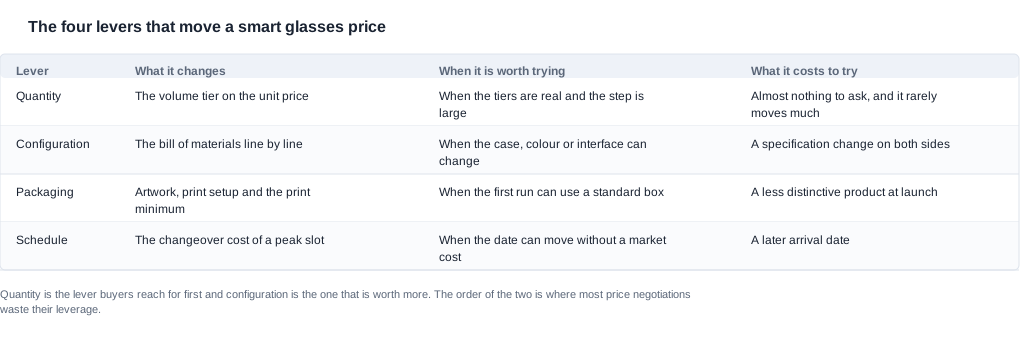
Four levers open a price in this category, and they are worth ranking by how much they actually move. Quantity is the one buyers reach for first and it is usually the weakest, because a tier structure is real but the step depends on where the factory's own costs break. Configuration is frequently worth more and is rarely asked about. Packaging is a one-run decision with a permanent effect on the print cost. Schedule is real and under-used, because a date that moves is a price that moves.
Against those four, three things are closed. The cost of compliance for a destination market is what it is, and a factory that cuts a conformity cost is cutting something a broker or a marketplace will find later. The cost of a change after the order is placed is a changeover and is priced as one. And the published specification is not negotiable: a supplier who will change a published figure to win an order is telling you that the figure is not a specification.

Pinning the configuration string before any price is compared
What a configuration string has to contain
Every quotation has to be against a configuration string rather than a model name: resolution, cell capacity, charging interface, case configuration, colour, logo treatment, packaging and firmware build. A quotation against a model name is not comparable with anything, and it is the reason two quotes that appear wildly different turn out to describe the same product.
The catalogue in this category makes the string concrete rather than theoretical. Eleven models carry a camera. Eight are 8 MP and three are 13 MP, and the two tiers are settled at the model level. Cell capacities run from 220 mAh through 260 mAh, 265 mAh and 290 mAh across the camera range. Three camera models ship with a 1400 mAh charging case, one is offered with a 900 mAh or 1400 mAh case, one carries a 1200 mAh foldable case, and four publish no charging-case row at all.
Each of those is a separate line in the bill of materials, and each of them changes the price. A buyer who asks what the case costs, and what dropping it saves, is often negotiating more than a buyer who asks for a volume discount — and the buyer who asks for both has a much stronger position when the two quotations are compared.
The string also has to carry the firmware build, because that is the line most often left implicit. Two quotations for the same hardware with different firmware builds are two different products, and the build is also the thing that determines whether the units arriving in the channel run the software the buyer expects.
Where the charging interface sits in the comparison
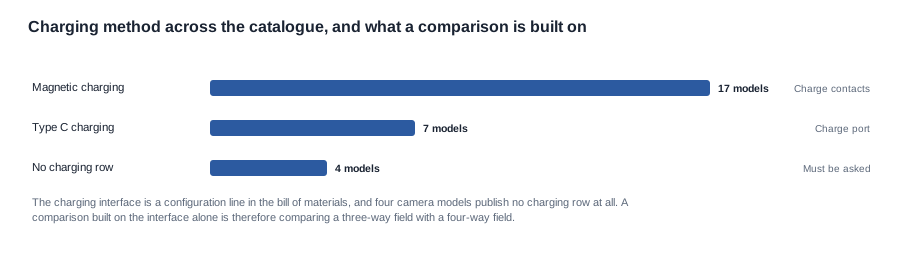
The charging interface deserves a specific mention because it is the field where a two-way comparison silently becomes a three-way one. Magnetic charging appears on seventeen of the twenty-eight models in the catalogue and Type C on seven, but four camera models publish no charging interface row at all.
That means a quotation for one of those four cannot be compared on the interface without asking which one is intended, and a quotation that lists magnetic charging for one of them is describing a specification the catalogue does not publish. This is a small line on an order form and a large one in a price comparison, because the interface determines the board and the connector.
The six questions to ask before comparing two quotations
- Which configuration string is this price against? Completion test: the full string, quoted back, with the resolution tier, the cell capacity, the charging interface and the case stated.
- Which of those elements are priced separately rather than bundled? Completion test: a per-option price for the case, the colour and the packaging, or an explicit statement that they are not separable.
- What does the price cover at the destination — the goods only, or the goods plus the freight basis and the tax treatment? Completion test: a stated delivery basis and an incoterm.
- What one-off items are in the quotation, and what volume was each amortised over? Completion test: a list with the amortisation volume beside it.
- Which compliance work is included, and for which markets? Completion test: a market list, so a market that is not on it is visibly not on it.
- What is the validity period of this quotation, and what changes it? Completion test: a date and the conditions that would end it.
Questions two and five are the ones that decide whether two quotations can be compared at all. Everything else on this list makes a comparison fair rather than possible.
The question that resolves a configuration difference fastest
Ask the supplier to send the configuration string back to you with the quotation. A supplier who has to reconstruct it will discover that something was never decided, which is worth knowing before the deposit. A supplier who can paste it back in a minute has an order form, and the price can then be read against it.
The second question is which options are priced separately rather than bundled. "What does the case cost and what does dropping it save" is a better question than "can you do a better price", because the answer produces two comparable numbers instead of one opaque one.
Reading three quantity tiers instead of one price
The absolute size of the steps matters more than the percentages
Ask for the price at your quantity, at roughly double it, and at roughly a quarter of it, and receive all three in the same message. Judge the absolute size of the steps rather than at the percentages. A price that drops sharply at the first step and then flattens has shown where the factory's cost structure changes, and that is more useful than the final number. A price that barely moves across the whole range has shown that the volume is too small to matter and that the configuration is the lever worth working.
The three numbers also tell the buyer something about the next order. If the step between the first and second tier is large, the next order's economics change at that point, and the buyer can plan around it. If the tiers are flat, then the value in this supplier comes from somewhere other than volume, and the buyer should search for it in the configuration or the terms rather than in a bigger commitment.
What a flat price across a wide range is telling you
A flat price is not a generous supplier; it is a supplier whose cost structure does not respond to the buyer's variable. It usually means the order is small relative to the fixed costs of running it, and that the negotiation should move to the terms, because the price has already been reached.
The practical consequence is that a buyer who receives three flat tiers should stop asking for a better unit price and start asking what is included: the compliance work, the packaging setup, the sample cost, the freight basis and the warranty. Those are the items that a flat unit price can be hiding.

Non-recurring costs and the amortisation decision behind them
The items that are quoted once and spread across the run
Logo tooling, artwork and print setup, a custom firmware build, a custom application build, a bespoke retail box and first-article inspection are all quoted once and amortised across the order. They are frequently shown as a single line called tooling or setup, which hides the fact that they are four different commitments with four different lives.
A tooling charge that buys a reusable mould is an asset that a later order can use. An artwork setup that buys a print plate for one box design is not. A custom firmware build is usually reusable only if the specification is unchanged, and a change to it reopens the question. Separating the one-off items into those that carry forward and those that do not is what allows the buyer to know what the second order will cost.
The volume the amortisation was calculated over
Every one-off item is quoted against a volume, and that volume is a decision rather than a fact. A setup charge calculated over a smaller volume is a higher unit charge on the first order than the same charge would produce on a larger one, and it means the first order is carrying more of the one-off cost than the second.
Ask for two things: the total, and the volume it was calculated over. Then ask what happens to the charge if the run is smaller than the quotation assumed, because a factory that recalculates the amortisation after the fact has moved a cost from the one-off block back into the unit price, where it is harder to see and harder to argue about.
The same question applies to the packaging minimum. A print run has its own minimum, and a print setup calculated against a print run that never happens is a charge the buyer paid for and cannot use.

When the price levers are exhausted
Why a price per unit is not a total cost
The unit price is the number that gets quoted, and it is the least complete number in the transaction. A landed cost adds the freight basis, the destination charges, the tax treatment, the payment method fee and the cost of the one-off items amortised into the first run. Two suppliers quoting the same unit price against different delivery bases are not offering the same thing, and the difference between the two can be larger than anything won in the price conversation itself.
This is why the delivery basis belongs in the request for quotation rather than in the shipping discussion afterwards. A quotation on an ex-works basis and a quotation on a delivered basis for the same configuration are two different commercial offers, and the second one contains a freight commitment that the first one leaves entirely with the buyer.
The same discipline applies to the sample cost, the tooling, the artwork setup and the inspection. A buyer comparing two suppliers on unit price alone will usually find that the supplier with the higher unit price is the cheaper total, because the other one has moved a cost into a line that was not quoted. The total cost is the comparison; the unit price is one of its inputs.
The terms that are still open after the unit price is fixed
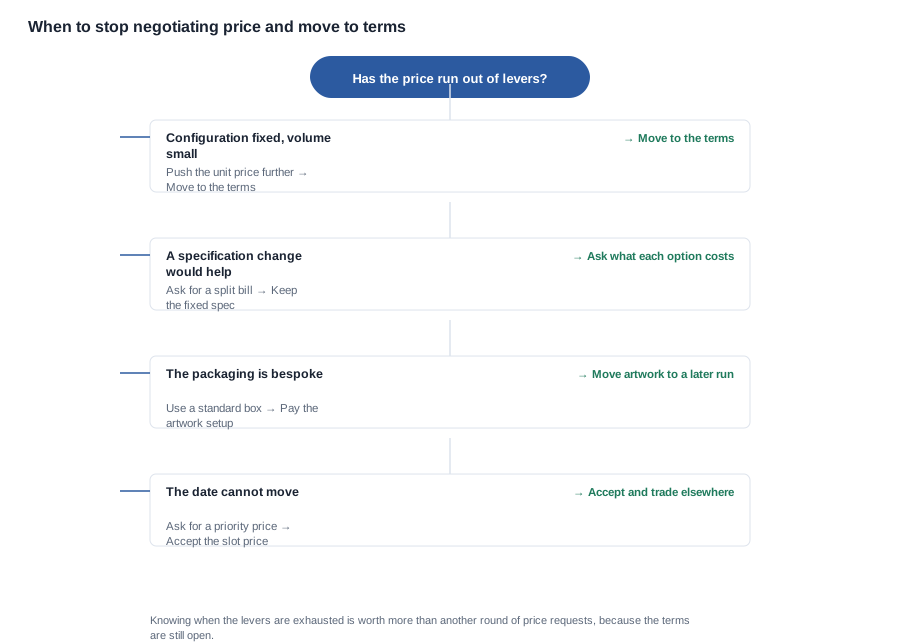
If the configuration is fixed, the quantity is small, the packaging is bespoke and the date is immovable, then the unit price is close to fixed, and the negotiation moves to the terms: the payment structure, the delivery basis, the sample arrangement, the warranty and the returns path, and the order of the quantity tiers for the next order.
That is not a consolation prize. A buyer who has hit the end of the price lever and knows it moves on is in a stronger position than one who keeps arguing about a number that will not move, because the supplier's willingness to move on terms is usually higher than its willingness to move on price at that point.
Why a supplier squeezed on both ends is a risk
A factory that has been squeezed on price and on terms is a factory that will find the cost somewhere the buyer is not watching. In this category the places it is found tend to be the conformity work, the inspection depth, the packaging materials and the support given when something goes wrong in the channel.
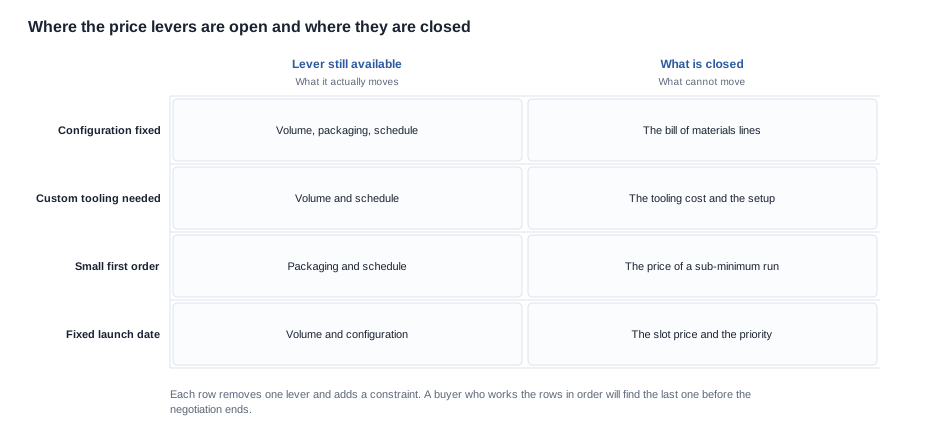
The matrix above maps which lever remains available as constraints accumulate. Notice that the constraint that closes first is usually the configuration, and that a configuration locked in early is what makes the later rows feel inevitable. This is the reason the sequence in this article starts with the configuration string rather than with the price.
A worked example of comparing two quotations
This comparison is worked through on assumed inputs rather than drawn from an account. No buyer, supplier, order or figure is claimed; one camera model, a first-run quantity, a single destination market, and two quotations against different configurations are assumed, so that the reasoning behind each comparison can be followed.
Suppose a buyer is comparing two quotations for a camera model at a first-run quantity, for sale into one market, and one quotation is noticeably lower on unit price.
The buyer asks for the configuration string behind each quotation. The first quotation describes the model with a 1400 mAh charging case, a custom colour, bespoke retail packaging and the compliance work for the destination market included, delivered on an ex-works basis. The second describes the same model without a case, with the standard colour and standard packaging, the compliance work excluded, quoted on a delivered basis. The second is cheaper on unit price, and the reason is now visible: it is a different product with a different delivery obligation.
The buyer then asks the first supplier for the price with the case removed, and the second supplier for the price with the case, the custom colour and the compliance work added. Both answers arrive. Now the two quotations can be compared, because both are against the same configuration string, and the second quotation turns out to be roughly at parity once the excluded items are priced in.
The buyer then asks for three quantity tiers from each supplier and finds that both are relatively flat across the range, which tells them the volume is not the lever on this order. The remaining open questions are therefore the terms: the payment structure, the sample arrangement and the order in which the next tier becomes available.
The lesson of the walkthrough is that the price difference the buyer was about to argue about was a description of scope, not a measure of margin. Two weeks of price negotiation on the original numbers would have produced a discount on a product the buyer had not yet specified.
What we quote, and what we will not quote
How we structure a quotation
We publish the per-model specifications and the colour and configuration options, so that a benchmark built on specification has a denominator. We do not publish a standing price list, because the same model at a different configuration, quantity and destination is a different price, and a list would be wrong for most of the entries it appeared against.
We will quote per configuration, per quantity and per destination, in writing, with the recurring and the non-recurring blocks itemised separately. We will give you the next two quantity tiers at the same time if you ask for them. We will not quote a landed cost for a market we have not shipped to, and we will not quote a compliance figure for a destination market whose requirements we have not confirmed, because a quoted figure we cannot evidence becomes a liability for both of us.
Send us the model, the configuration, the quantity, the destination market and the date, and we will quote against those five things rather than against a model name. If you send only a model name, we will send back a configuration string and a price for each of the two or three options it contains, because a single number against an open specification is a number we would have to withdraw later.
The pricing section sets out the quotation structure, and the pricing myths covers the assumptions that usually sit underneath a comparison.
Related reading


