

Smart glasses pricing comparison tables and the empty price column
A price comparison table in this category has exactly one job: to show the buyer what a price is made of, so that two quotations can be compared on the same basis. That is all. A table that does not achieve that is a more expensive format than an email, because it lends the comparison a credibility that the underlying numbers have not earned.
The table that follows is built for the catalogue we publish, and its price column is deliberately empty. The empty column is not an omission and it is not a refusal to be useful. It is the honest reason a price cannot be tabulated, and understanding that reason is what makes the rest of the table worth building. Our catalogue publishes configuration facts — resolution class, cell capacity with its cell count, runtime bands, charge time, case capacity, charging interface, the IP54 marking where it exists, the Bluetooth version where it exists — and it publishes no unit price, no minimum order quantity and no production lead time. A price in this category is a negotiated term attached to a configuration, a volume, a destination and a date. Four of those four are things you specify; only one of them is quoted.
So the practical conclusion is short. If you are comparing quotations, build the table on the published configuration rows first and let the price column arrive last, against a configuration you have already written down. If a supplier sends you a table with a price and no configuration beside it, send it back with a request for the model designation; that request is cheaper than the order you would otherwise place. If you need a price, you will have to ask for it, and you will have to ask for it in writing, per configuration, per quantity and per destination.
This article works through what a comparison table can carry, which rows earn their place, how to reconcile a table somebody else wrote, what a table cannot settle even when it is well built, and the one version of the table that is worth keeping in a procurement file.

Who builds the table and the decision it has to support
The table is normally built by the buyer, and it is normally built too late. That is the normal condition of this category, and it is worth naming because most of the bad comparison decisions in this category are not bad analysis. They are late analysis.
Three people build it. A brand-side procurement manager is comparing a second factory against an incumbent on a programme that is already running, and the table exists to answer one question: is the new supplier cheaper for the same thing, or different at a different price. A channel buyer is placing a first order into a category they do not manufacture, and the table exists to answer a different question: which of two answers describes a product that can be ordered at all. An importer is extending a range and the table exists to answer a third: which configurations can be carried on one bill of materials and which need their own documents, their own artwork and their own minimum.
Underneath all three is the same fear, and it is not a fear about quality. It is a fear about a shipment that arrives against a configuration nobody quoted, a delivery date that slips while the units sit finished, a document position that does not cover the model that was ordered, and an after-sales load that lands on a team with no spare capacity. Those four are what a table is being built to prevent, and each of them is a configuration question before it is a price question.
The supply chain is what makes the table the buyer's only reliable instrument. This category is assembled: cells, camera modules, electronics, optics, housings, cases and packaging are all sourced, and the factory's own work is the assembly, the test and the pack. Two factories quoting the same model designation will nevertheless differ in what they actually hold, because one may carry a different cell, a different charging interface, a different case, a different firmware branch and a different level of documentation. Those differences are what the unit price is pricing. When a table strips the configuration out and leaves only the number, it removes the only part of the quotation that explains the number.
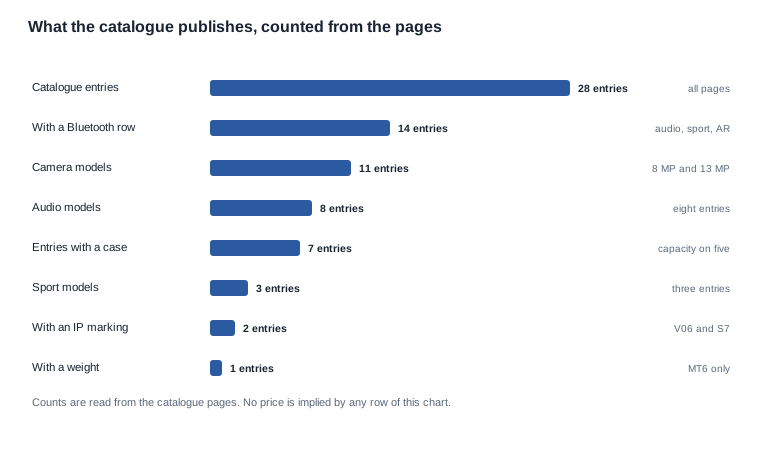
The chart above is a count of what is actually published, taken from the catalogue pages. Twenty-eight entries are published, of which eleven are camera models, eight are audio models and three are sport models; the remaining six are the three children's lines, the AR entry, the photochromic entry and the bone conduction entry. The three children's lines carry a model designation; the AR, photochromic and bone conduction entries do not. A Bluetooth version is published on fourteen entries, a case appears on seven with a capacity on five, an IP54 marking appears on two, and a weight appears on exactly one.
Read that distribution as a buyer and it tells you where your table is going to have holes. A weight column is going to have one cell filled in twenty-eight, which means it cannot be a comparison row at all — it is a request. The same is true of a per-model certification column, because the catalogue has a company-level export certification page and no per-model certification row, so every entry in that column is a request. The rows that survive as comparison rows are the ones published consistently across a family: resolution class, cell capacity with its count, the runtime band, charge time and, where the page has one, the charging interface.
The rows that can carry a comparison without a caveat
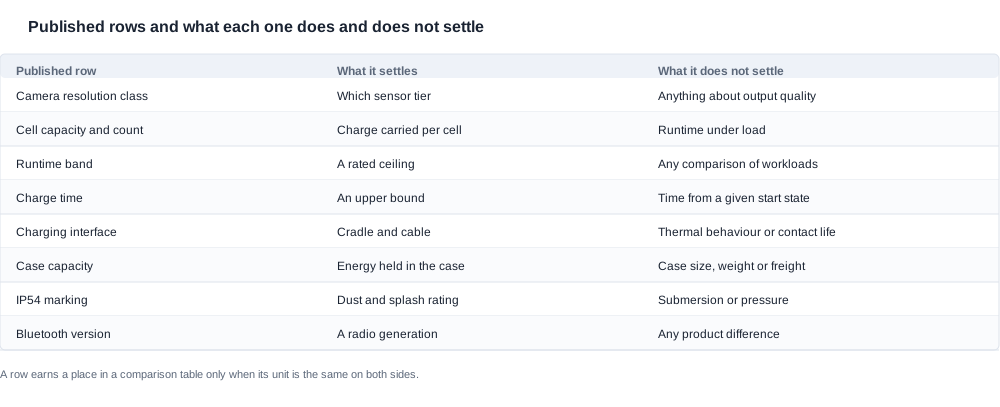
A row earns a place in a comparison table only when its unit is identical on both sides of the comparison. The eight rows above are the ones where that is true in this catalogue, and the third column is the part that stops a table from being mistaken for a verdict.
Camera resolution class. The catalogue publishes an 8 MP class across eight camera models and a 13 MP class across three, and nothing else about the imaging chain is published. The row settles which tier you are buying, which settles a good deal about the bill of materials and the price band, and it settles nothing about output quality, because the sensor part number, the field of view, the video specifications and the lens characteristics are not published for any model. A buyer who treats a resolution class as a quality ranking is reading a tier, not a result.
Cell capacity and cell count. The row has to be transcribed exactly: 100mAh for a single cell, 55mAh*2, 90mAh*2 and 70mAh*2 for paired cells. The count is part of the figure, not commentary on it, and a table that drops it has silently converted a two-cell row into a one-cell row. What the row settles is the charge carried per cell and therefore the shape of the bill of materials. What it does not settle is runtime, because runtime depends on load, and load depends on whether the model carries a camera.
Runtime band. Six bands exist across the catalogue: roughly eight hours, roughly seven hours, five to eight hours, six to eight hours, roughly six hours and, for the three children's lines, roughly twenty hours. The row settles a rated ceiling under favourable conditions. It does not settle a comparison of workloads, and it should never be reduced to a midpoint in a table cell, because a midpoint is a claim about typical performance that neither the catalogue nor the supplier made.
Charge time. Published for every entry: two hours or less for twenty-six of them, about one hour for the D17 and the ZH12. It settles an upper bound on a full charge. It does not settle the time from a given start state, and it does not settle a termination criterion, because the catalogue does not publish either, which is why a charge time cannot be used as a shift length in a schedule.
Charging interface. Magnetic charging appears on seventeen entries, Type-C on seven, and four cased camera models — the L1 Pro and the MT6, and the CY03 and the CY05 — publish no charging method at all and give only a case capacity. The row settles the cradle and the cable. It does not settle the current, the thermal behaviour or the contact life, and it does not settle whether a model that publishes nothing is magnetic.
Case capacity. 1400 mAh on the L1 Pro and the CY03, and the CY05; 900 or 1400 mAh on the L2 Utral; 1200 mAh on the foldable MT6 case. The KY06 and the MT5 have a case with no published capacity, and the V03 Pro has no case. The row settles the energy held in the case and therefore part of the accessory specification. It does not settle the case size, the case weight, the carton, the freight weight or the battery transport paperwork, all of which change when a case is in the parcel.
The IP54 marking. It appears on the V06 and the S7 and on no other model. The row settles a dust and splash rating. It settles nothing about submersion or pressure, and it must not be generalised across the range, because a marking that two models carry is a marking that twenty-six models do not carry.
Bluetooth version. Published on fourteen entries: V5.3 on the K01 and the K02, and V5.4 on the rest of the entries that publish it. The row settles a radio generation. It does not settle any product difference, it is not published for the camera series at all, and the catalogue text carries no touch row for any model, on the K01 or on anything else, so a table that lists touch for the K01 and the K02 has added a specification the catalogue does not carry.
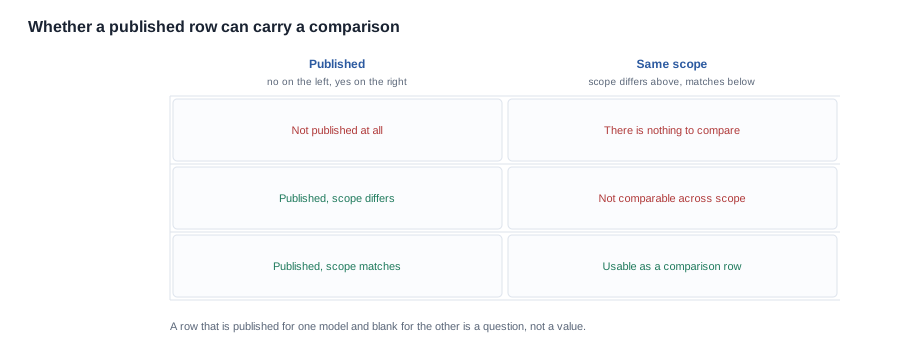
The matrix above is the acceptance test for any row a buyer adds. A row that is not published for the model has nothing to compare. A row that is published but whose scope differs between the two sides of the comparison cannot carry a number, and the scope difference is usually a configuration difference, which is exactly what a table is supposed to expose rather than hide. A row that is published for both models, on the same scope, is usable — and it is usable as a specification, not as a price, because the price is the one thing in this table that has to be negotiated.
One warning governs every row above: these figures are not directly comparable across suppliers, and the reason is usually the measurement rather than the product. A runtime measured with the camera active is not comparable with one measured idle. A charge time measured at a low cell voltage is not comparable with one measured from full. A capacity quoted per cell is not comparable with one quoted per pack. Until the conditions are stated, two numbers in the same row are two different measurements, and the table needs a conditions row at the top if it is going to be defensible.

Reconciling a table that somebody else wrote
Most comparison tables a buyer receives were written by a supplier, and most of them are built to make one column look better than it is. The first job is not to find the lie. It is to find the configuration.

Find the model designation behind every column. This is the step that decides whether the rest is worth doing. A column with a designation can be checked against a catalogue page. A column without one is a product description, and a product description can be accurate and still not orderable. For the entries that publish no designation at all — the AR entry, the photochromic entry and the bone conduction entry — ask for the internal code the factory uses on the packing list, and require that code on the purchase order.
Copy the catalogue rows without paraphrasing them. Take the rows from the catalogue page and write them into your own sheet in the catalogue's notation. A paraphrase is where the arithmetic error enters, because a paraphrase is where a band becomes a midpoint, a cell count disappears and an unpublished charging method becomes a word like "wireless".
Write the cell count beside every capacity. A column header that says "battery" and a cell that says "100" and a cell that says "110" is a spreadsheet waiting to produce a wrong answer. The count belongs in the cell, every time.
Blank every row that only one side has filled. A blank is a question. It is not a zero, and it is not a value carried across from the other column. The discipline matters because a blank is visible and a copied value is not.
Rebuild the price column as a written request. Once the configuration rows are right, the price column is no longer a number on a spreadsheet. It is a request: this configuration, this quantity, this destination, this delivery term, in writing. A supplier who answers that request has made an offer. A supplier who answers with a unit price and no configuration has not.
Attach the delivery term to each remaining price. A price without a delivery term is not comparable with a price that has one, because the delivery term decides who owns the freight, the duty, the insurance and the risk in transit. Two identical products quoted on two different terms are two different products to a buyer who has to budget the landed cost.
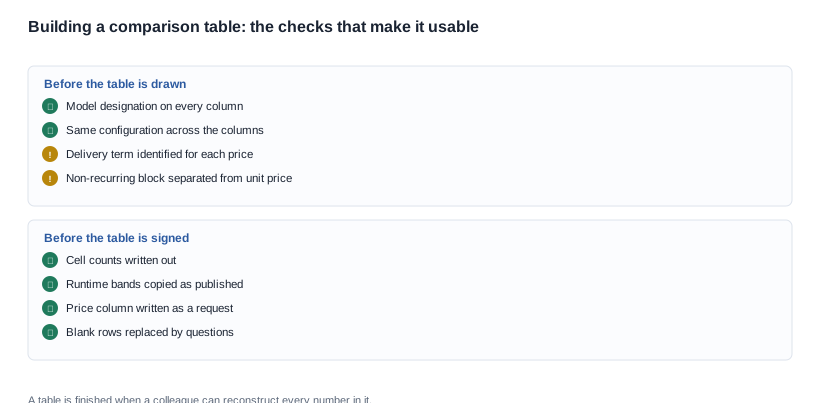
Run the table against the checklist before you circulate it. A table is finished when a colleague can reconstruct every number in it from the sources you named, and when a supplier can read their own column and recognise their own answer. If a colleague asks you what a number means and the answer requires a phone call, the table is not finished.
What a comparison table cannot settle
A well-built table still has limits, and the limits are where budgets go wrong. These are the five failures that show up most often in this category, each written as the symptom, the cause and the prevention.
The table mixes a factory-gate price with a landed cost. The symptom is that one column looks dramatically cheaper. The cause is that freight, duty, insurance, packaging and the compliance work sit on top of one quote and not the other, and the table gives them the same visual weight as a unit price. The prevention is to state the delivery term in the column header, so the reader cannot compare a delivered unit with a delivered unit and a carton with a carton.
The non-recurring block is buried in one column and missing from the other. The symptom is a headline unit-price gap that disappears at the programme level. The cause is that setup, tooling, artwork, firmware work and the documentation effort are not recurring costs, and a table that shows one of them without the other is comparing a first order with a repeat order. The prevention is to require the recurring block and the non-recurring block in separate lines, with the volume the non-recurring block is amortised over stated.
The documentation scope differs and nobody can see it. The symptom is a shipment that cannot be moved in the destination market. The cause is that a compliance position is a per-model, per-configuration matter, and a table that says "certified" without saying which model, which configuration and which document is a claim. The prevention is to make the document names and the model strings cells in the table, not adjectives.
The minimum is read as a per-order quantity when it is a per-configuration quantity. The symptom is an order that is either larger than the plan can fund or smaller than the supplier will build. The cause is that a model with four published colours is four configurations, and a configuration carries its own floor. The prevention is to add a configuration-count row to the table and multiply it out before the order is approved.
The quotation is treated as published policy. The symptom is a second request being declined, or a budget that assumed the price would hold. The cause is that a quotation is a number attached to a configuration, a volume, a destination and a validity period, and none of those four is a promise. The prevention is to record the validity period as a cell, and to build the plan so that a re-quote is a normal event rather than a crisis.
Correcting those five does not make the table a price. It makes it a valid basis for a price, which is the more useful thing. A buyer with a valid comparison can negotiate scope, per-configuration minimums, delivery terms, payment nodes, packaging, artwork and the documentation scope, and those are the lines that actually move a landed cost. A buyer with an invalid comparison has nothing to negotiate with except a number, and the supplier knows that.
The one table worth keeping
The table most buyers end up with is a column of prices. The table worth keeping is one that answers a question you will have to answer again next quarter, and it is built like this.
Take the configuration you have actually decided on — one model, one option set, one case decision, one documentation scope — and put it at the top of the sheet. Then put the same configuration at three volumes. For each volume add the same block: the unit price as quoted, the packaging, the freight, the duty, the compliance cost, the working capital cost implied by the payment terms, and the returns reserve. Then amortise the non-recurring block over the volume you actually intend to buy, not over the volume in the headline. Finally, put the delivery term, the payment terms and the validity period in the sheet as named rows, so that a change in any of them is visible as a change in the total.
This is a hypothetical example, not a client project. Assume a channel buyer who has chosen one camera model with a case, and who has three candidate volumes. At the smallest volume the non-recurring block dominates, and the total per unit is high. At the middle volume the block is spread and the total falls. At the largest volume the unit price is at its best, but the working capital term grows with the inventory days, and the returns reserve does not shrink. The result is a total cost curve that is not monotonic, and a buyer who only compared the unit price at the largest volume has picked the wrong point on it. The table is what makes that visible, and the visible point is usually the middle one.
The same table, used with a second supplier's answer, is what turns a negotiation into a comparison. Ask both suppliers for the same configuration at the same three volumes, on the same delivery term, and the difference between the answers is a difference about scope rather than about appetite. That is a negotiation you can have. A negotiation over two unit prices with no configuration attached is a conversation about nothing.
Here, the specifications in these tables are the published ones, and they are the only ones we hold. The frame weight of every model is recorded as not published, and so are the sensor part numbers, the field of view, the video specifications, the ingress test report numbers, the certification numbers, the acoustic figures and the battery transport report identifiers. The one weight the catalogue does publish is 158 g for the MT6 glasses unit including its cell and camera and excluding its foldable case, and a price comparison built on a specification we do not have would be a comparison of something else. We do not publish a price list, and we will not put a number into a table where it would be wrong for most of the rows.
What we will do is quote per configuration, per quantity and per destination in writing, with the recurring block and the non-recurring block itemised separately, and with the next two quantity tiers given at the same time if you ask for them. We will also mark which rows of your table the published catalogue answers today, and which rows have to come from the supplier or from a measurement on your own sample units. The range itself is at camera and audio smart glasses, the arithmetic side is in how to calculate pricing for your order, the negotiation side is in how to negotiate a price with a factory, the reference set is in smart glasses pricing industry benchmarks, and the beliefs that cost money are in smart glasses pricing myths.
Related reading


