

The most expensive mistake in smart glasses pricing is comparing two quotations without checking that they describe the same thing. We do not publish prices on this site: unit prices, production lead times and minimum order quantities are confirmed per enquiry, because each depends on a configuration rather than on a product family. What follows is therefore not a list of things to ask for. It is the order in which attention pays, and the specific levers that move a quotation once the configuration is settled.
The short version is this. Spend your attention first on the specification, because a well-specified order is worth more than a hard negotiation on a vague one. Spend your negotiation effort second, and spend it on the line that has the most leverage. Spend it last on unit price, which is usually the least flexible number on the page, and which is usually not the number that decides the total cost of the programme.
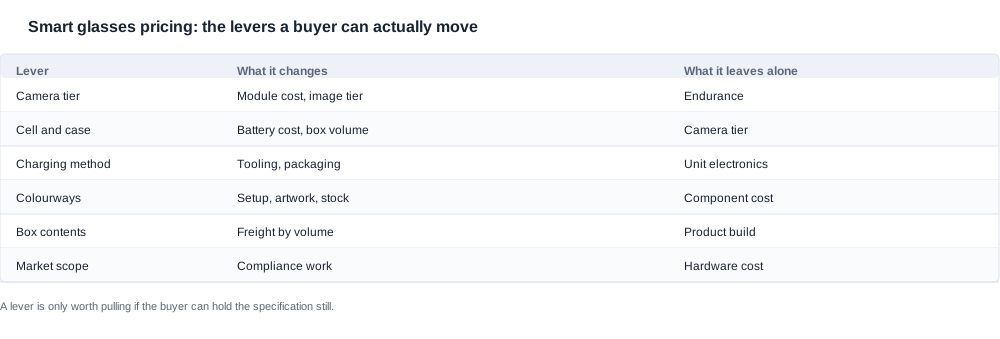
Smart glasses pricing: the levers to settle before you order
Two ways to rank a lever, and why the second one decides
A lever can be ranked by how much of the price it controls, or by how much of the price you can change. These two rankings rarely agree, and the disagreement is where procurement time is wasted. The battery sits high on the first ranking and low on the second, because the cell and its case are specified by the product rather than by you. The colourway count sits low on the first ranking and high on the second, because it costs you little per unit and you can change it whenever you like.
For a buyer holding a budget, the second ranking is the useful one. A lever you cannot move is not a lever at all; it is a condition of the programme, and the only useful response to a condition is to price it properly rather than to argue with it.
The published rows that sit behind each lever
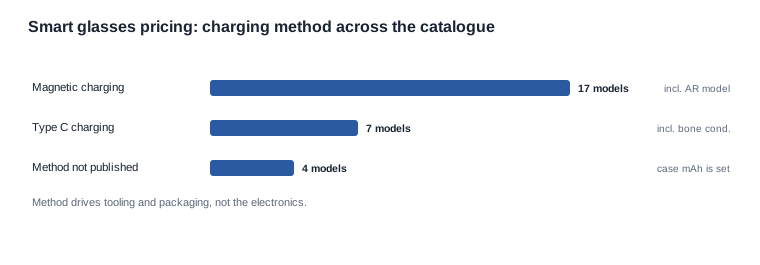
Our catalogue publishes enough for a buyer to see where each lever starts and stops. The camera range publishes two resolution tiers, eight models at 8 MP and three at 13 MP. Cell capacities run from 40 mAh to 290 mAh across the range, with cases published at 900 mAh, 1200 mAh and 1400 mAh. Charging is published for twenty-four of the twenty-eight models: seventeen magnetic, seven Type C, and four camera models that publish a case capacity but not the charging method itself.
Those published rows are the levers' starting positions. They tell you what a configuration is made of before a supplier quotes anything, which means the first conversation can be about the build rather than about the number.
Why the ranking changes with your programme stage
At the opening stage, the specification lever dominates, because nothing else can be priced until the build exists. At the sample stage, the box lever comes forward, because the sample is where the contents become visible. At the repeat-order stage, the volume lever returns, because now you know which configuration you want and the only question left is how much of it.
Buyers who apply one ranking across all three stages tend to spend their negotiating effort in the wrong place. The pricing checklist is arranged by stage for that reason.
What a lever looks like when the catalogue does not name it
Not every lever appears in a published row, and a buyer who only counts the published rows will underestimate how much room they have. The catalogue states cell capacities, case capacities, resolution tiers, charging methods, endurance, charge time and the ingress markings. It does not state colourway counts per model, the number of packaging variants, the artwork scope, the accessory list, or the level of assembly and calibration included in a quoted configuration.
Those unstated items are precisely where a buyer has leverage, because they are decisions rather than facts. A supplier proposing a standard packaging route and a buyer proposing a channel-specific one are two different requests, and only one of them is a specification. The same applies to the accessory list: whether the box carries a case, a spare cable, a printed quick-start card or a cloth is a decision that changes the line, and the catalogue tells you only whether a model ships with a case at all.
The practical instruction is to write the unstated items down as decisions you have made, rather than leaving them to be settled by whoever packs the box first.

The platform and camera tier a smart glasses pricing answer pays for first
The module decision that everything else inherits
The camera module is the first line a configuration inherits, because it fixes the sensor, the resolution tier and the electronics around it. Two products with an identical form factor and an identical cell can sit in different price bands for no other reason than the module inside them. The catalogue makes this visible without publishing a single price: eight models publish an 8 MP tier and three publish a 13 MP tier, and the cell sizes inside each tier are not uniform. The 13 MP tier runs at 290 mAh on the L1 Pro and the L2 Utral and at 260 mAh on the S7, while the 8 MP tier spans 220 mAh on the MT5, the V03 and the V03 Pro, 260 mAh on the KY06 and the V06, 265 mAh on the MT6 and 290 mAh on the CY03 and the CY05.
Eight models at one tier, three at another
The distribution matters as much as the split. A tier with eight models behind it is a tier the supply chain knows how to build, which usually means shorter lead times and more predictable pricing behaviour. A tier with three models behind it is rarer, and the questions a buyer should ask about it are different: what is the sourcing basis for the module, is it shared with any other model in the range, and would a change in that module reopen the lead time and the price together.
That last question is the one that matters for a brand committing a colourway or a channel committing a marketing window. A module shared across several models is a module with a second source behind it. A module unique to three models is a module where a single sourcing decision affects your schedule.
When the camera tier is the wrong lever to pull
The camera tier is the wrong lever when the programme's constraint is elsewhere. If the case is doing most of the freight work, or if the colourway count is carrying a setup cost that dwarfs the module, then moving between resolution tiers buys very little. The practical test is to ask which published row in your configuration sits furthest from the rest, and to pull that one first.
Where freight and case format quietly move a smart glasses pricing number
The box is a second product with its own line
The charging case is a second product inside the box, with its own cell, its own tooling and its own carton space, and a buyer who prices only the glasses is pricing the smaller half of the consignment. The catalogue shows how wide this range is: three models publish a 1400 mAh case, one publishes a folding 1200 mAh case, one offers a 900 or 1400 mAh choice, two more carry a case whose capacity is not published, and four camera models publish no charging-case row at all — the V03 and the V03 Pro, and the V06 and the S7.
Freight is usually settled by the volume of the box rather than by the weight of the device, and the catalogue publishes exactly one product weight, 158 g for the MT6 glasses body including the battery and camera but excluding the folding case. The case's own weight is not published, which means the box's contribution to freight is exactly the part you cannot estimate from the catalogue and must ask for.
Charging method as an invisible lever
Charging method changes little in the electronics and a great deal in everything around them. A magnetic charging model and a Type C model need different tooling, different packaging, different instruction material and a different expectation in the channel, and the catalogue splits twenty-four models across the two methods. For a buyer, the useful question is not which method is cheaper but which method the channel already handles, because an unfamiliar interface in a retail listing becomes a returns topic.
The four models that publish a case but not a method
Four camera models publish a charging case capacity without publishing the charging method. That is a real gap in the specification and the correct response is to ask rather than to infer it from a neighbouring model. Two related rows behave the same way: the charging method for the camera series is not published as a group, and the sensor part number is not published for any model. These are the rows a procurement file should carry as open questions.

A sequence that works: fix, compare, then negotiate smart glasses pricing
Stage one: the specification that makes a quote comparable
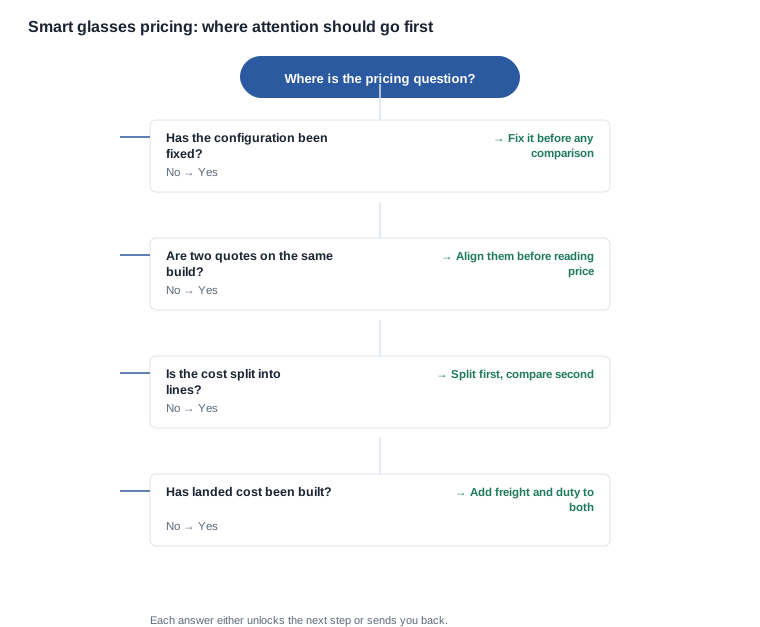
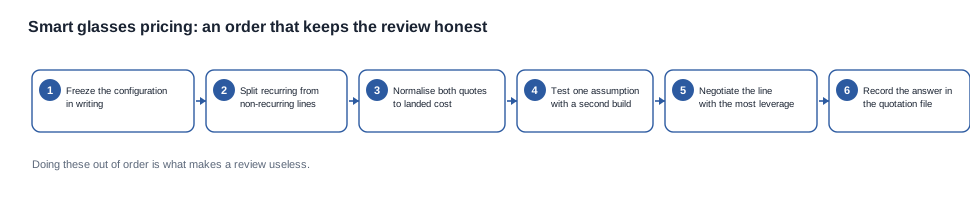
Before any number is compared, the build has to exist in writing. That means a configuration string that names the model, the camera tier where one applies, the cell and case capacity, the charging method and the box contents. A supplier working from a specification can quote without a clarification round. A supplier working from a product family will quote the family's cheapest member and wait for you to notice.
The second half of stage one is the quantity and the destination. Both change the number and both are easy to forget, and a quotation missing either one is not comparable with a quotation that has them.
The configuration string itself is worth writing out in full, because the fields people drop are the fields that create the argument later:
- The model and, where the range publishes them, the camera resolution tier for that model.
- The cell capacity and, where a case is included, its capacity and whether the choice between two capacities is open.
- The charging method, or an explicit request for it if the catalogue does not publish it for that model.
- The box contents, listed rather than summarised.
- The colourway count and the artwork scope.
- The quantity, the destination country and the incoterm.
Six fields, one page. A quotation that quotes against this list is a quotation you can compare; a quotation that quotes against a model name alone is not, however confident the tone of the email that carries it.
Stage two: the comparison sheet
Normalise each quotation to a landed cost at your destination before reading any unit price. Goods, freight, duty, destination charges and the treatment of tax all belong on the same sheet, and the incoterm must be identical across every row. Two quotations at different incoterms cannot be compared at any level above the unit price, and the comparison will otherwise be conducted on the one number that was never going to decide it.
Stage three: negotiating the line with the most leverage
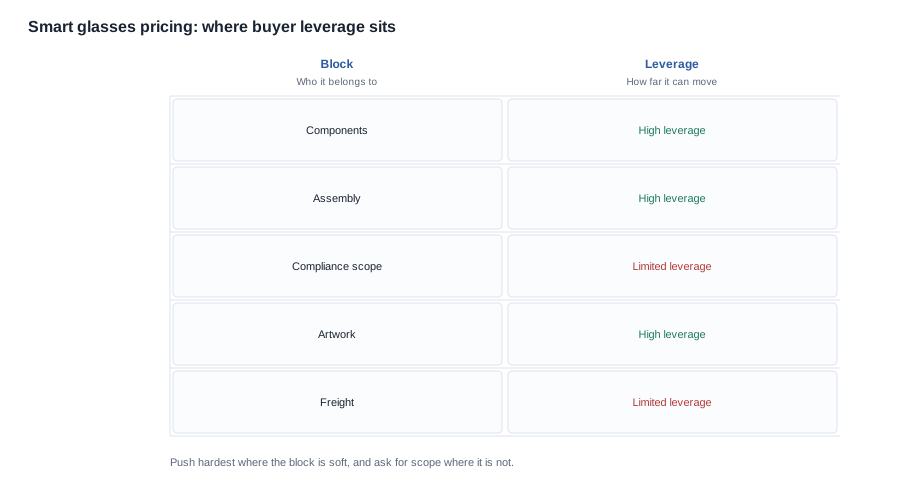
By the time you negotiate, the sheet should show which line has the most leverage, and the answer is rarely the unit price. Packaging and artwork respond to a buyer who brings a specific requirement, because the supplier can redesign them to meet the budget. Component cost responds to volume and to the component market, and it is the line where a larger commitment genuinely pays. Compliance work is close to fixed per product family and per destination market, so the useful question there is whether the scope in the quotation is the scope you need, rather than whether the number can be argued down.
The ordering matters. Negotiating the unit price first spends goodwill on the line with the least flexibility and teaches the supplier which line you will push on next.
There is a further reason to negotiate in this order that is about evidence rather than leverage. Each negotiation round produces a written answer about one line, and those answers accumulate into the specification. By the time the packaging and artwork lines have been settled, you often have a clearer picture of the build than you did when you started, and the supplier has confirmed the configuration in its own words. A negotiation conducted in the opposite order produces a better unit price and a vaguer order.

Which trade-off to take when smart glasses pricing budget is the constraint
Squeezing the box before the specification
When the budget is the binding constraint, the first place to examine is the box rather than the build. A configuration that is ordered without a charging case, or with a lower-capacity one, removes a second product from the consignment, and the effect lands on freight, on carton volume and on the tooling that the case required. Two camera models in the catalogue publish a case without publishing its capacity — the KY06 and the MT5 — and four more publish no charging-case row at all, which shows that the case is a documented option inside an existing product range rather than something that would require an invention.
The risk of taking this trade-off is that the case is often the reason a buyer chose the configuration. Removing it to protect the unit price and then losing the retail presentation is a worse outcome than the saving.
Squeezing the colourway count before either
The second place to look is the colourway count, and this is where the most money is usually lost without anyone noticing. Setup, artwork and stock carrying all scale with the number of colourways, and the unit price of a multi-colourway order is usually lower than the unit price of a single-colourway order because the setup is spread. The result is that a buyer who reduces the range sees the unit price rise and concludes that the range was cheaper, when the order total was in fact higher.
This is the trade-off most often resolved wrongly, because the unit price is the number everybody reads. The order total, the landed cost per sellable unit and the cost of the stock that does not sell are the numbers that decide it.
A workable discipline for this trade-off is to hold the order total as the constant and let the unit price move. If a programme has a fixed retail price and a fixed channel margin, then the landed cost per unit has a ceiling whether or not the supplier agrees to it, and the question becomes which line of the specification gives that ceiling back. Taking it out of the colourway count leaves the product intact but removes a retail variant. Taking it out of the box leaves the variant intact but changes what the customer receives. Taking it out of the resolution tier changes the product itself, and is the trade-off of last resort because the tier is the row a buyer most often chose the model for.
What to protect at all costs
Protect the configuration, the documentation scope and the packaging that the channel will actually handle. Those three determine whether the programme survives its first shipment, and they are the three where a small saving is paid back many times over in returns, in listings that do not convert, and in a documentation gap that stops a consignment at a border.
Everything else is a legitimate place to take the pressure. For the specific effect of order size on your margin, the MOQ and margin breakdown sets out how a minimum order quantity behaves in a channel model.
The smart glasses pricing figures we publish and the ones we hold back
What the catalogue states
We publish the electrical and configuration rows for every model: cell capacity, endurance, charge time, charging method where it is stated, case capacity where a case is included, the camera resolution tier, the ingress marking where one applies, and the product weight for the MT6. Where a row is open we mark it as open rather than substituting a neighbour's value, because a buyer who plans around a substituted figure finds the error at the dock.
What we will not publish
We do not publish unit prices, minimum order quantities or production lead times. Each is a property of a configuration and a quantity, and a published list would be read as a commitment to a product that does not exist. We would rather answer an enquiry precisely than give every reader a number that is wrong for most of them, and we would rather be judged on whether the configuration quoted is the configuration shipped.
There is a second reason beyond accuracy. A published price behaves like an anchor in the negotiation, and an anchored negotiation tends to spend its energy on the anchored number while the specification, the box and the documentation scope go unexamined. Those three are where the programme actually lives. If the specification is wrong, a low unit price simply buys the wrong product more cheaply, and the cost of discovering that arrives with the first shipment rather than with the invoice.
A closing note on how we sequence an enquiry
When an enquiry arrives with a configuration and a quantity, we answer it in the order a comparison needs: what the configuration is, what the published rows say about it, which rows are open for it, what the quotation includes, what it excludes, and how long the price holds. That sequence is not a formality. It is the reason two suppliers answering the same enquiry can still be compared, because both answers have been decomposed in the same order.
Separating published pricing rows from quoted items
Send the models, the quantities, the destination and the colourway count, and we will tell you which configurations exist for that combination, which published rows are open for them, and what a quotation would have to itemise. The pricing overview sets out the structure behind the quote, and the pricing checklist turns it into a list you can send.
Give us the configuration and the market, and we will say which parts of smart glasses pricing are settled on the published data and which parts you need to verify with a supplier.


