

Verification is the part of smart glasses pricing that separates a supplier who has done the work from one who has described it. Every step below works with documents and a sample, and every step produces something you can write down. None of it requires a factory visit, and none of it requires the supplier to agree to anything beyond answering a question in writing.
The reason verification matters so much in this category is structural. We do not publish unit prices, minimum order quantities or production lead times, and no other factory does either, so every number a buyer holds is an assertion made by somebody with an interest in the number. Assertions are not worthless. They are just unverified, and a comparison built on unverified assertions is a comparison of writing styles.
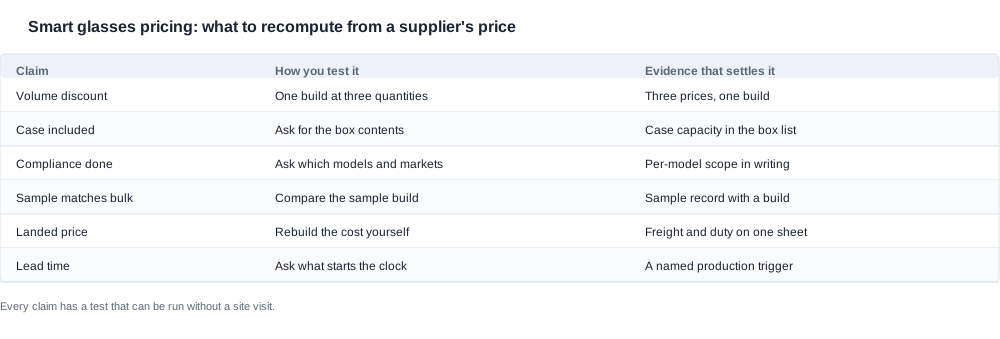
Smart glasses pricing verification: testing a supplier's number
What verification means when there is no published price
Verification without a published price works differently from verification with one. There is no reference figure to compare against, so the method has to be comparative rather than absolute. Every check below is built from something the supplier has already told you, and each check either reproduces the number or exposes the assumption inside it.
That is a different discipline from checking a figure against a catalogue. The question is not "is this right" but "does this number follow from the things you have told me". A supplier who prices 1400 mAh cases on three models and a folding 1200 mAh case on one, and who quotes a build with a case in it, has produced a number that can be inspected. A supplier who quotes a build without saying whether a case is included has produced a number that cannot.
A note on what verification is not
Verification is not an audit of the supplier's honesty, and a buyer who treats it that way gets a worse result than one who treats it as an exercise in producing comparable numbers. The supplier has no obligation to publish a bill of materials, and declining to do so is normal commercial practice rather than a red flag in itself. The red flag is declining to name the configuration in the quotation, because that is the thing a buyer genuinely needs in order to compare two offers.
The other thing verification is not: it is not a guarantee that the price is the lowest available. A verified price is a price you understand. Understanding is what allows a buyer to negotiate intelligently, to predict the reorder, and to explain to a channel partner why the product costs what it costs.
The three kinds of claim a quotation makes
Every line in a quotation makes one of three claims, and each kind is verified in a different way.
- A factual claim about the product. The unit carries a 220 mAh cell, the case is 1400 mAh, the camera publishes an 8 MP tier. These are checkable against the catalogue and against the sample.
- A commercial claim about the work. The tooling is included, the artwork is done once, the compliance scope covers two markets. These are checkable against documents and against the supplier's own consistency across quotations.
- A forward-looking claim about the future. The lead time is four weeks, the defect rate is under one percent, the price will hold for thirty days. These are checkable only by experience, by reference, or by putting them in the contract.
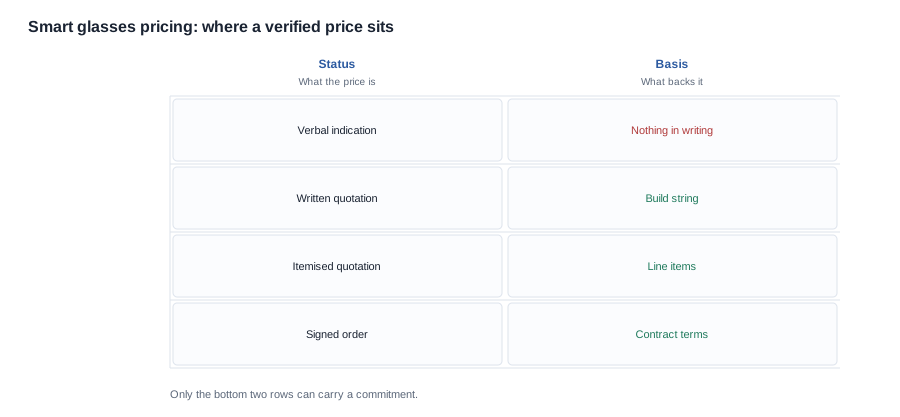
The third kind is where verification usually stops, and stopping there is a decision rather than a limitation. A buyer can put a lead time in the agreement, attach a remedy to a defect rate, and give a price a validity date, and in doing so convert an unverifiable claim into an enforceable one. That is the highest-value form of verification available to a buyer who cannot visit the factory.

Recomputing what the configuration implies about smart glasses pricing
What the published rows let you recompute
Our catalogue publishes enough for a buyer to rebuild part of a quotation independently. The camera range publishes two resolution tiers, eight models at 8 MP and three at 13 MP. Cell capacities run from 40 mAh to 290 mAh. Case capacities are published at 900, 1200 and 1400 mAh. Charging is published for twenty-four of the twenty-eight models. Endurance is published for all eleven camera models. These are not prices, but they are the quantities a price is built out of, and they let you check that the build you have been quoted is the build you asked for.
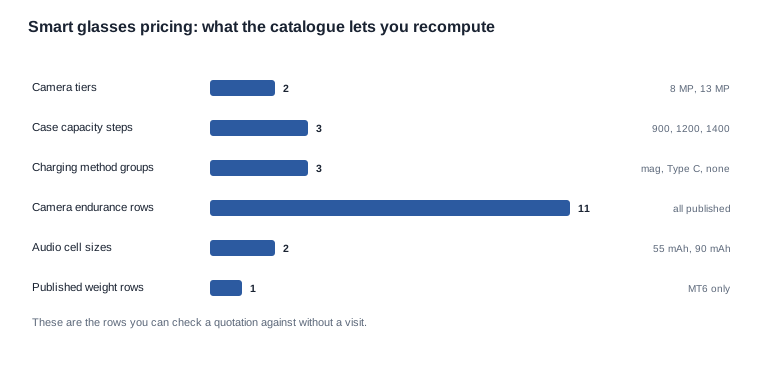
The arithmetic you can do before you ask
Four checks can be run on a quotation in the ten minutes before the first reply is drafted.
- The configuration check. Read the quoted build against the published rows for that model. A model quoted with a 1400 mAh case and a model quoted without a case are different products and cannot be priced against each other.
- The consistency check. Compare the quoted figures against the published figures for the same model. Endurance and charge time are published for every model in the range, so a quotation that states a different endurance is either quoting a different configuration or has not read the specification.
- The ratio check. Compare the quoted case capacity against the models that publish the same value. Three models publish 1400 mAh, one publishes 900 or 1400 mAh and one publishes a folding 1200 mAh. A quotation that puts a 1200 mAh case on a model that publishes 1400 mAh is worth a question.
- The scope check. Count the markets in the compliance line against the markets in the order. Two markets and one market are different work and different cost.
None of these checks tells you whether the price is right. All four of them tell you whether the quotation describes something, and that is the precondition for every other question.
The verification checklist, in one place
The checks below are the ones that can be run without a sample, and they are the right starting point before you order:
- Does every quoted line carry a configuration string that names one buildable product?
- Do the quoted figures match the published rows for that model, or is the difference explained?
- Are the non-recurring items listed separately, each with an amount and a trigger?
- Is the delivery basis named, with the destination and the incoterm?
- Is there a validity period, with an issue date and an expiry date?
- Are the markets in the compliance line the markets in the order?
- Can the sample build be described in the same terms as the quotation line?
Seven questions, one message. A supplier who answers all seven has produced a quotation you can put on a comparison sheet, and a supplier who answers three has produced a document that you can compare with another document but not with a number.
Where recomputation stops and enquiry starts
Recomputation stops at the parts of a build that are not published, and that boundary is worth stating precisely because a buyer who pushes past it is guessing. Not published: sensor part numbers for any model, the charging method for the four camera models that publish a case capacity without it, product weights beyond the MT6, the charging method for the camera series as a group, per-model certification rows, and the charge method for the AR and photochromic entries where the catalogue does not state it.
For each of those, the verification step is a written request. Not a request for an opinion, and not a request for "the typical figure", but a request for the value that applies to the configuration in the order.
Triangulating a smart glasses pricing number against a second, smaller build
Why a second build is a better test than a bigger order
Buyers naturally test a price by asking for a bigger quantity, because that is the visible lever. A second, smaller build is a better test, and it works for a reason that has nothing to do with the volume.
When a supplier quotes a second configuration, they have to make their own cost structure visible to themselves. The two quotes together reveal which lines scale with volume and which lines are a property of the build. A supplier whose quotes are produced by pulling a number from a table will produce two numbers that sit in a flat relationship to each other regardless of what differs between the builds. A supplier working from a cost sheet will produce two numbers whose difference is explained by the difference between the two specifications.
Running the triangulation
The test is simple and it is done in one message:
- Ask for the price of your configuration at your quantity.
- Ask for the price of a deliberately simpler configuration at the same quantity: no case where one is possible, one colourway, standard packaging.
- Ask what changed between the two builds.
The third question is the one that does the work. A supplier who answers it has shown you how their cost is structured, because they have had to explain it. A supplier who answers the first two and declines the third has told you that the relationship between the two numbers is not one they are willing to describe.
Why triangulation beats a reference customer
Buyers often try to verify a price by asking a supplier for a reference customer, or by asking a contact in the industry what they pay. Both are weak. A reference customer has agreed to their own price in their own context, and the number tells you about their configuration rather than about yours. An industry contact's recollection is usually about a different category, a different year and a different currency of risk.
Triangulation asks the supplier to describe their own cost structure twice, and it is the only method that produces a result you can act on, because it is the only one that stays inside your own programme. The total cost you are trying to verify is the total cost of your build, and only a second quotation for a second build inside the same programme speaks to it.
Reading the difference between the two answers
Three readings are possible and each one is informative.
- The difference is smaller than the specification difference. The supplier is absorbing part of the change, usually because the simpler configuration was priced from an internal reference. Check the answer against the published rows and re-ask if it does not follow.
- The difference matches the specification difference. This is the healthy reading. The price is being composed from the build, and further specification questions will produce more precise answers.
- The difference is larger than the specification difference. Something other than the specification is in the price. Usually the case, the artwork or the packaging, and it is worth asking which, because that is where the leverage is.

Checking the non-recurring block against the paperwork behind smart glasses pricing
The four documents to request
A non-recurring block can only be verified against documents, and four documents cover most of it:
- The artwork or packaging development quote, if the supplier is doing that work.
- The tooling or mould statement, showing whether the tooling is new, amortised or supplied by the buyer.
- The compliance statement for the destination markets, naming the models covered.
- The sample invoice, showing what a one-unit build costs and what it includes.
What each document settles
Each of the four settles a different question. The artwork quote settles whether the artwork line is a real cost or a pass-through. The tooling statement settles whether the tooling is amortised across future orders, which is the difference between a one-off and a recurring charge that happens to be named as one. The compliance statement settles the scope. The sample invoice settles what a single unit actually costs to build, which is the only reliable way to sanity-check the recurring line.
The sample invoice is the most useful of the four and the most often not requested, because a buyer who has already received a sample regards the question as answered. It is not. The sample invoice shows the cost of one unit including its setup, and a supplier who builds a production run at a lower per-unit cost has told you something about their efficiency that no unit price alone would reveal.
Where the paperwork and the quotation disagree
Disagreement is the useful outcome. When the sample invoice shows a different case capacity from the quotation, or the artwork quote does not match the artwork line, or the compliance statement names fewer models than the order, you have found the specific line in the quotation that is wrong, and you can now ask about that line rather than about the total.
This is the real difference between a document exercise and a negotiation. A buyer who compares two quotations can only argue about the total. A buyer who compares two quotations line by line can argue about the one line that matters.

What a supplier who will not answer is telling you about smart glasses pricing
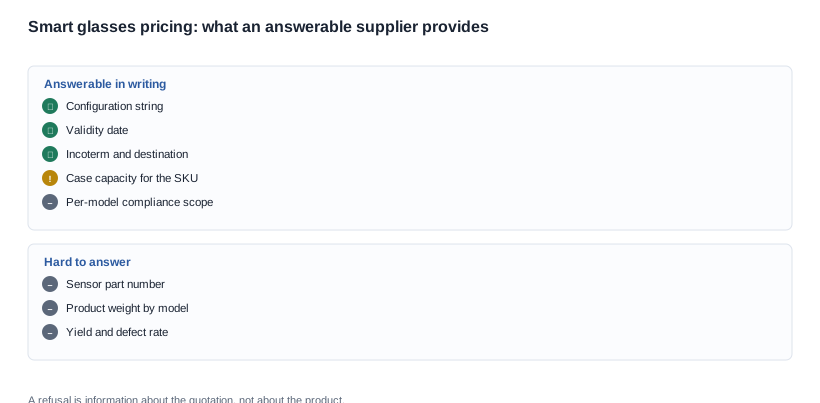
The refusals that are normal
Some refusals carry no information at all. A supplier will not tell you their margin. A supplier will not tell you which other customers they supply. A supplier will not commit to a defect rate before a specification exists. These are reasonable positions and a buyer who presses on them gains nothing.
The refusals that matter
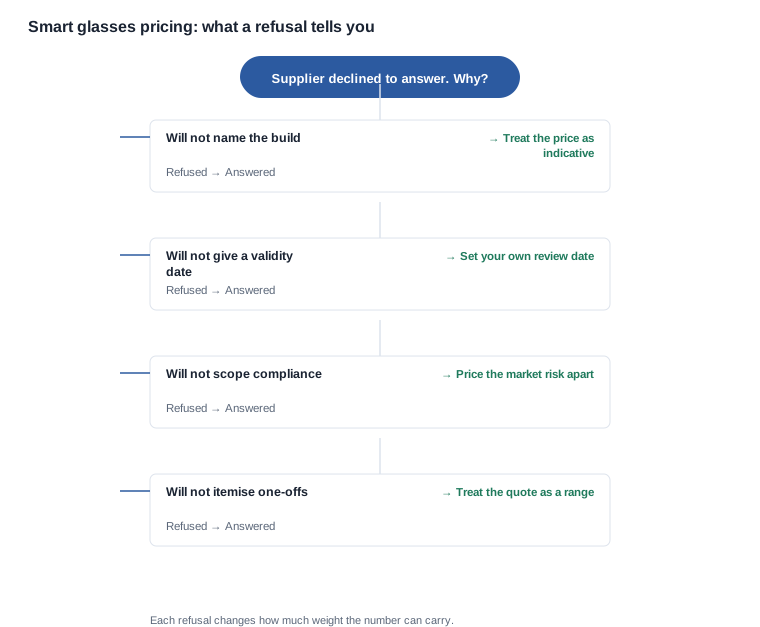
Three refusals are informative, and each one changes how much weight a number can carry.
- Refusing to name the configuration means the price applies to whatever the supplier decides the build is. Treat it as an indication, and do not put it on a comparison sheet beside a quotation that does carry a configuration string.
- Refusing to give a validity date means the price is a moment rather than an offer. Set your own review date and assume the number will be re-confirmed.
- Refusing to scope compliance means the destination market risk is unpriced. In the European Union the relevant scope is the Radio Equipment Directive (EU) 2014/53/EU applied to the model and configuration as supplied, and a scope that cannot be described cannot be priced or relied on.
The three questions that decide whether a refusal is acceptable
Before treating a refusal as a finding, ask three questions: does the unanswered item affect a line that will be paid, does it affect a commitment that will be made, and is it in the supplier's gift to answer? An item that is neither paid for nor committed to and that the supplier could answer if they chose to is a negotiating chip, not a finding. An item that will be paid for and cannot be answered is a finding, and it belongs in the exclusions of the comparison. An item that will be committed to in the agreement and cannot be answered is a finding that has to be resolved before signature, because a commitment to something nobody can describe is a commitment nobody can enforce.
How to record a refusal so it is usable later
A refusal should be recorded as a fact with a consequence attached, not as an impression. Not "they were cagey about certification" but "no per-model compliance scope provided for the EU market; the compliance line in the quotation therefore cannot be verified, and it is excluded from the landed cost comparison".
That second version is usable six months later. It tells the next buyer what to ask, it tells the team what to exclude from the comparison, and it tells the supplier what would need to change. A note that records an impression has to be re-interpreted by whoever reads it.
The verification file we would keep on our own side of smart glasses pricing
The five records
We would keep five records for every programme, and we would keep them for the same reason a buyer keeps them: a programme outlives the people who ran it.
- The configuration string for each quoted build, with the date it was issued.
- The published rows for each model in the build, so that a later reader can see what was known and what was open.
- The supplier's answers to the verification questions, with the dates.
- The refusals, with the consequence attached to each one.
- The landed cost working, showing how the comparison figure was built from the first four.
What we will and will not sign
We will sign a configuration string, a validity period with a review date, a recurring and non-recurring split with the one-off items itemised, and a scope naming the models and markets our market access file covers for your destination. We will not sign a price against a specification that has moved, and we will not re-quote a different configuration at the same number to avoid a conversation.
We will also not provide a figure for a row our catalogue does not publish, in either direction. A buyer who plans around an estimated number finds the error in the field rather than in the quotation, and the correction is more expensive than the question was.
Sending the quotation you hold, and what can still be checked
Send the quotation you are holding and the models it covers. We will tell you which parts of it can be checked against published data, which parts need a written answer from the supplier, and which parts should be excluded from a comparison until they are answered. The verification method sets out the questions in a form you can send, contract supplier verification covers what to put in the agreement afterwards, and the procurement pricing section sets out the structure behind the quotation.
Send the quotation and the model list, and we will say which lines of smart glasses pricing can be checked against the published data and which ones you need a written answer for.


