
Smart glasses contract: why supplier verification is a layered question
Verifying every entity, not one
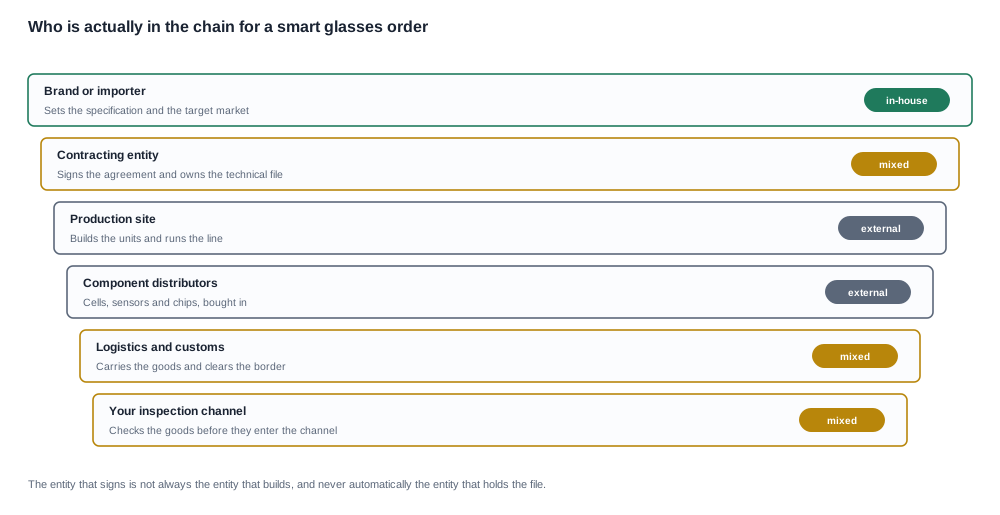
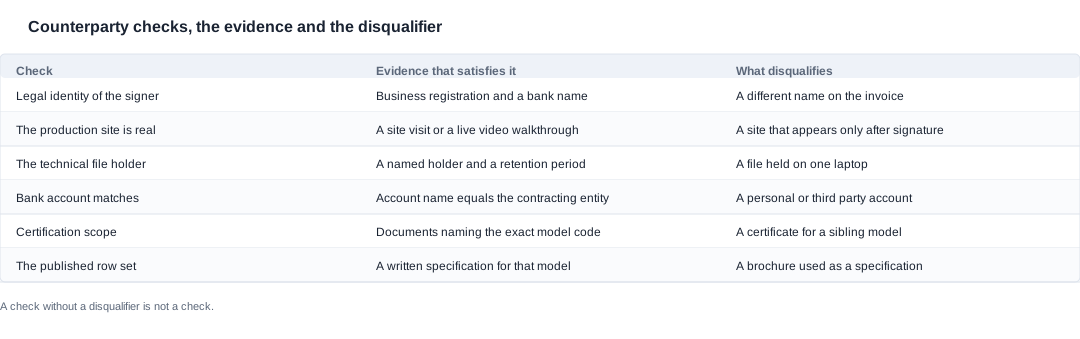
The single most common mistake in counterparty verification is to check one entity and assume the answers apply to all the others. In smart glasses sourcing there are at least five: the entity that signs the agreement, the site that actually builds the units, the party that holds the technical file, the distributors that sell the cells and the sensors, and the logistics chain that clears the border. The entity that signs is frequently not the entity that builds, and it is never automatically the entity that holds the compliance file. Verification therefore has to name which entity it is checking, and it has to be run against the entity that will be responsible for the obligation being tested. Six checks do most of the work, each with an explicit disqualifier, and a check without a disqualifier is not a check — it is a formality that produces a document rather than a decision.
Who is reading this, and what the supplier file should end up holding
The reader is a brand-side buyer, a channel buyer or an importer who has a supplier in front of them and a decision to make about how much to commit before the first order. The task is not to investigate a company. It is to build a file, quickly, that will still be useful in month nine when a claim, an audit or a repeat order requires the buyer to demonstrate what was established and when.
That framing changes what the checks are for. A due-diligence exercise that produces a long report is not useful here, because the person who needs the answer in month nine will not read a report. What is useful is a short file with a small number of named facts, each with an evidence reference and a date, and a list of the things that could not be established. That last part matters as much as the first: a file that records what is unknown is a file that can be acted on, and a file that records only what was confirmed gives a false impression of coverage.
The fear that drives the enquiry is usually specific and usually reasonable. It is that a supplier will turn out not to be the factory, or that the factory will be somewhere other than where the supplier said, or that the certifications will turn out to belong to a different model, or that the first shipment will be built by a sub-supplier the buyer has never heard of. None of these are exotic. All of them are normal features of this supply chain, and all of them are cheap to establish before an order and expensive to establish after one.

The six checks, and what each one disqualifies
| Check | Evidence that satisfies it | What disqualifies |
|---|---|---|
| Legal identity of the signer | Business registration and a bank name | A different name on the invoice |
| The production site is real | A site visit or a live video walkthrough | A site that appears only after signature |
| The technical file holder | A named holder and a retention period | A file held on one laptop |
| Bank account matches | Account name equals the contracting entity | A personal or third party account |
| Certification scope | Documents naming the exact model code | A certificate for a sibling model |
| The published row set | A written specification for that model | A brochure used as a specification |
The identity check, and why the invoice name matters
The first check is the legal identity of the party that will sign, which sounds trivial and is not. The reason it is not trivial is that in this category the parties are frequently related in a way the buyer is not told about, and the relationship can change what the buyer can rely on. A manufacturer that contracts through a separate trading entity means that the manufacturing site, the party holding the technical file, and the party with the technical capability are three different things, and the buyer has to know which one is behind each obligation.
The evidence is a business registration document and a bank account name, and the disqualifier is a mismatch between the two and the name that appears on the invoice. A mismatch is not automatically fraud; it is a structural fact about the arrangement, and the buyer's response should be proportional to it. What the buyer must not do is continue without recording it, because the entity that issues the invoice is the entity that will be pursued for payment, and if that entity has no assets and no history, the practical effect of every remedy in the agreement is nil. The factory versus trading company page sets out the structural difference in more detail.
The site check, and what a video walkthrough does and does not prove
The second check is that the production site is real, and it is the one most often skipped because it seems like the supplier's business. It is the buyer's business, for one reason: the documentation and the capability attach to the site, not to the trading entity, and the site is where a sub-supplier arrangement would otherwise be invisible.
A site visit is the strongest evidence. A live video walkthrough is weaker but not worthless, and it is worth being precise about what it does establish. It establishes that a production line exists, that the person showing it is standing in a working facility, and that the operator can answer questions about the process. It does not establish that this site makes your product, that this site holds the file for your model, or that this site will make your product rather than a near neighbour. Those are answered by the configuration, by the file, and by a reference order.
The disqualifier is a site that appears only after signature. In practice this shows up as a supplier who is entirely forthcoming about the site before the order and entirely vague about it afterwards, usually because the pricing was based on a different site than the one that ends up producing the goods. The factory audit questions list is the longer version of what to ask on a walkthrough.
The file check, and the two entities that have to be named
The third check is the technical file: who holds it, where it lives, and for how long. This is the check that gets skipped because it is a compliance question and the buyer is procurement, and it is the check that costs the most when it is skipped.
Two entities have to be named, and they are frequently different. The holder of the technical file is the party that can produce the documentation when an authority or a channel partner asks. The party that assembles the file may be a sub-supplier, a test laboratory or an external consultant, and knowing which one it is tells the buyer whether the file will still exist in three years. A file held on one laptop is not a record; a file in two places with a named owner and a stated retention period is.
The disqualifier is a supplier that cannot say who holds the file. A supplier that answers with a list of documents it can email you is telling you the file is not assembled at all, and that the documentation is re-created per order. That is workable for a first shipment and expensive later, and it is worth knowing before signing rather than before the first audit.
The bank check, and the account name that has to match
The fourth check is the one that takes five minutes and protects the largest single sum of money in the transaction: the bank account name has to match the contracting entity. Not approximately match, and not match a related company without an explanation that is written down.
The reason this is a separate check rather than part of the identity check is that it catches a specific and common failure: the account belongs to an individual or to a third party, and the money moves anyway. There are legitimate reasons for it and they need to be documented rather than assumed — a payment processor, a parent company that is the actual creditor, a letter of credit arrangement. What cannot be acceptable is a payment that goes somewhere the buyer cannot later ask questions of, because at that point the agreement is the only remedy and the counterparty to it is a bank account.
The certification scope check, and the sibling model
The fifth check is whether the certification documents cover the model being ordered. The scope of this check is narrow and specific, and the disqualifier is a certificate for a sibling model.
The reason to be precise about "sibling model" is that in this range the model designations are close together in a way that makes a name check unreliable. One model in the catalogue appears under its own designation and is also marked with a second name, so a strict string match fails on a correct document and a loose match accepts a wrong one. The check therefore has to be made against the model code and the configuration string, and the certificate has to be read together with the specification, so that a file for a 220 mAh 8 MP build cannot be filed against a 290 mAh 13 MP build.
The radio position sits under the Radio Equipment Directive (EU) 2014/53/EU and the general product safety framework under Regulation (EU) 2023/988, which has applied since 13 December 2024. A catalogue's export certification line describes a company-level capability and is not a per-model certification row, so it cannot be used to infer that a particular model holds a particular approval. This is a documentary check, and the what to ask before ordering list covers the surrounding questions.
The specification check, and why a brochure will not do
The sixth check is the easiest to run and the one most often reduced to a catalogue download. The supplier should supply a written specification for the model code, with the published rows and the open rows marked. A brochure is not a specification, and the difference is not formality.
A written specification for a named model in this category carries a cell capacity, a charge time, a rated runtime, and a charging interface on 24 of the 28 models — with four camera models publishing no charging interface at all, so those rows have to be closed by the supplier rather than inferred from the range. It carries a Bluetooth version on 14 models, a camera resolution on all 11 camera models, a charging case capacity on 5, an ingress rating on the two models that carry one, and a body weight on one model only, the MT6 at 158 g including its cell and camera and excluding its foldable charging case, whose 1200 mAh capacity is published but whose own weight is not. A specification that states all of that, and marks the rest as open, is a document a contract can be built on. A brochure is a document a contract cannot be built on.
The order in which the checks have to run

The sequence in the chart is not a preference. Each check depends on the one before it, and running them out of order produces answers that are true but useless.
Identity first, because every other check is a check on a party and a party has to be named before it can hold anything. Then the site, because the site is the location of the capability and the documentation, and a file held somewhere the units are not built is a file about a different product. Then the file, because the file check is what tells you whether the supplier is the manufacturer of record in practice or only on paper. Then the bank, because it is a check on the identity rather than on the capability, and it goes after the identity is settled. Then the certification scope, which is the point at which you have enough context to know whether the model code in the file is the model code in the order. Then the reference order, which is the only check that is not documentary.
The reference order is worth dwelling on. Nothing in the file substitutes for one completed order, because the first order tests the things that cannot be tested on paper: whether the goods match the sample, whether the documentation arrives before the booking, whether a claim can actually be made, and whether the supplier treats a problem as something to be closed. A buyer who skips it has verified a description of a company. A buyer who runs it has verified the company.
The order also has a commercial logic. Checks one to five are free or nearly free, and they can be run in an afternoon before the deposit. The reference order costs an order. By the time a buyer reaches the point of deciding whether to place a first order, the five documentary checks should already be closed, and the questions the first order is designed to answer should be the ones that only a first order can answer.

The file that has to exist when the programme scales
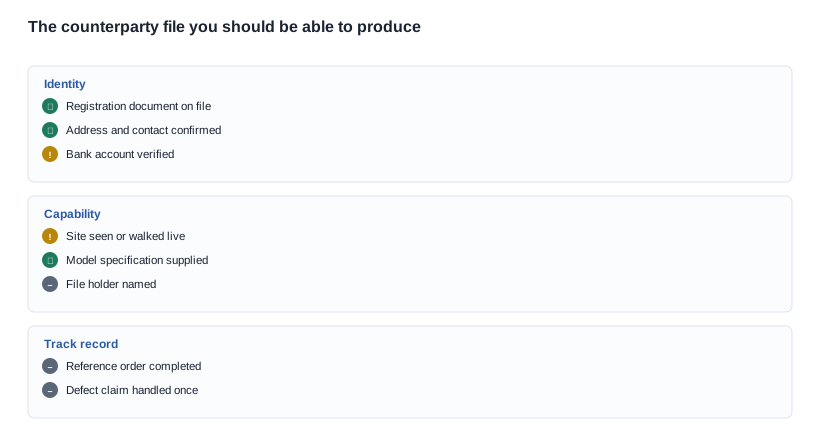
Three groups, and the discipline is to record what could not be established as well as what could. A file that only contains what was confirmed gives a reader a false sense of coverage, and the things that are missing are the things that will matter.
The identity group is the easy one, and it is the one most likely to be done and then filed in a place nobody can find. The registration document, the confirmed address and contact, and the verified bank account are the three facts that every future dispute will need, and they are the three facts that are most often kept in an inbox.
The capability group is where the file earns its keep. A site that has been seen or walked live, a written specification supplied for the model, a named holder for the technical file with a retention period. Note the last one: a retention period is a number the buyer should set, not one to ask for, and asking for it is the wrong question because the supplier will always answer with whatever is convenient rather than with what will still be true in five years.
The track record group is the one that is empty on day one and should not stay empty. A completed reference order, and a defect claim that was actually exercised once — not a claim that was resolved because the customer let it go. The second of those is the single most informative fact a buyer can hold about a supplier, and it is the one that has to be created deliberately, because nobody volunteers it.
What a trading company looks like from the outside, and what to do about it
None of this means that a trading company is a bad counterparty. Many are better than a factory with a thin compliance operation, and the comparison that matters is between the obligations you need and the ones the counterparty can actually discharge. The problem is not the label; it is the mismatch between the label and the capability, discovered late.
Three signals are worth weighing together rather than separately. A supplier that is vague about which site builds the product, when asked a direct question, is describing a production arrangement the buyer does not control. A supplier that holds no technical file, or will not say who does, has no assembly of the evidence the buyer will need at a border or in an audit. A supplier that cannot produce a written specification for a named model, while quoting a price confidently for that model, is pricing a configuration it has not described.
The response to any of these is not to walk away; it is to reallocate the obligations. If the site is unknown, the agreement should require notice of the production site and give the buyer a right to object, and it should allocate the file obligations to the party that can discharge them. If the file does not exist, the contract should make assembling it a supplier obligation with a date. If the specification is missing, it should be a condition of the deposit. Each of these is a contractual move that converts an unknown into an obligation, which is the whole point of the exercise.
What we will and will not evidence for you
We will tell you exactly what our own documentation supports and where the answer sits if it is not ours to give, and a buyer who has to rely on an estimate will find the error later at more expense than the question would have cost.
We publish the rows our own material supports — the rated runtimes, the cell capacities, the charge times, the charging interface on the models that publish one, the Bluetooth versions, the camera resolutions, the case capacities where stated, the ingress rating on the two models that carry one, and the MT6 body weight of 158 g excluding its foldable charging case. We do not publish sensor part numbers, field of view, ingress test report numbers, certification numbers, or any bare frame weight, and we will not estimate them. Unit prices, minimum order quantities and production lead times are quoted per project rather than published, because the variables that determine them are not knowable in advance.
What we will do for a buyer verifying a counterparty is straightforward: give you the written specification for a named model code, tell you which rows we hold and which are open, and tell you which parts of the file are ours to produce and which have to come from a sub-supplier. The contract terms section sets out the wider framework.
Send us the model code, the quantity and the destination market, and we will tell you which of the six checks we can help you close today, and which three are yours to run.
Related reading
- The structural check — factory vs trading company
- The audit questions — factory audit questions
- The counterparty questions — what to ask before ordering
Send the model code, the quantity and the market, and we will tell you which of the six checks you can close today.


