

Quality consistency is not about whether the product is good. It is about whether run two matches run one, which is a different question and the one that decides whether your second order is a reorder or a rescue. This checklist is organised around the five points where a product changes between production runs without anyone deciding that it should, and it is written for the buyer who already has a working supplier and a satisfied channel and has simply never made the comparison.
Smart glasses quality consistency: five points to check before a reorder
The reader is a brand-side buyer, a channel buyer or an importer with a product that has been through at least one reorder. Nothing is obviously wrong. The channel is not complaining. The problem is that the buyer's own records cannot tell them whether the current stock is the same product as the stock they approved, and that is the question which determines whether the next order is a routine purchase or a negotiation.
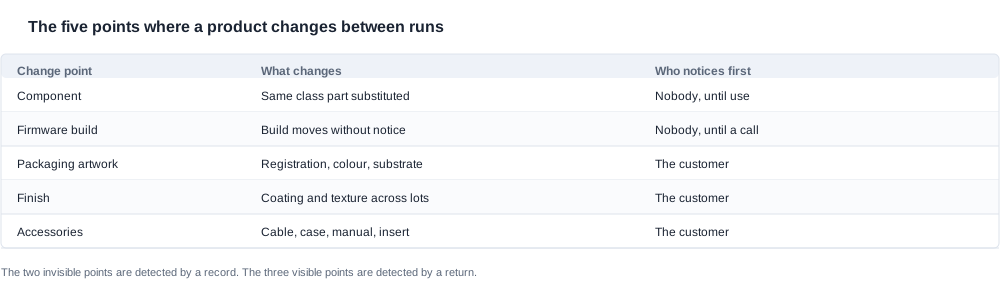
The five change points are the places where a product can drift without anyone deciding it should. They are not hypothetical, they are not exotic, and they are not all equally likely. The first two — the component and the firmware build — are invisible to any buyer who checks the finished product, because nothing about the appearance or the basic function of the unit changes. The second three — the packaging artwork, the finish and the accessories — are visible, and they are visible to the customer rather than to the buyer, which is why they arrive as returns rather than as findings.
The order in this checklist is the order the change points fail, not the order they are easiest to describe. That distinction matters, because the failure sequence tells a buyer where to spend the afternoon: a programme that starts at the artwork and works backwards will spend its time on the visible changes and leave the invisible ones running.
The buying question behind the list
Behind every item on this checklist there is a commercial question, and the questions are more useful than the items.
For the component, the question is whether you are buying the design you approved or a design that is equivalent. For the firmware, it is whether your users received one build in the first order and the same build in the second. For the artwork, it is whether the box in the warehouse is the box that was approved. For the finish, it is whether the supplier's process can hold a surface characteristic across lots rather than once. For the accessories, it is whether the contents of the box are the contents that were ordered, because a substituted cable, case, manual or language insert is a return attributed to the product rather than to the batch.
None of those five questions can be answered by a specification sheet, because a specification sheet describes the design and the drift is in the execution. They can be answered by records, and a record is a thing a supplier either keeps or does not.
Why the two invisible change points cost more than the three visible ones
A buyer allocating attention across the five points will almost always over-weight the visible ones, and the reason is entirely rational: the visible ones generate returns, and returns are counted. The invisible ones generate complaints that never become returns, because a customer whose unit behaves slightly differently does not always send it back, and when they do send it back the description is ambiguous enough to be filed under a different category.
The financial consequence is a curve rather than a step. A component substitution inside the same capacity tier produces a unit that is not faulty, so it is not returned, so it is never counted, and it accumulates as a small degradation in the channel. The buyer sees the effect only as a slow decline in the returns rate that nobody can explain, which is the hardest possible symptom to argue about because there is no single event to point at.
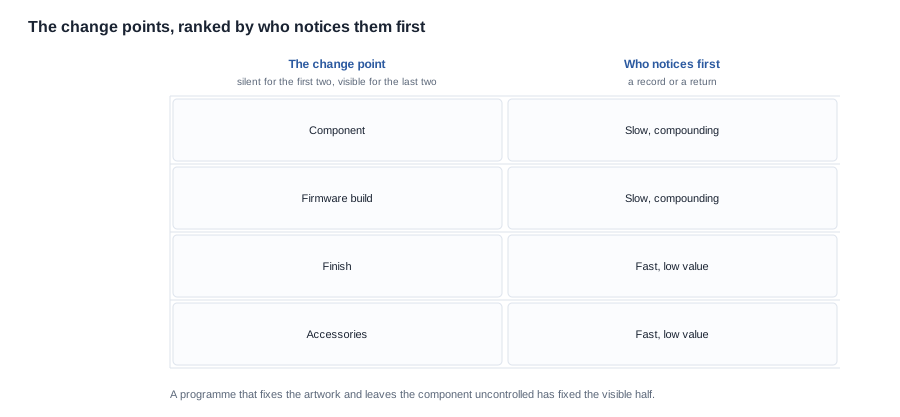
The three visible change points behave the other way round: they generate a high volume of low-value returns, they arrive quickly, and they are the ones that consume the buyer's attention in the quarter when the attention is available. A programme that fixes the artwork and leaves the component uncontrolled has improved the part of the problem that was already visible and left the part that compounds.
This is the argument for ordering the checklist as it is set out, and it is also the argument for the two documents. A drift in an invisible point is detected by a record, and a record is produced by a process, and a process is installed by a document. A drift in a visible point is detected by a customer, and the customer is a slow, expensive and unreliable instrument.

The component and the firmware: the two changes nobody notices
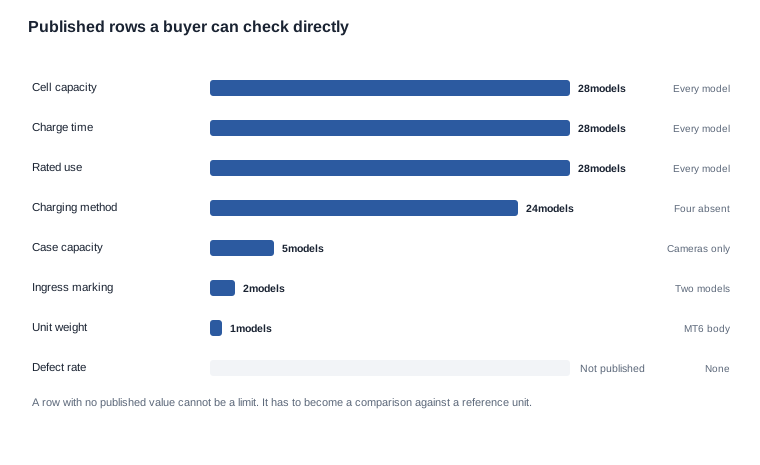
The component is the first change point, and it is the most common cause of a product that differs from its own approval. A camera module, a battery cell or a Bluetooth component substituted for an equivalent part changes the behaviour of the unit while leaving the published rows untouched. The catalogue publishes cell capacity, charge time, rated use, the charging method, the case option and the Bluetooth version per model, and none of those rows changes when a cell is swapped for one of the same class. The swap is invisible on the specification sheet and visible in use.
The published cell capacities across the range run from 40 mAh on the A05 and the A06, through 70 mAh on the A07, 100 mAh on the D11, the D12, the ZH12 and the electrochromic model, 115 mAh on the D17, 220 mAh on the MT5 and the V03 Pro, and the V03, 260 mAh on the KY06 and the V06, and the S7, 265 mAh on the MT6, to 290 mAh on the L2 Utral and the CY05, and the L1 Pro and the CY03. Those are the tiers a substitution usually stays inside, which is exactly why the substitution is invisible.
The question to ask is not whether substitution happens. In a category with a broad supply base, a substituted component is a normal consequence of allocation, and treating it as misconduct produces a supplier who does not tell you. The question is whether it is fixed by part number and whether a substitution requires your written approval, and the answer to the second question is the one that matters: a supplier who answers "we would tell you" has not answered, because telling is not approving.
The firmware build is the second change point, and it is the one most likely to explain a batch that does not match a good sample. A build identifier moves, an app update changes behaviour, and neither is visible on a physical inspection of the unit. The three things to ask for are a baseline build, a record of where the released version is logged, and a stated trigger for an update. A golden sample signed against a named build is what converts "the product" into a defined thing, and without it a firmware dispute cannot be settled because neither party can say which build the customer was actually holding.

The packaging artwork, the finish and the accessories: the three visible ones
The packaging artwork is the change point customers photograph. Print registration, colour and substrate all vary between print runs, and the result is a box that reads slightly wrong in a way that is hard to describe and easy to return. This is also the point at which a drift becomes a market-access question rather than a cosmetic one, because the carton in a European market carries the manufacturer information and the responsible economic operator details under Regulation (EU) 2023/988, applicable since 13 December 2024. Those details are part of the same artwork revision as the registration, and they must not drift either.
Specify the substrate, require a pre-production proof approval, and keep the approved proof against the run file. The retention is the part that is usually missing: a proof that is approved and then released without being filed is a proof that cannot be produced when a channel partner disputes a registration, which is the moment the buyer needs it.
The finish is a supplier capability question, and the only way to assess it is across lots. Paint, coating and texture consistency across a production lot cannot be judged from one unit. Ask to see two different lots side by side rather than one sample from the current batch, because a single sample cannot show drift, and a supplier that has only ever run one batch for you is telling you something important about the programme's depth. This is also the point where an audit is worth more than an inspection, since the question is about the process rather than the units.
The accessories are the components nobody inspects carefully, which is exactly why they get substituted. A cable, a case, a manual and a language insert that differ between runs produce returns attributed to the product rather than to the batch, and the returns arrive with a description that sends the investigation in the wrong direction. The remedy is unglamorous: put the accessory list into the acceptance criteria explicitly, and the inspection will cover it. An accessory that is not in the criteria is not inspected.

The two documents that make the five points enforceable
The five change points are only interesting if something is done about them, and the something is two documents. A checklist with a method attached is enforceable; a checklist without one produces an argument about interpretation instead of a decision about quality.
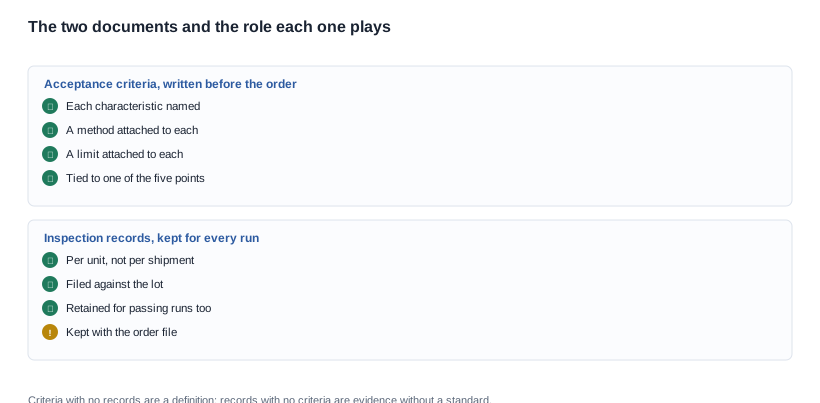
Acceptance criteria, written before the first order. Not a description of the product — a set of measurable conditions, each with a method, a sample size and a limit, and each attached to one of the five change points. The row is the mechanism by which a fault becomes a finding, because a criterion without a limit is a preference and a preference cannot be enforced. The written criteria are also what make a supplier's quotation comparable with another supplier's, since two quotations can only be compared when both have answered the same questions.
Inspection records kept for every run. Every run, including the ones that passed. This is the document that turns a memory into a comparison, and the discipline that decides whether a drift conversation is an argument about evidence or an argument about opinions. A supplier who keeps records for passing runs is a supplier who can be shown a trend, and a trend is what makes a second-run conversation tractable.
The two documents are related in a way that is easy to get wrong. The criteria define what a pass is, and the records show what passed. A programme with criteria and no records has a definition and no evidence. A programme with records and no criteria has evidence and no standard. Both are needed, and the second is the one that is normally skipped because it only costs something when something goes wrong.
The two documents are cheap, and the reason they are not written is timing
Both documents can be produced in an afternoon by a buyer and a supplier working together, and neither requires a laboratory, a third-party audit or a factory visit. The acceptance criteria are a page that names the characteristics, the method for each and the limit for each, agreed by both sides. The inspection record is a form with the same rows on it, filled in per unit or per sample, and retained.
The reason they are frequently not written is not effort. It is timing. Acceptance criteria are hardest to write before the first order, because the buyer does not yet know which characteristics will be disputed, and they are easiest to write after a failure, when the buyer knows exactly which characteristic was disputed and has no leverage to get a limit agreed. The window in between is where the document is usually lost.
The same applies to the inspection record. It is nearly free at the point of arrival, when the units are already on a bench and the sample is already being drawn, and it is close to impossible to reconstruct a month later, because the units have shipped and the sample has been consumed by the channel.
The practical instruction that follows is unglamorous and it is the single most effective change most buyers in this category can make: put both documents in the purchase order as delivery items, so that they arrive with the goods rather than being negotiated alongside them. A document that is a line on the order is a document that gets produced.

What to do when a run fails, and what not to do
The first thing is to establish whether it is a process failure or an acceptance-criteria failure, because the remedy differs in a way that is not negotiable.
A process failure — a shifted component, a misaligned print, an uncontrolled firmware build — belongs to the supplier, and the remedy should state what changed in the process so that the next run is not a repeat. An acceptance-criteria failure usually means the criteria were ambiguous, and the remedy is to rewrite them before the next run rather than to argue about the run that already happened. The distinction matters because the first remedy changes the supplier's process and the second changes the buyer's document, and a buyer who applies the wrong remedy pays for the same failure twice.
The second decision is whether the failed units are recoverable. Relabelling or reworking them is often cheaper than destroying them and frequently takes longer than the next production run. In a category where the carton carries market-access content, rework also creates a documentation problem of its own, because a reworked carton is a carton whose artwork revision is no longer the approved one.
The thing not to do is resolve the failure as a discount. A discount closes the commercial gap and leaves the process unchanged, which means the same failure arrives on the next run with a smaller invoice attached. Ask what changed, in writing, and file the answer with the inspection record.
Who owns the remedy, and how long it takes
Two commercial details decide whether a remedy is usable, and both belong in the agreement before the first failure rather than after it.
The first is the decision route. A finding needs a named decision maker and a named time limit, otherwise it becomes a report that arrives after the channel has already reordered. In this category the time limit has to account for the reorder cycle rather than the factory's own schedule, because a remedy that lands after the next order is placed is a remedy for the wrong order.
The second is the boundary between a credit and a rework. Which one is available, at whose election, and at what proportion, changes the cost of a failure by a large factor and changes how a supplier behaves in the run before the failure. A supplier that knows a small cosmetic drift will be scrapped has every incentive to control the cosmetic drift; a supplier that knows it will be credited a percentage of the shipment has an incentive to let the drift spread and settle the difference later.
What Cynrin publishes, what it does not, and the action to take
Here, consistency is a property of a documented process rather than of a supplier's diligence, and the five change points above are where that documentation earns its cost. We publish the per-model configuration rows exactly as the catalogue holds them — resolution tier, cell capacity, charging time, the rated use, the charging interface, the case options, the Bluetooth version and the colour availability — and we publish the absence of tolerances, defect rates and cycle life ratings with the same prominence.
We do not publish a defect rate or a quality-consistency figure, because any number without a denominator and an inspection method is a marketing figure rather than a measurement. Quality rates are not published in our documentation. We do not publish frame weights for any model, and the one weight the catalogue does carry is the MT6 glasses body at 158 g, including its 265 mAh cell and its camera, and excluding the 1200 mAh folding charging case, whose own weight is not published. The IP54 marking appears on the V06 and the S7 as a catalogue annotation with no third-party report number published against it, so it belongs in a configuration sheet as a marking rather than in an acceptance rule as a measured result.
What we will do is agree acceptance criteria with you in writing before production, keep inspection records for each run, and tell you in writing when a component or a firmware version has changed. We will not define quality as "acceptable" without a method attached, because a definition of that kind cannot be applied by anyone else.
The wider framework is at the quality consistency section. The factory-side assessment that tests these five points on a supplier is at the advanced factory audit guide, the exposure ranking that decides where to spend the time is at who needs smart glasses quality consistency, and the contractual way to attach remedies to acceptance criteria is at contract terms.
The action to take now. Send us the models, the configurations and the number of runs you have completed, and we will tell you which of the five change points your current documentation does not cover, and which two documents would close the gap before the next order rather than after the next complaint. A second order that can be compared with the first is a procurement decision; a second order that cannot is an argument waiting to happen.
Related reading
- Sampling finished stock on a factory visit — advanced factory audit guide
- Where consistency exposure is highest — who needs smart glasses quality consistency
- Attaching remedies to acceptance criteria — contract terms


