

Smart glasses quality consistency is a risk whose size is set by the number of re-orders rather than by the size of any single order, and that is the whole answer to who needs it most. A one-off buyer holds a binary risk: the batch is right or it is not, and one inspection settles it. A buyer with twenty re-orders holds a cumulative risk, because a small drift in the fourth batch is still present in the twentieth, and it is only visible if somebody has been comparing batches. The second buyer needs the discipline; the first one mostly does not.
The counter-intuitive part of this is that the buyers with the least history are not the ones who need it most. What determines the exposure is not the order history but the re-order rate, the drift-proneness of the configuration and the channel that will carry the variance when it appears.
This category makes the point unusually clear, because so much of the specification is published. A buyer can control the published rows without any help, which means the consistency work can be spent entirely on the rows that are not published and on the rows that drift.
Smart glasses quality consistency: the exposure compounds with every re-order
A one-off order and a re-order programme are different risks
A one-off order is a acceptance problem. The buyer samples the goods, checks them against the written list, and either accepts or rejects. There is no accumulation, because there is nothing after the batch to accumulate into, and a defect in that batch is found once and dealt with once.
A re-order programme is a trend problem, and it behaves differently in three ways.
The first difference is that drift is invisible within a batch. A cell that is slightly outside the published capacity, a case that is a fraction heavier, a camera module that renders marginally differently — each of these is inside a single unit, and a single unit passes or fails. The drift is only visible when batch four is compared with batch one, which means it can only be caught by a comparison the buyer has explicitly designed.
The second is that the error is multiplied by the channel. A one-off defect becomes one return. A systematic drift becomes a pattern in the returns data of a channel that is watching, and channels that watch do not distinguish between a bad batch and a bad product.
The third is that the remedy gets harder with time. A defect found in the first re-order is a conversation about one batch. The same defect found in the twelfth is a conversation about whether the product should stay in the channel at all.
The three conditions that turn variance into a problem
Variance is always present and is not always a problem. Three conditions have to be present together before consistency work is worth funding.
- A re-order rate high enough for drift to compound. A programme with two further orders can be managed by inspecting each. A programme with twenty cannot, because the inspection load is no longer proportionate and the programme begins to skip checks.
- A configuration with rows that are not published or not controlled. The published rows are self-stabilising, because a unit that matches a published capacity can be checked against it. The open rows are where drift goes unnoticed.
- A channel that punishes variance. A marketplace amplifies the return rate and the language of the reviews. A retailer audits the supply chain and asks for a record. A direct channel leaves the burden with the brand's own service desk, where the cost appears as support time rather than as a chargeback.
A buyer who has one of the three is managing a nuisance. A buyer with all three is managing an exposure that grows on its own, and the discipline is worth the cost.
What consistency means when the catalogue publishes only some rows
The rows a sample can check on every unit
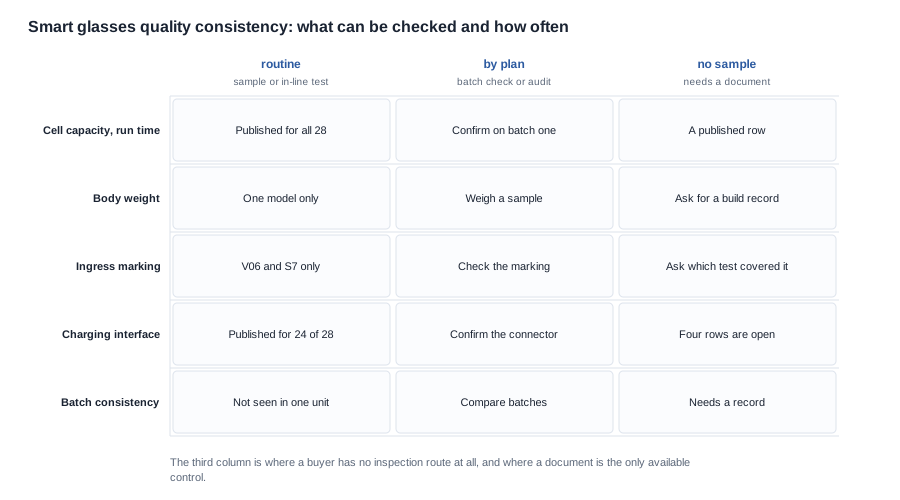
The published rows are the buyer's leverage, because a published row can be checked on every unit without a factory's cooperation. The catalogue publishes cell capacity and run time for all 28 models, and a charging interface for 24 of them — 17 on magnetic charging and 7 on Type C. A camera resolution class is published for all 11 camera models, splitting into 8 MP for eight of them and 13 MP for three, the L2 Utral and the S7, and the L1 Pro.
These rows behave well under a consistency programme because they are absolute rather than comparative: a unit either presents the published capacity or it does not, and the check takes minutes.
Two cautions apply to them. Charge time is published for all 28 models, 26 of them written as a ceiling of two hours or less and the D17 and the ZH12 written as about one hour, and a ceiling is an upper bound, so an inspection sheet that says "under two hours" has quietly changed the meaning of the published row. And cell capacity is published as cell values with a cell count, 55 mAh twice, 90 mAh twice, 70 mAh twice and 100 mAh as a single cell, so a check written against a combined total is testing a derived figure rather than a published one.
The rows a sample can only check once
Some rows are published but not practically checkable on every unit, and they are where a consistency programme has to make a decision rather than a measurement.
The body weight is the clearest case. The catalogue publishes a body weight for one model only, the MT6 at 158 g for the glasses body including the 265 mAh cell and the camera and excluding the folding charging case, whose own weight is not published. Every other model in the range has no published weight, so a buyer cannot run a weight check against a specification for 27 of the 28 models, and a weight check is exactly the kind of check that detects a substitution in a heavier or lighter component.
The ingress marking is published on two rows only, the V06 and the S7, and it is a marking rather than a performance figure: a unit either carries it or it does not, and the check confirms the marking, not the resistance.
The charging case is published in four different states across the 11 camera models. Five models publish a case capacity, two publish a case without a capacity, and four publish no case row at all, which is a variable the consistency sample has to close. Checking the case means confirming which of the four states the unit is in, which on the models with no published row is a request rather than a check.
The rows that cannot be checked at all
Three groups cannot be inspected by the buyer, and a consistency programme that pretends otherwise will fail quietly.
The camera behaviour rows. No camera model publishes a field of view, a frame rate, a video format, a storage path or a low-light figure, and no camera model publishes a Bluetooth version either. These can only be characterised by a sample, and only once, because characterising them is a laboratory activity rather than a field check.
The conformity rows. There is no per-model certification row in the catalogue, and its text contains no CE, FCC or RoHS reference for any model, so there is nothing for a buyer to inspect against. Where the destination is in the European Union, the instrument has to be named correctly in the request: the Radio Equipment Directive is (EU) 2014/53/EU, the electromagnetic compatibility directive is the separate (EU) 2014/32/EU, and the EN 301 489 series is a harmonised standard cited inside a conformity assessment. The general product safety regime, Regulation (EU) 2023/988, applicable since 13 December 2024, and the lithium battery transport regime both belong in the document request rather than in the inspection plan.
The process rows. Yield, per-unit test records, the bill of materials and the cell traceability are not published for any model. A consistency programme that needs them has to ask for them in writing, and a supplier that answers with a promise rather than a record has told the buyer what it is.
How to choose which rows to control
A buyer cannot control every row, and the criteria for choosing are narrower than they look. Three questions decide whether a row goes into the inspection plan.
- Is the row published? A published row is checkable against a written reference with no cooperation from the factory, and it is stable by definition because the specification is fixed. It belongs in the routine check.
- Can the row drift without the published rows changing? This is the only real criterion for a controlled row. A row that moves while the published rows stay put is a row the specification does not describe, and it is exactly where the fifth-batch problem appears.
- Does the channel measure it? A row the channel never tests is not worth a control unless the buyer is measuring it for its own reasons, and a row the channel does test has to be controlled whether the buyer wants to or not.
The shortlist that results is usually four to six rows, and the checklist is the criteria rather than the count. A buyer who has decided which rows to control, on which re-orders, and what to do when one fails has a consistency programme. A buyer who has decided to check everything has an inspection budget and no discipline, because the rows that need attention are the ones that will be skipped when the programme gets busy.
The trade-off to weigh is how to verify the rows that cannot be checked at all. Inspecting them is impossible and asking for them in writing is the only route, so the question for a buyer is when to escalate a request into a clause. The answer is short: escalate when the row is drift-prone and the re-order rate is high enough for the drift to compound, and leave it as a request otherwise.
An inspection plan that scales with the re-order rate
Three inspection intensities
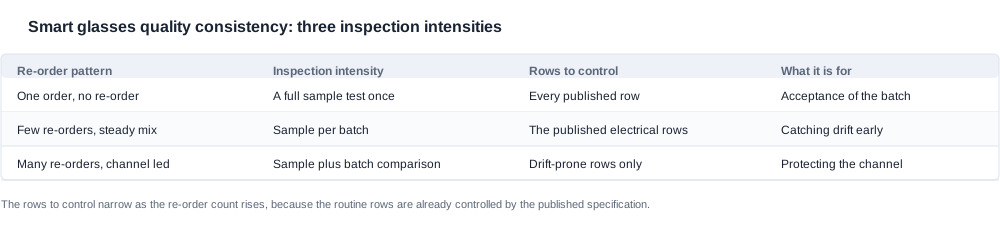
The right inspection plan is a function of the re-order rate, and the plan gets narrower as the rate rises, which is the opposite of what buyers expect.
At one order and no re-order, the plan is a full sample test against every published row, once. This is an acceptance decision rather than a consistency programme, and the sample order checklist is the right instrument for it.
At a few re-orders with a steady mix, the plan is a sample per batch against the published electrical rows — cell capacity, run time, charge time, and the interface where it is published. The published rows are self-stabilising, so the sample is there to confirm rather than to characterise.
At many re-orders into a channel-led business, the plan is a sample plus a batch comparison, and the rows to control narrow to the drift-prone ones. A buyer who controls four rows well is better protected than a buyer who tries to control twenty, because the four are the ones that move and the twenty are the ones that are already fixed by the published specification.
What each inspection has to record

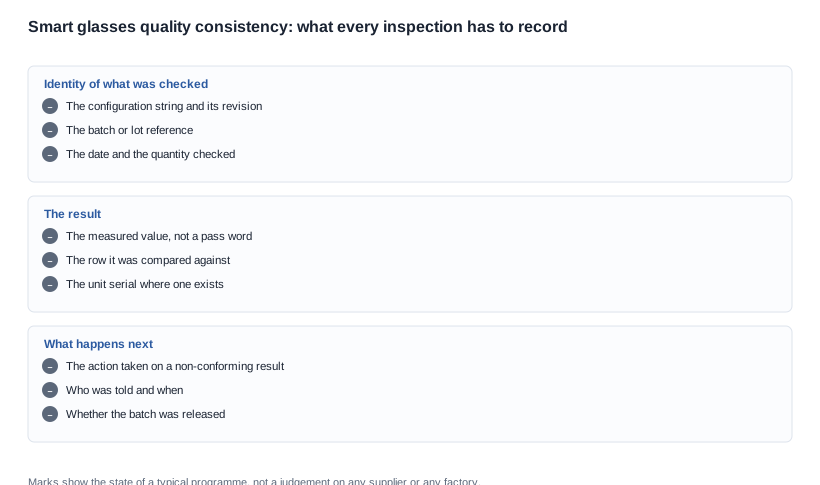
An inspection that records only a pass or a fail cannot detect drift, because drift is a trend and a trend needs numbers. Three groups of information have to be captured, and the third group is the one most often skipped.
The first group identifies what was checked: the configuration string and its revision, the batch or lot reference, the date and the quantity. Without the batch reference, a comparison between consecutive batches is impossible, and the comparison is the entire point.
The second group is the result: the measured value rather than a verdict, the row it was compared against, and the unit reference where one exists.
The third group is what happened next: the action taken on a non-conforming result, who was told and when, and whether the batch was released. This is what turns a set of inspections into a quality control system with an audit trail, and it is what a retailer's own supplier audit will ask for.
The quality consistency checklist is the working version of that list, the factory audit advanced guide covers the case where the rows that cannot be checked at all have to be settled by a visit, and the contract common mistakes article covers the clauses that make an inspection result usable as evidence.

The channels that punish variance hardest
Marketplace, retailer, direct
The channel decides how quickly a drift becomes a commercial event, and the three behave differently.
A marketplace magnifies both the return rate and the language of the reviews, because a single drifted characteristic produces a visible pattern in the review text rather than a line in a returns spreadsheet. The commercial consequence arrives first, because a listing's position is affected by review quality before any procurement conversation happens.
A retailer asks for substantiation before it asks for anything else. Its exposure is to its own customers and to its own auditors, so it asks for a record, a batch reference and a corrective action route, and it asks for them before the second season rather than after the first complaint. This is the channel that turns consistency from a cost into a commercial requirement, because the retailer prices the requirement into its own terms.
A direct channel leaves the burden entirely with the brand's own service desk. The drift appears as support contacts, as returns that nobody has attributed to a batch, and as a marketing problem, because the brand's own material describes the product. This is the slowest channel to show the problem and the most expensive one to absorb, because nothing external forces the comparison that would have revealed it.
Where a drift becomes a commercial event
Three moments are where a drift turns into something that costs money, and a consistency programme can be designed around them.
- The re-order gate. A drift is only detected at a re-order if a comparison exists. The gate is the point at which the previous batch is compared with the new one, and a programme that skips it has no mechanism at all.
- The channel audit. A retailer or marketplace asks for a record, and the record either exists or does not. A supplier with per-unit test records can produce one; a supplier without them can only offer an assurance, and an assurance is not a record.
- The listing claim. A published row that drifts away from the goods creates a gap between the listing and the unit, and that gap is a claim risk rather than a quality problem — the same gap that appears when a model is quietly re-specified.

A worked illustration: the first batch and the fifth
The example that closes this article is a constructed scenario. It describes no customer and no shipment, and the quantities are chosen to show where variation accumulates.
A brand-side buyer orders a camera model in the 8 MP class for a channel programme, and expects to re-order through the year. The first order is checked in full: every published row for that model is tested on a sample, the result is recorded, and the batch is accepted. The buyer's supplier is asked for per-unit test records and for the bill of materials; the supplier provides a summary of test results but not per-unit records, and the buyer notes the gap without escalating it.
At the second and third re-orders, the buyer's programme is a sample per batch against the published electrical rows. The results are consistent, and the buyer's working assumption forms: the product is stable, and a full check would be a waste of effort.
At the fifth re-order, the buyer compares the fifth batch against the first on the rows that were checked every time, and they match. The buyer also notices something they did not expect: the charging case in the fifth batch does not correspond to the case configuration in the first. The model publishes a case row, so the buyer knows which state the goods should be in, and the first batch was in it. The fifth batch is in a different state — a case that the published row for that model does not describe.
Nobody has made an error. The published specification was followed, the sample checks passed, and the buyer's plan was correct for the rows it covered. The drift happened in a row that the published specification does not describe for that model, and the buyer's plan had no mechanism for it because the check they had built was a check on the published rows.
The recovery is straightforward once the gap is visible: the case state becomes a controlled row, the packaging description and the order line are aligned to it, and the next comparison includes it. But the buyer only found it by accident, at the fifth order, when something else made them compare.
The lesson generalises to the whole category. The published rows are what a buyer can control; the rows that are not published are where consistency actually fails; and the comparison between consecutive batches is the only mechanism that detects a failure in a row nobody had specified. A programme with a rising re-order count needs that comparison, and a programme without it is relying on the assumption that nothing changes between batches, which is the one assumption in this category that is never true.
The consistency evidence we do not hold
The short answer: we publish the specification but not the consistency evidence, and the two are different things. We publish cell capacity, charge time and run time for all 28 models, a charging interface for 24 of them, a camera class for all 11 camera models, a charging-case capacity for five of those camera models, an ingress marking on two rows and a body weight for one. We do not publish yield, per-unit test records, the bill of materials, cell traceability, unit prices, minimum order quantities, capacity or lead time, and we do not publish per-model certification, because the catalogue contains no per-model certification row and no CE, FCC or RoHS reference for any model.
The honest position is therefore a boundary rather than a claim. A buyer can control the published rows today, without any documentation from us and without any cost. What a buyer cannot do is verify batch-to-batch consistency, because the evidence that would settle it — per-unit records, a bill of materials, a cell traceability file — is exactly the material that is not published.
What we can do is tell you, for a named model, which rows are published and therefore checkable, which rows are open and therefore drift-prone, and which of the four case states or the two ingress rows or the single published body weight apply to the model in front of you. Send us the models, the configuration, the expected re-order pattern and the channel, and we will tell you which rows to put in the inspection plan, which rows to request as documents, and where the drift would most likely appear.


