

Smart glasses quality consistency has implications that reach well past the product it describes, and the reason is structural rather than dramatic. A unit is the smallest object in this chain, but the consequences of a variation start at the unit and surface at the brand, where they arrive as a returns reserve nobody can defend, a channel partner who has stopped repeating the order, and a listing claim that no longer survives contact with the field. This page takes those implications one layer at a time, names who carries each one, and identifies the early warning that arrives before the cost does — because the implications are only expensive if you are the last to notice them.
Smart glasses quality consistency and the layers it reaches
The implications question this page answers
The reader is a brand-side purchasing manager, a channel buyer or an importer who is not asking about units at all. They are asking what happens to the business when the units are not consistent, and they are asking it because somebody above them has started asking. A finance lead wants to know why the returns reserve is what it is. A channel manager has noticed that one distributor is reordering and another is not. A product lead wants to know whether the runtime figure on the product page is safe to keep.
The decision that follows is a resource decision rather than a specification decision: where does the effort go, and who owns it. Consistency programmes fail more often from ownership than from technique. The factory owns the process, the buyer owns the specification, the brand owns the claim and the channel owns the relationship, and a programme where nobody has been told which of the implications is theirs becomes a programme that everyone assumes is someone else's. The shortlist criteria for deciding where to start are worth stating early, because the wrong starting layer is the most expensive mistake available to a buyer here.
The structure of the implications matters for that reason. They do not arrive in a random order and they do not stay where they originate. The chain runs from the unit to the lot, from the lot to the shipment, from the shipment to the channel, and from the channel to the brand, and the last two layers are the expensive ones because they are the hardest to reverse. A unit that can be replaced is an inconvenience. A channel partner who has stopped repeating the order is a commercial event.
The five layers, and who owns each one
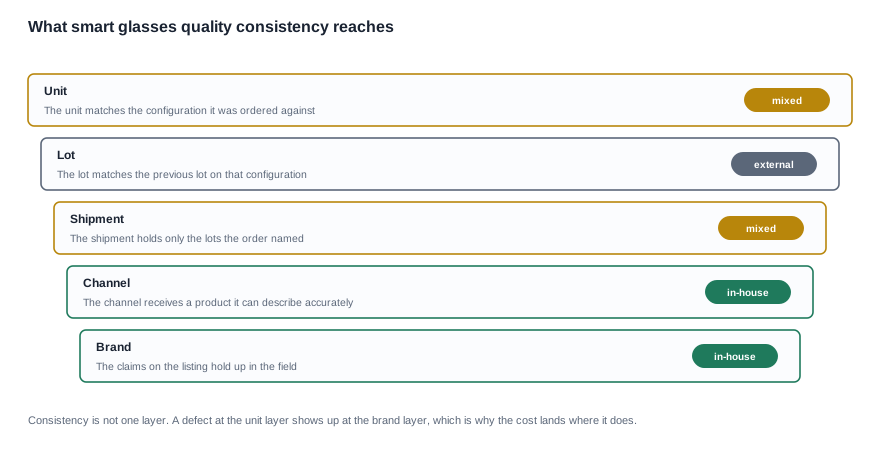
The layer picture is the argument of this page in one chart. The unit layer is a matching question — does this unit match the configuration it was ordered against. The lot layer is a repetition question — does this lot match the previous lot on the same configuration. The shipment layer is a containment question — does the shipment hold only the lots the order named. The channel layer is a description question — can the channel describe what it received accurately. And the brand layer is a claim question — do the claims on the listing hold up in the field.
A buyer who only works the first two layers will believe the programme is under control, because those are the layers where a factory can produce evidence. The last three layers are where the money is, and none of them can be settled by a factory document.

The implications, the owner, and the early warning
Five implications a procurement team will actually meet
The table below is the working list. Each row names an implication, the part of the organisation that carries it, the signal that appears before the cost, and the control that removes it.
| Implication | Who carries it | The early warning | The control that prevents it |
|---|---|---|---|
| A returns reserve set by guesswork | Brand finance | A reserve with no complaint record behind it | Tag every complaint with a lot and review the rate by lot |
| A channel partner stops reordering | Brand and channel | Two shipments described differently by the same partner | A frozen configuration plus a retained sample per lot |
| A listing claim stops holding | Brand marketing | A published figure with no test condition attached | Claim only what the catalogue publishes, with its exclusions |
| The forecast absorbs the variation | Brand planning | A reorder rate that changes between lots | One configuration held across the run |
| The next order repeats the problem | Procurement | No change notification route in the agreement | A clause naming affected models and lots |
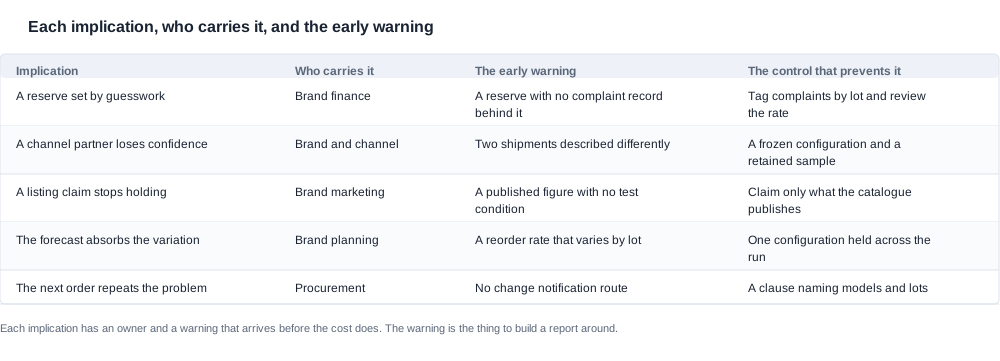
Two of the five rows are worth expanding, because they are the ones that a procurement team usually recognises last. The reserve row is a finance issue that originates in a returns process nobody owns, and the forecast row is a planning issue that originates in a supply decision. Both are late symptoms of decisions taken early and cheaply.
The reserve that nobody can defend
A returns reserve is a number with three possible origins, and only one of them survives a budget review. It can be a percentage chosen by a finance team from a category assumption, which is the most common and the least defensible. It can be a rate derived from a complaint record tied to production lots, which is defensible because it can be re-derived and challenged. Or it can be a rate derived from a complaint record that is not tied to lots, which is better than a percentage and still cannot be argued with a supplier, because a supplier can always ask which lot the returned unit came from and the buyer will not be able to answer.
There is a second reason the reserve matters more than its size suggests, and it is the one that does not appear on the spreadsheet. The reserve is the number the brand is judged on when a channel partner asks whether the product is reliable. A brand that can say "our return rate across the last three production lots was X" is making a claim; a brand that says "we reserve Y percent" is making a budget statement. The first one survives a commercial conversation and the second one does not.
The practical step is small. One field on the returns form — the production lot — converts the reserve from a budget assumption into a measured rate, and it costs nothing beyond the discipline of copying a number from the carton.
The claim on the listing
Every product page in this category makes claims, and a claim is a promise about a range of units rather than about a sample. The catalogue publishes what it publishes, and the discipline a brand applies to its own claims should be the same discipline it applies to a supplier's: state the figure, state its exclusions, and do not add a condition that the figure was never measured under.
The exclusions are the part that gets dropped in translation. The catalogue publishes a runtime band, and the band carries no starting state of charge, no duty cycle and no termination criterion. It publishes a charge time for every model, and it publishes no termination criterion for the charge either. It publishes a weight for one model only, the MT6 glasses body at 158 g including the 265 mAh cell and the camera and excluding the 1200 mAh folding charging case, and no model in the range has a published frame weight. It publishes the IP54 marking on the V06 and the S7 as a catalogue annotation rather than a report-backed claim, and it contains no CE, no FCC and no RoHS marking for any model. A listing that repeats the figure and drops the exclusions makes a stronger promise than the catalogue does.
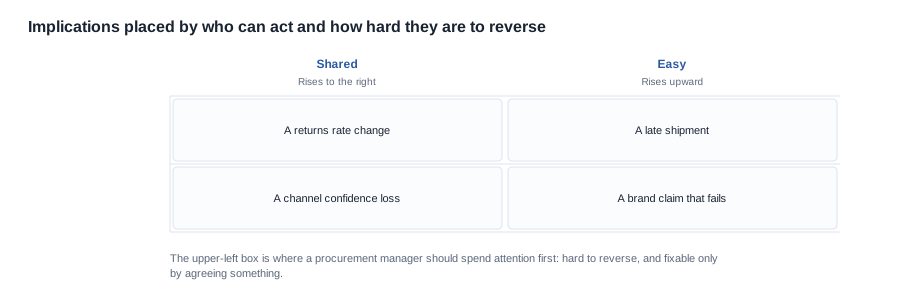
The matrix is the order of attention. The upper-left box is the quadrant that is hard to reverse and can only be fixed by agreeing something in advance — the channel relationship and the brand claim. A buyer cannot inspect a channel partner back into confidence and cannot inspect a published claim back into being true, which is why those two need a decision before the next order rather than a response after the next complaint.

Verifying an implication before it becomes a cost
The evidence each implication needs
Each implication has to be evidenced before it can be sized, and the evidence differs by row. The reserve needs a complaint record with lot identifiers and a fault-versus-expectation split, because a reserve that includes expectation gaps overstates the quality exposure and understates the product brief problem. The channel implication needs a comparison of what the partner said about two separate shipments, because a channel report is an opinion and becomes evidence only when it is attached to a lot and a configuration. The listing implication needs the published figure and its exclusions kept together, so that the marketing claim and the specification are the same document. The forecast implication needs the reorder rate by lot, so that the difference between a demand problem and a supply problem can be seen. The repeat-order implication needs the change notification route in the agreement, and a notification route that names only "a component" cannot be acted on.
The common feature is that all five are evidenced by something that already exists, and in four of the five cases the thing that exists is a record the factory or the returns team keeps anyway. The work is in the indexing rather than in the collection.
The questions to ask before the implication is priced
An implication that is sized before it is evidenced becomes a number in a model, and numbers in models acquire authority they have not earned. The questions to ask are therefore questions about evidence, and they are worth asking before you order rather than after the first return.
- Which layer does this variation reach, and who owns that layer? Completion: a named layer and a named owner on the buyer's side, not a department.
- What is the total cost of this implication once it reaches that layer? Completion: a figure with the reserve, the remedy and the schedule effect shown separately.
- Which red flags would have told us this was coming? Completion: a list drawn from the quotation and the order, not from the returns.
- What should we have asked the supplier before you order? Completion: a written question set, and the answer to it.
- What is the earliest warning, and who watches for it? Completion: a signal, an owner and a review date.
- Is this a specification problem, a process problem or a claim problem? Completion: one of the three, with the evidence that places it there.
Six questions in this order are enough to establish which implications a programme can actually manage, and the third one is the most useful of them, because a red flag identified in the quotation costs nothing to close while the same flag identified in the channel costs a reorder. A buyer who wants to evaluate the real exposure of a quality programme should be able to name the flags that preceded it, and a supplier who cannot name them is telling the buyer that the programme will be run by reaction.
Where the trade-offs actually sit
Three trade-offs run through all five implications, and each of them has a defensible position rather than an obvious one. The first is between a fast answer and a defensible one. A reserve set from a category assumption is available on day one and indefensible on day ninety; a reserve built from a by-lot complaint record is defensible and arrives late. For a brand with a launch inside a quarter, the first is sometimes the only available choice, and the correct response is to mark it as provisional rather than to quietly let it harden.
The second trade-off is between breadth and depth. A programme that holds every characteristic to a written limit is thorough and unaffordable; a programme that holds two characteristics is affordable and testable. The decision of which two is a commercial one, and the criteria for making it are the channel complaint rate and the cost of the remedy, not the number of characteristics the buyer's team feels able to administer.
The third trade-off is between the buyer's control and the supplier's convenience, and it is the one that is usually settled by default. Retained samples, a named change recipient, a per-lot record set and a first-failure disposition all inconvenience the factory slightly, and all four are the things a buyer discovers it needed only after the first dispute. Negotiating them at the order costs a paragraph; negotiating them afterwards costs the relationship.
The response path when a lot is in question

Six steps, and the order is what makes the path cheap. Holding the shipment first is the only step that prevents the cost from spreading to the channel and the brand layers, and it is the step buyers are most likely to skip because nothing has gone wrong yet. Matching the unit to a lot and a configuration second is what separates a configuration problem from a process problem. Separating a fault from an expectation gap third is what stops the team from chasing a cause that does not exist. Naming the variation source with its evidence fourth is what makes the claim arguable. The remedy fifth is the part that costs money and the part nobody can avoid. The sixth step — writing the control into the next purchase order — is the only one that makes the next occurrence cheaper, and it is the one that gets skipped when the team is relieved that the shipment was stopped.
The full checklist of signs that a flag has surfaced is worth keeping in one place, because the signs arrive in a different order every time and a team that has to reconstruct them during a dispute will reconstruct them badly. A buyer who has the checklist, the lot identifier and a retained reference unit can settle a claim in a morning; a buyer who has none of the three will settle it in a quarter, if at all.
Where these implications break
Four failure patterns recur, and each of them has a signature that appears before the cost.
The reserve that was cut in planning. The numbers look better and the returns arrive the same as before, because the reserve was an accounting entry rather than a measurement. The control is a by-lot returns rate that is reviewed at a fixed point in the cycle, so that a cut is a decision rather than an omission.
The claim that outlived its condition. A published figure is repeated in a channel listing without the condition it was measured under, and a customer comparison that does not reproduce it becomes a complaint that is technically a fault and commercially a claim problem. The control is to keep the figure and its exclusions in one place and to reuse that place.
The channel relationship that was rebuilt twice. A partner reports a difference, the brand credits the units, and the partner still does not reorder because the brand has not demonstrated that the difference was found and fixed. The control is to send the lot-level answer, not the credit note.
The supplier change nobody announced. A new sub-supplier or a new line produces a gradual difference across shipments, and the brand's own planning absorbs it as a demand change. The control is the notification route, with a named recipient on the buyer's side.

A worked implication case, and what we publish
An implication case, worked through
This worked case is constructed to carry an argument about what consistency is worth, not to report an engagement. No customer is named and no order is claimed; the camera model, the two shipments, the reserve and the channel report are all assumed, so that the sequence from a unit-level variation to a brand-level consequence can be followed step by step.
A brand has launched a camera model into a channel. Two shipments have been delivered. The returns team has a monthly count of around forty units and a finance team has set the reserve at a percentage of order value. One distributor has reordered once; another has asked twice whether the units will be identical to the first shipment. Nobody in the business can say which lot any of the forty returns came from.
Step one is to establish the size of the problem honestly, which means separating the returns into faults and expectation gaps before anything else, because a reserve built on the combined number is both a financial and a diagnostic error. Step two is to attach a lot identifier to the returns form and re-ask the forty questions, which is tedious and produces the single most useful dataset the brand owns. Step three is to read the dataset by lot, and to discover that the returns cluster in the second shipment while the first produced almost none. Step four is to pull the configuration for the two shipments and to find the case option was ordered differently, which converts a suspected process problem into a configuration one and reduces the exposure considerably.
Step five is to deal with the two remaining implications, which are the expensive ones. The reserve is rebuilt from the by-lot rate rather than from a percentage, which is both a smaller number and a defensible one. The channel answer is a lot-level explanation with the configuration named, not a credit note, because the distributor's question was about the next shipment rather than about the last one. Step six is to fix the listing claim, so that the published figure travels with the condition that produced it. None of this required a factory visit, and every step produced a document that survives the person who wrote it.
What we publish, and what we will not promise
Stated plainly: the published rows are the part of the specification we can stand behind, and the implications of consistency are the buyer's to manage rather than ours to price. Everything a claim about the brand layer depends on has to trace back to a published row, so the configuration rows are published exactly as the catalogue states them: the resolution tiers, the cell capacities, the colour availability, the charging interfaces and the case options, the published runtime bands, the charge times and, for one model, the whole-unit weight with its exclusions. What is absent — tolerances, defect rates, cycle life ratings, capacity data — is the part of a claim a brand should not make at all. We will not quote a defect rate, we will not estimate a returns reserve, and we will not present a certification mark as evidence of a controlled process, because each of those is a claim the catalogue cannot support.
The published rows are also the boundary of what a claim is allowed to depend on. A sensor model, an acoustic measurement, an ingress test report number, a certificate number with its validity date, a cycle life rating, a factory or line capacity figure and the weight of any model other than the MT6 are all outside the catalogue, and we would rather a brand's claim rest on a published configuration row than on a figure we cannot produce on request. Where a model has no published figure, the honest answer is a question to the supplier and a row in the agreement, not a number we estimate on your behalf. Two limitations decide what a brand can safely say. The IP54 marking on the V06 and the S7 is a catalogue annotation rather than a report-backed claim, and the catalogue text carries no CE, FCC or RoHS marking for any model, so a listing built on either of them is a claim the brand cannot support in the field. Both are document requests, and both should be made before the listing is written.
What we can do is take a complaint file, a configuration and a set of published figures and tell you which implication the evidence points at, which layer it reaches, and which control belongs in the next purchase order. The camera side of the specification is at camera technology and key specifications, the sample-side procedure is at the sample policy SOP template, and the product range is at AI camera glasses. The pillar page is quality consistency.
The action to take now. Send us the model, the configuration and the complaint categories, and we will tell you which layer the variation reaches, which implication it will produce first, and which control belongs in the next purchase order rather than in the next quarter.
Related reading
- The camera specification — camera technology and key specifications
- The sample-side procedure — sample policy SOP template
- The product range — AI camera glasses
Send us the model and the complaint categories, and we will show you which layer the variation reaches — the implications of smart glasses quality consistency, from the unit to the brand listing.


