

What affects smart glasses quality consistency is mostly decided before the line starts, and a buyer who only inspects the finished units is checking the last hour of a process that started weeks earlier.
Consistency in this category is not a manufacturing virtue that a good factory simply has. It is the result of a set of decisions, each of which is made once and applied to thousands of units: which cell batch, which firmware build, which case source, which module, which colour tolerance, which carton, which artwork revision. Each of those decisions is a point at which the programme can drift, and each of them leaves a record if the buyer asks for it. The published model data gives you the baseline for every one of them, because the differences between models in our range are specific and named. The CY03 and the CY05 share a 290 mAh cell and a 1400 mAh case and differ in ways our published material does not spell out. The L2 Utral is offered at a 900 or 1400 mAh case and carries a Type-C interface. The V03 Pro is published in three colours and the V06 in four.
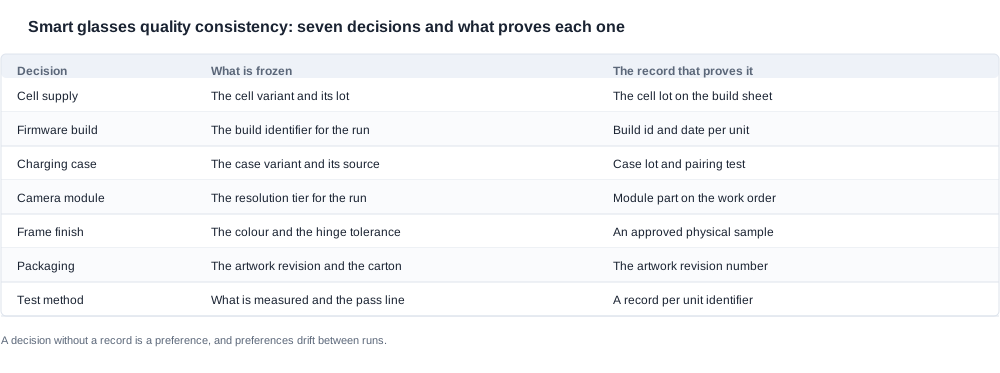
Smart glasses quality consistency: seven decisions, each frozen before the run
The table above sets out the seven decisions and, more importantly, the record that proves each one was held. The second column is what a buyer freezes; the third is what a buyer asks for. A decision without a record is a preference, and preferences drift between orders in exactly the way a buyer does not notice until a customer does.
The seven decisions are not equally difficult to freeze, and the ranking is worth knowing. The cell variant and its lot is easy to freeze and easy to prove, because the cell capacity is published for every model and the lot goes on the build sheet. The camera module is the same: the resolution tier is published for all eleven camera models, so a run held to a tier is a run whose module variance is bounded. The artwork revision is easy to freeze and easy to prove. The colour tolerance is medium: it is a decision, but it is a judgement, and it needs a physical reference to be checkable against.
The charging case is harder, because the case is a separate purchase and in several models its state is not published at all. The firmware build is the hardest to freeze in a commercial sense, because a build change is invisible on the shelf and perfectly legitimate from the supplier's point of view — the software is improved for reasons that have nothing to do with the buyer. And the test method is not a decision so much as an agreement, because it decides what the programme will know about its own output.
The published rows that give each decision a baseline
The baseline is what makes the freeze checkable rather than aspirational, and this is where the catalogue is more useful than it appears.
Cell capacity is published for every model. The camera range runs 220 mAh for the V03, the V03 Pro and the MT5, 260 mAh for the KY06, the V06 and the S7, 265 mAh for the MT6, and 290 mAh for the L2 Utral and the L1 Pro, and the CY03 and the CY05. A run whose cell lot is recorded against those figures is a run whose endurance behaviour can be checked against a published number rather than against a feeling.
Resolution tier is published for all eleven camera models — eight megapixels across eight of them, thirteen on the L1 Pro, the L2 Utral and the S7. Module consistency inside a run is therefore measurable against a published class.
Charging method is published for twenty-four of the twenty-eight models: seventeen magnetic, seven Type C, and four — the MT6 and the CY03, and the CY05 and the L1 Pro — with no charging-method row at all. For those four, the charging interface is an open decision that has to be frozen explicitly, because it is exactly the decision that changes the assembly and therefore the case behaviour.
Case capacity is published for five camera models at 900 mAh or 1400 mAh for the L2 Utral, 1200 mAh for the MT6's foldable case and 1400 mAh for the CY03, the CY05 and the L1 Pro. Two more, the KY06 and the MT5, ship with a case whose capacity is not published, and the catalogue publishes no charging-case row at all for the V03, the V06 and the S7, while the V03 Pro has no charging-case row.
Ingress marking is published on two models only. IP54 appears on the V06 and the S7, with no test report number attached. A run that includes a different model has no published ingress position to hold to, and a product page that extends that marking to other models is making a claim no document supports.
Colourways are published per model, which is what makes the colour tolerance a per-configuration decision rather than a general one.
What the catalogue does not publish matters just as much: no sensor part number, no field of view, no video resolution, no frame rate, no stabilisation figure, no microphone pickup distance, no defect rate, no yield and no per-model certification row. Each of those is a freeze decision with no published baseline, and each of them has to be closed in writing before the run rather than checked afterwards.
The three decisions that change between orders rather than within them
The matrix below sorts the seven by when the variation appears, because the two groups need completely different controls.
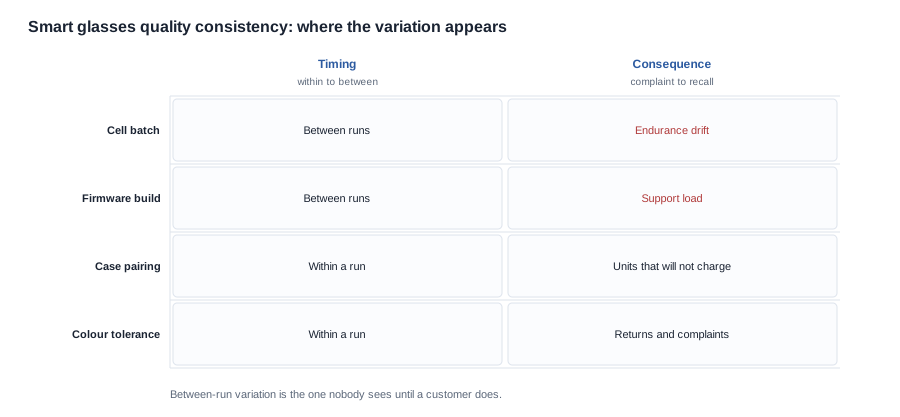
Within-run variation is the one that inspection catches. A unit that is out of tolerance against a published figure is found by the receiving inspection, and the cost is a replacement. The controls are sampling and a written pass condition, and this is the part of quality that a factory does well when its process is stable.
Between-run variation is the one that inspection does not catch, because each individual run is internally consistent and the shift happened at the boundary. Three decisions drive it, and they are the three a buyer most often forgets to ask about.
The firmware build is the first. A firmware change is invisible on the shelf and obvious in use, and it is the kind of change a supplier will make for a good reason and apply to units already in the field. If a run carries a firmware identifier, a build date and a stated policy on updating units already shipped, then a support enquiry has an answer. If it does not, a customer reporting a fault is reporting a fact nobody can check.
The cell lot is the second. Endurance is the slowest-varying attribute in the whole set, and it is the one a buyer is least likely to notice within a single run. A cell lot change between two orders does not produce a visible fault; it produces a gradual difference in how the units behave at the end of a shift, and by the time it is visible it is a returns pattern rather than a production fault.
The case source is the third, and it is specific to this category. A magnetic case is a mechanical and electrical interface between two parts that were assembled in different places, so a change of case source changes the behaviour of the interface without changing anything on the frames.
The practical rule that follows is simple and worth applying to all three: ask what is frozen for a production run and what is frozen on a date. A run-level freeze is what protects consistency within a shipment. A dated freeze — the point at which a change takes effect — is what protects consistency across shipments, and it is the one that is missing from most agreements.

Why the case and the unit have to be tested as a pair
This deserves its own treatment because it is the fault in this category that most often reaches a customer mislabelled.
A unit that will not charge on its own case is a fault that presents as a dead battery. The customer reports a short battery. The support line issues a replacement. The replacement arrives, charges on the case, and works perfectly, and the original unit is written off as a manufacturing defect that the supplier never reproduced. Meanwhile the real cause — a case-to-unit coupling that was not tested as a coupling — stays in the production system and reappears on the next lot.
The reason this happens is a testing structure rather than a component failure. A unit test proves that the frame charges through its own interface. A case test proves that the case delivers power. Neither proves that the two will work together, because the interface between them depends on alignment, contact geometry and the tolerance stack across two separately manufactured parts. This is the same class of problem as a connector that has to mate with a particular receptacle: each part passes its own test and the pair still fails.
The control is unglamorous. Test the pair, record the pair, and define the coupling test at the level of the unit-plus-case rather than at the level of the two components. Where a programme ships cases, the case coupling should appear as a row on the receiving inspection sheet at goods-in, not as an assumption that the factory covered it. The questions to ask are how the pair is tested, what is recorded per unit, and what the pass condition is for a case that does not charge.
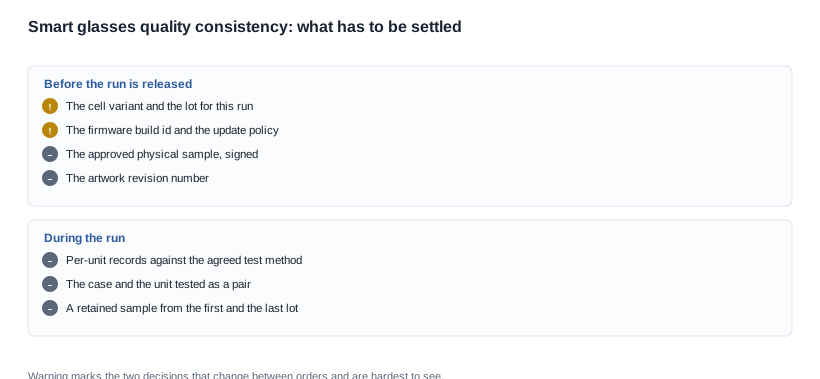
The five questions that decide whether a run is actually controlled
The checklist above is the set of items; these five questions are the ones that produce an answer rather than a confirmation. They are worth asking in this order, because each one narrows the field.
- What is frozen for this run, and what changes only on a stated date? A written list with two named change points. The second half is the part that protects consistency across shipments, and it is the half that is usually missing. A supplier who answers only the first half has frozen the run and left the programme unprotected.
- How are the unit and its case tested together, and what is recorded per unit? A record against a unit identifier, not a pass on a bench board. The reason this is second rather than later is that a coupling failure is the one that reaches a customer as a mislabelled symptom, and it is invisible in an averaged figure.
- What happens to units already shipped when the firmware build changes? A written policy with a date. In this category the firmware is improved for reasons that have nothing to do with the buyer, and a policy agreed in advance is what stops a support enquiry becoming an argument.
- How do you decide that a production unit matches the approved sample? A physical comparison against a signed reference, on an agreed checklist. The word that matters is physical: a photograph cannot carry a colour tolerance or a hinge tolerance, and the two models in this range with the most colourways are the ones where a colour decision has the most units riding on it.
- What happens when a fault appears in one unit of a batch? A containment process — how the lot is identified, how the population is bounded, and how the affected units are found before they reach the channel rather than after.
The red flags worth naming are specific rather than atmospheric: a change policy that describes a process but names no date, a test method with no pass condition, a retained-sample practice that keeps samples from the first lot but not the last, and a defect figure quoted without a sample size. Those are the pitfalls worth designing out, and each of them can be converted into a line in the order rather than into a lesson learned after a shipment. The questions to ask before you order are these five, and they are worth putting in the enquiry rather than in the negotiation.

Consistency is a run property, not a model property
A model can be consistent and a run can still be inconsistent. The distinction decides where attention belongs, and it is the distinction most often lost in a supplier comparison.
At the model level, the question is which supplier to choose. The method is to send samples from each, test them against the same written list, and compare. This is a short comparison and it is the right one to start with, because it settles whether the comparison is even fair.
At the run level, the question is whether the programme is holding. The attention belongs on the frozen configuration, the frozen firmware, the approved sample and a record of what was shipped when. This is the harder question, because a run-level failure is invisible in the shipment that contains it — nothing appears wrong, every unit passes, and the drift shows up two shipments later as a complaint that no one can explain.
The reason the distinction matters commercially is that the two levels have different remedies. A model-level failure is a supplier selection problem and the answer is to change supplier. A run-level failure is a control problem, and the answer is a freeze, a record and a retained sample. Treating a run failure as a supplier failure is expensive, because it discards a supplier who may be entirely capable, and it is the single most common way a buyer loses a working relationship over a fixable problem.

A run controlled end to end, and what we will and will not hold
Three shipments, one repeating battery-life pattern
The example below is constructed. No client, no production run and no outcome is claimed; the camera model with a charging case, the two colourways and the European destination are all assumed, so that the sequence can be followed.
A brand has run three shipments of one camera model with a charging case in two colourways, and the support data has started to show a pattern: a small but steady number of units that report short battery life. The factory's own testing shows no failure, and the units work when they are charged through the case in the factory.
The first step is to separate the two candidate causes. The first is a cell lot change between shipments, which would produce slow endurance drift across the programme. The second is a case-to-unit coupling issue, which would produce a smaller, more concentrated set of failures. The evidence points to the second: the failures are clustered rather than spread, and they are clustered on one colourway, which is a clue that would be invisible in an averaged defect rate.
The second step is to find the control that should have caught it. There are two candidates: a per-unit coupling test, and a dated freeze on the case source. Neither exists, because the cell lot is recorded on the build sheet but the case source is recorded only as a case capacity, and there is no coupling test at all. The cause is therefore not a component defect. It is the absence of a freeze and a test.
The third step is the containment. The programme stops shipping the affected lot, the case source for the next run is frozen and identified, and the coupling test is added as a per-unit record with a written pass condition. The retained sample from the earlier lots is brought back and paired against units from the current lot, which establishes the scale of the affected population.
The fourth step is the forward fix, and it is the one that protects the programme rather than the shipment. A dated freeze is written into the agreement: what is fixed for a run, what changes only on a stated date, and a change-notification obligation so that a change of cell lot, case source or firmware build arrives as a written notice rather than as a surprise in the field.
The result is not a dramatic recovery. It is a programme that can now answer the question it could not answer before: whether any given unit in the field came from a configuration the programme still recognises.
Where our position sits
The working rule we apply: quality consistency in this category is mostly a configuration-control problem, and the published model data is the only objective baseline available to both sides. We publish the model-level figures — resolution tier, cell capacity, run-time band, charge time, charging method, case capacity where one is published, colourways, the ingress marking on the two models that carry it, and the single published weight — and we will tell you plainly which of them we can hold a run to and which we cannot.
What we will not do is publish a defect rate, a yield figure or a tolerance band, because the catalogue does not contain them and a published number without a method behind it cannot be compared against anyone's. We will also not state that a model carries an ingress marking beyond the two that do, and we will not extend the IP54 annotation on the V06 or the S7 to other models in the range.
What we will do is take a configuration, a volume band and a run schedule, and tell you which of the seven decisions are already fixed by the published rows, which are open and have to be closed in writing, and which records to ask for so that the freeze can be evidenced rather than asserted. A supplier who cannot name a frozen configuration for a production run has no answer to the question, and a supplier who can name one has usually already done the hard part.
The quality consistency pillar sets out the framework, and the first-order checklist turns it into items.
Send us the configuration, the volume band and the destination market, and we will tell you which rows a smart glasses quality consistency programme can hold to today and which have to be closed in writing before the first run.


