

The documents to request for smart glasses quality consistency come in a particular order, and the order is not the one most buyers use.
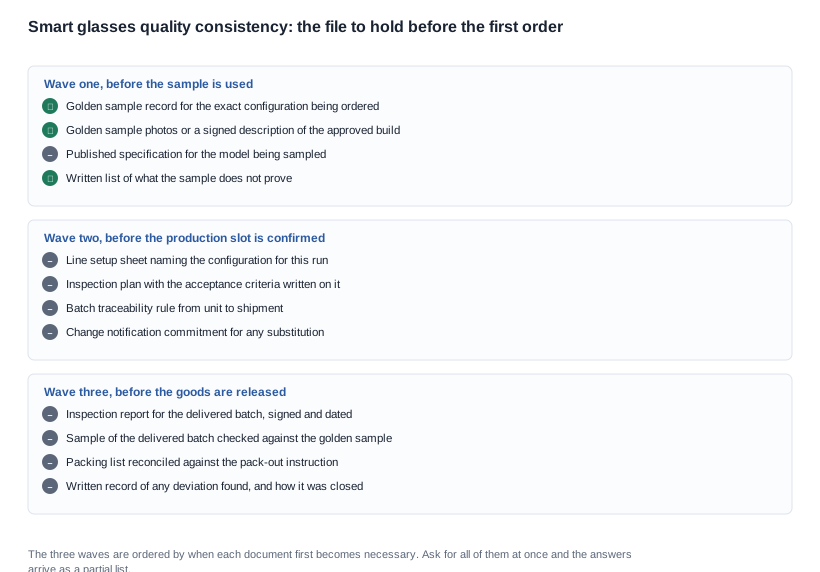
Most buyers ask for everything at once in the first week, get a partial answer, and end up chasing a mixed list for six weeks. The better approach is to request in three waves, ordered by when each document first becomes necessary, because the answer to a request that arrives too early is almost always a "not yet" rather than a document.
That ordering is not administrative. It reflects where drift enters this category. Drift does not appear at the end of the line; it appears when a component lot changes, when a case option is substituted, when a firmware build is refreshed mid-run, and when a packing instruction is read from a different revision than the one that was approved. Each of those moments happens at a specific point in the programme, and each has a document that either exists at that moment or does not. Request the document before its moment and you get a refusal; request it after and you get a record.
What follows is the working version: what the documents are, in which wave they belong, what a good answer looks like, how to test whether the documents actually exist, and where the failures happen once you have them all.
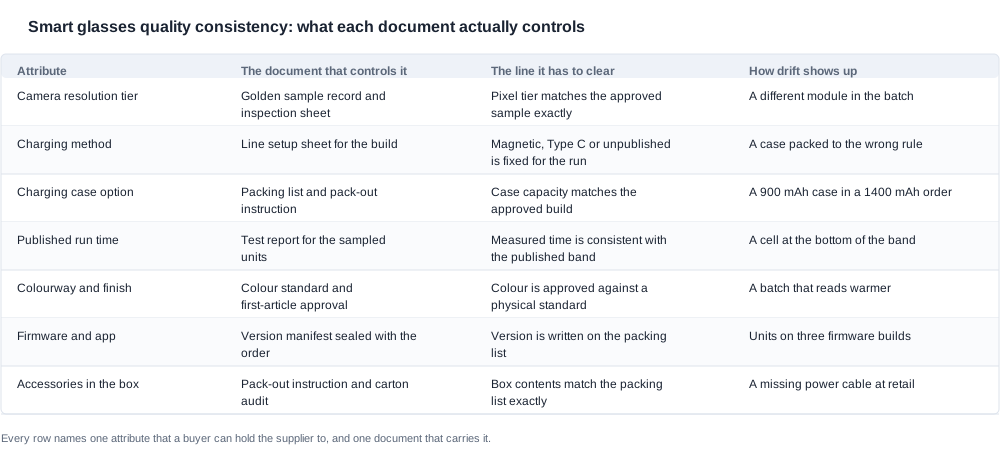
Smart glasses quality consistency: wave one, and who owns the baseline
A sample arrives before most of the quality records do, and that is not a problem — it is the natural order of a programme. What matters is that the buyer knows which questions the sample can answer and which it cannot, because the second category is where a programme goes wrong.
A sample can tell you how the hardware presents. It cannot tell you whether the unit you will receive in twelve weeks was built to the same specification, whether the components in it came from the same lot, whether the firmware on it is the build you approved, or what will be in the carton. Those are four different questions and each of them has a different document behind it.
The four documents in wave one exist before the sample is even opened, because they are the baseline everything else is measured against.
| Document | Why it is needed now | What a good answer contains |
|---|---|---|
| Model configuration sheet | Everything else is checked against it | Model, tier, colour, case capacity, interface, packaging, dated |
| Published specification extract | The baseline for every test | The published figures for that model, not a marketing summary |
| Test plan and pass criteria | Without them, a test result is meaningless | Each test with a method and a written criterion |
| Sample and production relationship | A sample that is not a production build proves less | A written statement of how the sample relates to the build |
The last row is the one buyers skip and the one that determines how much the sample is worth. A sample taken from an engineering batch, from a different component lot, or from a build made before the production line was set up is still a useful object; it is simply not a reference. A supplier who states the relationship plainly has told you how to read everything the sample shows you, and a supplier who cannot state it has told you the sample carries less weight than you assumed.
The published specification extract matters for a specific reason. The published run times in this category are given as bands rather than as single figures — five to eight hours, six to eight hours, about seven hours — and the test condition behind those bands is not published. That means the specification gives you a target, not an acceptance criterion. A test plan that says "runtime shall be about seven hours" is not a test plan; a test plan that says "runtime shall be at least the published lower bound under the stated condition" is one, even when the condition is a working temperature and a usage profile you have to agree in advance.
The reader, and what is actually at stake
The reader here is someone buying on the brand side, a channel buyer or an importer. The situation is one of three: a quotation has arrived and the buyer is deciding whether the supplier's quality process is real; a first batch has arrived and does not match the approved sample; or a programme is being scaled from a pilot order to a volume order, and nobody is sure the process holds at a different run length.
What is at stake underneath all three is not a defective unit. It is the discovery, after the goods have shipped and after the packaging has been printed with the brand on it, that the specification was never written down anywhere. At that point the options are narrow: accept the batch, re-inspect it, or send it back. All three are expensive, and the third is usually impossible.
Consistency is also the attribute buyers most often assume rather than verify, because the phrase sounds like it describes an effort level rather than a set of records. It does not. Consistency is a consequence of documents: a golden sample that defines the target, a test plan that defines the acceptance line, a traceability rule that connects a unit to a lot, and a change notification that tells you when the inputs moved.
How the three waves are ordered and why
The ordering follows one principle: each wave contains documents whose absence would make the next wave meaningless.
Wave one is the baseline. Without the configuration sheet, nothing in wave two can be checked, because there is nothing to check against. Without the test plan, the results in wave three are numbers without criteria.
Wave two is the mechanism. This is where the supplier shows how the baseline is enforced during the run: what is set up on the line, what is inspected, what is recorded against each unit, and what happens when something changes. Most of these documents exist only once a run is under way, which is why requesting them in week one produces a "not yet".
Wave three is the evidence. This is the batch-level record that shows the run actually conformed, plus the log of anything that went wrong and how it was closed.
A buyer who asks for all three waves at once will be told, accurately, that several of them do not exist yet. A buyer who asks in sequence gets an answer at every step, and the answers arrive in the order they can actually be produced.

Wave two: what controls the run while it is being built
Wave two is the wave that gets resisted, and it is also the wave that decides whether wave three will be worth anything. The documents in it describe a process that either exists or is described in prose.
| Document | Why it is needed now | What a good answer contains |
|---|---|---|
| Approved golden sample record | Appearance and finish disputes have no reference point | Where it is held, who holds it, how it is protected |
| Cell and component batch records | An endurance complaint has to be investigable | The batch that went into which production run |
| Firmware build record | A support query has to be checkable against a version | The build identifier and the date it was applied |
| Artwork approval | A revision in front of production is a schedule event | The signed print revision and the approved carton |
| Line setup sheet | The build has to be fixed before the run starts | Configuration, colourway and case option for this run |
| Unit-to-case matching procedure | A charging fault presents as a dead battery | The method, and the record against each unit |
The golden sample record is the reference point for everything visual, and its absence is the reason so many quality arguments end without resolution. "It reads differently from the sample" is not a disputable claim if there is only one sample and it is in a box in the buyer's office. A golden sample held by the supplier, under version control, and available for comparison against a current production unit is what makes the claim testable.
The line setup sheet is where configuration drift is stopped before it starts, and it is the document that connects the configuration sheet from wave one to the actual units. In this category the configuration has several dimensions that a line can quietly get wrong, and the published catalogue shows how many. The camera models differ in charging method, with magnetic charging published across most of the range, Type-C charging published on a defined subset, and the charging method recorded as unpublished on four camera models — the CY03 and the MT6, and the L1 Pro and the CY05, where only the case capacity is given. The charging case itself is published in several variants: 1400 mAh on the CY03 and the CY05, and the L1 Pro, a choice of 900 or 1400 mAh on the L2 Utral, and a 1200 mAh foldable case on the MT6. Every one of those is a setup decision, and a setup decision that is not written down is a decision made differently each time the line runs.
The record that matters most after the first complaint
The cell and component batch records are the request that gets resisted, and they are the ones that matter most after the first complaint. Our published position is that the endurance figures come without a test condition, so the only way to investigate an endurance complaint is to know which cells went into which batch. A supplier that cannot trace a cell lot is telling you that an endurance complaint will not be diagnosable, and that is worth knowing before the first complaint rather than after it.
This is worth dwelling on because it is the sharpest example of a general principle in this category. Almost every published specification figure here is given without the condition that produced it. The charge time is published as two hours or less across the range, and it is published without a starting state of charge or an end criterion. The run time is published as a band. The published weights, where they exist, are for one model. In every one of these cases, a buyer who holds only the catalogue figure cannot settle a dispute about a delivered unit, because the catalogue figure is a description of typical behaviour rather than a specification of a particular unit.
What settles the dispute is the record. Which cell lot, which camera module lot, which firmware build, which packing revision. That is the whole argument for wave two, and it is the reason the wave is worth pressing on.
Wave three: the evidence that the batch conformed
Wave three is the last gate before the goods leave. It is also the wave most buyers treat as a formality, because the goods are already made and everyone wants to close the purchase order.
| Document | Why it is needed now | What a good answer contains |
|---|---|---|
| Batch test results | Evidence of conformity for the run you bought | Unit-level results, not a summary sheet |
| Non-conformance and containment log | A process that ends at the failed unit repeats it | What was contained and what changed |
| Certificate and test report set | Needed for the destination market | Document, holder, dates, standard, batch scope |
| Change log for the run | The changes made during the run | Every change with the date it was applied |
| Packing list reconciliation | The last check before the carton is closed | Carton contents checked against the pack-out instruction |
The distinction between a unit-level result and a summary sheet is not pedantic. A summary sheet tells you that the batch passed; a unit-level record tells you which unit was the outlier, and therefore whether the failure was a single unit or a systematic condition affecting the run. The second case is a containment problem and a supplier change; the first is a sorting problem.
The change log is the document that closes the loop with wave two. If wave two asked for a change notification commitment, wave three is where you check that the commitment was honoured. An empty change log across a production run is not proof of stability; it is more likely proof that changes were made without being written down, which is the same finding as no traceability at all.
On the certificate and test report set, one point has to be stated carefully, because it is a point where buyers are often misled. Our catalogue holds a company-level export certification page and it does not carry a per-model certification row. There is no per-model statement in the published material that a given model holds a particular conformity assessment, and no per-model statement that it does not. That means the question of which documents exist for a specific model and a specific destination market is not answered by the catalogue; it is answered by a supplier's own file, and it has to be asked for as part of the wave three set with the document number, the holder, the issue and expiry dates and the batch scope named on it.

The three questions that reveal whether the documents exist
A document request is a diagnostic test as much as a collection task, and these three questions are where the diagnosis happens. They are worth asking in wave two or wave three, in person where possible, because the value is in the pause rather than in the answer.
-
Show me the last batch's test record against one specific unit. If the answer takes more than a minute, or the record is a summary, the record is not in the form a claim will need. A factory with unit-level records retrieves one in seconds because the record is indexed by serial.
-
Show me the approved golden sample next to a current production unit. A verbal standard is not a standard, and this comparison is where most discrepancies appear. The differences you see are the ones a customer will see, and they are usually not the ones the specification mentioned.
-
Show me the change log for the last six months. A log with entries is a process. An empty one is usually written after the fact, and the honest answer — that changes are tracked in the engineers' heads — is useful information even if it is not what you wanted to hear.

A fourth question is worth adding if the programme is large enough to have a returns reserve attached to it: ask which single attribute would be hardest to detect downstream if it drifted. The answer is usually the charging method on a configuration where the catalogue does not publish it, or the case option on a build where two case capacities are available. Asking it tells you where to point your own incoming inspection, which is a different question from asking the supplier to inspect it for you.
Where drift is caught, and where it is not
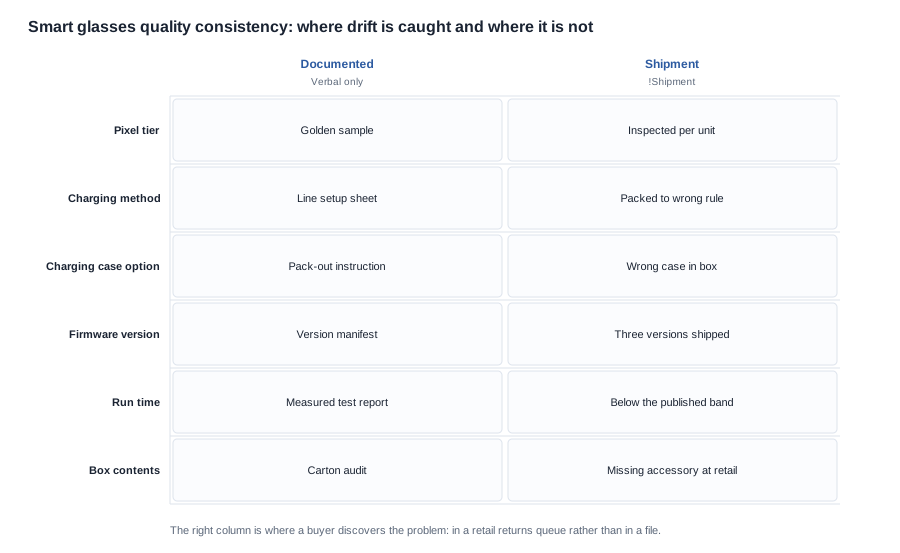
The matrix above sets the two outcomes against each other for six attributes. The left column is the position when the attribute is under document control, and the right column is the position when it is not.
The right column is worth reading twice, because it is where a buyer discovers the problem. A pixel tier drift reaches the customer as a camera that produces a different resolution from the one in the listing. A charging-method error reaches the customer as a unit that will not charge. A wrong case option reaches the customer as a box containing a different accessory than the one promised. A firmware split reaches the customer as a support query that cannot be reproduced.
The pattern is consistent. Documented drift is caught before the shipment, in a file, where it costs a sort. Undocumented drift is caught after the shipment, in a returns queue, where it costs the unit, the freight, the customer relationship and the review cycle.

Smart glasses quality consistency: the case where failures reach the buyer
Each of the following is a symptom, a root cause and the control that prevents it.
The sample that proves too much. A buyer treats a favourable sample as evidence of the production batch, and no record links the two. The control is the wave one document that states the relationship between the sample and the build, requested before the sample is even evaluated.
The change nobody announced. A component lot changes mid-run because the original lot was short, the batch is delivered conforming, and nothing in the file says the inputs moved. The control is the change notification commitment in wave two and the change log in wave three, checked against each other.
The correct case, packed wrongly. The configuration is right and the packing instruction is a different revision from the one that was approved. The control is the pack-out instruction referenced by version on the order, and the carton audit before release.
The certificate that covers a different model string. A test report is produced for a model whose label string differs by one suffix from the ordered model. The control is asking for the document, the holder, the dates and the model scope in writing, which our own catalogue cannot supply because it carries no per-model certification row.
The record that exists for a large run and not a small one. A pilot order gets a full inspection record and the volume order gets a summary sheet, because the volume order was treated as a repeat of the pilot rather than as a new build. The control is to say, in the order, which documents are contractual for this run.
Not one of these is exotic, and not one of them is grounds for moving to another supplier. Each is a reason to have one more line in the purchase order.
How to shortlist two suppliers on document quality rather than on price
When two quotations arrive for the same configuration, the price difference is usually visible and the document difference usually is not, so buyers default to comparing the visible number. There is a better way to compare, and it takes one question.
Ask each supplier to describe the record that would let them investigate a single complaint from a customer three months after the goods shipped. The question is the same for both, the answer is short, and the difference in the answers is larger than the difference in the prices.
The three answers to look for are: a record that exists and is retrievable by serial, a record that exists but is kept in a summary, and a record that would have to be reconstructed. A supplier who answers with the first has a process. A supplier who answers with the second has a batch-level quality system that will not survive a contested claim. A supplier who answers with the third is telling you the complaint will be handled by memory.
From that answer you can build a shortlist without a site visit, and you can do it before the price negotiation starts, which is the only point at which the answer is still an answer rather than a position. Before you order a large programme, the red flags to watch are the four documented in the preceding section, and the criteria for judging them are the three questions above.
The due diligence here is cheap. It is one question to each supplier, and it tells you more about how their factory runs than a factory video ever does.
The commercial terms this document set is worth
The commercial value of the quality file is that it changes what you can charge for defects, and it is worth negotiating in the same conversation as the price rather than afterwards.
What goes in the agreement is the configuration string, the reference to the golden sample, the inspection plan by version, the tolerance allowed against the published specification, the traceability requirement from unit to shipment, the change notification commitment, and the remedy for a unit that does not match. The unit price is the least interesting line in the document; the golden sample reference and the remedy are the two that decide what happens when something arrives that you did not order.
One term is worth resisting carefully: an acceptance clause that allows rejection only above a defect rate defined on the delivered batch rather than on the sample. A batch-level-only acceptance rule means a single bad unit in a large batch is invisible to you, and the rate-based version of it is the clause that quietly transfers the returns reserve from your margin to the factory's.
The trade-off worth naming is that a full unit-level record set costs the factory inspection time, and that cost is sometimes quoted as a premium. It is usually worth paying at the first volume run, because the alternative is discovering a process difference at the second run, when the packaging is already printed and the retailer's on-sale date is fixed.
Our position, and what we will send
Stated plainly: a document request is a diagnostic test as much as a collection task, and the answers tell you more about the supplier than the documents do. We publish the model data and we will supply the records for a production run, and we will also say plainly which of these we would not have in a normal small order, because some of them only exist once a run is large enough to need them.
There is one boundary worth stating because it is easy to misread. Our published catalogue gives the electrical and configuration rows for each model — the pixel tier, the cell capacity, the charging method where it is published, the case capacity where it is published, and the published run time. It does not give the test conditions behind those figures, it does not give per-model certification rows, and it gives a published weight for only one model in the range. We would rather tell you that than quote a typical figure you cannot verify, and a buyer who builds a claim on an estimated number finds the error in the field rather than in the quotation.
If you tell us the models and the run size, we will say which wave applies and what each item has to contain. The quality consistency buyer checklist is the item-level version, the factory audit documentation requirements covers the same ground from the audit side, and the quality consistency advanced guide covers the record set in more depth. The AI camera glasses range lists the baseline the records are measured against.
A hypothetical order, worked through
The case below is constructed rather than a client project. It sets out the decision sequence. A brand-side procurement manager is opening a camera model with a 1400 mAh charging case for a European retail programme, and the first quotation offers a shorter schedule than the second without explaining the difference.
The first step is wave one, and it is where most of the gap closes. The configuration sheet for the first supplier turns out to specify a build without a charging case at all, which is a smaller material set and a shorter schedule for a reason that has nothing to do with quality. The two quotations were never for the same product, and the difference was never a capacity difference.
The second step is wave two for the build that is actually being ordered. The supplier is asked for the line setup sheet for the 1400 mAh case configuration, the golden sample record for that build, and the unit-to-case pairing procedure. The line setup sheet names the case option explicitly and the matching procedure records each unit against its case, which means a charging fault in the field can be traced to a specific unit and a specific lot rather than argued about in the abstract.
The third step is wave three, before release. The batch test results come back at unit level rather than as a summary, the change log for the run is signed and dated, and the certificate set is requested by document, holder and scope because the catalogue carries no per-model certification row to check against.
The decision at the end is that the programme proceeds with the second supplier on a build that both parties describe identically, with the inspection plan referenced by version in the purchase order and the acceptance rule written against the delivered batch. The commercial point was never the price difference; it was that the shorter schedule belonged to a different product, and the only way to see that was to request the configuration sheet before anything else.
Send the model, the configuration, the quantity and the destination market, and we will say which wave applies and what each document has to contain for your programme.
Related reading


