
A smart glasses sample policy fails most often after the unit has arrived, not before it was ordered. The request was precise, the supplier was careful, the unit is on the buyer's desk, and three weeks later the evaluation produces a view instead of a result, and the programme needs a second unit that nobody budgeted for.
The reason is structural. A sample arrives with no test attached to it, and a unit with no test attached to it produces whatever the person holding it brings to it. The six mistakes below are the ones that recur, and every one of them is a decision that was available before the unit arrived and was not made.
Smart glasses sample policy: the mistakes that live in the evaluation
The conclusion first. Run the arrival inspection as a single session, against a written list agreed before the unit shipped, and produce three artefacts at the end of it: a result for every question on the list, a photograph for every result, and a written list of the questions the unit could not answer. Those three artefacts are what make an evaluation transferable to a production order. Without them, a sample is an experience.
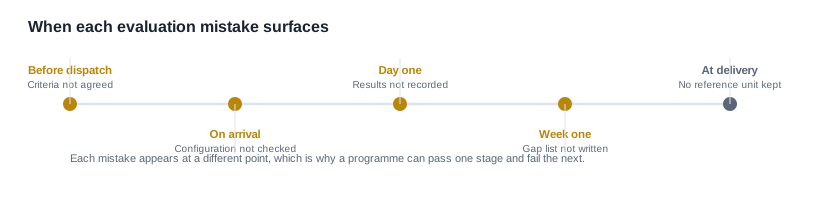
The six mistakes are not a list of cautions. Each one has a control, and every control is a sentence in a document that can be issued before the unit moves.
Two situations deserve separate treatment. A buyer who has accepted a unit against a first order and found it acceptable still has to run the second evaluation properly, because the second evaluation is the one that produces the baseline the production run is measured against. And a buyer who is evaluating several suppliers at once needs the same list for each, in the same order, or the comparison will be made on impressions.
Who is reading this, and where the programme is going
The reader is a brand-side buyer, a channel buyer or an importer, and the moment is the arrival of a unit that somebody asked for.
The usual situation is that the unit is now in a room with a person who did not write the request and did not agree the criteria. That is the ordinary failure mode of a sample programme in this category, and it is not a failure of diligence; it is a failure of hand-off. The request was written by a procurement manager, the unit is received by whoever was in the building, and the evaluation is run by a product or marketing colleague with a strong prior about what the answer should be.
What the reader needs is a procedure that survives that hand-off, which means a written list that can be handed over with the unit, a named sign-off, and a rule about what happens to a question the unit cannot answer.

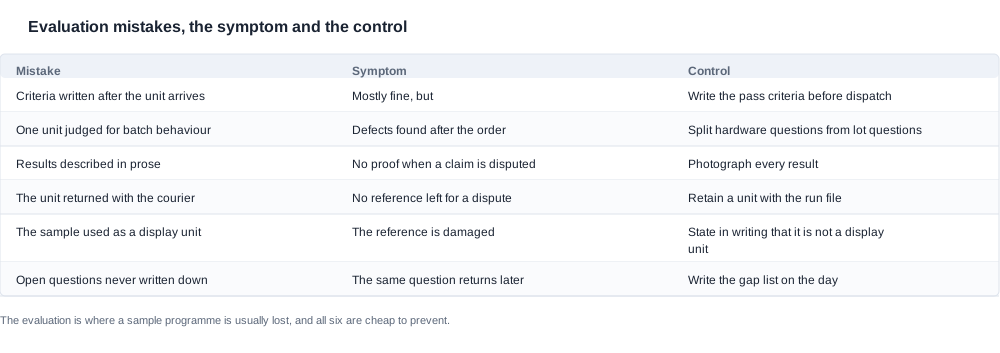
Six evaluation mistakes, and the control that stops each

| Mistake | Symptom | Control |
|---|---|---|
| Criteria written after the unit arrives | Mostly fine, but | Write the pass criteria before dispatch |
| One unit judged for batch behaviour | Defects found after the order | Split hardware questions from lot questions |
| Results described in prose | No proof when a claim is disputed | Photograph every result |
| The unit returned with the courier | No reference left for a dispute | Retain a unit with the run file |
| The sample used as a display unit | The reference is damaged | State in writing that it is not a display unit |
| Open questions never written down | The same question returns later | Write the gap list on the day |
None of the six is a technical failure. They are the ordinary results of running an evaluation without a written list, and they are the reason a sample programme in this category so often costs twice what it was expected to cost.
The first mistake: criteria written after the unit arrives
This is the one that turns a sample into a second sample request.
The sequence is almost always the same. The unit arrives, somebody handles it, and they form an impression. The impression is mostly positive, with one reservation. Because there is no agreed list, the reservation becomes the subject of an email, and the email becomes a request for a different unit, because the thing that was wrong cannot be described precisely enough to be fixed.
Agreeing the pass criteria before the unit ships is an hour of work, and it is the single most effective thing a buyer can do in this category. The criteria are not the test procedure. They are the definition of what a pass is, written in advance, with a named sign-off, and short enough that a colleague can apply them without asking a question.
The criteria that work in this category are shaped by what the catalogue does not publish. The range covers twenty-eight models: eleven camera models, eight audio models, three sport models and six further entries — the AR frame, the three children's models, the electrochromic model and the bone conduction model — and the electrical rows are published for all of them: cell capacity, charge time, rated endurance, charging interface on twenty-four of the twenty-eight and, where one applies, the case capacity. The physical rows are open. The range publishes a single weight figure, 158 g for the MT6 glasses body including its 265 mAh battery and camera and excluding its foldable charging case, and no bare frame weight for any model. No model publishes a field of view, a video format, a frame rate or an ingress test report number, and the catalogue carries no per-model certification row at all.
So the criteria a buyer writes in advance are mostly about the open rows: the measured weight, the observed capture path, how the case connects and whether it does so reliably, the construction at working distance, the behaviour of the controls. Those are exactly the rows a sample can settle, and writing them in advance is what makes the sample worth having.
A criteria sheet that can be handed over
The sheet itself is short, and it has four columns.
- The question. One line, written so that it can be answered yes, no, or with a number. A question that can only be answered with an adjective will be answered with one, and the answer will be agreed.
- The method. What is done, in what state, for how long. For a runtime figure this means the load, the starting state and the end condition, because the catalogue publishes a rated endurance of about seven hours on the L1 Pro and the CY03, and the MT6 and the CY05, and the L2 Utral, and between five and eight hours on the V03 Pro and the V06, and the S7 and the V03, without publishing the condition behind any of them.
- The pass line. A threshold, agreed before the unit arrives. A criterion with no pass line is an opinion with a method attached.
- The result and the evidence. A number, a yes or no, and a photograph. Left blank on delivery, filled in during the session.
The sheet is also what makes the evaluation comparable to a production run later, because the production inspection can be written in the same four columns.
The hand-off is where the criteria go missing
Most of the criteria loss in this category happens between the person who writes the list and the person who holds the unit, and it is worth diagnosing because each point of the hand-off has a different fix.
The first point is the request itself. If the criteria are attached to the request rather than sent later, they travel with the unit and cannot be lost. The second point is the person who signs the unit for the courier. A signature on a delivery note is not an acknowledgement of the evaluation criteria, and a courier signature that also confirms the list is in the box removes the gap for almost nothing. The third point is the first person to open the parcel. Whoever opens it is about to make an impression, and an impression formed before the list is read is the one that survives. The fix is procedural rather than motivational: read the list before the unit is handled, not after.
The fourth point is the person who writes the file up. A results sheet filled in from memory a week later is a description of an impression with numbers attached, and it will differ from what the photographs show. Filling the sheet in during the session, next to the unit, is what keeps the results and the evidence in step.
None of these four points is under the buyer's control at the factory, and all four are under the buyer's control before the unit ships. That is the practical reason to write the criteria early: not because the criteria are difficult, but because every hour of delay between writing them and using them is an hour in which they can be quietly replaced by an opinion.
Running the session with two suppliers side by side
When two units from two suppliers are being evaluated, the discipline has to be tighter, not looser, because the two sessions drift towards each other and the buyer ends up comparing the sessions rather than the units.
Three rules handle it. Use the same sheet for both, with the same questions in the same order, so that a difference in the answers is a difference in the product rather than a difference in the method. Run both sessions in the same conditions where the conditions are controllable, including the charge state, the duration of the run and the network environment, because a runtime measured on a different connection is not a comparable number. And complete one sheet before starting the other, because interleaving the two invites a conclusion about the first before the second has been recorded.
The comparison this produces is a comparison of evidence rather than of impressions, which is the only kind that survives a disagreement about which supplier to award the order.

The second mistake: one unit judged as if it were a batch
A unit that behaves correctly tells the buyer that a unit can be built and that it behaves in the buyer's hand. It does not tell the buyer what a thousand units will do, and the difference is not a matter of caution. A single unit was not drawn under a sampling plan, was not inspected against a defect classification, and is statistically incapable of establishing a defect rate.
The mistake is easy to make because the two questions are genuinely different and it is convenient to merge them. The fix is to split the evaluation sheet into two columns before the unit arrives: the questions a unit settles, and the questions only a lot can settle. The first column is answered on the sample. The second column is scheduled, and the second column usually means a pilot lot or an inspection on the production run.
What belongs in the second column in this category is fairly predictable. Batch consistency of the case, the cell, the camera module and the interface. Behaviour of a firmware update across a volume. The rate at which a cosmetic defect appears on a lens or a temple. Long-term ageing. None of these is answerable on a desk with one unit, and a buyer who writes them into the sample criteria will get an answer that looks like an answer and is not.
The third mistake: the evidence that evaporates
Three things disappear from a sample programme without anybody deciding to remove them, and all three are needed later.
The photographs. A description of a result is an account of a result, and an account is what a buyer has when the supplier disputes the finding. A photograph of the screen, the file listing, the reading or the connector is the thing that can be put in front of the other side. This is the difference between an evaluation and an opinion, and it costs nothing but the habit of taking the picture.
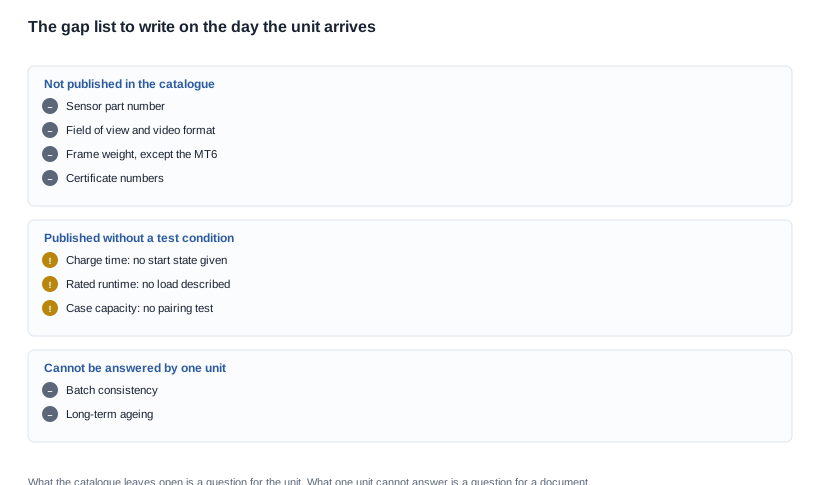
The gap list. The list of questions the unit could not answer is the most valuable page in the file, because every entry on it is a decision that has to be taken on incomplete information. In this category the list is long: the open rows in the catalogue, the rows the supplier has not answered, the measurements the buyer took with no published figure to compare them against, and the questions that only a document or a lot can close. Written on the day, it is a work list. Written a month later, it is a reconstruction.
The reference unit. A sample that is returned with the courier leaves a dispute with no reference point, and the comparison available then is against a specification row rather than against the thing that was approved. A unit kept in the buyer's own file for the life of the programme is the only object that can arbitrate a question about a production batch, and it cannot be created retrospectively. If the unit is to be kept, that has to be agreed in advance, including where it is stored and who may inspect it.
The display unit problem
There is a fourth evaporation that is not about evidence at all, and it is the one buyers forget to control. A sample is the only unit of a configuration for months, and it is the obvious object to put on a table at a meeting, to send to a colleague, to photograph for a brochure draft. In doing so it acquires marks, and a reference with marks on it cannot be used to argue about a defect on a production run.
One line in the order prevents the whole problem: the sample is not a display unit, it is not traded, resold or used in public, and it is retained by the buyer as the reference against the production run. Sent in advance, it is unremarkable. Sent afterwards, it is an argument about whether a scratch matters.
What a completed evaluation file contains
A finished evaluation in this category is a small file, and the smallness is the point. It contains the configuration string that was ordered, the criteria sheet with its four columns filled in, a photograph for every result, the gap list, the notes of the questions sent to the supplier afterwards, and the reference unit in a named place. Six items, one session, and the programme can be closed and the order placed.
The two mistakes that remain possible with that file are both commercial rather than technical. The first is a decision to order a volume the sample cannot support, when the second column of the evaluation sheet was never scheduled. The second is a belief that the sample settled the certification scope, when the catalogue never carried a per-model certification row and the answer was a document request.
It is worth being precise: the published material is the part of the specification we can stand behind, and the rest is a question for the supplier's own file. We publish the resolution class, the cell capacity, the charge time, the rated endurance, the charging interface where it is published, the case capacity where it is published, the Bluetooth version for the audio and sport models and the colour options where they exist. We do not publish a bare frame weight for any model, and the one weight figure in the range is the MT6 glasses body at 158 g, which includes the battery and the camera and excludes the foldable charging case. We will not fill an open row with a typical figure, because a buyer who builds a claim on an estimated number finds the error in the field rather than in the quotation.
We will also state the build identity of a unit before it is sent, retain a production reference unit with the run file, and keep the records that let a quality conversation four months after delivery have a reference point. We will not treat a single unit as evidence of batch behaviour, and we will not send a unit in a configuration that differs from the one intended for the order.
What we will answer during the evaluation
Three questions come up in almost every evaluation session, and they are worth answering in advance because they are the ones where a buyer's expectation and the published data do not meet.
The first is the charge time. It is published for all twenty-eight models: two hours or less on twenty-six of them, and about one hour on the D17 and the ZH12, which are the two sport models on Type-C. What is not published is the starting state of the battery and the point at which charging is judged complete, so a measured figure is only comparable with another measured figure if both were taken the same way. We will say what condition our own figure refers to when we quote one.
The second is the charging interface. It is published as magnetic on seventeen models and Type-C on seven, and it is not published at all for four camera models, which are the L1 Pro and the CY03, and the CY05 and the MT6. Those four publish a case capacity but no interface row, and we will state the interface for the unit we build rather than leave the gap in the file.
The third is the certification scope. The catalogue carries a company-level export certification page and no per-model certification row, and its text contains no CE, FCC or RoHS marking for any product. So the scope of a model is a document to request per model, in writing, and it is not something a unit can demonstrate. We will say that plainly rather than let a sample appear to settle it.
Send us the models, the quantities and the target market, and we will tell you which of your questions a sample settles, which need a document, and which need a pilot lot. The samples pillar sets out the wider process, the margin article covers what the arrangement does to the commercial side, and the field work comparison sets out the rows a sample cannot settle.
Send the configuration, the quantity and the market, and we will say which parts of the evaluation are settled and which are yours.


