

A smart glasses sample policy decides how much money leaves the programme before anyone knows whether the programme can build the thing at all. The sample fee is the smallest number in that conversation and the least consequential one. What actually reaches your margin is the rework you did not budget for, the tooling amortisation you accepted without asking about it, and the returns reserve nobody calculated. Set the sample policy properly and the fee is a rounding error against the order. Set it badly and the fee turns out to be the cheapest line in a bill that arrives six weeks after the shipment did.
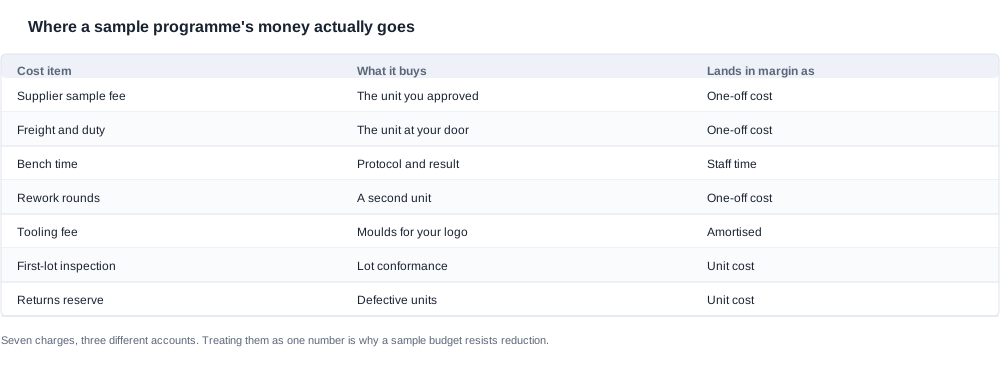
Seven charges sit inside a sample programme and they behave like three different kinds of money: one-off programme costs, recurring unit costs that the sample taught you to calculate, and non-recurring engineering costs that only amortise if the programme actually runs. A buyer who treats them as one number cannot tell which lever to pull, which is why sample budgets in this category resist reduction even when the programme is over budget.
Smart glasses sample policy is a margin line, not a paperwork line
The buying task behind a margin-defending sample programme
The reader is a procurement manager at the brand, a channel buyer or an importer, and the situation is usually one of two. Either a quotation has arrived and the numbers on it do not reconcile with the numbers in the business case, which means somebody has to work out where the sample stage is hiding cost. Or the programme has already passed the sample stage, the first shipment landed, and the margin model was built on assumptions that the shipment has now contradicted.
Both situations have the same root cause, and it is not supplier behaviour. It is that the sample stage produces decisions rather than products, and a decision that is not written down has no cost attached to it. When a buyer approves a configuration verbally, the cost of that decision is paid later as a mismatch. When a buyer accepts a unit without a lot identifier, the cost of that decision is paid later as an untraceable complaint. When a buyer accepts a supplier's capacity figure without asking for its basis, the cost of that decision is paid later as a delivery date that moves.
The second reason to treat the sample stage as a margin line is that it is the only stage where the cost of a mistake is still small. A wrong configuration discovered on a sample costs one unit and one round. The same configuration discovered on a first shipment of several thousand units costs the units, the freight, the clearance delay and the channel relationship that was built on the launch date. The arithmetic is not complicated, but it only works if the sample stage is priced as a decision-making instrument rather than treated as a formality between the enquiry and the purchase order.
The practical consequence is that a buyer who wants to know how to evaluate a sample policy should not start with the fee. Start with the decision the sample has to settle, because which model you are approving, and which attributes on that model have to be proven on real hardware, determines whether one round is enough or whether the programme is really a pilot.
Seven charges, three different accounts
The seven charges are listed in the figure above. What matters for margin is not the list itself but the accounting treatment, because the same sample programme produces very different margins depending on which account each charge lands in.
| Charge | When it is paid | Where it lands | Can a buyer change it |
|---|---|---|---|
| Sample fee | At order | Programme cost, written off | Yes, by asking |
| Freight and duty on the unit | On arrival | Programme cost, written off | Yes, by choosing a mode |
| Bench and test time | On receipt | Programme cost, written off | Yes, by sequencing tests |
| Rework round | On the second unit | Programme cost, written off | Partly, by fixing the round count |
| Tooling and artwork | Before production | Non-recurring, amortised | Partly, by asking about ownership |
| First-lot inspection | Before release | Unit cost | No, it is the cost of control |
| Returns reserve | After release | Unit cost | No, it is the cost of risk |
The first four are programme costs. They do not appear in the unit cost of a single unit and they should not be spread across the order to make it look better. They are real, they are one-off, and the only question worth asking about them is whether each one was necessary. The fifth is different in kind: tooling is a non-recurring expenditure that amortises across every unit of the programme, and the single most consequential question a buyer can ask about it is not the amount but the amortisation period and the ownership. A tooling fee amortised over five hundred units behaves very differently from the same fee amortised over fifty thousand, and a fee that is owned by the supplier behaves very differently again from one the buyer has paid for and can therefore move to another supplier.
The last two are the ones most programmes never calculate at all. First-lot inspection and the returns reserve are unit costs, and unit costs are the only numbers that reach the margin. A buyer who has never asked what a first lot costs to inspect has never seen the real cost of quality, and a buyer who has never computed a returns reserve from a written defect assumption is running the programme on the assumption that the supplier is perfect. That assumption is not a margin strategy, it is an absence of one.
The total cost of a sample programme is therefore not the fee. It is the fee, plus the rounds that the specification did not prevent, plus the engineering cost that the programme inherits, plus the reserve that the quality assumptions generate on every unit it ships. Comparing two suppliers on the fee alone is comparing two numbers that carry almost none of the information.
Where the negotiation actually sits
The negotiability of the seven charges is not uniform, and this is the part that most sample-policy discussions get wrong. The sample fee on a shortlisted candidate is the cost of the whole programme and there is very little room in it, because it buys the one artifact you personally approved. Rewarding a supplier for a lower fee at the cost of an unstated configuration is a transfer of risk from a cost you control to a risk you do not.
The freight mode is almost always the buyer's decision, and the buyer is the only party who knows whether the arrival date matters. The number of evaluation rounds is negotiable but has to be fixed before the first round starts, because the second round always costs more than the first and the third more than the second. The tooling fee is negotiable on amortisation period and on what happens to it if the programme is cancelled before it is used, which is the question most often skipped entirely.
What is not negotiable is the cost of producing a unit to the published specification, and the time the factory needs to build a genuine production configuration rather than a demonstration unit. A supplier who can produce a production-configuration unit quickly is telling you something about the line that is worth more than a discount on the fee.
The questions to ask before you order are short, and they are the same for every candidate: what is the configuration string, what does the sample fee include, what is the credit condition against the first order, how many evaluation rounds are included, and what happens to a unit that does not match the order. A supplier who answers all five in the first round has told you whether the quotation is comparable with the others.
What the catalogue lets you measure, and what it does not
The published rows a sample can be checked against
The reason a sample programme in this category can be costed honestly is that a great deal of the specification is already public, and a sample is the right instrument for testing a unit against a published reference. The catalogue publishes, model by model: the camera resolution tier, the cell capacity, the rated use, the charge time, the charging method, the charging case option, the colour availability, and the ingress marking where one exists.
That list is short enough to write into a bench protocol, and that is the point. A protocol that says "check the runtime against the published band for this model, from the stated charge state, on the stated duty cycle" is a protocol any competent supplier can satisfy. A protocol that says "confirm the battery performs to the buyer's expectations" is not a protocol at all, and it is also the sentence that turns a sample programme into a cost with no measurable return.
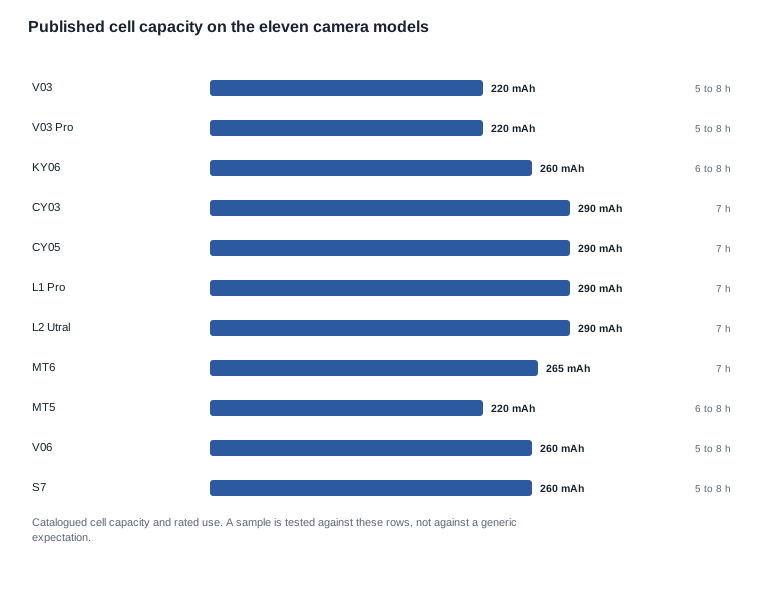
The published rows differ in how much a sample can actually prove, and the difference decides where the sample money should go.
- The rated use is a genuine reference. All eleven camera models carry a published band: about seven hours on the L2 Utral and the MT6, and the CY05 and the CY03, and the L1 Pro, six to eight hours on the KY06 and the MT5, and five to eight hours on the V03 and the S7, and the V03 Pro and the V06. A sample can be tested against it, provided the protocol names the start state, because the published figure carries no starting state of charge and no termination criterion.
- The charge time is a reference for a different purpose. It is published for all twenty-eight models, at up to two hours on twenty-six of them and about one hour on the D17 and the ZH12. It describes a bench condition rather than a product limit, so it tells you what to expect on a charger and not what a shift of use produces.
- The charging method is a reference worth checking on the unit. Magnetic charging is published on seventeen models and Type C on seven, while the method is not published at all for four camera models, the L1 Pro and the MT6, and the CY05 and the CY03. A sample of one of those four cannot be checked against a published method and has to be checked against what the supplier states in writing.
- The case option is a reference with a trap in it. The L1 Pro and the CY03, and the CY05 are published with a 1400 mAh case, the L2 Utral with either 900 mAh or 1400 mAh, the MT6 with a 1200 mAh folding case, the KY06 and the MT5 with cases whose capacity is not published, and the V03 Pro with no case at all. A sample that arrives with the wrong case option is a useful result, but only if the protocol said which option was ordered.
- The ingress marking is a reference only on two models. The IP54 marking appears on the V06 and the S7 as a catalogue annotation, with no third-party test report number published against it. A sample of the V06 or the S7 can be checked for the marking; no other model can be checked for anything in this area.
- The weight is a reference on exactly one model. The MT6 glasses body is published at 158 g, including its 265 mAh cell and its camera and excluding the 1200 mAh folding charging case, whose own weight is not published. That figure can be checked on the unit; nothing else can.
The rows that are not published at all
Everything else is a request, not a measurement. Sensor models, acoustic measurements and thresholds, ingress test report numbers, certificate numbers and validity dates, cycle life ratings, defect rates, and the weight of every model except the MT6 do not appear in our published material. The catalogue carries a company-level export certification page, and it does not carry a per-model certification row for any of the twenty-eight models; the text of that catalogue contains no reference to CE, FCC or RoHS at all.
A sample cannot settle any of those rows, and a sample programme budget spent trying to settle them is the most expensive mistake in this category. This is where margin is quietly destroyed. The buyer who wants a cycle life figure, orders a sample, spends a round of bench time and a freight bill trying to extract one, and ends the round with an impression. The correct instrument for those rows is a document request attached to the quotation, and a document request costs nothing.
Thresholds that keep a sample from turning into a rework bill
The three thresholds a sample has to clear
A sample should clear three thresholds and only three. Anything beyond them belongs either in a document request or in a sample drawn from a later production lot, and moving a threshold into the wrong bucket is what converts a sample cost into a rework cost.
- Identity. Is this the configuration that was ordered? The check is the configuration string read against the order, and the case option read against the published option for that model. This is the cheapest and the most commonly failed test in the category, and it fails because the order said "L2 Utral" instead of "L2 Utral with the 1400 mAh case".
- Function against a published reference. Does the unit behave within the published row for this model? The runtime check runs against the published band with a stated start state, the charging check runs against the published method on the shipped configuration, and the camera check runs against a reference unit in the same resolution tier and the same configuration.
- Record. Can the unit be tied to a production window, and does the supplier hold the records that would let a channel complaint be traced back? The check is a lot identifier on the unit or on the paperwork, plus a retained unit from that lot.
The first threshold is a match, the second is a measurement, and the third is a request. A sample programme that does all three has done its job. A programme that tries to settle certification scope, reliability or factory capability with a physical unit is spending money on a question that the unit cannot answer, and it will usually answer it with an answer that costs more than the programme.
The number you must attach to every published figure
There is a condition attached to every published figure in the catalogue, and a bench protocol that omits the condition will produce a result that cannot be defended later. The condition is not a technicality; it is the difference between a measurement and an opinion.
For a runtime check the condition is the starting state of charge and the duty cycle. For a charge time check the condition is the starting state and the termination criterion, because a published charge time without a termination criterion does not tell you when the charger may be unplugged. For a charging method check the condition is the shipped configuration, because the method is published per model and not per order. For a camera check the condition is the resolution tier, and here the tiers are precise: eight camera models are published at 8 MP, the MT6 and the V06, the CY03 and the MT5, and the CY05 and the KY06, and the V03 Pro and the V03, and three at 13 MP, the L2 Utral and the L1 Pro, and the S7.
A sample of an 8 MP model that behaves like a different tier is the earliest available signal that the configuration string is not being honoured, and it is a signal that arrives in an hour rather than in a quarter.
The order of the tests
One protocol decision deserves more attention than it usually gets: the order of the tests. A runtime test consumes the charge state the unit arrived with, so it has to come either consistently before or consistently after the checks that depend on that state, and the protocol has to say which. A case-to-unit match test should come before a long runtime test, because a unit that will not charge in the ordered case option may not survive the bench session at all, and a unit that dies on the bench produces a false failure on the next test.
Ordering the tests is free, and it removes one of the most common causes of a sample that appears defective for reasons that have nothing to do with the product. A sample that fails for a reason the protocol did not anticipate is a sample that triggers a second round, and the second round is where the margin starts to leak.


How the sample programme is verified before the order is released
The verification chain
Verification is the part of a sample programme that separates a supplier who has done the work from one who has described it, and it is also the part that protects the margin. Five links, each one producing an artifact.
- List the claim in the supplier's own words. Not your summary of it, not the phrase used in the brochure. A claim that cannot be quoted cannot be checked, and a claim that has been paraphrased cannot be shown to have been answered.
- Ask the question that would expose a false claim. For a capacity figure that means the basis of the number. For a certification statement that means the scope per model. For a sample that is claimed to be the production build, that means the identifiers that make it traceable.
- Receive the answer in writing. A verbal answer cannot be attached to a file, and a claim that will not hold up at a quality discussion is not worth anything at a production order.
- Check the answer against a published row or a document. Where the catalogue publishes the row, the check is a comparison. Where it does not, the check is against a document the supplier holds.
- Record the evidence against the model and the configuration. Evidence recorded without a configuration cannot be reused, and evidence recorded without a model cannot be quoted to a channel partner.
A claim with no artifact behind it stays a claim. That is the whole discipline, and it is the difference between a supplier who can build your configuration and a supplier who can describe your configuration.
The record that has to survive a finance review
Three things have to accompany the sample result, and they are the three most commonly skipped. The lot identifier and the production date, so a channel complaint two months later can be traced to a production window. The protocol used, word for word, so that a second measurement months later is comparable with the first. And the name of the person who ran the test, because an unattributed measurement cannot be defended in a quality discussion.
None of these costs anything. All of them are worth something at the moment a finance reviewer asks why the programme spent what it spent, and all three are worth more still at the moment a claim arrives.

Where sample programmes fail, and what each failure costs
Five failures, each with a control
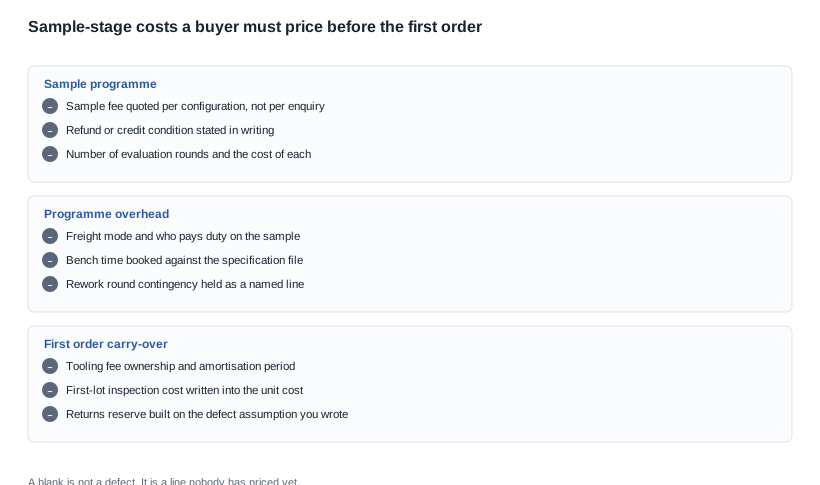
The red flags in this category are rarely technical. They are the five below, and each of them can be converted into a line in an order document before the sample is ordered rather than a lesson after the first shipment has been paid for.
The sample that was not the product. A modified unit was shipped for evaluation and the approved build was never built. The cost lands in the first lot, as a difference between what was approved and what arrives. Require a build identity on every sample and record it on the evaluation sheet.
The attribute tested on the wrong sample. A production-consistency attribute was judged on a single hand-built unit, and a pilot lot was never scheduled. The cost lands as a defect rate nobody can explain. Split the evaluation sheet into hardware-settled attributes and production-only attributes, and schedule the pilot lot for the second group.
The second round that was not budgeted. Revisions were made on a new unit at a new cost with a new lead time. The cost lands in the schedule as well as the budget, because the artwork freeze usually waits for the approval. Agree the number of rounds and the cost of each one before the first round starts.
The sample credit that disappeared. The sample charge was expected to be credited against the first order and was not. The cost lands in the first order as an unplanned one-off. Put the credit condition in the order confirmation, in writing, with the order value attached.
The defect assumption that was never written down. The returns reserve was never calculated because no defect rate was ever stated. The cost lands in the margin model of every unit the programme ships, for as long as the programme runs. Write the assumption into the specification file, even if the number is a working estimate, because an unwritten assumption cannot be challenged and cannot be improved.
The margin effect of a failed round
None of these failures is exotic and none of them is a reason to change supplier. They are reasons to put a line in the order, and the reason to do that is arithmetic rather than principle. A second round typically costs the fee again, plus a freight bill, plus bench time, plus the calendar delay between the artwork freeze and the production release. That delay is the expensive part, because it sits on the launch date rather than on the sample budget, and a launch date that moves is a cost that no line in the cost breakdown has ever captured.
The signs that a round is going to fail are visible long before the unit arrives, and they are all in the quotation rather than in the shipment: a price with no configuration attached to it, a refund described as possible rather than stated, a lead time with no start condition, and a round count that is open-ended. These are the same four items that appear on the supplier's list of red flags, and checking them costs a single email.
The practical instruction is short: run the sample checks before the order is placed rather than after the goods have shipped, and run them against the same documents you intend to sign. Each of the failures above becomes a line in an order document, and a line in an order document is worth more than a lesson learned after a shipment has already been paid for.
What we publish, what we withhold, and the next action
Our position on sample pricing and evidence
It is worth being precise: the published material is the part of the specification we can stand behind, and the rest is a question for the supplier's own file. We publish what our documentation states, we mark the rows that are open, and we will not fill an open row with a typical figure taken from a supplier's general data. A buyer who builds a claim on an estimated number finds the error in the field rather than in the quotation, and the correction is always more expensive than the question was.
Three things in particular are not published in our catalogue, and we would rather say so than let a buyer assume otherwise. We do not publish frame weight for any model, and where a weight is published, as it is for the MT6 glasses body at 158 g including the 265 mAh cell and the camera and excluding the 1200 mAh folding case, we state exactly what that figure includes. We do not publish per-model certification, because the catalogue carries no per-model certification row for any of the twenty-eight models and its text contains no reference to CE, FCC or RoHS. And we do not publish sample fees, credit conditions or round counts, because those are commercial terms of a specific quotation and not catalogue data.
What we will do is tell you what a sample will and will not prove for a given model, before you pay for it, and where the deciding row is not published, say so rather than sending you a unit that will not answer the question.
What happens when you send us the configuration
Send the models, the quantities and the target market, and we will tell you which configurations exist, which of them are open on the published data, and what the sample answer is for each one. If your programme needs a sample to settle something our catalogue does not publish, we will say that too, and tell you what document to ask for instead. That is the whole of what a supplier can usefully contribute to a sample programme before a single unit is built, and it costs nothing.
Related reading
- What a sample can and cannot prove — the evaluation framework behind the three thresholds
- Sample policy hidden costs — the smaller leaks in the same programme
- Sample policy cost breakdown — how the seven charges are normally quoted
- Pricing checklist for smart glasses — the cost lines a quotation has to break out
- Product recommendations for field work — a case where the published rows decide it
Send the configuration, the quantity and the market, and we will say which parts of the sample programme are settled and which are yours.


