

The practical advice that saves the most money in a smart glasses sample programme is unglamorous: write the specification before you ask for a price, screen the candidates before you ask for a sample, and check the build identity before you check anything else. Everything else in this article is detail on those three instructions, and the detail matters because each of them is the point at which a programme most often loses its evidence.
There is one more piece of advice that outranks the other three, and it is the least popular. Most sample programmes should order fewer samples than they do. A screen of eight to twelve questions, sent in writing to every candidate at the same time, removes more candidates than a sample ever will, and it removes them in days rather than weeks. Sampling is the last step, not the first.
The advice in this article assumes the reader is a procurement manager on the brand side, a channel buyer or an importer with a real order to place, a real market to enter, and a launch date that is not going to move. It does not assume the reader is deciding whether to buy smart glasses at all.

Smart glasses sample policy: practical advice for the first week
The advice in one page
Six instructions, in the order they should be executed.
- Write the configuration string. Not the model name — the model name is a family. The configuration string names the model, the case option, the charging method where one is published, and any artwork or colour requirement. It is the document that makes two quotations comparable.
- Screen every candidate with the same written questionnaire. Ten questions, one document, sent at the same time to everybody.
- Order samples only for the shortlisted configurations, and only after the fee, the credit condition and the number of evaluation rounds have been agreed in writing.
- Check the build identity the moment the unit arrives, before any other test, because a unit that is not the ordered configuration makes every later result worthless.
- Test against the published rows, not against expectations, and write the start condition into the protocol.
- Close the round in writing, including a negative result, because a recorded failure is worth more than an unrecorded approval.
Each instruction is cheap. None of them requires a supplier to have answered anything yet, which is why all six can be started on the same day.
Why the order matters more than the content
Buyers usually think the value of a sample programme is in what the sample proves, and it is not. It is in what the sample is measured against. A unit measured against a written protocol with named thresholds produces a result. A unit measured against a mental picture of the product produces an impression, and an impression cannot be attached to a purchase order or defended to a finance reviewer.
The order matters because each step depends on the previous one having been done. A screen cannot be applied to a specification that does not exist, because there is nothing to ask about. A test protocol cannot be written against a configuration that has not been named. A close cannot be written without a record to close.
The consequence of skipping a step is not usually a visible failure. It is a programme that appears to have worked, in the sense that a unit was received and an approval was given, and that produces nothing a buyer can use later.

What to do before you contact any supplier
Nine actions that need no answer yet
The first two days of a sample programme should not involve a supplier at all, and this is the advice most often resisted. It feels like delay. In practice it is the only stage of the programme where your own work is the critical path, and every hour spent here removes an hour of waiting later.
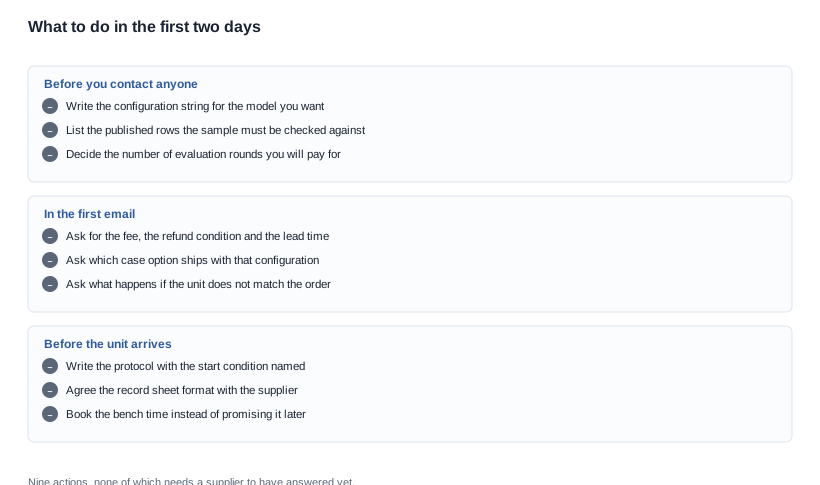
Before you contact anyone:
- Write the configuration string for the model you intend to specify.
- List the published rows the sample will be checked against, and the measurement condition for each one.
- Decide how many evaluation rounds you will pay for, and what triggers another one.
- Write the evaluation sheet, split into attributes a unit can settle and attributes only a lot can settle.
- Write the protocol, with the starting state of charge named for every runtime test.
- Name the tester and reserve the bench time.
- Agree the record sheet format, including where the lot identifier comes from.
- Decide the order of the tests, and write it down.
- Draft the questions you will put to every candidate, so that the screen is identical for all of them.
None of these depends on a quotation, a supplier or a model number that you do not already have. All of them make the first reply from a supplier more useful, because the reply will be about your specification instead of about a general capability.
The three that take the longest
Of the nine, three routinely take longer than anyone expects, and they are worth scheduling separately.
The split evaluation sheet takes the longest because it requires a decision about which attributes the supplier is accountable for. The published catalogue helps: it publishes, model by model, the camera resolution tier, the cell capacity, the rated use, the charge time, the charging method, the charging case option, the colour availability, and the ingress marking where one exists. Everything outside that list is a document request, and putting those rows in the second group is a decision, not a measurement.
The protocol's start conditions take longer than expected because each published figure carries an implied condition that nobody wrote down. A published runtime band of five to eight hours has no starting state of charge and no termination criterion. A published charge time of up to two hours has no starting state either, and it is a bench condition rather than a product limit. A published charging method is a method for the model, not for the shipped configuration.
The configuration string takes longest where the model has options. The L2 Utral is published in two case options, 900 mAh and 1400 mAh. The V03 Pro has no charging case. The MT6 has a 1200 mAh folding case. The KY06 and the MT5 have cases whose capacity is not published. A string that says "L2 Utral" is not a string.
The screen that removes most of the candidates
Ten questions, one document, sent at the same time
The screen is a written questionnaire, and it is short. Ten questions, sent to every candidate at the same time, answered in writing, and scored against the same criteria. The purpose is not to find a winner. It is to remove candidates who cannot answer questions, because a supplier who will not answer a written question about its own process is unlikely to produce the evidence a sample programme depends on either.
The ten questions, in the order that filters most effectively:
- What is the configuration string of the unit you would ship?
- Is the sample a stock unit, a modified unit, or a pre-production build?
- What does the sample fee include, and is it credited against the first order?
- How many evaluation rounds are included, and what triggers another one?
- What is the sample lead time, and what is its start condition?
- Which case option ships with the ordered configuration?
- Does the unit carry a lot identifier, and is a unit from the lot retained?
- What is the basis of your minimum order quantity, and what does it apply to?
- What is your per-model certification scope, and where is it documented?
- Who signs the evaluation result on your side, and against what protocol?
Questions one and eight do most of the filtering. A supplier that cannot produce a configuration string cannot quote a configuration, and a quotation without a configuration cannot be compared with any other quotation. A minimum order quantity that applies per model, per configuration and per order are three different commercial structures with three different consequences for a launch plan, and a single number for the whole range is not an answer to any of them.
What a good answer sounds like
The completion test on every answer is specificity. "We have a rigorous quality process" is not an answer. "The sample is a stock unit at the published specification, we credit the fee against the first order above a stated quantity, and the unit carries the production lot identifier on the packaging" is an answer, and it is answerable by any supplier with a process.
Two answers deserve particular attention because they are the ones buyers cannot evaluate later.
The certification scope answer tells you whether you are dealing with a per-model position or a company-level statement. Our own catalogue carries a company-level export certification page and no per-model certification row for any of the twenty-eight models, and its text contains no reference to CE, FCC or RoHS at all, so a supplier who says "certified" without naming the model has told you the scope is company-level. That is a legitimate answer and a weak one.
The lot identifier answer tells you whether a complaint can be traced. This is the answer that a buyer who has never had a channel complaint does not think to ask, and it is the answer that matters most when one arrives.
How to score the answers, and when to stop
Ten answers per candidate is ten chances to find out that the candidate is not a production partner. Score them against the same criteria rather than by impression, and write the criteria down before the answers arrive, because criteria written afterwards are always a rationalisation of what the answers turned out to be.
Four criteria carry the decision on their own. A candidate is out if it cannot name a configuration string, if it cannot state a minimum order basis that distinguishes a model from a configuration, if it answers the certification question at company level when the programme needs a per-model scope, or if it cannot say where the lot identifier comes from. Everything else is a matter of degree and belongs in the negotiation.
Two or three candidates should survive. If more than three survive, the screen was not applied strictly enough and the sample budget is about to expand to meet it. If none survives, the screen was applied to the wrong question set, and it is worth sending the questionnaire to a supplier you already trust as a control before concluding anything about the market.
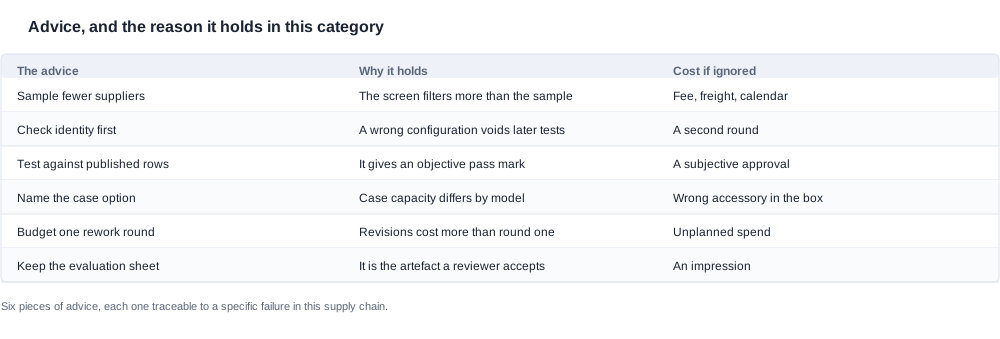
Two questions to ask yourself before you order reach the first sample, and both are answered by the screen rather than by the unit. First, which model and which configuration are you actually shortlisting, and does each candidate's string match yours exactly rather than approximately. Second, what is the total cost of the round you are about to open, counting the fee, the freight, the bench time and the one rework round you have decided to budget — because a programme that has not costed its own sample stage cannot tell you what the production order should cost either.
The pitfalls here are mostly avoidable by sequencing. Sending a screen to one candidate and a different questionnaire to the next produces answers that cannot be laid side by side, and it also tells the first supplier it was being asked unusual questions. Allowing a candidate to answer the screen verbally produces answers that cannot be quoted in the order confirmation three weeks later. Both are free to avoid and expensive to undo.

Advice about the sample itself
Check identity first, and order the tests on purpose
Two instructions, both free, both routinely skipped.
Check the build identity on receipt. A production-configuration unit carries identifiers that a stock or demonstration unit does not, and a unit that cannot be traced back to a build is a unit that proves nothing about the lot that will follow. The check is the configuration string read against the order and the case option read against the published option for that model, and it takes minutes.
Order the tests deliberately. A runtime test consumes the charge state the unit arrived with, so it has to come either consistently before or consistently after the checks that depend on that state, and the protocol has to say which. A case-to-unit match test should come before a long runtime test, because a unit that will not charge in the ordered case option may not survive the bench session at all, and a unit that dies on the bench produces a false failure on the next test. Ordering the tests removes one of the most common reasons a sample appears defective for reasons that have nothing to do with the product.
Test against the published rows, and keep the conditions visible
This is where the advice becomes specific to this category, because the published rows differ enough between models to catch a substituted configuration.
The camera range splits cleanly by resolution tier: eight models at 8 MP, the KY06 and the V03, the MT5 and the CY03, and the V06 and the MT6, and the CY05 and the V03 Pro, and three at 13 MP, the S7 and the L1 Pro, and the L2 Utral. A sample of an 8 MP model behaving like a different tier is the earliest available signal that the configuration string is not being honoured.
The audio range splits by capacity and by runtime in a way that catches a different error. The K01 and the K02 are published at Bluetooth V5.3 with two 90 mAh cells, magnetic charging and about eight hours of use. The D11 and the D12 are published at V5.4 with a 100 mAh cell, Type C charging and about seven hours. The LC-105-1 and the LC-105-2 are published at V5.4 with two 55 mAh cells, magnetic charging and about eight hours, while the G07 and the YK12 share that same two-cell 55 mAh configuration and magnetic charging but publish about six hours — the slimmer and removable-temple builds are the two that publish the shorter figure, so a unit in that tier arriving with an eight-hour expectation is a protocol error rather than a product fault.
Write the expected band next to the model on the protocol and the check becomes a comparison rather than a judgement. That is the practical form of "test against published rows": the threshold is already written, so the tester is not inventing one.
Budget one rework round and say so
Advice that sounds like giving away money. A rework round costs the fee again, plus a freight bill, plus bench time, plus the calendar delay between the artwork freeze and the production release, and the last of those is the expensive one because it sits on the launch date rather than on the sample budget.
Budgeting one round in advance and telling the supplier it is included does two things. It stops the supplier from pricing the round as an exception, and it stops your own organisation from treating a second round as a failure that has to be escalated. A programme that has named the round count has a place to put the revision, and a programme that has not will have the revision land on the launch date.

Closing the round, and the advice that costs nothing
Close in writing, including a negative result
The most valuable sentence in the whole programme is the closing one, and it is the one most often skipped. A round that closes with a recorded negative result is worth more than a round that closes with an approval, because it tells the next buyer what the supplier does not do well, and because a recorded failure is a fact that can be compared against a later result.
What a close must contain:
- The configuration string that was evaluated, as it was on the order.
- The protocol used, word for word, so that a second measurement later is comparable with the first.
- The result against each threshold, including any result outside the published band.
- The lot identifier and the production date.
- The name of the person who ran the test, because an unattributed measurement cannot be defended in a quality discussion.
- The number of rounds consumed and what triggers another one.
- Whether the unit is retained, and by whom.
Keep the record and reuse the sheet
The last piece of practical advice is about the next programme rather than this one. Keep the evaluation sheet, the protocol and the record sheet after the programme closes, and reuse them for the next supplier. The second programme in a category should run on a template that has already survived one round of contact with reality, and the template is the cheapest asset the programme produces.
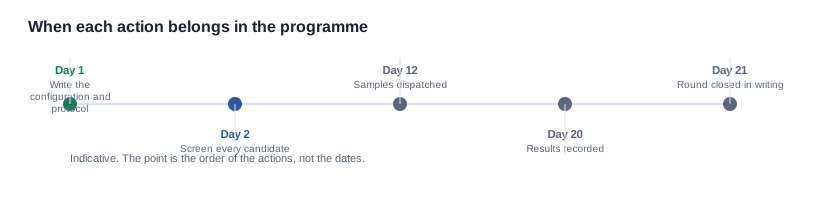
The same advice applies to the questions. A screen that has been sent once is a screen that can be sent again, with the answers you already have from the first round used to check whether a second supplier's answers are consistent with the first supplier's.
What we publish, and what we will do with your request
The narrow view we take
The view we take is narrow and deliberate. We can speak with evidence about what our published rows say, and we can speak with evidence about which of those rows a physical unit can settle. Everything beyond that is a supplier's own file, and we would rather say so than invent a number. A buyer who is told nothing is better placed than a buyer who is told something approximate, because the first can ask a second question and the second has to spend a round finding out.
Three rows in particular get asked for every week. We do not publish frame weight for any model, and where a weight is published, as it is for the MT6 glasses body at 158 g including the 265 mAh cell and the camera and excluding the 1200 mAh folding charging case, we say exactly what the figure includes and what it excludes. We do not publish per-model certification, because the catalogue has no per-model certification row for any of the twenty-eight models and its text contains no reference to CE, FCC or RoHS. And we do not publish sample fees, credit conditions or round counts, because those are commercial terms of one quotation and not catalogue data.
What we do with the request
Send the models, the quantities and the target market, and we will tell you which configurations exist, which of them are open on the published data, and what a sample would and would not settle for each one. If your programme needs a sample to settle something our catalogue does not publish, we will say so and tell you which document to request instead.
If you are further along than that, send the configuration strings you have and we will tell you what to add to them, what published rows apply to each one, and what the supplier ought to be asked to put in writing. That is a practical answer and it is free.
Related reading
- Red flags to avoid in a sample policy — what to do when the answers are not specific
- Sample policy SOP template — where the nine actions become a standing procedure
- What a sample can and cannot prove — the published rows and the questions behind them
- Bluetooth audio glasses — the eight-model audio range the screen applies to
Send the configuration, the quantity and the market, and we will say which parts of the programme are settled and which are yours.


