

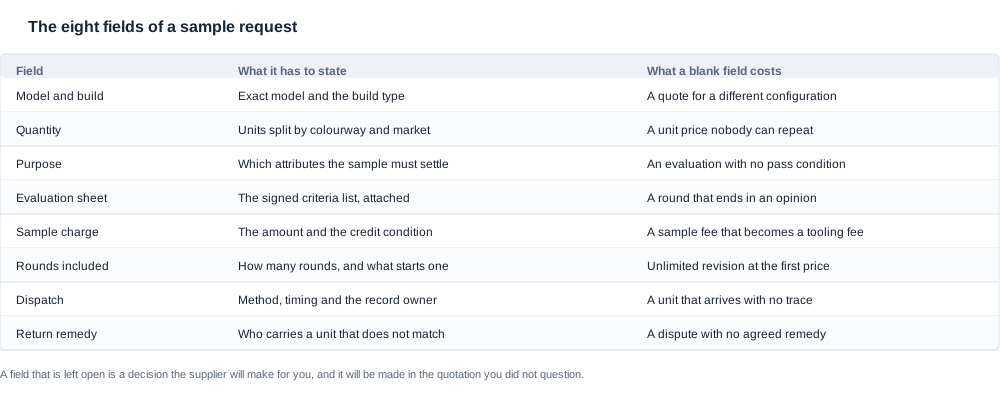
A sample request is a specification instrument, not an enquiry, and the difference between those two things is decided by how many fields you fill in before the supplier starts building. A buyer who sends a product name gets a price. A buyer who sends a request form with every field closed gets a configuration that can be repeated, evaluated, and signed — and a sample that can prove something specific. This is what a smart glasses sample policy has to do: it is the control document that decides what a sample is allowed to be used for, and what happens when it fails. The eight fields below are the ones that decide it, and the article also covers what happens to a programme when each of them is left open.
Smart glasses sample policy: what the request form is actually for
The request form exists to stop four decisions from being made by the factory instead of by you. It fixes which build of which model you are paying to receive. It fixes which attributes that unit is allowed to prove. It fixes the money: the sample charge, whether it comes back, and how many rounds you are entitled to. And it fixes what happens to a unit that does not match — who sends it back, who pays the freight, and who carries the loss.
None of those four things is technically difficult. All of them are routinely decided implicitly, which is why they are expensive. A factory that receives "please send a sample of the CY03" has been told a model and nothing else. It will pick the build that is on the shelf, charge what that build costs, and send it. If your programme was written around a 290 mAh cell with a 1400 mAh case and the unit that arrives carries a different cell, you will not find out from the factory, because the factory never promised a cell. You will find out from your own charge tester, three weeks later, after the artwork is printed.
The buyer who signs it, and the moment they sign it
The reader is a brand-side procurement manager, a channel buyer, or an importer opening a new line. The moment that matters is the one before the deposit: the point where three quotations are on the table and the programme has to be reduced to one, or where a new model has been shortlisted and a sample is the last gate before the tooling spend.
What that buyer is actually afraid of is rarely price. It is schedule. A sample programme that does not produce a decision in three weeks is not a sample programme, it is a delay with a courier cost attached, and it pushes the whole launch back by the same interval. The second fear is a sample that proves nothing — the unit arrives, looks right, feels acceptable, and leaves the team with a subjective impression and no criteria. The third is the unit that arrives, proves something, and is then quietly ignored, because nothing in the paperwork made it binding.
Those three fears have a common structure: they are all failures of the written record rather than of the product. That is the argument for treating the request form as a controlled document with a version number and an owner, rather than as a message to a sales engineer.

The eight fields a request has to settle
The table above sets out the eight fields. Each row states what the field has to contain and what a blank field costs. The cost column is worth reading twice, because in every row the cost is a decision that moves silently from your side of the table to the other side.
Identity, quantity and the configuration string
The first field names the model and, more importantly, the build type. In this category a "sample" can be one of three different things: a stock unit from the finished-goods shelf, a modified unit with your logo, colourway and packaging already applied, or a pre-production build made to your configuration specification. These three cost different amounts, lead to different schedules, and settle different questions. A request that does not name which one is asking for the cheapest and the least informative, and will usually receive it.
The quantity field is where most first-time buyers get it wrong. "One sample" is not a quantity. One unit of which colourway, for which market, with which artwork, and does the buyer want a second unit held back as a reference against which the first is judged? That last question is worth asking even if the answer is no, because the answer determines whether a disagreement three weeks later can be settled by comparison or only by argument.
The configuration string is the field that does the real work, and it is the one that changes how a quotation can be compared. A quotation built on a configuration string can be placed next to another quotation built on a different string, and the difference can be read. A quotation built on a product name can only be compared on price. This matters in a range where the published rows genuinely differ: a camera model in our catalogue is published at 220 mAh, 260 mAh or 290 mAh depending on the model, and the charging method row is not published at all on four of the eleven camera models. The configuration string is what freezes those rows for the unit you are about to pay for.
Purpose, criteria and the evaluator
The purpose field states which attributes the sample must settle, and — just as importantly — which attributes are out of scope for a sample. The list should be short. A sample is a single unit; it can prove what that unit does, what it looks like, how it behaves in the hand, and how the interface responds. It cannot prove lot-to-lot consistency, it cannot prove how the unit will behave after six months of use, and it cannot prove that a certification will be granted for a configuration that has not been built.
The criteria field is the evaluation sheet, and it needs two sign-offs rather than one. A sheet signed by the person who will use the product and by the person who will pay for it survives internal disagreement. A sheet signed by one person becomes a matter of personal preference within two weeks, and preference is not a procurement record.
Money, rounds and the credit condition
The sample charge field has two halves, and suppliers routinely answer only the first. The amount is the easy half. The credit condition is the half that matters: whether the sample amount is credited against the first production order, against the tooling charge, against nothing at all, and under what condition. That condition is where the money actually is. A sample that is credited unconditionally against the first order is worth a real amount at the size of a first order; a sample that is credited only if the first order is placed within a stated window is worth much less, and the window is the term to negotiate.
The rounds field states how many evaluation rounds are included and what triggers another one. One round is the norm and one round is enough if the criteria are right; two rounds is normal if the artwork is not final; unlimited rounds is not a policy, it is an open-ended liability, and it is usually written as though it were generous. Every additional round carries freight, a lead time and a new sample charge, and it resets the reference unit, so the second round has to be compared against the first one or the comparison is meaningless.
Dispatch, remedy and the record
The dispatch field names the method, the timing and the owner of the record. This is not a logistics detail; it is the point at which a sample becomes evidence. A unit that arrives with a named carrier, a tracking reference, a dispatch note that states the build identity and the configuration string, and a photographed seal on the carton can be checked against a request later. A unit that arrives in a padded envelope with a handwritten note cannot.
The remedy field is the one that is most often left out and most often needed. It should state what happens to a unit that does not match: who returns it, who pays the return freight, whether the sample charge is refunded, and whether a replacement is built before the round is closed. A programme with no remedy has no way to close a failed round, and the round will not close — it will simply sit in an inbox until somebody needs the answer.
How a field becomes a control instead of a wish
A field on a form is not a control. It becomes a control when three conditions hold at once, and it is worth testing every row of your own form against them.
The first condition is that the field has a default. A field with a default is answered by the form; a field without a default is a negotiation that happens by email, one at a time, with whoever answers first. The default for the sample charge, for example, is "quoted as a separate line, not included in the unit price" — because that default protects the comparison, not just the money. The default for the rounds field is "one round included, further rounds quoted and scheduled" — because that default protects the schedule.
The second condition is that the field has an owner who can refuse. A field owned by a procurement manager who can decline to release the order is a control. A field owned by nobody, or owned by a role that cannot say no, is a wish. In practice this means the form has to be issued by a named person, and that person has to be able to hold the form rather than forward it.
The third condition is that the field has a deadline, and that the deadline is earlier than the thing it governs. A remedy field filled in after the sample has shipped is a record of what went wrong. A remedy field filled in before the first unit is built is a control.

The three conditions together produce the behaviour you want. The form is answered once, in full, before anything is built. The answers are written into the order document rather than living in a thread. And the criteria survive contact with the supplier, because they were agreed before anyone was exposed to the unit and had a reason to want it.
Defaults, owners and deadlines
It is worth writing the three conditions onto the form itself, because the reason most forms fail is that they were filled in by somebody optimising for speed. The form is a tool for making decisions uncomfortable at the point where they are still cheap. Every field that is left open is a decision that has been postponed to a moment when it costs more and is harder to revisit.
The opposite failure is the over-specified form, where a buyer has written a specification so detailed that the supplier can only answer it by quoting a custom programme. That is a real risk when you are comparing three suppliers on a standard model, and it is the reason the purpose field should describe the test rather than prescribe the build beyond what the programme needs.

Four ways a request form fails before the sample ships
The request names a product instead of a build. The symptom is a sample that arrives and cannot be matched to any specification, and a supplier reply that says the unit is "the current production version" — which is a statement about a date, not a configuration. The root cause is that the identity field was written as a model name. The prevention is to require the build identity, the configuration string and the date of the build to be written on the dispatch note, and to treat their absence as a reason to refuse the sample rather than to infer them.
The criteria are written after the unit arrives. The symptom is a round that ends in a discussion rather than a decision, and a second round that costs a second sample charge and a second lead time. The root cause is that the criteria field was left to the evaluator's judgement on the day. The prevention is to attach the evaluation sheet to the request itself, unsigned by the supplier but signed internally, with a written pass condition for every attribute on it.
The sample arrives without a build record. The symptom is a unit that looks correct and later turns out to be the only unit of its kind, so there is nothing to compare it against. The root cause is that the dispatch field did not name a record owner. The prevention is to require the dispatch note and the seal condition to be photographed before the carton is opened, and to keep the retained reference unit from the same build rather than from a later order.
The credit disappears in the first invoice. The symptom is a sample charge that reappears as a tooling fee or a setup fee on the production order, and a disagreement that is settled by whoever writes the invoice first. The root cause is that the credit condition was answered verbally or left in a separate email. The prevention is to put the credit against the first order, with its condition, in the order confirmation, and to state that the sample amount is not a setup charge.
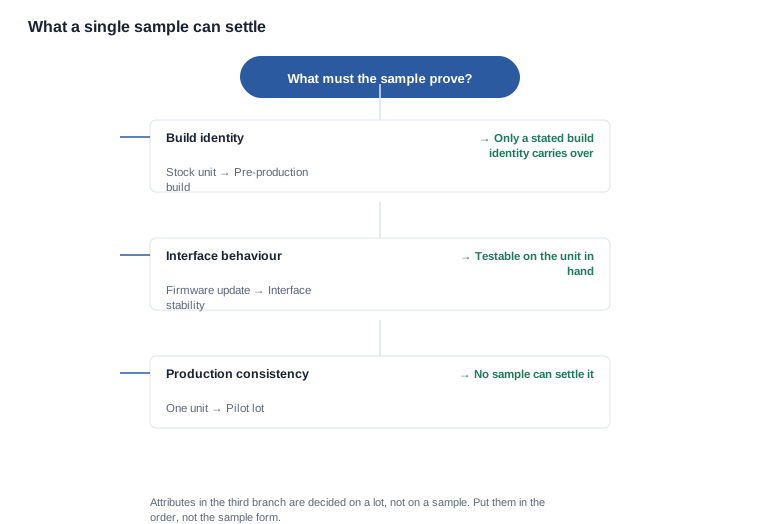
The diagram above separates the attributes a sample can settle from the ones it cannot, which is the distinction the purpose field has to capture. Everything in the top two branches can be written into an evaluation sheet and signed. Everything in the bottom branch has to be moved into the order, the pilot lot or the production schedule, where it can actually be tested.

Where the money in a sample programme is negotiable
The sample charge itself is usually the smallest number in the file and the least worth arguing about, because it covers a real cost — a unit pulled from a finished-goods batch, a courier, a small quantity of packaging. What is worth arguing about is the condition attached to that charge, the number of rounds, and the treatment of anything that has to be created for the evaluation rather than taken from the shelf.
The credit condition is the first of these. Whether the sample amount comes back against the first order, and on what trigger, is a genuine commercial variable and is usually negotiable. The trigger is where the argument should happen: a credit that survives a cancelled programme is worth more to the supplier than one that does not, and a buyer who asks for that in the first round is asking for something real.
The rounds and the artwork treatment are the second. Artwork preparation, a custom colour mock-up and a printed logo treatment sit closer to tooling than to the sample charge, and they behave the same way: they are a non-recurring cost that is amortised across the programme rather than paid once. A buyer who negotiates the sample charge and ignores the artwork treatment has negotiated the small number.
The dispatch method and the return freight arrangement are the third. Express, courier and forwarder are all available and all priced differently, and the return leg is routinely unpriced — a programme that expects a failed unit to be returned has a return cost that is not in anyone's quotation unless it is asked for.
What is not negotiable is worth stating plainly, because pretending otherwise wastes the relationship. Certification cost and certification time are a fixed cost per configuration and a queue at the laboratory; the elapsed time is set by the laboratory, not by your order size. Tooling is a one-off that is normally amortised across the first order, so the useful questions are over what volume it is amortised and what happens to it if the programme is discontinued. And the physical build of a given configuration is not a commercial variable: a supplier who will not change the cell, the case or the interface is telling you that the build is fixed, and the programme has to be built around that fact rather than against it.
The clauses worth writing into the order
Five clauses carry almost all of the value, and each of them is cheap to write when the request is sent. The build identity and configuration string, attached to the order as an agreed document. The evaluation sheet as a contract document, with the pass conditions attached. The number of evaluation rounds included and the trigger for another. The sample credit and its condition. And the ownership and amortisation of any tooling or artwork, including what happens to it if the programme stops.
A supplier who accepts the evaluation sheet as part of the contract has accepted your acceptance criteria, which is a materially stronger position than a supplier who has agreed verbally to make changes. The clause does not create a new obligation; it makes an existing one enforceable.
What our own sample request file contains
It is worth being precise: the published rows are the part of a smart glasses sample policy we can stand behind, and the rest is a question for the supplier's own file. We publish what our catalogue states. We mark the rows that are open. We will not fill an open row with a typical figure from a supplier's general data, because a buyer who builds a claim on an estimated number finds the error in the field rather than in the quotation, and the correction costs more than the question did.
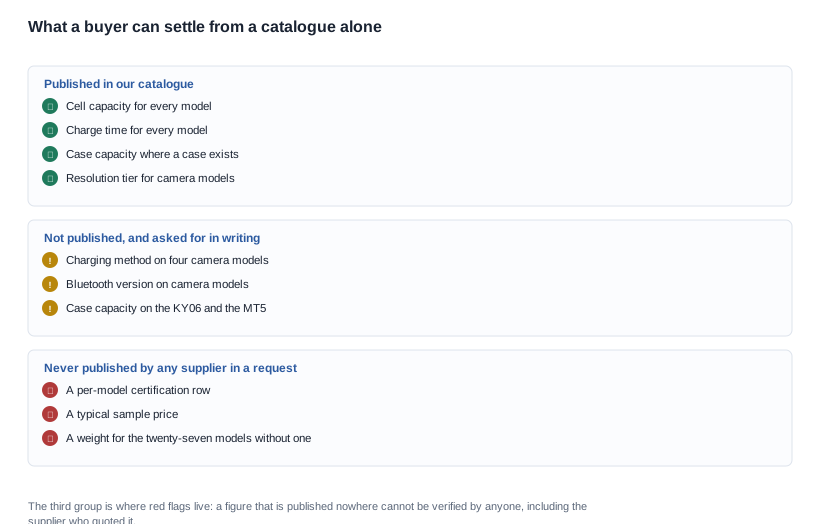
So here is what our own catalogue does and does not settle for a sample request. We publish the cell capacity, the charge time and the runtime for each of the twenty-eight models in the range, and the charging method for twenty-four of them, with the method stated as magnetic on seventeen, Type C on seven, and not published on four camera models — the CY05 and the CY03, and the L1 Pro and the MT6, which publish a charging case capacity but no charging interface row at all. We publish the case capacities where they exist: 1400 mAh for the L1 Pro and the CY03, and the CY05, 900 or 1400 mAh for the L2 Utral, and 1200 mAh for the foldable case on the MT6, while the KY06 and the MT5 carry a case whose capacity is not published and the V03 Pro has no case at all. We publish the resolution tier, the audio and camera family split, and the Bluetooth version where the catalogue states it.
We do not publish, and will not estimate, several things that a request form will want to reference. Our catalogue carries no per-model certification row, so a request that needs a certificate for a specific model cannot be answered from our published data and has to be answered with a document from the supplier's file. We publish no test report numbers, no laboratory names and no detection data. The catalogue's export-certification page is a company-level page and not a per-model list, which means it cannot be used to infer that any particular model carries a particular approval. And of the twenty-eight models, exactly one carries a published weight — the MT6 at 158 g for the glasses unit including the cell and the camera, excluding the foldable case, whose own weight is not published.
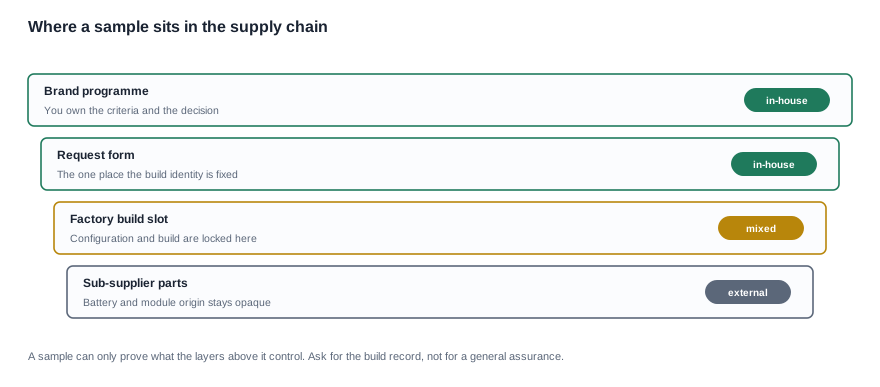
That last distinction matters more than it sounds. A weight figure of 158 g quoted as "frame weight" for the whole range is a sentence that will be wrong for twenty-seven of the twenty-eight models, and a certification claim quoted at company level will be wrong for every model. This is the same reason the request form asks for the build identity: a sample proves a build, and a build is the only unit of account that a programme can actually be run against.
The three things to do this week
Write the eight fields on one page, with a default on each. Do not send it as a message. Send it as a form with a version number, and let the blanks be visible.
Decide which two attributes the sample must settle and write the pass condition for each. Everything else goes into the order, not into the sample. If you cannot write a pass condition for an attribute, it is not a sample attribute.
Send us the model, the quantity, the target market and the configuration, and we will tell you which parts of it are settled on our published data and which are open rows you need to get answered in writing before you release the deposit. The policy itself, and what each step of it costs, is set out under sample policy and cost. If you want the mechanics of placing the order first, how to order a sample covers the sequence, and do you ship samples with tracking covers the dispatch record that the remedy clause depends on.
Where to look next
Send the eight fields, and we will mark which of them our published catalogue rows can already answer.


