

Smart glasses sample policy is not really about samples. It is about what a sample is allowed to prove, what it cannot prove no matter how good it is, and what the buyer should have in writing before that unit arrives. A sample policy that does not answer those three questions will let a buyer approve a configuration that the production run cannot reproduce, and the discovery will happen at the point where the change is most expensive to make. The nine questions below are the ones that close that gap, and the first one decides what the sample is for.
Smart glasses sample policy decides what the sample is allowed to prove
The buyer reading this, and the decision behind the sample
The reader is a procurement manager on the brand side, a channel buyer or an importer who is about to spend money on a unit before committing to a run of several thousand. They are usually already convinced the product is suitable in general terms — the category decision has been made and the remaining work is configuration, volume and timing. What they are managing at this point is the risk of approving something the factory cannot build twice the same way.
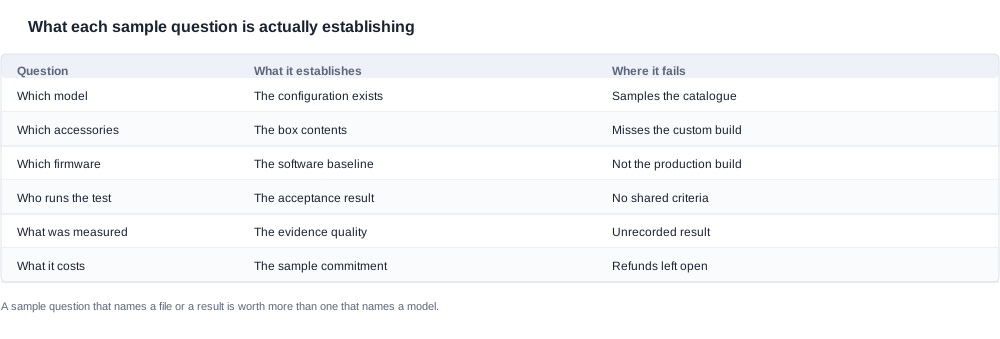
That risk has a specific shape in this category. The catalogue publishes twenty-eight models across three families — eleven camera models, eight audio models and three sport models — and the published specification for a model does not describe every variable in a build. The charging-case position alone splits five camera models with a published case capacity, two camera models with a case whose capacity is not published, and four camera models with no charging-case row at all, which is a variable the sample order has to pin down rather than inherit from the catalogue. The charge method is published for twenty-four models and unlisted for four. The camera resolution splits into two published tiers.
So a sample is an observation of one unit built under one set of conditions. What the buyer needs from the sample policy is a statement of which of those unfixed variables the sample actually covers.
The three questions a sample policy has to answer
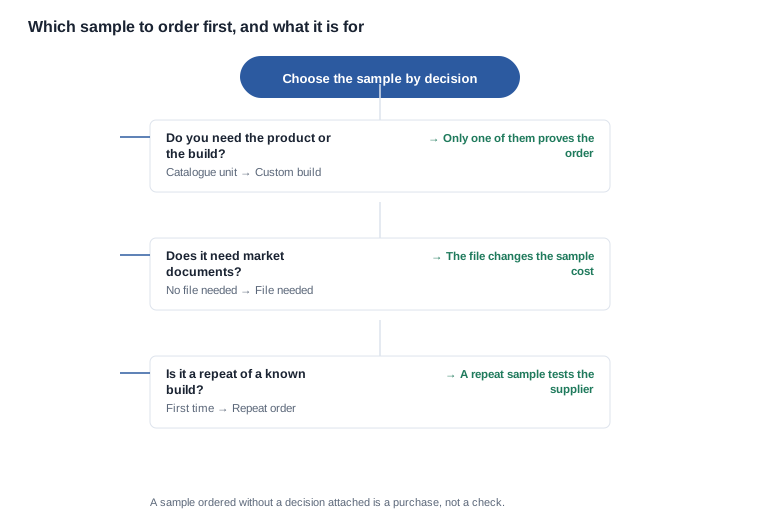
What decision is this sample supporting? A sample ordered to confirm that a product exists, a sample ordered to approve a configuration, and a sample ordered to qualify a supplier for a repeat order are three different purchases. They cost different amounts, take different amounts of time, and — this is the part that matters — they support different decisions. Ordering the cheapest one to support the most consequential decision is the most common sampling error in this category, and it is expensive precisely because it feels economical.
What does the sample cover, and what does it leave open? The honest answer lists the variables the sample fixes and the ones it does not. A catalogue-configuration sample leaves the accessory position, the firmware build, the artwork and the packaging open, and for a programme with any of those in scope, that is most of the programme.
What follows from the result? A sample policy that does not say what a pass means, what a fail means, and what happens to the production order in either case, produces a sample and then a fresh negotiation.
What a sample can establish, and what it structurally cannot
What a sample does establish
There are four things a physical unit settles immediately, and they are worth having in a first order because they are cheap relative to the decision they support.
It settles the configuration as built. What is actually in the box, how the parts fit together, what the finish and the surfaces look like, where the ports and the buttons sit. Several of these are not described in a published specification at all, and a catalogue row tells you nothing about them.
It settles the accessory position, provided the sample was ordered with one. This is where the sample earns its cost in this category, because the charging-case position is genuinely ambiguous in the catalogue for several camera models, and a physical sample ends the ambiguity.
It settles the firmware baseline — what the software does, how it behaves, how the companion application behaves with it, and what the configuration options are. This is often the largest part of what a buyer is actually evaluating.
It settles the documentation position for that unit, in the sense that a sample can be examined for markings, labelling and the presence of any materials the supplier is willing to hand over with it.
What a sample structurally cannot establish
Three things, and each of them is a common source of disappointment.
It cannot establish consistency across a run. A sample is one unit from one point in one process. A production run is produced across a production window, with incoming material variation, changeovers and restarts in between. The consistency question is answered by the production quality scheme, not by the sample, and the quality consistency article sets out what that scheme has to contain.
It cannot establish the capacity of the supplier to build the volume. A sample does not reserve a build slot, and a factory that can produce one unit for you this week may have a full calendar for your configuration in the quarter you want. The sample is evidence about the product; the build slot is a separate commercial act, and it should be requested separately.
It cannot establish a market position. A sample with a design, a packaging and a label tells you nothing about whether the product as configured can enter the market you are aiming at, because the entry requirements attach to documentation and to the production configuration, not to a unit on your desk.
What a second sample is for, and why it is not a repeat of the first
Buyers who order a second sample often expect the second unit to be the same as the first with the same result, and are disappointed when it is not. The second sample has a different job, and it is worth naming the job before it is ordered, because the two jobs need different specifications and different criteria.
A confirmation sample tests a specific change: a modified firmware build, a revised carton, a different accessory, a re-tooled part. Its criteria are narrow and it is cheap. Its purpose is to establish that one specific thing changed as intended and nothing else did, which is why the comparison against the first sample has to be part of its criteria rather than an assumption.
A qualification sample tests a supplier against a specification, and it is the right form when the buyer is moving from a sample programme to repeat production. Its criteria are the full acceptance criteria, and it is more expensive and slower than a confirmation sample because it exercises the whole specification rather than one line of it.
A regression sample tests the production run itself, and it is the one most programmes skip and most need. Ordering a unit from the production line at a defined point, and comparing it against the approved sample, is what converts the approval of the first sample into evidence about the run. Without it, the buyer's approval covers one unit and the shipment contains thousands.
The distinction is worth putting in writing because each type has a different result and a different next step, and the commonest failure in this category is a buyer who ordered a confirmation sample and treated the pass as a qualification.
When the buyer cannot test the sample themselves
Plenty of buyers are working with a small team and no laboratory, and the usual reaction is to accept the sample on the basis of photographs and a supplier's own report. That is workable, but it changes what should be asked for, because the burden of evidence shifts from the buyer's own testing to the supplier's documentation.
What to ask for instead: the supplier's own test report for that unit, naming the test method and the result; a written statement of what is not covered by the report; and the number of units the report was based on. A report covering one unit is an observation, not a qualification, and the buyer should be told which one they are holding.
The cheaper alternative, when the budget allows it, is to send the sample to a third-party test house rather than to skip the evidence. The cost of an independent check on one unit is usually smaller than the cost of discovering a configuration problem in a batch, and it gives the buyer a document rather than an opinion.
The build slot, and the deadline that protects it
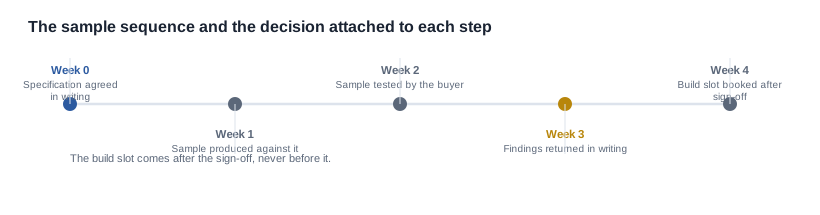
The sequence above is the order the decisions should be taken in. Note where the build slot sits: after the sign-off, not before it. A build slot reserved before the sample is signed off is a schedule commitment made against an unapproved configuration, and it is the mechanism by which a buyer ends up paying for the wrong thing on time.
The sample specification has to be the production specification
What to put in the written sample specification
The single most consequential line in a sample order is the one that says the sample is built to the production specification. It sounds redundant and it is not: most sampling disputes turn out to be disputes about whether the sample and the order were ever the same object.
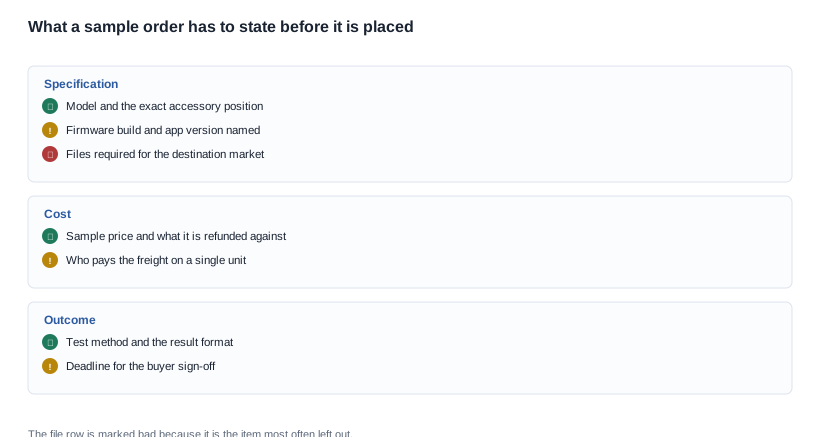
The specification needs to cover, at minimum, the model designation, the accessory position, the firmware build, the artwork and packaging if those are in scope, the destination market if documentation is in scope, and the test method the buyer will apply.
The model designation is not enough on its own
Naming a model in a published catalogue fixes a great deal, and it does not fix everything. A buyer who writes "MT6" and nothing else has specified the glasses body, the battery and the camera, and has left the charging case ambiguous in a way that the catalogue itself does not resolve — the case capacity is published at 1200 mAh and the folding case weight is not published at all. The same holds across the camera range: the catalogue publishes a case capacity for five camera models, a case without a published capacity for two, and no charging-case row at all for four.
Where the accessory matters to the programme — and in a retail programme it usually does — name it.
The firmware build, which no catalogue row covers
The firmware build identifier is the one specification item that is not in the catalogue at all, and it is the one most often left out of a sample order. Two units that look identical, sit in identical packaging and behave identically for the first five minutes can be running different builds.
Write the build identifier into the order. Then ask the question that matters for a repeat order: whether the production run will use the build the sample used or the current build, and who decides if the current build has moved on. That question is what separates a sample order from a sample programme.
The destination market, when documentation is in scope
Where the programme is aimed at a market with radio-equipment requirements, the sample order is the moment to establish what documentation comes with the sample and what comes with the production order. A sample that arrives with no documentation, on the basis that documentation follows with the bulk shipment, teaches the buyer nothing about whether the file will exist when it is needed.
The relevant framework for radio equipment is the Radio Equipment Directive (EU) 2014/53/EU. Our catalogue does not publish a per-model certification row for any of the twenty-eight models, and its text contains no CE, FCC or RoHS marking, so the documentation position has to be requested rather than assumed. The certification buyer checklist is the request list, and it is worth sending with the sample order rather than after it.

Asking about sample cost, timing and the commitment behind them
Sample cost, and what it is refunded against
A sample cost is usually the smallest line in the programme and the one with the most ambiguity attached. Three things have to be established, and they are usually different from each other.
What the sample cost covers. A single unit at the catalogue configuration is one thing. A unit built to the production specification, with artwork, with a custom carton and with a specific firmware build, is another. The second costs more and takes longer, and the difference is the price of removing the ambiguity.
Whether it is credited against the production order. A sample cost that comes back as a credit against the first production order is a commercial concession with a clear purpose: it makes the sample a cost of the programme rather than a cost of the evaluation. A sample cost that does not come back is simply the cost of an evaluation, and it should be treated as such when comparing suppliers.
Whether the freight is included. One unit shipped from a factory in Shenzhen to a buyer in another market is not cheap relative to the unit, and freight on a single unit is frequently the larger part of the sample invoice.
The sample programme cost breakdown is worth reading alongside the quotation, because it separates the parts that scale with the programme from the parts that do not.
Timing, and why the sample date is not the production date
A sample has a lead time of its own, and the sample date is a weak predictor of the production date because the two orders sit in different queues and the sample is often the faster of the two — it is one unit, it skips the setup for a full run, and it can be built from stock rather than from allocated materials.
The useful question is not "when will the sample arrive" but "what has to be true for the production order to be built in the week we want". That question produces the actual dependencies — material allocation, the build slot, the artwork approval, the documentation scope, the firmware sign-off — and it produces them while there is still time to act on them.
The commitment, which is the part that is usually missing
The question that turns a sample order into a decision is: what happens if the sample passes? Specifically, is the production order now reserved, or is it subject to a fresh quotation and a fresh approval?
A supplier who will reserve a build slot against a signed-off sample has told you something about how the programme will run. A supplier who treats the sample as an isolated sale has told you that the configuration will be re-negotiated after the buyer has already committed emotionally and financially to it. The sample supplier verification article covers the verification side, and the step-by-step guide walks through the sequence.

Sample failures and what they mean for the order behind them
The sample fails on something the acceptance criteria did not cover
What happens. The buyer receives a unit that does not match the expectation, finds itself unable to say precisely why, and the conversation with the supplier becomes a matter of opinion.
Why it happens. The criteria were written as a description rather than as a test. "The camera should be sharp" is a description. "The image is captured in the stated lighting condition and reviewed at full size on the stated display" is a test, and only the second one can fail in a way that produces a finding.
How it is avoided. Write the test method with the criterion. Where a criterion cannot be written as a test, say so explicitly and agree in advance that the sample is for information only and the production order proceeds on a separate approval.
The sample passes and the production run does not match it
What happens. The sample is approved, the order is released, and the first cartons differ in ways the buyer did not authorise.
Why it happens. The sample was built from stock while the production order is filled from a new material lot, or the firmware moved between the two dates, or the line was set up for a different variant and the changeover was not re-checked.
How it is avoided. Make the first-article check a requirement on the production run and compare it against the approved sample, in the same way the sample was compared. That single step is the bridge between the sample and the run, and it is the cheapest consistency control available.
The sample is approved and the schedule has moved on
What happens. The buyer approves, and by the time the order is released the build slot for the target week has gone.
Why it happens. The sample order and the production order were never connected, so the approval did not trigger a reservation.
How it is avoided. Ask for the reservation as part of the sample programme, with a stated deadline for the sign-off after which the slot is released. That gives both sides a date, and it protects the buyer from losing a slot while a decision is being made internally.
The sample is refused and the cost is not recoverable
What happens. The unit is rejected, the cost is gone, and the buyer has to decide whether to place another sample or change supplier — a decision that is much harder to make well without the first sample having told them something useful.
Why it happens. The refund conditions were not established, so the outcome of a failure was never discussed.
How it is avoided. Establish the refund position at the order, not at the failure. The samples pillar covers the structure, and the AI camera glasses range is where the configuration options sit.
What we publish about samples, and what we agree per order
We do not publish a sample price, a sample lead time or a refund policy as standing numbers, and we will not invent them. In this category those three figures depend on the configuration, the destination and the market scope, and a published figure would be true for nobody.
What we do publish is the specification a sample has to be built against, and it is complete enough to make a sample order precise: the battery capacity, the published runtime and the charge time for every model; the charge method for twenty-four of the twenty-eight, unlisted for the L1 Pro and the CY05, and the CY03 and the MT6; the camera resolution tier across the eleven camera models; the charging-case position including the five camera models with a published capacity and the four camera models for which no charging-case row is published; and the IP54 marking on the V06 and the S7.
Against that specification we will state, in writing and before the sample is produced, what the sample will be: which configuration it is built to, what the accessory position is, which firmware build it carries, what documentation comes with it for the destination market, what it costs, what is credited against the production order, and what the deadline for sign-off is. We will also tell you what a given sample will not establish, because the more useful conversation is about the parts of the programme the sample leaves open rather than about the parts it confirms.
Send us the configuration, the destination market and the decision the sample has to support, and we will tell you which sample answers it and which parts of the question it will leave open.
Related reading
- Sample policy step-by-step guide
- Sample supplier verification
- Sample programme cost breakdown
- Certification buyer checklist
- Samples pillar
- AI camera glasses range
Tell us the configuration, the destination market and the decision the sample has to support, and we will tell you what it will and will not prove.


